Ottawa’s Confederation Line Catches The Canada Line Disease
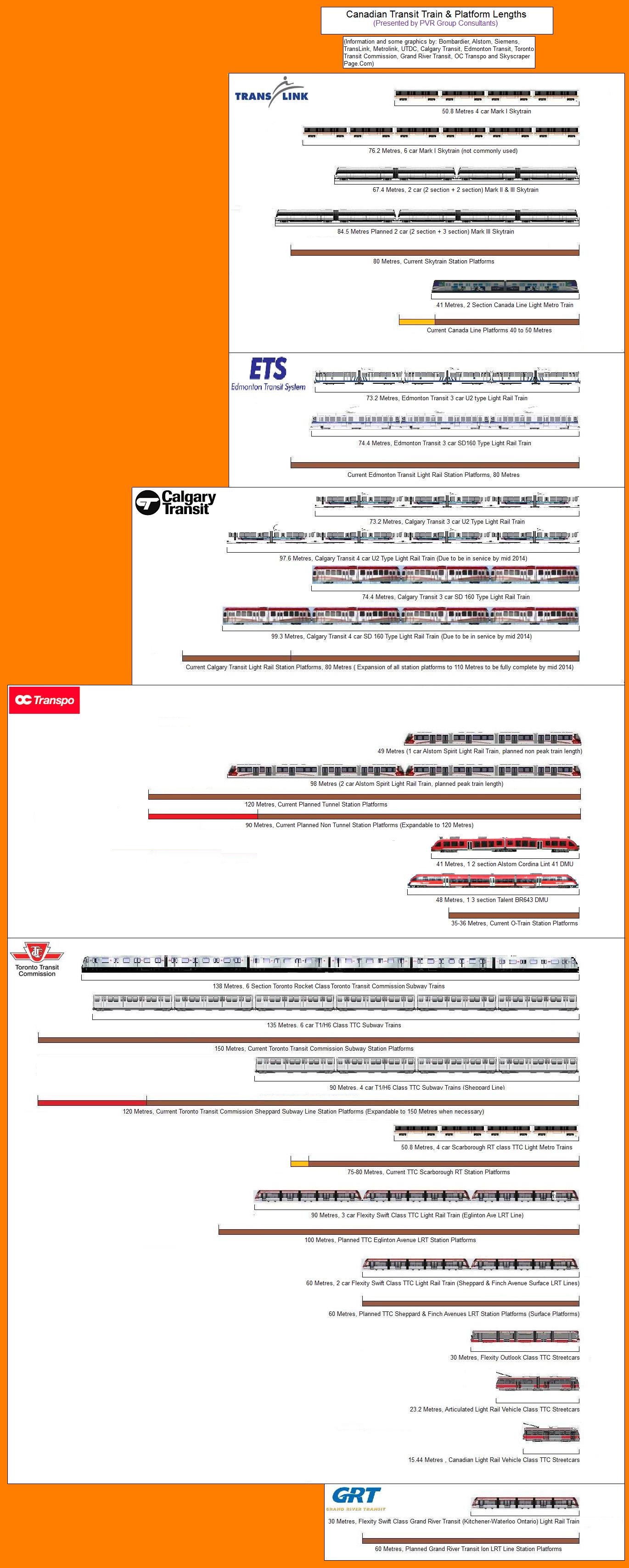
LRT stations on the Confederation Line will be shrinking from 150 to 120 meters in the Tunnel section and 120 to 90 meters on the surface stations. They will still be upgradeable to 120 meters if necessary. The reason given was budgetary pressure from the $2.1 billion hard limit and the inclusion of the huge pedestrian bridge at the Trembley Rd. Station and the work to allow buses from Gatineau to use the former CPR Prince of Wales Railway bridge (currently unused and owned by the City of Ottawa) to cross the Ottawa River and access the Bayview LRT Station. Trains will still be able to use the bridge, it will have cycling and pedestrian walkways as well.
At the Trembley Rd. LRT station a much needed pedestrian bridge is now being included in the project linking Ottawa’s VIA Rail Train Station as well as the Ottawa Baseball Park (formally Jetform Park and the former homeAi??of the Triple AAA Ottawa Lynx Baseball Team). The Stadium and LRT/VIA Rail Station Complex are separated by a 8-10 lane Expressway the Highway 417 (locally known as the Queensway). The ballpark complex located on Coventry Rd. also has many local stores and aAi??hotel connected to it.
On theAi??Confederation Line 2Ai??car train operation will still continue at the surface stations during the peak periods even though the trains now exceed the length of the platform (the trains have not shrunk yet), aAi??similar condition to the current O-Train. The Train just stops in a way that, all the boarding doors are still all on the platformAi??and the ends of the train goes beyond the platform at each end. This will reduce the ultimate capacity range of the line from 25,000-29,000 pphpd to 24,000 -26,000Ai??pphpd, using my personal capacity modeling software. The new limitations still make it way better than the Skytrain as they have adopted a operational plan that will allow for more new trains to be added earlier due to earlier implementation of Automatic Train Control by 2031 instead of after 2031 and a minimum of 6 new trains ordered 6-12 months after opening of the line in 2018.
Thank you Havacow for the report.
So the Confederation Line has caught the Canada Line disease and the scope of the project is being reduced, but unlike the Canada Line, which saw its station platforms shrink to 40 metres to 50 metres, the confederation Lines platforms are shrinking to a respectical90 metres, which is 10 metres longer than the present Expo Line station platforms. The Confederation Line will still be able to handle 98 metre long two car coupled sets and without the cumbersome selective door opening kit that TransLink is going to use to operate five car, 84.5 metre long sets of MK. 2 vehicles.
If automatic train control is used on the Confederation Line, it will no longer be considered LRT, but as a light metro. One wonders by 2031 would there be a need for ATC as we know it, rather would more modern signalling applications be used.
The French and Germans are toying with on board ATC, where the tram controls its own operation and keeps time itself without the need for a central control room. Drivers would be kept to monitor both tram operation and revenue collection. All sounds like science fiction today, but so did cell phones 30 years ago.




Actually Zwei on board ATC is exactly what is being proposed because they don’t want to have a control room based system due to very high staffing costs. The control room will only monitor and have a cut off or system wide kill switch. Keep in mind though this is at the shortest, a decade away.
With 6 new trains appearing 6-12 months after the opening of the line that means an 3 extra peak hour trains (most likely 2 operating trains and one in more in reserve). That means the Confederation Line will then have 17 (instead of the currently planned 15) running during the peak, only a year after its opening. This also means that at peak hour the frequency will increase from one train every 3 minutes and 16 seconds to 2 minutes and 53 seconds.