Better Mousetrap Department
In the summer of 1966, the New York Central Railway experimented with a jet powered train, which reached a maximum speed of 294.5 kph. No passengers were ever carried.


Not about to be outdone by the Americans, the Soviet Government invested in their own jet powered train in the 1970, which obtained a top speed of 290 kph. No passengers were ever carried.

In 2014, all what remains of the Russian jet train is a rusting hulk.
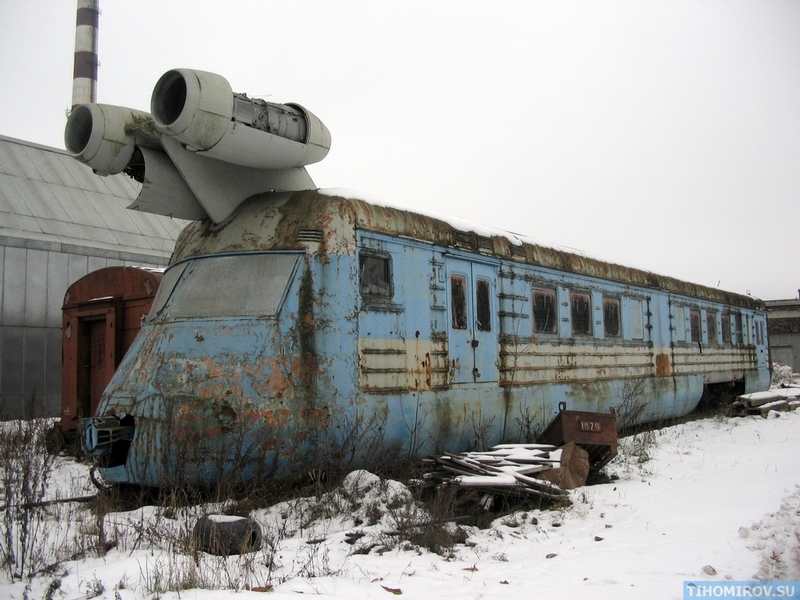
The moral of this post is that instead of experimenting with fancy jet powered trains, would it not have been better just to build customer oriented trains; trains that would provide a convenient and affordable service without fancy jet motors and alike?
Something to think about when TransLink wants to build a subway on a route that has barely the traffic flows to sustain LRT.



And yet today high speed rail lines routinely achieve greater speeds than this….and have been shown to be good investments in the right places. By your logic that research money was wasted too….
The jet powered RDC #3 NYC M-497 (Nee, New York Central Railroad Metroliner 497) was part of a larger industry experiment to produce Turbine powered equipment that could rival the high speed characteristics of Pen’s Electric GG1 ‘s and the then brand new Japanese electrically powered bullet trains. In Canada and the USA it was made manifest by the Turbo Train, introduced in the early 70’s that, had many teething problems and was finally killed in the early 80’s. Too bad too because, the determination that VIA showed with the Turbo had finally begun to pay off. The last of the technical issues had been fixed and the higher speed and lower fuel costs that are possible with Turbines was finally showing results by 1980. Today Bombardier offers a higher tech version of the Turbo called the “Jet Train”. It has near high speed capability 125-145 MPH (200-230 KPH) with no need for wires and the fuel economy of the much slower, GE P42 Genesis Unit (Currently used by both VIA Rail and Amtrak) which maxes out at 115 MPH (185 KPH). For freight engines the Turbine Diesel motor (known as the “Prime Mover”) is the basis for most of the super efficient diesel-electrics used by most of the main railroads in North America and Europe.
Yet, in the USA, development of a replacement for the BUDD RDC was left wanting.
I know turbine trains were the flavour of the 1960’s & 70’s and yes there is a need for experimental trains, I cannot help feel if monies were invested for a robust regional DMU, the railways could have stemmed the flow of railway abandonment and create a viable commute operation in scores of locations.
In North America, Regional Rail or Commuter Rail has made a comeback for the same reasons the follow ons to the RDC were abandoned. Economics made it very difficult to provide any passenger rail during a period in which, super cheap gas, expanding personal wages and relatively speaking ,cheap suburban housing with a massively subsidized public road network (including all those superhighways and expressways) had been hacking away at the profits of all railroads. Especially the ones that still carried passengers. Remember in 1971 when CP Rail gave up passenger service, they gave their entire passenger carrying fleet (except, thankfully, some great historical equipment) to CN for $1.
Then things changed, namely the economics. Fuel costs shot up and the real costs of all that urban sprawl began to be noticed. As prices increased most people began moving out further and further to have that big house and lawn they could afford. Their costs continued to go up the further people went out. In some large cities people the average driver is spending 2+ hours a day commuting to work and school (both ways) mostly by car. Regional Rail Lines with a host of new equipment, including new DMU’s, sometimes even EMU’s, are sprouting again because of all these new costs.
Across North America most new highway development has completely stopped, there are a few hold overs but, its mostly about maintaining what we have instead of building new. Finally highways and roads are being held to the same planning standard as new transit projects, that’s why they are taking a lot longer to build and fund. You should see some of the road warriors scoff at the idea that, a $2 billion highway project have as good a business case for its development as a $2 billion transit project needs for its development.