Weekend Quizz
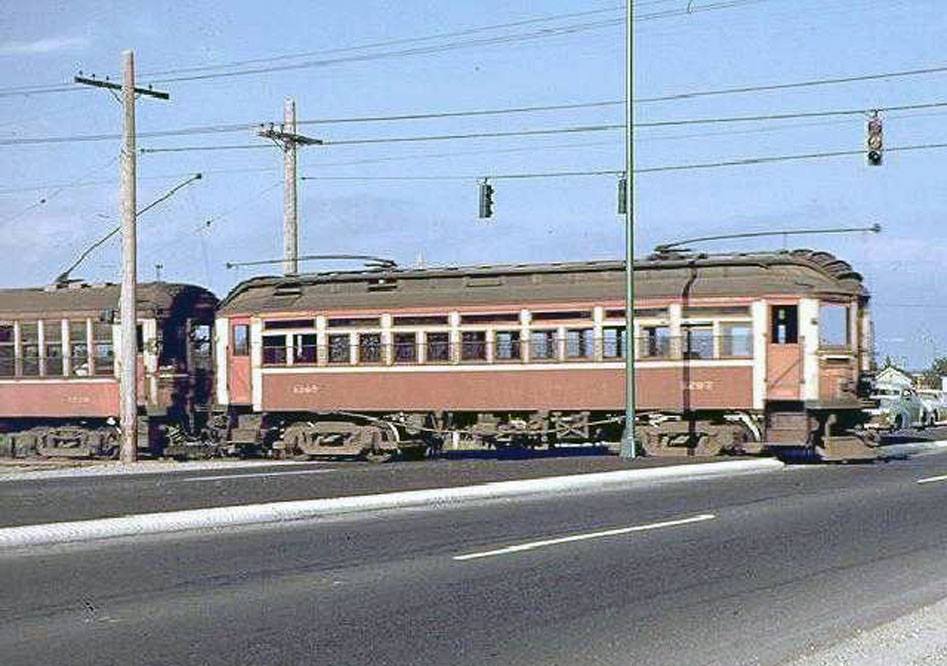
This picture of a pair of BC Electric interurbans has intrigued me, where is the location that this photo was taken?
It seems it is a single track crossing a four lane road with a tarmac median. If so, then it is not the Arbutus or Central Park Lines.
I do not think it is in Richmond, having spent the first seven years of my life in Richmond I do not recall any four lane roads, let alone any with a tarmac median.
The second auto in the picture looks like early 50’s (52 or 53), so the picture is near the end of operation.
Burnaby Lake Line?
What do you think.



Whenever it was, traffic sure was a lot lighter without the mega-density around high rise condos along the s-train lines, presently. Now, if TransLink weren’t giving out driving allowances and paying its new useless CEO $320K/yr (~ $415K/yr with bonuses) to plan more s-train lines, we might be able to afford interurban routes in Metro Vancouver.
It seems as if the real problem with transit is the Ministry of Transportation paying TransLink and not the puppets collecting their preposterous salaries at TransLink. Wow, good thing, we shot down the transit tax, how much would the half wit CEO at TransLink be making if the transit tax passed: $1,000,000 per year with a golden pension and $140,000 per year driving allowance, to creep out in meetings all day and not take loser s-train?
http://www.cbc.ca/news/canada/british-columbia/translink-ceo-job-posting-lists-massive-salary-benefits-1.3167431
One thing for sure is that the area surrounding this interurban rail line has an open and spacious environment compared to the cramped area full of ugly highrises surrounding the SkyTrain now.
@Robot Terminator
And notice how there appears to be no one riding the tram. Any kind of transit is more successful if there are more people living within walking distance. The other options are more buses or massive expensive and ugly park and ride lots.
Zwei replies: Richard, utter rubbish as usual.
Hi Zwei, I was away so just saw your reply to Richard. Care to elaborate on your reply to Richard? What part of what he said was rubbish? Transit is more successful if there are more people living within walking distance? That if you don’t build transit where the people are the other options are more feeder buses or park and ride lots? Just wondering how your brain works.
I have no idea where it is locally. My guess is that the second empty car is being taken in or out of service. The trolley poles are down so its not drawing voltage and amperage. You would not run a heavy vehicle like that as a trailer, unpowered. So the second car is being towed, allowing a vehicle to push even if it had the abilities are limited and frowned on because it would be considered dangerous operationally in Canadian Interurban/Radial service circles at the time. So with no one on it, its probably being rushed somewhere else as extra service or being repaired. The forward standing roof line vents along the cupola are open, something done by the driver when he or she starts a run to allow air flow into the vehicle when it has been idle and the air in the vehicle is stale or its very warm or hot outside. The fact that the empty car has a long cupola at all means that its an older vehicle compared to the arched roof on the first car so that, it is probably a vehicle used for secondary runs or as an extra. I can’t tell because of the angle and clarity of the photograph if the MU controls are connected to the first car. The centre body air valves appear to be closed meaning the car has been secured for unpowered travel. As for the location, I would check close to the location of the system’s storage yards and work out from there.
Zwei replies: it is that paved median which is a puzzle. The photo can be no later than 1958 and my guess is it is in Burnaby somewhere.
Oops, just realized the first car (the interurban car on the left) is towing the unpowered car (heading to the left side of the photograph) because of the trolley pole. If it were heading in the other direction the single visible pole on the towing car would be in the down position and the trolley pole we can’t see would be up in the operating position. So the second and most visible car is being towed towards the left side of the photograph.
One other thing, did the system have track that was generally used as non service track? Many Ontario Radial Systems had some generous sections of non service tracks that were either old main line routes no longer being used for passenger service but still in use as service track or pre designed sections of service track. Most historic maps only show the operational lines and ignore service track that may have been in use at the time. Even today Toronto’s Streetcar system has up to 8 km of service track that is only used to move LRV’s around the system for non passenger service or emergencies or allow for short turns and bypasses on certain lines.