The continued misinformation from the usual sources about SkyTrain being cheap to operate, must be again, refuted. When compared to light rail, SkyTrain has cost much more to operate ad maintain. According to TransLink from information in 2020, the operational costs of both the Expo line extension to Langley and the Broadway subway would add at least $80 million to TransLink’s operating budget. Accounting for inflation, this cost has now risen past $96 .5 million annually!
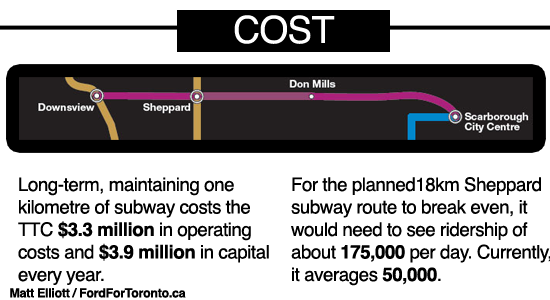
This cost is based on 2020 figures.Adjusted for inflation the cost would be $4 million per km in operating costs and $4.7 million per km in capital costs every year; for a total of $8.7 billion per km.
If one took the ‘Way-back’ machine to the late 1980’s, the argument that SkyTrain was cheaper to operate than LRT, would show the massive propaganda campaign to give the public a positive view of the proprietary ALRT light-metro. This is because it was forced upon the region by the Social Credit government of the day.
There were no comparative studies done as the orders came directly from the Premiers Office.
The reality was, building the Expo line with ALRT was a horse-trade with the government of Ontario (the UTDC was their Crown corporation) to both sell an unsalable R/T system and to obtain the services of the then Ontario Conservative governments ‘Blue Machine’ to win the next BC election.
This is the base for Vancouver’s love affair with light-metro.
The SkyTrain light-metro system has been portrayed as a wonder system, which over time has built up to the current SkyTrain myth. Like Robin Hood or King Arthur, the SkyTrain myth is nothing more than cobbled together claims and cherry picked facts and a myth often repeated tends to become fact in the people’s minds.
It is all “repeat a lie enough times and the people will come to believe” shtick.
It also be remembered that both BC, Transit and TransLink were in partnership to sell Advanced Rapid Transit (ART) or SkyTrain, abroad. This meant that there would be no way for LRT to be built in metro Vancouver.
The Calgary C-Train has traditionally carried more customers than the Expo Line (both being about the same length) and costing less than half to build and much less to operate.
Today, many of the “old gang” at TransLink have retired and the new lot of bureaucrats (many earning six figured salaries”) repeat the old porkies actually believing they are true.
Sadly, it never was.
The print and electronic media also fell into this trap as those reporters who did investigative reporting have long retired, with the new crop of reporters,eager to please their corporate bosses, treat TransLink news releases as real news, instead of a well planned propaganda campaign.
Even in the 90’s, then huge subsidies for ALRT, made the mini-metro not cost effective in operation.
Vancouver’s SkyTrain light-metro system has had the transit eyes of the world on it for almost 40 years, yet no one has copied Vancouver and that is a question that the SkyTrain Lobby prefer not to deal with.
In an era of unprecedented investment in public transport, no one has copied the Vancouver model, the exclusive use of a light metro, including a proprietary light-metro system, for urban transport.
Why?
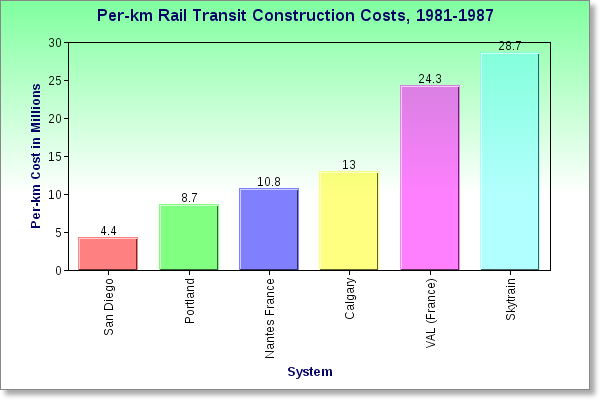
The per km cost of LRT and light-metro, 1981 to 1987.
A Comparrison Of Operating Costs – SkyTrain & Light Rail
The late Des Turner was meticulous with his research with the SkyTrain light metro system and in 1988, embarrassed the then Social Credit Government to release the real costs of the mini-metro.
What is more interesting is comparing the operating costs of the Calgary C-Train light rail and SkyTrain.
Thought the operating costs are a year in difference, it must be noted that the Calgary C-Train has historically carried more customers than the Expo Line, yet its operating costs are more than $12 million less than that of SkyTrain.
BC Transit knew this, but continued the myth that SkyTrain was cheaper to operate. This is called professional misconduct; others may call it more.
TransLink, which was mostly made up of BC Transit bureaucrats jumping ship, knew this, but continued the myth that SkyTrain was cheaper to operate.
COMPARISON OF OPERATING COSTS
The total 1988/89 budget for SkyTrain:
Operations………………… 5,483,863
Maintenance……………. 14,243,092
Administration………….. 7,931,834
Total: $27,658,789
(Rick Krowchuck, Executive V.P. Finance)
Calgary C-Train 1990 Operating Budget
Operators……………………… $2,332,000
Maintenance………………….$4,804,000
(Labour, parts, materials)
LRV Power……………………. $1,384,000
Fixed Operating …….Costs $6,815,000
(administration, cleaning facilities/buildings)
Total: $15,335,000
(Niel Mckendrick Coordinator of Transit Services, Calgary Transit)
There are those who are still taken with the SkyTrain myth and firmly believe that the proprietary railway is the best, yet evidence clearly shows, that once out of the SkyTrain bubble of Metro Vancouver, what we call SkyTrain is nothing more than a dead branch on the public transit tree of evolution.
Today, in BC, funding for hospitals, care homes for the aged and many more public services are being curtailed, mainly to source funding for the $16 billion plus, 21.7 km expansion of the Expo and Millennium Lines and will be legacy for a government’s refusal to admit, that building with SkyTrain was strictly a politcal decision and not a practical one.
One interesting thing about the graphic you are using. The Sheppard Ave. East subway (as well as Sheppard Avenue West) is back. This time, the line will run from Don Mils Road to McCowan Road (arrow straight). This will meet up the Bloor-Danforth Subway extension at Sheppard Avenue. They are also looking at the possibility of an extension west (done at the same time) from the Yonge Subway’s Sheppard Station to the Sheppard West Station on the Spadina York subway extension. The Assessment is to be completed in the summer.
Actual Figures TL 2020 vs 2024
2020 TTC $3.3 M x 70.5 km = $232.65 Operations & Maintenance?
2020 BCRTC Operations & Maintenance $205,159,759 / 79.6 km = $2,577,383.90 per km of Operations cost.
2024 BCRTC Operations & Maintenance $321,941,320 / 79.6 km = $4,044,488,94 per km of Operations cost.
SLS 16 km x $4,044,488,94 M = $64,711,823.11 /2 = $32,355,911.55 Operations cost
BSP 5.7 km x $4,044,488,94 = $23,053,586.98 Operations cost
or all 101.3km BCRTC $377,350,818.53 Operations cost
Note: SLS project 6 min frequency, all day.
Expo line cost should 1/3 of operations but 1/2 more accurate of SLS.
Lifetime operation
30 y x $32,355,911.55 = $970,677,346.73 30 y Operations cost
30 y x $23,053,586.98 = $691,607,609.54 30 y Operations cost
capital costs every year: IDK
Rapid transit higher order transit of the pyramid. Skytrain is lower cost than other subways or metro services in the world on a per kilometer distance. LRT’s ambiguous technology bad -> good -> amazing. Most LRT and metro are designed to go an average 30 kmh slow for something that is called rapid transit. Skytrain average 40+ kmh very difficult to go back to something that is slow.
Zwei replies: Utter and pure nonsense, the commercial speed of transit is based more on the distance between stations and the time allowed for trains to operate at top speed. The more stations per route km, the slower the commercial speed!
The problem with TransLink is that you can never believe what it says; TransLink never produces a report based on the same set of assumptions.”
Former West Vancouver Clr. Victor Durman, Chair of the GVRD (now METRO) Finance Committee.
As for SkyTrain’s cost, guess what it is deemed one of the most expensive transit systems one can build, so tell your handlers that stop selling their bump!
Just a note folks, I had an interesting chat from an X Translink employee about certain claims. The person confirmed that TransLink employees a large cadre of, for want of a better name, Spin doctors, to spin the truth about both the bus and light-metro system.
Like the SkyTrain lobby, they have the resources to spin numbers and create false comparisons, which the local media eat up.
The person also told me that Translink knows well that speed, capacity and being driverless are what the voters tend to remember and not costs (until tax time). We also talked about the U-Pass, which the person added, has made any real calculation of ridership extremely hard because Translink does not know how many times a U-Pass is used per day, only the initial use, if used on SkyTrain.
The buses serving the major universities and post secondary institutions remain the most heaviest used route, but they do not generate, due to the U-Pass, the revenue to improve service. An interesting comment is that that Translink’s hype and hoopla with the so called BRT buses is that, no one really cares, even after a major promotional campaign.
But what I found interesting and was not totally aware of, is the fact that transit ridership is dropping (3.2% from last year) and the trend is a future steeper decline in ridership. (The current gulf war and $2 a litre gas may alter that) The problem facing TransLink is that internal studies are finding that the government’s inspired extensions to the Expo and Millennium Lines will not counter this decline. The person also said that my estimate that the total cost of the expansion of the Expo and Millennium Lines may pass $18 billion and (especially with the NDP’s sour record in financial matters) may see a wholesale reorganization of TransLink prior to the next election as the current model is failing badly.
A lot of info in a 10 minute conversation.
Like Mr. Cow, the person who phoned me still has contacts withing both the MoT and TransLink and would like to remain anonymous.
Keep in mind Legoman, Toronto”s subway already moves nearly double the daily passenger levels of the Skytrain and a maximum capacity of over twice, almost 2.25 times actually, of the Skytrain’s planned maximum capacity of 17,500 passengers/hour/direction with the new operating system on line #1 (Yonge-University-Spadina-York Line). The new train control system is going to be added to the Bloor-Danforth Subway (Line#2) starting next year.
Your line might be cheaper but it moves half the number of people as Toronto’s subway or Montreal’s Metro. That’s a higher cost per passenger, especially when you consider its intake of fare money. Keeping this in mind, when you hit 90% of capacity you seriously start to bleed choice transit riders.
Remember, the rapid transit portion of your system is supposed to make a profit, which helps subsidize the money losing surface system. Fares should be covering at least 50% of your operating costs, anything less than that has historically shown to be financially unsupportable, over the long term. Here in Ottawa when fares recovery dropped to 47.25% last year and had stayed below 50% for 5 years, there was panic. The 35%-40% fare recovery rate Translink claims is far too low. More financially supportive LRT or tram-Trains for that matter, is just a better operating technology, if you want a more financially solvent transit service.
A quick note: Only the Expo Line will be signalled for a maximum capacity of 17,500 pphpd and the Millennium Line (Broadway Subway), will be signaled for a maximum capacity of only 7,500 pphpd.
There is growing panic that the provincial government as the the province is putting the brakes on several long-term care projects – including the long-term care project in Delta, has has gone over like a lead balloon and there has been several non to subtle hints that TransLink, especially with declining ridership is going to face reduced funding.
TTC
to day 2 min 30 sec 24 tph x1080 = 25,900 ppdph
in Future 1 min 55 sec or 31.3 tph x 1080 = 33,800 ppdph
Toronto Rocket 358 m2
Skytrain Frequency is still king.
to 122 sec 28 tph 14,000-15,500 ppdph
Exclusively running mk 3/5 25-27 tph 17,500 ppdph
in Future 98.75 sec 36.45 tph Exclusively running mk 5 24,500 ppdph
with platform expansion 945 x 36.45= 34,500 ppdph*
mk 5 205 m2
new mk 282.5 m2
Zwei replies: you can spin all you want but until you can source numbers NOT FROM TRANSLINK, in other words independent sources, what you offer is more of an opinion than anything else.
Just to let you know, light rail can operate at frequencies of 30 to 45 seconds if need be and does on scores of routes around the world.
The real problem facing Translink is that ridership is dropping, 3.5% from last year and the trend seems to be continuing and your boasting seems a little over the top, considering that the money building the E&M Lines extensions is coming from money due to be spent on hospitals.
SKYTRAIN, THE ONLY WORLD CLASS TRANSIT SYSTEM IN THE WORLD, NO ONE WANTS TO BUY!
First of all, the Yonge Subway peaks at 29,500 pass/hr/direction on average. Busy days it can get to 31,000-32,000 p/h/d. The 1080 capacity is the ideal point that the TTC adds another train. In reality 1100 to 1250 per train during morning peak is common. The new operating system (Communication Based Train Control) could handle up to 38,000 p/h/d for Yonge Street.
However, the point being, you want to add another train at 1080 per 6 car train (6 segments) for theToronto Rocket Trains because you start loosing considerablely large amounts of choice riders beyond this point. So once the Skytrain hits 15,250 (assuming a 17,500 max capacity) you are loosing choice passengers. What is needed are more lines but Vancouver can’t afford it because of the operating technology being used. That’s why Skytrain kind of sucks and always did.
Zwei replies: My wife regularly takes the Canada Line every Saturday to her work and she has noticed a decline in ridership.
I both deliver her to Bridgeport or Landsown Stations and pick her up (about 40 KM total) because the bus service is unreliable on weekends. A few weeks back she would have waited at least 60 minutes at Bridgeport Station (one of the most ill designed stations I have ever used), if I had not picked her up, in fact we had a car full back to south Delta.
Evidently a “drivers shortage” caused the delays to the 601/620/351 routes.
Here resides a major problem with light metro, if bus connections don’t work, one travel time may increase by a factor of 2 or 3. It is the reason why I have stopped taking transit, I was marooned at Bridgeport Station for 45 minutes, with zero help from anyone in authority. Sadly, from what I have been told, it is now standard operating practice and is one of the excuses used to promote the Langley extension!
This is a issue with many modern rapid transit lines and their stations, 0 staff, by design!
Zwei replies: This was true about the SkyTrain stations but so many issues cropped up that the government, greatly increased the number of attendants for the system to make sure there was some official presence at stations. The VAL system in France, after many issues ensured that there was an attendant at both at the station and on a train at all times.
Bridgeport is the main hub station for the Canada Line as by contract all South Fraser Buses must end there and those continuing to Vancouver or YVR must transfer to the Canada Line. There was once a direct UBC bus from Bridgeport to the university but Translink stopped the service with the rumour being, ridership on the Canada Line was declining.
Another point, frequency (headway’s) is important for attracting customers, but this importance declined sharply after 4 minutes (240 seconds), thus the frequency you mention has little to do in attracting ridership and far more to do to deal with traffic flows as the light-metro’s capacity is limited. This means the trains have to operate more often to deal with traffic flows easily handled by a standard metro, which in turn drives up operating costs, which is one of the “Achilles Heels” of light metro.
As well, one doubts that the SkyTrain light metro system could handle much more traffic than the planned 17,500 pphpd, because all the stations would need to be rebuilt to handle the traffic flows, from such a service. This would be especially true of the subway stations. Read some history about London’s Victoria Line and the issues with longer trains smaller headway’s. The platforms were so congested at peak hours that there was a delays of service as trains could not unload due to the numbers of customers on the platform.





One interesting thing about the graphic you are using. The Sheppard Ave. East subway (as well as Sheppard Avenue West) is back. This time, the line will run from Don Mils Road to McCowan Road (arrow straight). This will meet up the Bloor-Danforth Subway extension at Sheppard Avenue. They are also looking at the possibility of an extension west (done at the same time) from the Yonge Subway’s Sheppard Station to the Sheppard West Station on the Spadina York subway extension. The Assessment is to be completed in the summer.
Actual Figures TL 2020 vs 2024
2020 TTC $3.3 M x 70.5 km = $232.65 Operations & Maintenance?
2020 BCRTC Operations & Maintenance $205,159,759 / 79.6 km = $2,577,383.90 per km of Operations cost.
2024 BCRTC Operations & Maintenance $321,941,320 / 79.6 km = $4,044,488,94 per km of Operations cost.
SLS 16 km x $4,044,488,94 M = $64,711,823.11 /2 = $32,355,911.55 Operations cost
BSP 5.7 km x $4,044,488,94 = $23,053,586.98 Operations cost
or all 101.3km BCRTC $377,350,818.53 Operations cost
Note: SLS project 6 min frequency, all day.
Expo line cost should 1/3 of operations but 1/2 more accurate of SLS.
Lifetime operation
30 y x $32,355,911.55 = $970,677,346.73 30 y Operations cost
30 y x $23,053,586.98 = $691,607,609.54 30 y Operations cost
capital costs every year: IDK
Rapid transit higher order transit of the pyramid. Skytrain is lower cost than other subways or metro services in the world on a per kilometer distance. LRT’s ambiguous technology bad -> good -> amazing. Most LRT and metro are designed to go an average 30 kmh slow for something that is called rapid transit. Skytrain average 40+ kmh very difficult to go back to something that is slow.
Zwei replies: Utter and pure nonsense, the commercial speed of transit is based more on the distance between stations and the time allowed for trains to operate at top speed. The more stations per route km, the slower the commercial speed!
The problem with TransLink is that you can never believe what it says; TransLink never produces a report based on the same set of assumptions.”
Former West Vancouver Clr. Victor Durman, Chair of the GVRD (now METRO) Finance Committee.
As for SkyTrain’s cost, guess what it is deemed one of the most expensive transit systems one can build, so tell your handlers that stop selling their bump!
Just a note folks, I had an interesting chat from an X Translink employee about certain claims. The person confirmed that TransLink employees a large cadre of, for want of a better name, Spin doctors, to spin the truth about both the bus and light-metro system.
Like the SkyTrain lobby, they have the resources to spin numbers and create false comparisons, which the local media eat up.
The person also told me that Translink knows well that speed, capacity and being driverless are what the voters tend to remember and not costs (until tax time). We also talked about the U-Pass, which the person added, has made any real calculation of ridership extremely hard because Translink does not know how many times a U-Pass is used per day, only the initial use, if used on SkyTrain.
The buses serving the major universities and post secondary institutions remain the most heaviest used route, but they do not generate, due to the U-Pass, the revenue to improve service. An interesting comment is that that Translink’s hype and hoopla with the so called BRT buses is that, no one really cares, even after a major promotional campaign.
But what I found interesting and was not totally aware of, is the fact that transit ridership is dropping (3.2% from last year) and the trend is a future steeper decline in ridership. (The current gulf war and $2 a litre gas may alter that) The problem facing TransLink is that internal studies are finding that the government’s inspired extensions to the Expo and Millennium Lines will not counter this decline. The person also said that my estimate that the total cost of the expansion of the Expo and Millennium Lines may pass $18 billion and (especially with the NDP’s sour record in financial matters) may see a wholesale reorganization of TransLink prior to the next election as the current model is failing badly.
A lot of info in a 10 minute conversation.
Like Mr. Cow, the person who phoned me still has contacts withing both the MoT and TransLink and would like to remain anonymous.
Keep in mind Legoman, Toronto”s subway already moves nearly double the daily passenger levels of the Skytrain and a maximum capacity of over twice, almost 2.25 times actually, of the Skytrain’s planned maximum capacity of 17,500 passengers/hour/direction with the new operating system on line #1 (Yonge-University-Spadina-York Line). The new train control system is going to be added to the Bloor-Danforth Subway (Line#2) starting next year.
Your line might be cheaper but it moves half the number of people as Toronto’s subway or Montreal’s Metro. That’s a higher cost per passenger, especially when you consider its intake of fare money. Keeping this in mind, when you hit 90% of capacity you seriously start to bleed choice transit riders.
Remember, the rapid transit portion of your system is supposed to make a profit, which helps subsidize the money losing surface system. Fares should be covering at least 50% of your operating costs, anything less than that has historically shown to be financially unsupportable, over the long term. Here in Ottawa when fares recovery dropped to 47.25% last year and had stayed below 50% for 5 years, there was panic. The 35%-40% fare recovery rate Translink claims is far too low. More financially supportive LRT or tram-Trains for that matter, is just a better operating technology, if you want a more financially solvent transit service.
A quick note: Only the Expo Line will be signalled for a maximum capacity of 17,500 pphpd and the Millennium Line (Broadway Subway), will be signaled for a maximum capacity of only 7,500 pphpd.
There is growing panic that the provincial government as the the province is putting the brakes on several long-term care projects – including the long-term care project in Delta, has has gone over like a lead balloon and there has been several non to subtle hints that TransLink, especially with declining ridership is going to face reduced funding.
TTC
to day 2 min 30 sec 24 tph x1080 = 25,900 ppdph
in Future 1 min 55 sec or 31.3 tph x 1080 = 33,800 ppdph
Toronto Rocket 358 m2
Skytrain Frequency is still king.
to 122 sec 28 tph 14,000-15,500 ppdph
Exclusively running mk 3/5 25-27 tph 17,500 ppdph
in Future 98.75 sec 36.45 tph Exclusively running mk 5 24,500 ppdph
with platform expansion 945 x 36.45= 34,500 ppdph*
mk 5 205 m2
new mk 282.5 m2
Zwei replies: you can spin all you want but until you can source numbers NOT FROM TRANSLINK, in other words independent sources, what you offer is more of an opinion than anything else.
Just to let you know, light rail can operate at frequencies of 30 to 45 seconds if need be and does on scores of routes around the world.
The real problem facing Translink is that ridership is dropping, 3.5% from last year and the trend seems to be continuing and your boasting seems a little over the top, considering that the money building the E&M Lines extensions is coming from money due to be spent on hospitals.
SKYTRAIN, THE ONLY WORLD CLASS TRANSIT SYSTEM IN THE WORLD, NO ONE WANTS TO BUY!
Now spin yourself out of that one!
First of all, the Yonge Subway peaks at 29,500 pass/hr/direction on average. Busy days it can get to 31,000-32,000 p/h/d. The 1080 capacity is the ideal point that the TTC adds another train. In reality 1100 to 1250 per train during morning peak is common. The new operating system (Communication Based Train Control) could handle up to 38,000 p/h/d for Yonge Street.
However, the point being, you want to add another train at 1080 per 6 car train (6 segments) for theToronto Rocket Trains because you start loosing considerablely large amounts of choice riders beyond this point. So once the Skytrain hits 15,250 (assuming a 17,500 max capacity) you are loosing choice passengers. What is needed are more lines but Vancouver can’t afford it because of the operating technology being used. That’s why Skytrain kind of sucks and always did.
Zwei replies: My wife regularly takes the Canada Line every Saturday to her work and she has noticed a decline in ridership.
I both deliver her to Bridgeport or Landsown Stations and pick her up (about 40 KM total) because the bus service is unreliable on weekends. A few weeks back she would have waited at least 60 minutes at Bridgeport Station (one of the most ill designed stations I have ever used), if I had not picked her up, in fact we had a car full back to south Delta.
Evidently a “drivers shortage” caused the delays to the 601/620/351 routes.
Here resides a major problem with light metro, if bus connections don’t work, one travel time may increase by a factor of 2 or 3. It is the reason why I have stopped taking transit, I was marooned at Bridgeport Station for 45 minutes, with zero help from anyone in authority. Sadly, from what I have been told, it is now standard operating practice and is one of the excuses used to promote the Langley extension!
This is a issue with many modern rapid transit lines and their stations, 0 staff, by design!
Zwei replies: This was true about the SkyTrain stations but so many issues cropped up that the government, greatly increased the number of attendants for the system to make sure there was some official presence at stations. The VAL system in France, after many issues ensured that there was an attendant at both at the station and on a train at all times.
Bridgeport is the main hub station for the Canada Line as by contract all South Fraser Buses must end there and those continuing to Vancouver or YVR must transfer to the Canada Line. There was once a direct UBC bus from Bridgeport to the university but Translink stopped the service with the rumour being, ridership on the Canada Line was declining.
Another point, frequency (headway’s) is important for attracting customers, but this importance declined sharply after 4 minutes (240 seconds), thus the frequency you mention has little to do in attracting ridership and far more to do to deal with traffic flows as the light-metro’s capacity is limited. This means the trains have to operate more often to deal with traffic flows easily handled by a standard metro, which in turn drives up operating costs, which is one of the “Achilles Heels” of light metro.
As well, one doubts that the SkyTrain light metro system could handle much more traffic than the planned 17,500 pphpd, because all the stations would need to be rebuilt to handle the traffic flows, from such a service. This would be especially true of the subway stations. Read some history about London’s Victoria Line and the issues with longer trains smaller headway’s. The platforms were so congested at peak hours that there was a delays of service as trains could not unload due to the numbers of customers on the platform.