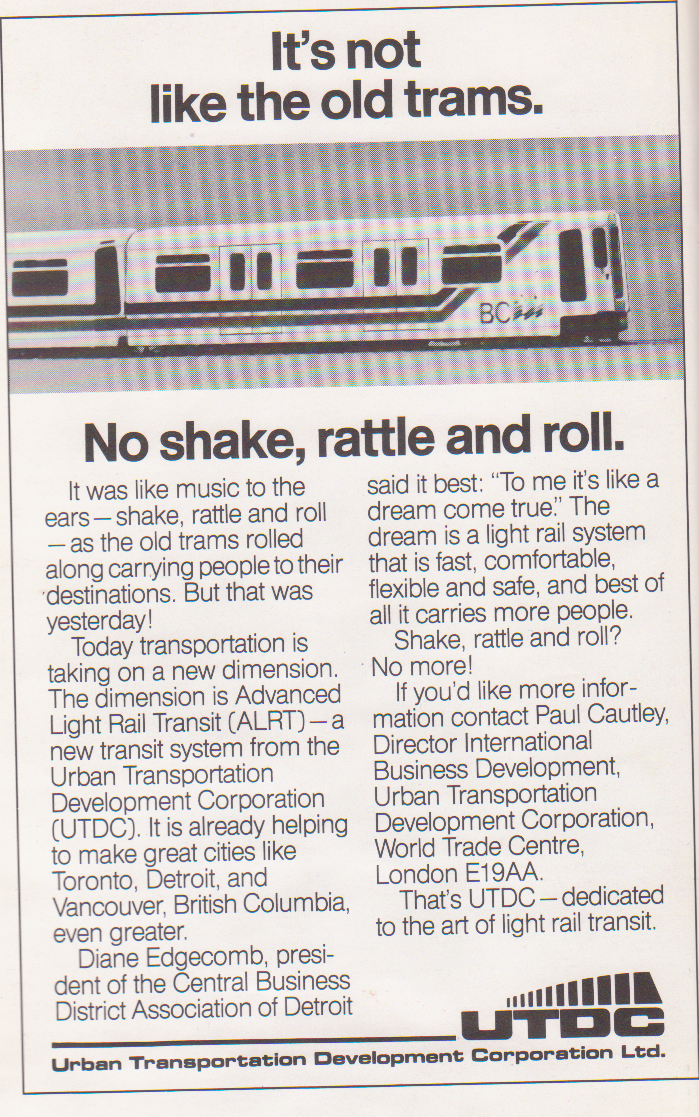
The Pied Piper of SkyTrain
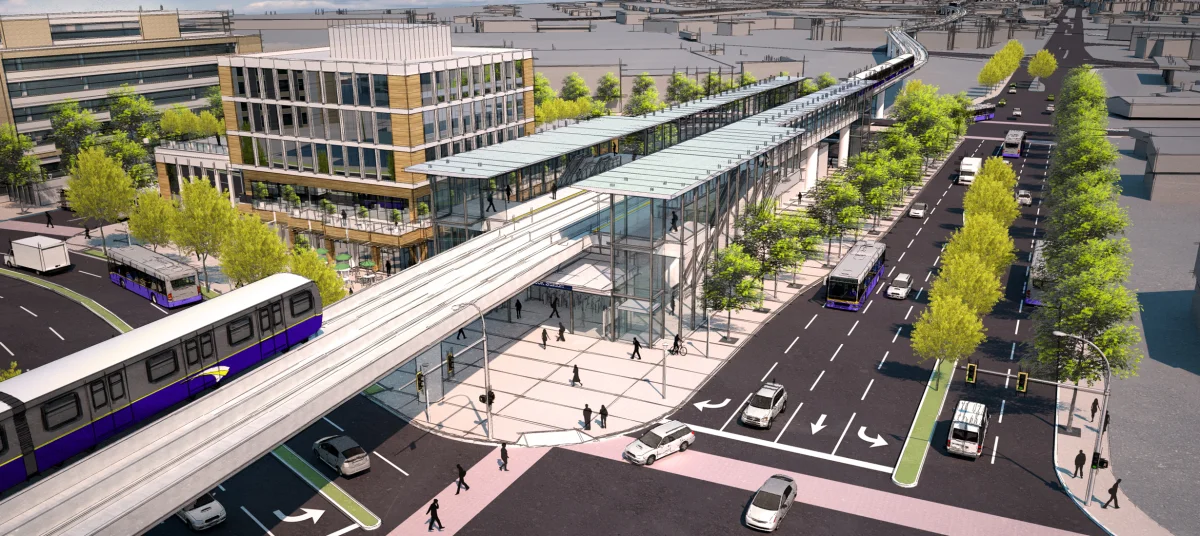
Evidently, the 16km Expo Line to Langley is in trouble, so who else to defend this hugely expensive project but the folks at SkyTrain for Surrey, otherwise known as FOX Entertainment North.
The claims made by SFS are breathtaking and needs serious comment.
True to form, the deliberate misinformation by SkyTrain for Surrey is again creating many misconceptions about transit and transportation and our regional public transit system is in trouble with declining ridership. The taxpayer has spent around $30 billion on SkyTrain, yet ridership has been in an ever steepening decline.
Because of the efforts of SkyTrain for Surrey, the city of Surrey will suffer from poor transit for decades to come as there will be scant monies available to expand the light metro system to a point where it will become an alternative to the car. Thus the SkyTrain light metro system will continue to offer “lessons” that local politcans and bureacrats refuse to learn.
Following the “Pied Piper” of SkyTrain has created and will continue to create public transit chaos in the region.
Zwei will comment when needed and it is certainly needed here.
MAYOR’S $8 BILLION SKYTRAIN ESTIMATE NOT SUPPORTED BY EVIDENCE
Zwei replies: Evidence, what evidence, unless one makes it up as one goes along.
Every few years, someone throws out a big, scary number about the cost of future SkyTrain expansion—and this year, that number was $8 billion. Mayor Locke’s statement reads like a warning, framing the idea of a future SkyTrain as unrealistic before the project has even been defined.
But here’s the reality: no one actually knows what a South Surrey SkyTrain extension would cost yet. Not because it’s unaffordable, but because it hasn’t been studied—whether by TransLink or the province. There is no finalized route, no design, and no engineering work to base a price on, so saying this future SkyTrain is “cost‑prohibitive” or claiming it would take “two decades” to build is not just premature—it’s irresponsible.
We’ve seen this pattern before.
Zwei replies: What is irresponsible is even talking about a SkyTrain south along the King George Hwy.
Queue up folks because any thought of a SkyTrain extension in Surrey must come after the now $8 billion completion of the Broadway subway to UBC and the now over $15 billion North Shore SkyTrain to Metro Town.Sorry, any talk of SkyTrain expansion in Surrey in the near future is just plain daft.
In the early 2000s, the then-proposed Canada Line was subject to heavy scrutiny. Critics called the project “prohibitively expensive”; local leaders in other municipalities repeatedly voted to stall it; and some groups pushed for it to be converted to a surface LRT—including Richmond City Council, led by then mayor Malcom Brodie. It took the intervention of SkyTrain advocates, who called on the City of Richmond to hold a referendum, to keep an elevated line on the table—and on March 9, 2004, the finished public consultation drew a record response. Out of more than 13,000 respondents, the majority voted in favour of an elevated, grade-separated line over an at-grade LRT system.
Zwei replies: The Canada Line was a Gordon Campbell faux P-3 project, designed as a long term investment tool for Bombardier, SNC Lavalin and the Caisse du Depot. The problem was, the trains used on the Expo and Millennium Lines are proprietary and no other company cared to bid on the project.
In desperation, The Campbell BC Liberals allowed Siemens and Alstom to bid on the project but promptly tossed them from the bidding process because they used trams as vehicles. SNC Lavalin cut a deal with ROTEM from Korea to use EMU’s and won the bid because a conventional system is always cheaper than the proprietary LIM powered system used on the E&M Lines.
The result: The Canada Line is the only heavy rail metro in the world, built as a light metro that has less capacity than a modern streetcar costing a fraction to build. Any polling done were cleverly crafted push polls using deliberately misleading information.
Although Mayor Brodie and Richmond Council continued to stubbornly push for an at-grade system, TransLink and regional planners realized they had to respect the wishes of the people. So they sought a private partner who innovated to keep the elevated design, converted Mayor Brodie’s “no” vote into a “yes”, and eventually delivered the grade-separated Canada Line we know and love—on time and on budget.
Today, the Canada Line has become a national and international model for good public transit, inspiring projects like Montréal’s REM, which is opening a brand‑new 14‑kilometre extension to the West Island this weekend.
Zwei replies: Actually Richmond council was gung-ho for SkyTrain and not light rail for the Canada Line. Now buyer’s remorse has set in as the Canada Line has not done much to reduce traffic and there is zero chance of the Canada Line ever being extended in its present form. It is a ‘sort-of’ White Elephant’, with the only winner being YVR!
REM is a financial clone of the Canada Line as the Caisse du Depot is making a lot of money on the Canada Line P-3, as they will with REM.
========
“Dismissing a future SkyTrain on the basis of costs, but in the absence of a feasibility study that actually looks at those costs, is completely irresponsible,” says Daryl Dela Cruz, Founder of SkyTrain for Surrey.
Zwei replies: Actually, what we call SkyTrain, especially the trains used on the Expo and Millennium lines were deemed unsalable since the very early 1980’s when a TTC commissioned study, “The Accelerated Rapid Transit Study (ARTS) found that ICTS (the first name that SkyTrain was marketed by) cost up to ten times more to install than light rail for about the same capacity”. Death sentence for ICTS, but reprieved under a new name Advanced Light Rail Transit (ALRT) for the sale to Vancouver.
========
The Canada Line story shows how misleading early assumptions can be, and why it’s important to separate political messaging from actual project planning. Costs don’t come from speeches; they come from engineering, design choices, procurement models, and lessons learned from recent builds. And on all of those fronts, Surrey is in a far stronger position today than critics would have you believe.
To understand why the $8 billion figure doesn’t hold up, it helps to look at the fundamentals. Here are five key reasons a South Surrey SkyTrain extension is far more realistic—and far more affordable—than the mayor suggests:
***
#1: If a South Surrey SkyTrain were being built at the cost of the SLS today, it would cost only about $7 billion.
Using the Surrey Langley SkyTrain cost of $375 million per kilometre as a benchmark puts the 19-kilometre project cost closer to $7 billion. That’s not small—but it’s also not $8 billion!
And even this estimate assumes the South Surrey line would mirror SLS’s most expensive requirements: Expo Line infrastructure, long 80-metre platforms, and full system integration. But a future line doesn’t have to be built this way.
SkyTrain was always more costly to build than LRT
Cost comparisons from the 1980’s
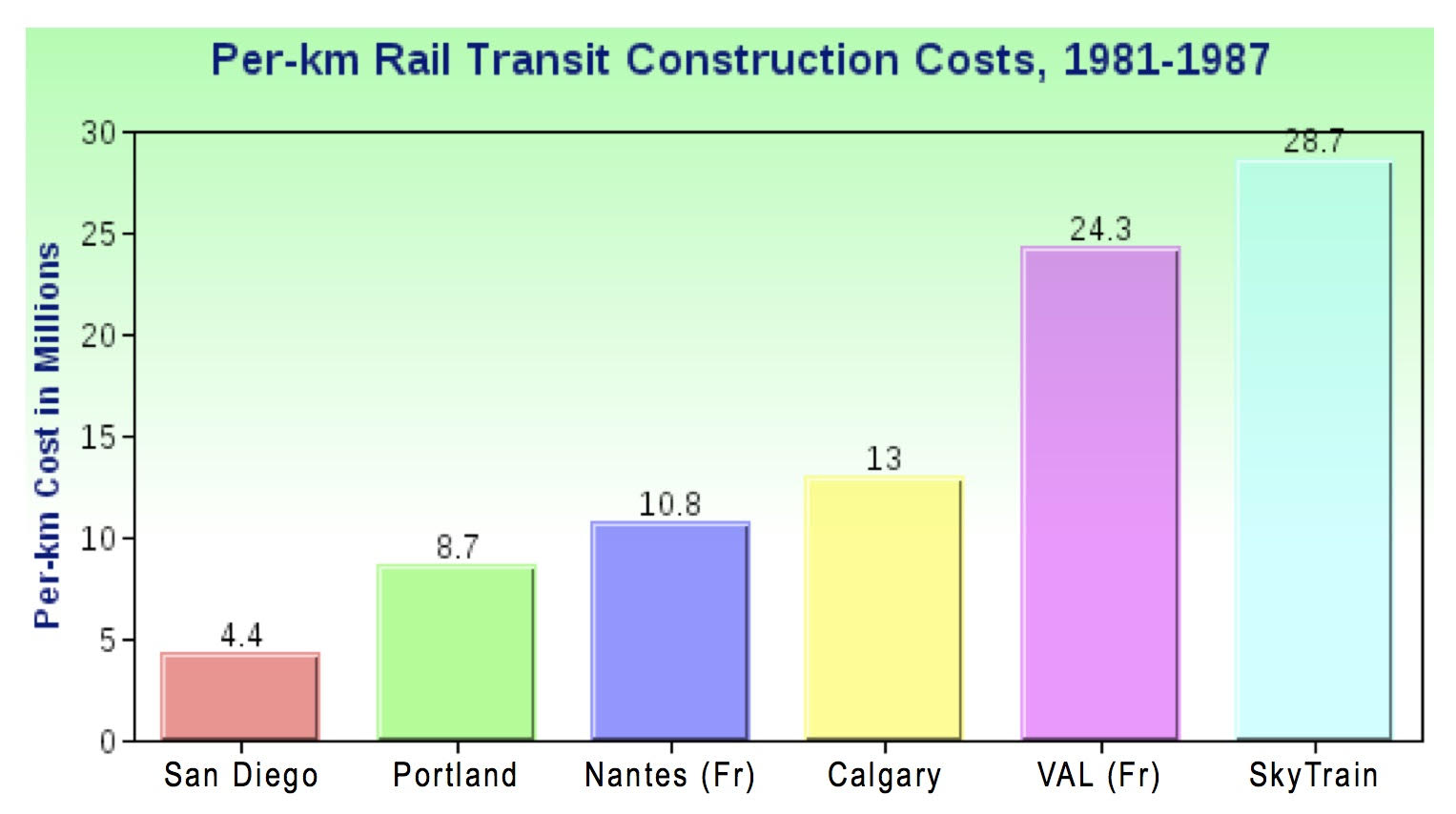
Zwei replies: Wishful thinking at best. The final cost for the Expo Line to Langley is not finalized and the best the government can do is give two year old estimates. Building small stations is not in the cards as any future extension would have to accommodate the five car Innovia 300 train-sets. The estimated full cost of the Langley extension may well exceed $7 billion and may even exceed $8 billion due to inflation.
Also remember if there is a future extension to the light metro system, the UBC extension to the Millennium Line will come first and that is 20 years in the future at minimum. Also factor in that the proprietary trains needed to extend both the Expo and Millennium Lines will be long out of production as no one is interested in building with the system, evidenced by no sales for the past quarter of a century!
—
#2: The first phase to Newton would not require an OMC.
Although TransLink has not studied the full route to South Surrey, TransLink did study an Expo Line extension as far as Newton Centre in 2012 (with the cost estimates updated in 2019). This study noted that the short 5.5-kilometre extension would not require a new operations and maintenance centre (OMC)—dramatically reducing the costs by removing land acquisition requirements.
This was also long before we knew there would be OMC #4 in Coquitlam—and before we approved the SLS, which comes with OMC #5. Both of these OMC facilities should ensure that an OMC is not necessary for the first phase of King George Boulevard SkyTrain.
Zwei replies: Actually the OMC #5 is needed for the five car Innovia 300 train-sets replacing the Ml. 1 cars.
—
#3: The line does not have to follow the Expo Line’s infrastructure requirements or platform lengths
Nobody said that the future line has to be an extension of the Expo Line. As we discussed in our previous post, Two Ways to Build SkyTrain on King George Boulevard, a separate line with different design standards could be built for far less. This includes shorter platforms, because the line wouldn’t need to handle 5-car-long Expo Line trains (and the trains can be made wider to compensate).
Zwei replies: Obviously the station platforms would have to accommodate the Innovia 300 five car train-sets that are in operation. This line of reasoning is pure nonsense.
—
#4: The current BRT project will reduce the cost of the SkyTrain.
Every dollar spent on the King George BRT is a dollar that won’t need to be spent later on SkyTrain. That’s because BRT construction includes utility relocations, land acquisition, street reconstruction, and corridor widening. All of this work would otherwise be bundled into the SkyTrain budget—at a higher and inflated cost, and with greater disruption.
Surrey residents should be familiar with this: before Surrey Langley SkyTrain construction reached Green Timbers Forest, Fraser Highway was widened there from 2 to 4 lanes. Today, while the Surrey Sprinter launch gantry and work crews work on the guideway above, the two outer lanes below are kept open for traffic. The alternative would have been a full closure of Fraser Highway through Green Timbers for multiple years, sending transit buses and cars through local neighbourhood streets like 92 Avenue.
Zwei replies: I shake my head at this. BRT will not reduce the cost of SkyTrain light-metro construction. This is pure unsound reasoning by someone who is desperately trying to mislead the public.
Similarly, when the region’s first BRT (the 98 B-Line) was constructed on No. 3 Road in Richmond, the work done for it was critical for enabling the Canada Line. Before the BRT, No. 3 Road was a narrow 4-lane road with a centre turn lane, with malls and shops coming up to the sidewalk; there was no space to build a SkyTrain. Although the BRT was there for only 5 years before Canada Line construction began, the alternative would have been catastrophic: a fully closed road, shutting down businesses and severing the lifeline of the city.
Zwei replies: Nice try but again not true. Fact is, the Canada Line was a pure Gordon Campbell, BC Liberal project to promote P-3 construction and light metro was not planned for at least another 15 to 20 years. The notion that #3 Road was narrow comes from the 1950’s and 1960’s and by the time the B-98 was in operation. Actually #3 road and the Express Bus lanes were designed to accommodate LRT, not SkyTrain (which was actually built on the ‘gutter’ lane), but the NDP flip flop from LRT to light metro with the Broadway Lougheed Rapid Transit project made sure no LRT was to be built in Metro Vancouver.
Strange coincidence is that the NDP flip flopped again from LRT to light metro for Surrey, using the much more expensive proprietary MALM system.
—
#5: Integration with a larger regional or intercity rail project could make the SkyTrain essentially free.
That’s right, free!
Zwei replies: This is pure nonsense and desperately shows both the ignorance of the author of this piece. Currently there are no regional or intercity rail being proposed.
Rail for the Valley’s $2 billion Marpole to Chilliwack proposal only integrates with the Canada Line at Cambie for service to Richmond and YVR.
Groups like Mountain Valley Institute and experts like Reece Martin have often pointed out that much larger projects could include urban rapid transit in Surrey, including proposed high-speed rail to Seattle and Portland, and regional rail connecting the Fraser Valley (Abbotsford-Chilliwack) and Sea-to-Sky (Whistler-Squamish) regions to Greater Vancouver.
Zwei replies: Excuse me but mountain Valley Institute are not experts, rather they have no actual experience building rail and are basically theorists more than anything. Reece Martin, is a You Tube presenter, who again is not an expert.
Rail for the Valley have engaged real experts, such as Leewood Projects (UK) who have a good working knowledge on rail projects, for the Leewood Study.
When one talks of High Speed Rail, one instantly should recognize that due to costs, will not happen in Metro Vancouver or the Fraser Valley and should be seen as comments by real amateurs!
Large‑scale nation-building rail projects often incorporate local rapid transit infrastructure as part of their corridor design. This is common worldwide—and it could happen here. If a future regional or high‑speed rail line uses the King George corridor, the incremental cost of building the local SkyTrain component could be minimal or effectively zero.
Zwei replies; Absolute nonsense.
The problem with extending the SkyTrain light Metro system is finance and the huge costs of light-metro, a transit mode grossly ill suited to operate as a regional railway.
The failure to recognize the expensive pitfalls of using proprietary trains on the Expo and millennium lines and the politcal interference with the Canada Line P-3, with the line being the only heavy-rail metro built in the world as a light-metro, having less capacity than a modern tram or streetcar coasting a fraction to build.
Need I remind the reader that of the seven such proprietary railways built, as used on the Expo and Millennium Lines, two were forced upon the operating authority (Vancouver and Toronto); two were involved in bribery scandals involving payments of “success fees” to senior bureacrats and politicians (Korea and Malaysia); one was financed by the Canadian Overseas Development Bank because a panel of experts found the system too expensive and poorly built (JFK Airtrain); and one was built to gain technical information (Beijing).
The proprietary system used on the Expo and Millennium Line were also marketed under at least six different names, Intermediate Capacity Transit System; Advanced Light Rail Transit; Advanced Light Metro; Advanced Rapid Transit ; Innovia Rapid Transit; and Movia Automatic Light Metro.
The proprietary railway has also had four owners; the UTDC; Lavalin; Bombardier; and now Alstom.The SkyTrain light metro system has a sad history of corruption, professional misconduct and politcal, interference, which has left Vancouver as an outlier with public transit as not one city has copied Vancouver’s transit planning, nor its exclusive use of light metro.