Lausanne’s New Tramway
Lausnne, Switzerland, with a population 144,000 and a regional population of 420,000, is building a new tramway, The city also has a two line metro system, with one line using rubber tired metro’s based on the Paris metro and the other metro line using light rail vehicles.
The high cost of metro construction has now focused city planners on more economic tramways for future transit construction.
In North America, the new tramway would be termed light rail, due to much of its route operating on dedicated right-of-ways.
The lesson to be learned in Vancouver is that transit mode should be chosen to deal with traffic flows on the route and not for politcal prestige as it seems the good Burghers of Lausanne care far more for the taxpayer;’s dollars than their counterpart politcans in Metro Vancouver.
From Vision to Reality: Lausanne’s New Tramway
von Michael Levy

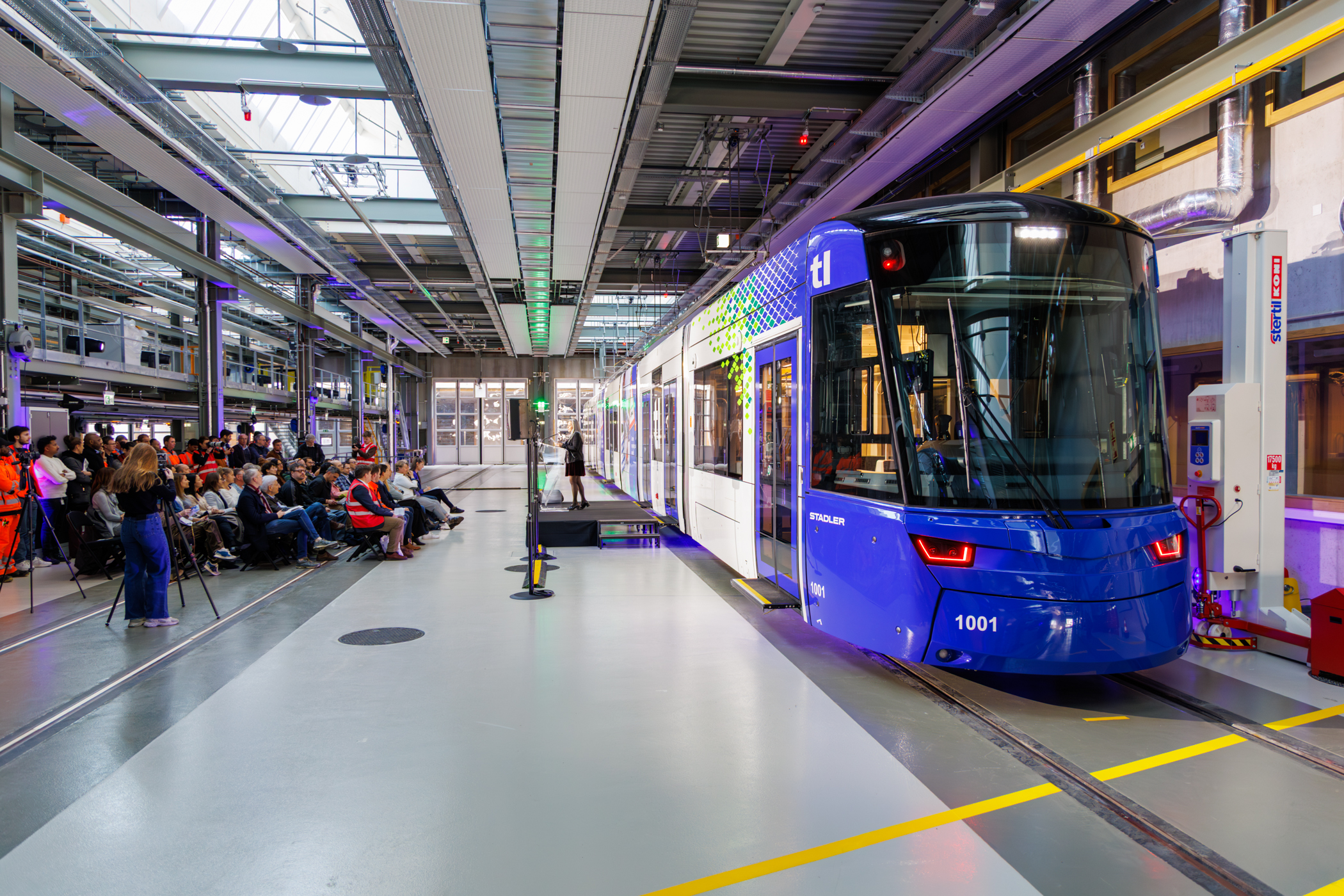
The first Stadler Tramlink for the new tram system in Lausanne was unveiled to the public during an open day I © Lionel Breitmeyer
With the new tram line T1, the Swiss city of Lausanne is reintroducing a tramway system for the first time since 1964. At the weekend, a public open day at the Renens-Perrelet depot attracted significant interest, allowing visitors to explore the new vehicles supplied by Stadler Rail and gain insights into the project’s progress and future operation.
Construction timeline and investment
The new T1 tramway line in Lausanne is the result of a multi-stage planning, political and approval process that began in 2005 with the development of an air quality action plan for the Lausanne–Morges agglomeration. This plan was approved in 2006 and identified the expansion of public transport as a key measure, as existing bus services were no longer expected to adequately accommodate projected demand growth. For the Lausanne–Renens corridor, the construction of a modern tramway was therefore recommended.
Following a political framework decision in 2008, the transport operator tl was granted a 50-year concession by the Swiss Federal Council in 2011. The original scheme envisaged a link between Lausanne-Flon and Renens only. However, by 2012, a further extension to Villars-Sainte-Croix had already gained broad political support.

Large posters (and figures) along the route draw attention to the upcoming test runs of the new tram I © Lionel Breitmeyer
During the planning phase, several modifications were introduced, including the abandonment of a planned underground terminus at Flon in favour of an at-grade solution at Place de l’Europe. This change generated savings of approximately CHF 83 million.
However, the project was heavily affected by legal disputes, particularly concerning a proposed road ramp in the Flon area and interventions in green spaces. Multiple objections between 2016 and 2019 led to delays and federal court proceedings.

Construction of the new tram line officially began in August 2021 following several years of planning and approval procedures. The project involves extensive civil engineering works along the Lausanne–Renens corridor, the laying of utility lines, and the construction of a new depot in Perrelet.
The first phase of construction is estimated to cost around CHF 500 million (approx. €546.43 million).
The first phase is scheduled to come into operation at the end of 2026, with the extension to Villars-Sainte-Croix expected to follow in 2027.

Technical outline of the system
The first phase of the line runs over 4.6 km, connecting Lausanne-Flon with Renens-Gare and serving 10 stops. Journey time is approximately 15 minutes, with a planned headway of 6 minutes. In the full build-out, the system will extend by a further 3.4 km, reaching Villars-Sainte-Croix.
Projected demand is estimated at around 13–18 million passengers per year, depending on final network development.

Stadler Tramlink: high-capacity rolling stock
The fleet consists of ten seven-section, fully low-floor Tramlink vehicles:
- length: 45 m
- width: 2.65 m
- capacity: approx. 300–316 passengers
- bidirectional design
- eight double doors per side
The vehicles were manufactured in Valencia, Spain, and are specifically adapted for high-frequency urban operation in a dense mixed-traffic environment.
Integration into Lausanne’s public transport network
Lausanne already has a highly efficient public transport system: the 7.8-kilometre-long M1 low-floor metro line, the 5.6-kilometre-long fully automated M2 Metro Lausanne, and the 59-kilometre-long trolleybus network.
The new tram line will thus create, for the first time, a third efficient above-ground transport network that complements the metro and trolleybus services and, in particular, strengthens the link between the city centre and the surrounding area.

With construction now in an advanced stage, Lausanne’s tramway represents one of the most significant urban rail reintroductions in Switzerland in decades. The combination of metro, trolleybus, and tram creates a highly structured three-tier public transport system, rare for a city of this size in Europe. 07.05.2026



To me, this is another story (a good one for a change) where just a few dollars more means no story at all, let me explain.
In this case whether you like it or not, Lausanne said yes to a surface LRT with little or no underground stations and running sections. Surprise, surprise, what they can realistically afford, is what they are building. I am so tired of people on line saying, “if you built it all or partially in a tunnel it will attract more riders”, no that is not the case. If you want tunnels and underground stations, especially in this case, it doesn’t get built at all.
For Lausanne, €546.43 Million Euros was enough (roughly $874.3 Million CAD) and an extra €91.3 Million was too much ($1.02 Billion CAD). The advantage of starting cheap is that, you can build a much bigger network down the road. Later, as the network gets bigger with more lines and line extensions you get multipliers, in this case passenger number multipliers.
Unless Vancouver spends even more money, your network won’t grow and you already spend way, way too much for what you get. Especially, trying to build even a small regional sized rail system, with a operating technology that was never designed to do that.
Zwei replies: Exactly! I was in a conversation with a former Translink type a few weeks ago and he told me that Translink is in panic as ridership is in decline and that they have no answer for the politcans except “build more rapid transit”. This may explain Daryl’s recent comeback and the host of videos on You Tube.
He agreed with me that the demands from Vancouver Island (E&N) and BC Rail probably means no big metro Vancouver project until 2035 at the earliest. It seems Surrey is under the impression that the next SkyTrain extension will be down the King George to 64th but by the time there is financing, there will be no Innovia cars in production.
I was told in an email from a LRTA type that the new cars for Kuala Lumpur are indeed cloned Innovia cars from Beijing’s ART system and are not updated and I think that will suit the transit authorities there because they will operate happily with existing cars.