Mr. Haveacow – The Ridership Question
Christopher MacKechnie Transit Expert is a transit planner and lawyer and writes for the About.Com website as their go to guy on public transport. The About Public Transport.Com site answers some basic questions and issues in transit operation and planning in an easily understood accessible way. Most of his articles, are pretty basic and are unfortunately, a little biased towards the American transit funding and planning regime, so not all of his answers apply in all situations to Canadian cities. However, he is quite good at explaining basic problems that often public transit is heavily and in my opinion often unfairly criticized for. He occasionally though, really hits one out of the park. This article is an excellent example when he nails it 100% and he could have gone on for a hundred or more pages. He shows the many ways that data about transit can be misleading or is poorly understood by people whom donai??i??t work in or around the transit industry and worst of all manipulated by just about anyone so that people who really donai??i??t understand what is being said can draw incorrect or overly exaggerated conclusions. His main beef is the recent trend for top 10 lists on just about anything, including transit.
Four Ways That Top Ten Lists in Transit Can Be Misleading
Like many aspects of life, transit is amenable to ai???Top Tenai??? lists and fairly frequently you see news articles proclaiming the ai???Top Tenai??? transit cities or less often the ai???Bottom Tenai??? transit cities in the United States, Canada, or the world.Ai?? Often these are misleading because the rankings are based on only a few criteria, and the criteria chosen may not even be that useful.
Here are a few of the criteria used and how they could be misleading:
1)Ridership ai??i?? Upon first glance, ridership would seem to be an effective way to gauge transit success, since every person who rides a bus or train could be considered a ai???saleai??? by the transit agency.Ai?? There are several caveats we must keep in mind when considering ridership, however.
First, in the United States we measure ridership by ai???unlinked passenger tripsai???.Ai?? What this means is that a person who takes a bus and train to work is considered two passengers by the transit agency even though only one trip was taken ai???a complete or linked tripai???.Ai?? As a result, transit agencies that have a lot of people transferring between lines will have higher reported ridership than those who do not, even if all other variables are the same.
Ai?? Second, some cities are served by only one transit agency while others have several.Ai?? While likely more than 95% of transit trips in New York City are taken on a vehicle operated by the New York MTA, in Los Angeles the corresponding agency (Metro) may only carry 70% of total transit trips, with a large number of other transit providers picking up the rest.
A true accounting of transit in Los Angeles would require the summation of ridership of more than twenty separate transit systems, an effort that may be too daunting for the casual examiner.
Ai?? Third, ridership is of course very correlated with population.Ai?? We would expect Houston (metro area of 6.18 million) to have more transit ridership than Eugene, OR (350,000); that does not mean transit is better in Houston.
Ai?? A better statistic would be ridership per capita, which controls for population size, and results in 22.9 annual transit trips per person in Houston and 39.7 in Eugene (2012 NTD data).
2) Number of Bus Stops ai??i?? One review stated that Modesto, CA had the best bus system in the United States because it had the highest percentage of residents within A? of a mile of a bus stop.Ai?? However, just because there is a bus stop does not mean that the bus service is usable ai??i?? in Modesto, buses run every thirty minutes and stop at around 8:30 PM on weekdays and around 7:00 PM on weekends.
3)Jobs Available Within a Certain Time Period on Transit ai??i?? Another popular ranking variable is the number of jobs available within a certain time period on transit, usually thirty or sixty minutes.Ai?? This favors smaller urban areas that are not big in geographic area, especially smaller urban areas with a dominant employment district (often college towns).Ai?? Does anybody believe New York does not have a great transit system because it takes too long to ride the ai???Aai??? train from Far Rockaway to Morningside Heights?Ai?? No, because New Yorkers would believe you were an idiot if you lived in Far Rockaway but worked in Morningside Heights.Ai??Ai??Ai?? Despite anecdotal reports on extreme commutes, the average trip on city bus systems average around five miles ai??i?? a distance that can be covered in less than thirty minutes even on the lowly local bus.
4)Safety ai??i?? Recently I noticed an assessment of transit that included safety as one of the variables.Ai?? Considering how safe transit as a whole, makes safety a curious choice indeed.Ai??Ai?? Transit agencies that operate fixed guideway systems and have extensive mileage in suburban areas are likely to do well in this category since their vehicles will not get into as many accidents.Ai?? Ridership also plays a role, with crowded conditions forming the perfect opportunity for a pickpocket.Ai?? The combination suggests that a very safe city for public transportation would have lightly ridden trains and buses in a low density suburban area.Ai?? In fact, in this list San Jose, CA comes out as the sixth best transit system in the country even as its far lower than expected light rail ridership (caused by the massive job loss in the dot.com meltdown) has made it the number one case study for American anti-rail advocates.
Because the United States has not chosen to devote enough resources to provide comprehensive transit options through all parts of our nationai??i??s urban areas, cities often fall into one of two categories.Ai?? In the first category, the central city is filled with excellent transit options with the suburbs often having relatively little service.Ai?? Chicago and Los Angeles are two cities that immediately come to mind in this category.Ai?? I applaud Seattle, which has excellent transit options in the central city, for trying to improve suburban transit.Ai?? In the second category, a uniformly relatively low level of service is operated throughout the metropolitan area.Ai?? Phoenix, with a grid-based route system operating routes with mostly thirty minute headways and covering almost all the developed area, is a good example of this category.
Since the complete lack of resources means that quality transit service can often be provided in only a small subset of a metropolitan area, it makes more sense to compare these areas rather than the overall region.Ai?? Which cities do the best job in offering bus and train service to these so-called ai???transit-supportive areasai??? ai??i?? areas that are considered capable of supporting transit due to some combination of population density, trip generators, and other things?Ai?? As of November 2015 I have not seen any study that can answer that question.
From Haveacow
Just to add my two cents about ridership being tracked in unlinked passenger trips instead of linked trips. Many treat this as a conspiracy by the transit agency or by the people who run them to falsely bump up statistics to make them look better. This is really a ai???red hearingai??? issue to me. The lack of ridership data in certain forms that make for easier comparison when agencies do it or more problematic when they donai??i??t, is frankly, just annoying it is not a conspiracy. It really comes down to the cost of doing things for the Transit Agency. You know a transit agency can’t win whether they provide the data to the public or not. In most cases the data is used for something negative by an outside group orAi??individual to explain why their agency isn’t deserving of anything but criticism or its complete destruction. My favorite last year was a report that graded the largest Canadian transit operations by City Region or Metro Area. The point was, every local newspaper or blogger used information from this study to show why their agency was the worst and should be “blown up and started again” regardless how good or bad they performed in the actual survey
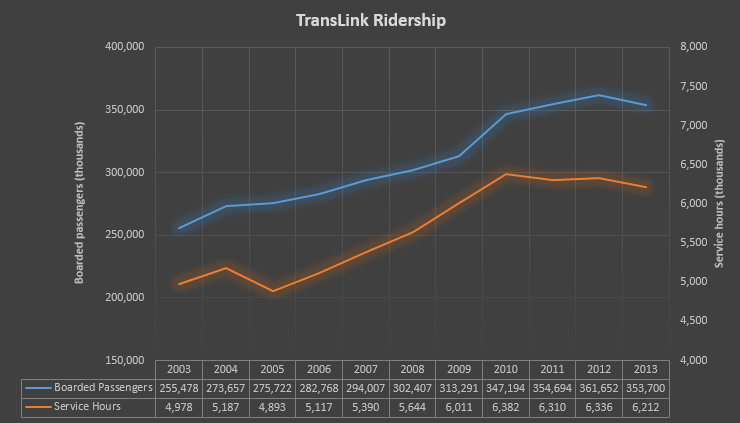
Many agencies do provide ridership in both linked and unlinked trips, Translink included. If you look hard you will find it. Or you can pay for it, like I do, you can get it from the Canadian Urban Transit Association (CUTA). Even some provinces like Ontario, provide it free however, you do have to ask very nicely for it from the Government of Ontario and it is only in digital form. It is the Ontario Urban Transit Fact Book, a joint government of Ontario and CUTA product. The point is, without a separate professional nationally based transit organization crunching the numbers and putting it in a readable, scientifically accurate format, it would just be too expensive and or time consuming to do for most transit operators.
Ai??The acceptance of digital fare cards by transit operators or through Smart Phone Apps, makes this type of data retrieval a lot cheaper because the system tracks the location of each vehicle through GPS and keeps statistics on whether a fare is being paid or whether it is a transfer. This gives an individual transit operator solid reliable passenger data, as it is actually happening, probably for the first time in history. This means a lot fewer of those seriously time consuming and very expensive after the fact, passenger surveys. If you have ever taken one you understand, it forces passengers to break down their daily trip segment by segment and ask 50 or so annoying questions about this daily trip. These surveys can be so onerous a process that, some transit agencies (GO Transit being one of them) offer prizes if you fill it out. On paper or on line via the internet.
Many Thanks,
Haveacow