A repost. First posted by zweisystem on Friday, March 27, 2020
With all the hype and hoopla about the new SkyTrain 5-car train-sets being delivered and the media oo-ing and aw-ing about the system, I thought retelling a little history was in order.
One just has to shake ones head!
Except for brief mentions of our local SkyTrain Lobby, we do not hear about the now called Movia Automatic Light metro system in Youngin and for very good reason, as it has mired Bombardier into a massive local scandal.
The local prosecution office is more blunt: EverLine, a lead prosecutor says, was built after Bombardier engaged in corrupt practices to win the 2004 contract for its construction.
The evidence his office gathered showed that Bombardier supplied its South Korean representative, Henry Kim, with lobbying fees totalling $1.8-million over a five-year period. Bombardier sent gifts to the homes of local politicians, as well as to researchers tasked with creating the ridership forecasts that would underpin construction of the new light-rail line, the prosecutors found. Mr. Kim received a further $4.7-million in advanced payment incentives that were deposited into a Swiss bank, under the name of Mr. Kim’s wife, Mr. Cha said.
One wonders what gifts and lobbying fees were given or paid locally to in Metro Vancouver to continue planning for the now obsolete MALM system?
Why do local politicians still strongly support building with it, when expert opinion, in Canada and abroad, has deemed our SkyTrain light-metro system obsolete?
Why do local politicians never explain that only seven such systems have been built in the previous 40 years and only three are seriously used for urban transport?
why do local politicians sidestep any question about the light metro system with inaccurate or misleading statements?
In Canada, politicians and police don’t care to know!
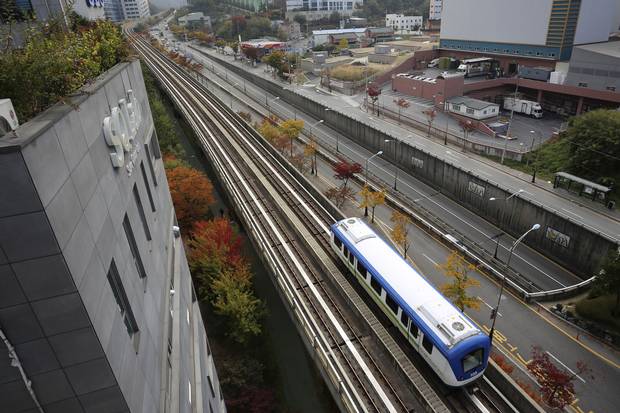
The Bombardier-built EverLine, which runs along an 18-kilometre track in Yongin, South Korea, was sold to local leaders as a vision of the future, but is now derided by locals as a bus on rails.NATHAN VANDERKLIPPE/THE GLOBE AND MAIL Dec. 30 2017
Yongin, South Korea
Every few minutes, a single car passes by Chodang station, one of the stops on 18 kilometres of elevated track that wind through Yongin, a small city 40 kilometres south of Seoul. When the EverLine was sold to local leaders, it was a vision of the future – driverless cars that would swiftly transport tens of thousands of passengers a day.
Today, locals mockingly call it a bus on rails, slower on some routes than taking an actual bus, and, for the city that built it, far more expensive. The local prosecution office is more blunt: EverLine, a lead prosecutor says, was built after Bombardier engaged in corrupt practices to win the 2004 contract for its construction.
The project’s one-trillion-Korean-won price tag, equivalent to $940-million in today’s dollars, was based on initial expectations that some 160,000 people would ride the EverLine every day. But even three years after operations began in 2013 – a start date delayed by legal wrangling between Yongin and the Bombardier-led consortium that built the line – actual ridership was less than a fifth of that figure. The resulting financial shortfalls have saddled Yongin with so much debt that the municipal government was forced into austerity measures around the time the line entered service.
The problems have brought intense scrutiny to how a consortium led by Bombardier won the right to build the project. A special investigation by Yongin prosecutors concluded that the company operated a slush fund and bribed researchers and decision-makers with gifts and trips. For half a year, a team of six South Korean prosecutors, 14 investigators and two certified public accountants worked together. They examined the records of 52 fixed phones, analyzed 115 cellphones and computers, scoured 725 bank accounts and accumulated 285 boxes of documents. “We were aiming to hold people responsible for this wrongful private-sector investment project,” prosecutor Cha Maeng-ki told The Globe.
In Yongin, lawyer Hyun Geun-taek is surrounded by more than10,000 pages of paper, the accumulated record of legal challenges to the Bombardier-backed Everline.NATHAN VANDERKLIPPE/THE GLOBE AND MAIL
The evidence his office gathered showed that Bombardier supplied its South Korean representative, Henry Kim, with lobbying fees totalling $1.8-million over a five-year period. Bombardier sent gifts to the homes of local politicians, as well as to researchers tasked with creating the ridership forecasts that would underpin construction of the new light-rail line, the prosecutors found. Mr. Kim received a further $4.7-million in advanced payment incentives that were deposited into a Swiss bank, under the name of Mr. Kim’s wife, Mr. Cha said. Some of that money, Mr. Cha said, was used to buy real estate in South Korea.
The company also flew 37 people, including 18 city councillors, to Canada, where it “paid their full expenses, put them up in luxury hotels, and provided them with golfing trips, a trip to Niagara Falls and other luxuries,” he said. “These trips took place at the time during which Yongin city and Bombardier were going through negotiations for their business conditions.”
Mr. Cha said, “Providing gifts or funding trips to civil servants in the line of duty constitutes bribery.”
The results of Mr. Cha’s investigation were made public in 2012 and, in the years that followed, local courts found Lee Jeong-moon, the former mayor of Yongin, guilty of corruption on charges related to the EverLine construction. He was sentenced to prison for bribery related to the selection of subcontractors, including his younger brother and friends, for the rail-construction project.
Mr. Kim was found guilty of embezzling funds from the Bombardier-led consortium, where he had served as CEO. But the Bombardier representative did not face trial on charges of corrupting officials nor was the company itself charged with wrongdoing. By the time prosecutors began digging into the company’s South Korean project, it was too late for charges. “The statute of limitations at the time was five years,” Mr. Cha explained.
Canada’s toughened anti-corruption law contains no such statute of limitations.
(Mr. Kim’s phone number in South Korea has been disconnected, and The Globe was unable to reach him for comment.)
Bombardier’s Mr. Marcil, however, contested Mr. Cha’s interpretation of events. “We reject the insinuation that we, in any way, acted wrongfully in the Yongin project, or that we unduly influenced either the choice of technology or the decision to build the transit system,” Mr. Marcil said. “After our full cooperation in their investigation, South Korean investigators determined that there was no cause for charges against Bombardier.”
Mr. Lee, the former mayor sentenced to jail on corruption charges, also defends the EverLine – and the company that built it. He is “completely in favour of them,” he said in an interview. “Bombardier didn’t hurt Yongin City the tiniest bit. Not one bit.”
Bombardier had been given preferential status in bidding for the Yongin project, and was the sole company to submit a bid, according to a local lawmaker.
But the company has since gained many detractors in a city where the EverLine has grown into a symbol of extravagance and waste. The lower-than-forecast number of riders has meant less revenue than initially expected and has sparked a dizzying number of efforts to assign blame. Prosecutors charged 10 people, accusing them of bribery and violating construction safety laws. A citizens group has sued Yongin for damage compensation.
The city and the Bombardier-backed consortium faced off twice before the International Court of Arbitration, or ICA, after Yongin accused the consortium of safety flaws and noise issues. The consortium then sued over delays in opening the line, and won. In two judgments, the ICA awarded the consortium a total of 778.6 billion Korean won, an amount roughly 22-per-cent greater than the consortium’s share of construction costs. Because the city could not afford to pay the entire sum at once, it agreed to continue payments until 2043. After a contractual change, Bombardier no longer operates the rail project that it helped bring to Yongin, where the project continues to raise local passions.
Lee Sang-cheol, one of the 18 councillors who travelled to Canada with Bombardier, acknowledged that the company gave him gifts, although he down-played them as “nothing out of the ordinary.” He also defended the trip he took to Canada on Bombardier’s dime. “If they want to sell us machines, they have to show us those things,” he said. And he added that “stopping by some tourist attractions shouldn’t be such a big deal. How can we just see light rail and nothing else?”
Still, he has come to regret the company’s involvement. “Bombardier made zero losses in this transaction. Bombardier lost absolutely nothing. It took everything it wanted to take,” he said. And he resents the financial duress that the EverLine project inflicted on his city. “Honestly, what Bombardier did, it caused massive harm to Yongin city.”
All fake news. skytrain is great and everyone builds with it. No one builds with choo-choo light rail anymore because it does not work, look at Ottawa.
SkyTrain built everywhere, Germany, Asia, France and the USA its a great system and cheap to operate. Translink told me that this group is no good all fake news because Vancouver is going to build skytrain to north Vancouver and Mission, no ned for your choo-choo train. Hopefully they build it to Whistler!
Zwei replies: Yikes, where do I begin. Oh yes, the trains used on the Expo and Millennium Lines have been on the market in one form or another for almost 50 years, with only 7 sold. Today only 6 remain in operation. There has been no sales for the past 20 years.
Ottawa had problems but they were politcal, bad decisions made by politcans and not the system itself. The P-3 maintenance contract played a big part in their start-up woes.
SkyTrain is definitely not cheap to operate as a 1992 GVRD study found just the Expo line was subsidized by the government at $157 million annually ($300 million in today’s money), more than the total bus system!
The cost to build Skytrain to the North Shore is $10 billion plus and to Mission, at least $20 billion – show me the money!
From what I can gather TransLink’s new 5 car train-sets have gone over with a dull thump as there is a general lack of seating, with capacity increased by reduced seating. Hardly a selling point to customers.
I was reluctant to post this, but if Translink doesn’t like this group, means they are reading this and they are upset by this, which means Rail for the Valley is still relevant.
There are 6 LRT lines under construction right now in Canada and 1 more to start construction next year. 10 LRT lines in the USA (even with Trump), 42 lines under construction in Europe and no fewer than 24 in Australasia. Yes, people still build with LRT.
There are only 6 Skytrain like systems in existence world wide, only Vancouver is building anything, no one else wants it anymore. Too expensive to build compared to heavy rail Metros and LRT and moves too few passengers.
The Scarborough RT in Toronto (the first Skytrain system opened in 1985) was finally closed, in favor of a subway extension. It’s parts and components were sold to Detroit’s People Mover (the 3rd Skytrain System which opened in 1987). Yes that’s right, Detroit chose Toronto’s garbage over new Skytrains and modern components. Says a lot about your new Mark V trainsets.
There are few seats on the MK.5 cars to increase capacity. TransLink promised the Expo Line will increase capacity from 15K pphpd to 17.5K pphpd as this includes expensive signalling/electrical/track rehab, the $1.47 billion re-signalling contract with Thales, left little money for the other two, so to show an “on paper” maximum capacity of 17,500 pphpd, it is a smoke and mirrors job by taking out seats. I am afraid this will deter ridership.





All fake news. skytrain is great and everyone builds with it. No one builds with choo-choo light rail anymore because it does not work, look at Ottawa.
SkyTrain built everywhere, Germany, Asia, France and the USA its a great system and cheap to operate. Translink told me that this group is no good all fake news because Vancouver is going to build skytrain to north Vancouver and Mission, no ned for your choo-choo train. Hopefully they build it to Whistler!
Zwei replies: Yikes, where do I begin. Oh yes, the trains used on the Expo and Millennium Lines have been on the market in one form or another for almost 50 years, with only 7 sold. Today only 6 remain in operation. There has been no sales for the past 20 years.
Ottawa had problems but they were politcal, bad decisions made by politcans and not the system itself. The P-3 maintenance contract played a big part in their start-up woes.
SkyTrain is definitely not cheap to operate as a 1992 GVRD study found just the Expo line was subsidized by the government at $157 million annually ($300 million in today’s money), more than the total bus system!
The cost to build Skytrain to the North Shore is $10 billion plus and to Mission, at least $20 billion – show me the money!
From what I can gather TransLink’s new 5 car train-sets have gone over with a dull thump as there is a general lack of seating, with capacity increased by reduced seating. Hardly a selling point to customers.
I was reluctant to post this, but if Translink doesn’t like this group, means they are reading this and they are upset by this, which means Rail for the Valley is still relevant.
There are 6 LRT lines under construction right now in Canada and 1 more to start construction next year. 10 LRT lines in the USA (even with Trump), 42 lines under construction in Europe and no fewer than 24 in Australasia. Yes, people still build with LRT.
There are only 6 Skytrain like systems in existence world wide, only Vancouver is building anything, no one else wants it anymore. Too expensive to build compared to heavy rail Metros and LRT and moves too few passengers.
The Scarborough RT in Toronto (the first Skytrain system opened in 1985) was finally closed, in favor of a subway extension. It’s parts and components were sold to Detroit’s People Mover (the 3rd Skytrain System which opened in 1987). Yes that’s right, Detroit chose Toronto’s garbage over new Skytrains and modern components. Says a lot about your new Mark V trainsets.
The new Mark V 5 car trains are very expensive.
They cost per meter twice as much as similar Subway or LRT Trains.
The five car skytrains look like they are designed for standing only. Why can’t Canada use side seating like in London, England?
Skytrain is great and extension to Langley will reduce travel time.
BC Transit should replace their fraser valley express bus with a train to Langley from Chilliwack.
There are few seats on the MK.5 cars to increase capacity. TransLink promised the Expo Line will increase capacity from 15K pphpd to 17.5K pphpd as this includes expensive signalling/electrical/track rehab, the $1.47 billion re-signalling contract with Thales, left little money for the other two, so to show an “on paper” maximum capacity of 17,500 pphpd, it is a smoke and mirrors job by taking out seats. I am afraid this will deter ridership.