Ottawa’s Trillium, often mistakenly called LRT by the media is actually a DMU operation, using existing railway right-of-ways. In fact, the Trillium Line is in no way connected to Ottawa’s troubled hybrid light metro/rail system.
The Trillium Line is a single track, with three passing sidings on dedicated rights-of-way shared with Ottawa Central freight trains south of Walkley Yard, which occasionally serve the National Research Council of Canada‘s Automotive and Surface Transportation Research Centre. Despite being a local public transit line, it is actually a federally regulated mainline railway and operated under the official name “Capital Railway”, which appears on the trains in addition to the service’s logo. All stations except Carleton have single platforms.
Between 2013 and 2015, the line was upgraded and its fleet replaced, cutting wait times during peak periods from 15 minutes to 12 minutes.
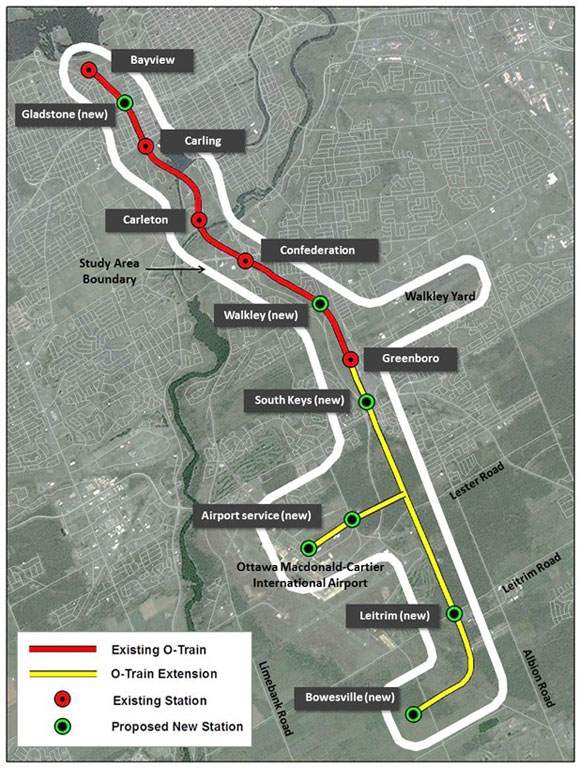
On May 3, 2020, the line was shut down for a three-year upgrade and expansion project, which will add eight stations and 16 kilometres (10 mi) of track, including a spur to Macdonald–Cartier International Airport. During its closure, service along the line is being provided by buses. The upgraded and expanded line is expected to reopen in 2023.
The concept of the Trillium Line is what is needed for badly needed improved public and regional transit in BC. Cheaper rail solutions are paramount if BC is to deal with global Warming and climate change as the taxpayer cannot afford the SkyTrain light-metro solution.. The failure of the current government and metro Vancouver city governments to invest in more affordable rail solutions, such as DMU’s using existing rail corridors and track share with mainline railways will leave the region with permanent traffic congestion and gridlock as the the current rapid transit system has failed to achieve any modal shift on any of the routes where light metro operates.
The failure to attract the the motorist from the car has not been unnoticed abroad as no one has copied the Vancouver model of light metro only operation.
As the next phase of the defining transit project of his mayoral career comes together, Mayor Jim Watson shared his “great confidence” that the O-Train south extension “will not see the kind of challenges we’ve seen in the first stage of the Confederation Line.”Watson spoke to this newspaper after the Friday unveiling of the new Trillium Line fleet: seven Stadler FLIRT trains that will service the extended line stretching from Bayview Station to Limebank Road in Riverside South. The old Alstom Cordia LINT trains, used on the Trillium Line before its closure in 2020 for Stage 2 construction, will run along the new airport spur.Watson said his confidence came from the different technology for the southern O-Train branch; unlike the electrified Confederation Line, the Trillium Line is diesel-powered, with the potential for conversion in the future. It’s also being built on a system that has worked well for two decades.However, Watson added, “At the end of the day, it will be seeing is believing … People will not take our word until the trains are out, they’re working properly, they’re reliable. And that’s ultimately our objective.”
Ottawans have already had to digest disappointment that their new Trillium Line was running nine months and then a year behind its contracted completion date of August 2022. It’s to be the first finished of the three rail extensions that make up the Stage 2 project. The next update will come at a September meeting of council’s finance and economic development committee.
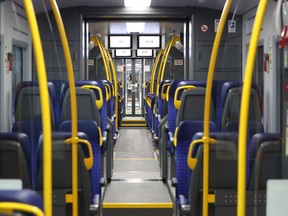
An interior view of one of the new fleet of light-rail trains unveiled at the maintenance and storage facility for O-Train South Extension on Friday.Photo by Tony Caldwell /Postmedia
It’s also one of the companies in the Rideau Transit Group consortium behind LRT Stage 1, also known as the Confederation Line. The extension of this line to the east and west by Kiewit and Vinci makes up the remainder of the $4.6-billion Stage 2 project funded by the federal, provincial and municipal governments.
Alongside Swiss chocolate, courtesy of Stadler, fodder for optimism was dispensed Friday.All seven trains have arrived, testing has begun and both station construction and installation of track are “progressing well” along the extended Trillium Line, said Michael Morgan, the city’s rail construction program director. Stretching 80 metres and capable of holding 420 passengers, the Stadler trains are twice as long and double the capacity of their Trillium Line predecessors.“Fantastic vehicle. It’s been working great,” Morgan said. “We’ve had no issues since we started the testing.”They’re looking to have the full track and signal system available end-to-end by the year’s conclusion, allowing winter testing in December, January, and February. But they’re not expecting problems with the trains’ performance in cold conditions, Morgan added.As the mayor did, Morgan focused on key differences between the Trillium and Confederation Lines when asked about the potential for problems like those riders encountered with LRT Stage 1.“The Trillium Line’s a different technology, it’s a different system, we’re starting from a different base. We already have a number of vehicles that work today. We have seven new vehicles that will come, they’re ready to go, they’re ready a year in advance of the opening … We’re quite confident that the different technology, the different systems are going to make a huge impact in terms of how the system operates.”As Stage 2 work continues in the south, east and west, an independent commission probing the problem-plagued first phase of LRT in Ottawa will prepare a final report with recommendations to prevent future system failures. Following weeks of hearings and countless pages of publicly accessible evidence submissions, the report is due by Aug. 31, but the deadline could be pushed to Nov. 30 with approval of Ontario’s transportation minister.
Mayor Jim Watson and Coun. Allan Hubley, chair of the transit commission, assess the interior of one of the new fleet of light-trail train cars.Photo by Tony Caldwell /Postmedia
Transit commission chair Allan Hubley said Friday that he’d welcomed the public inquiry from its outset, noting its distinction from a judicial inquiry, which council ultimately voted against pursuing and could have cost the city millions and taken years.
“The public inquiry was great because it’s focused on a couple of key issues and we’re expecting a report by the end of August, which is really good turnaround because we want to action whatever comes out of that report,” Hubley said. “We want to make sure that we do it, whatever they recommend with the train.”
Hubley said he also found it heartening to see “the number of experts that said that we did the right thing, that, you know, changing the testing criteria didn’t make that big a difference … 98 to 96 wasn’t a big game-changer.”
“I remember at the time it being discussed that … you’d go from a 3.5- to a five-minute wait time,” Hubley said.
“I compared that to 15 minutes waiting for a bus and thought, ‘You know, people aren’t going to be that much upset over it.’”
Stretching 80 metres and capable of holding 420 passengers, the Stadler trains are twice as long and double the capacity of their Trillium Line predecessors.Photo by Tony Caldwell /Postmedia
E&N was a VIA rail service. It was shut down because the rail needed maintenance. VIA does not do track maintenance and waits for the owner of the rails to do the maintenance before they resume service. The owner is a non-profit so they need some help from the government. There was some estimates in the cost to repair the track but nothing done yet.
Zwei replies: VIA will not resume service on the E&N, even of the track is repaired. to make usable the cost to repair track issues, etc. is about $500 million. To rehab the E&N to see a usable rail service is about $3 billion.
This upgrade would enable 4-8 train/day with cars weighing up to 286 thousand lbs. Passenger trains could travel at 60 km/hr and freight trains 40 km/h (Class 3 track standard).
The report recomended an option that would reduce the initial cost to $0.43 billion by upgrading some lower-demand sections to a lower standard.
The report also estimates operational costs and revenues.
A monthly pass for the commuter trains into Victoria would be $200, and the regional sections from Duncan to Courtenay would cost $20/trip.
Zwei replies: You should know in BC, technical documents or Business Cases are really politcal documents in disguise. The $550 million is nothing more than bare bones, with little money left for anything. My discussion with those who have expertise in reactivating railways and that includes Mr. Cow, puts the cost nearer to $3 billion, when all is said and done. I imagine the former premier Horgan and current premier Eby actually know the real costs involved and do not not want to touch the E&N with a 6 foot pole. $11 billion investment in SkyTrain may win an election, but a $3 billion investment for the E&N will not garner much votes.
I will give you just one example of why restart or more precisely reactivation costs are commonly underestimated. lmagine a railway bridge on the the E&N right of way, not a major bridge but a significant bridge 50m to 60m long crossing a fast moving shallow river.
When VIA Rail stopped service they informed the Railway Directorate of Transport Canada that passenger service was being discontinued and would not be restarted. I checked, they did this. Officially this line has had its passenger services “Discontinued and Deactivated” by its loan operator VIA Rail meaning, until someone does the upgrade work no passenger service can legally happen.
When another railway does plan to start up passenger services again, the railway must apply for the official reactivation of the line or service. This service is described using the standard railway mile post mileage markers on this particular railway subdivision, this precisely describes where the service will run. All construction and repair work must be at the standard of the time of reactivation and be located inside said mileage markers.
Let’s say the bridge I talked about was last upgraded in the late 1940’s or early to mid 1950’s, many of Canada’s railway bridges were last upgraded at that time, coinciding usually with the introduction of diesel locomotives and the retirement of steam locomotives. A lot steam infrastructure was taken down and older infrastructure upgraded or outright replaced. Even if the bridge is in great shape it most likely wouldn’t pass an inspection today.
For example, if a train carrying passengers stops on this bridge and needs to evacuate, can a disabled passenger use the bridge’s emergency walkway, is it wheelchair accessible? If not the bridge must be modified, the old wooden or steel or iron mesh that the walkway uses, even if wide enough, isn’t a modern material that Transport Canada considers safe, so it is replaced. In many cases, the modification costs are so high it’s just cheaper to build a new bridge.
Now Transport Canada may allow the old bridge to be used initially but at the first sign of trouble or if a local upgrade happens after the line reopens, at that moment, major renovations are done or a new bridge is built. Which means shutting down an active line and doing the major renovation work or start building the new bridge. This massive extra cost is what many locals or railway hopefuls do not consider when startup costs are being planned. This goes for every bridge on that line that they plan to use in passenger service. This why most reactivated lines start with freight and plan to go to passenger services later. The O-Train, had this problem at startup in 2001.
Mr Zwei, all ‘technical’ reports, everywhere in the world, contain some dose of ‘political’ influence/direction. BC is not as special as you think.
Yes, the cost would no doubt balloon from half a billion, though your six times that seems a litle rich for the short-to-intermediate time horizon relevant for decisions about this rail line.
Mr Cow, I know nothing of such things, but the technical report relied upon by the Initial Business Case indicates the half billion costing was not cooked up by rail amateurs:
“The British Columbia Ministry of Transportation and Infrastructure (MoTI) engaged WSP Canada Group Ltd.
(WSP) to conduct a detailed evaluation of the base asset condition of the Island Rail Corridor on Vancouver Island…The assessment of the corridor covered railway infrastructure, grade crossings, bridges and rockfall activity.
As part of the condition assessment MoTI also requested that WSP examine the cost to upgrade infrastructure to
resume normal rail freight and passenger service. This includes the cost of upgrading the rail line to meet the
standards needed to implement a Commuter Service with frequent train service between Victoria and Langford as
well as Inter-City service between Victoria and Courtney….
…The corridor condition assessment builds upon previous studies, and in particular the 2009, Hatch Mott MacDonald, Evaluation of the E&N Rail Corridor: Baseline Report (HMM report) to reduce duplication and to focus on an updated assessment of the corridor. The HMM report concluded that the condition of the Island Rail Corridor was not in compliance with BC Safety Authority Railway Regulations and Rules respecting Track Safety. VIA passenger rail service was discontinued in 2011.”
Mr Cow, where would you peg the realistic cost of restoring freight and passenger rail service from Victoria to Courtenay?
Zwei replies: Mr. B, keeping an eye on the cost of railways abroad, the so called technical report was a politcal document designed for an election if the NDP needed to promise the E&N to garner votes. As for the Ministry of Transportation, they have little credibility these days and has become a political echo chamber. It is now 2023 and not 2009 and a lot of infrastructure has literally rotted away.
Just a reminder, Rail for the Valley engaged Leewood Projects (who have worked on similiar projects) to do a study for the “return of the interurban: a modern version, and the cost for a all electrified route with a maximum of 3 trains per hour per direction, operating on a well maintained railway, was about a billion dollars in 2010. There is no way a railway left derelict for so many years to be rehabilitated for just over half a billion dollars. It defies logic.
The real cost would be around $3 billion and is why the NDP have dropped it like a hot potato because $3 billion will not be a good investment for votes on the Island, on the other hand $4.5 to $5 billion to extend the Expo Line to Langley may buy an election in Surrey and Langley.
According to this 2014 article by CBC. There was negotiations between VIA rail, Southern rail, the governments and the island corridor foundation. Once the agreement was in place, government would release $20million to fix the track. They said repairs would take nine months to complete.
In 2012, the federal government announced it was contributing $7.5 million to repair the old E&N railway line that runs from Esquimalt to Courtenay, matching a $7.5 million commitment made by the province a year earlier.
Unfortunately, no agreement had been reached.
The foundation consists of 5 regional districts and 5 first nations to preserve the rail corridor.
VIA Rail pulled passenger service from a portion of the railway route in 2011 after a portion of the tracks became unsafe.
The E&N railway — once known as the Esquimalt and Nanaimo — has a long history that dates back to 1871, when the federal government agreed to build a railway as part of the colony of British Columbia’s decision to join Confederation.
In January of 2019, the Provincial government announced, that as a first step in restoring service they will be undertaking a new study of the condition of infrastructure on the corridor. They expect to have the study completed by October of 2019 following which there will be recommendations put forward as to how to proceed.
The Business Case estimates the construction costs for the project to be $381 million and $50 million for the acquisition of rail equipment for a total cost of $431 million. Costing for the project is based on the 2020 Island Rail Corridor Condition Assessment updated to reflect 2023 dollars.
That picture of the two car Trillium line in Ottawa would work well on Vancouver Island.
Vancouver island has almost the same population of Ottawa.
Very few experts exist in this category because the O-Train or the Trillium Line or Ottawa Line #2, whatever name you want to use, is the only inactive, discontinued, deactivated rail line in Canada that has been brought back into regular 4 to 5 trains per hour, all day, passenger service in the last 25 years. Any other mainline railway line project brought back wasn’t brought back from a inactive state (no freight, no passenger services, simply left to rot in place) state. Unless WSP Canada had people involved with the original O-Train Pilot Project, the 2013-2015 O-Train update, or with the 2 or maybe 3, similar projects in the U.S., they really don’t have more than superficial knowledge and I wouldn’t trust their figures other than a starting base assessment of the costs involved.
Per a 2021 court decision on indigenous ownership of a short section of the right of way, a decision to re-establish this line must be made next month or else that portion of the right of way will be lost.
There is also a vocal lobby for the right of way to be a walking/cycling trail only, without rail.
Zwei Relies: the utterly dishonest Rails to Trails folks hav e so skewed the debate that efforts to save the E&N have all but collapsed. This group, lead by a senior NDP type has utterly destroyed any chance of affordable transit in BC. In the end, the joke will be on them because if any FN land is given back, they will not allow trails.
When Leewood Projects did the Leewood Study, they were in communication with Transport Canada to see what could and could not be done. I would wager zero people in the MoT or metro Vancouver have any expertise on rail, especially when they still claim that SkyTrain is the best transit system in the world.






E&N was a VIA rail service. It was shut down because the rail needed maintenance. VIA does not do track maintenance and waits for the owner of the rails to do the maintenance before they resume service. The owner is a non-profit so they need some help from the government. There was some estimates in the cost to repair the track but nothing done yet.
Zwei replies: VIA will not resume service on the E&N, even of the track is repaired. to make usable the cost to repair track issues, etc. is about $500 million. To rehab the E&N to see a usable rail service is about $3 billion.
The May 2022 Initial Buisness Case by the Island Corridor Foundation reported that an ‘intermediate’ upgrade would cost $0.55 billion.
See https://www.islandrail.ca/wp-content/uploads/2022/05/Initial-Business-Case-FINAL.pdf
This upgrade would enable 4-8 train/day with cars weighing up to 286 thousand lbs. Passenger trains could travel at 60 km/hr and freight trains 40 km/h (Class 3 track standard).
The report recomended an option that would reduce the initial cost to $0.43 billion by upgrading some lower-demand sections to a lower standard.
The report also estimates operational costs and revenues.
A monthly pass for the commuter trains into Victoria would be $200, and the regional sections from Duncan to Courtenay would cost $20/trip.
Zwei replies: You should know in BC, technical documents or Business Cases are really politcal documents in disguise. The $550 million is nothing more than bare bones, with little money left for anything. My discussion with those who have expertise in reactivating railways and that includes Mr. Cow, puts the cost nearer to $3 billion, when all is said and done. I imagine the former premier Horgan and current premier Eby actually know the real costs involved and do not not want to touch the E&N with a 6 foot pole. $11 billion investment in SkyTrain may win an election, but a $3 billion investment for the E&N will not garner much votes.
I will give you just one example of why restart or more precisely reactivation costs are commonly underestimated. lmagine a railway bridge on the the E&N right of way, not a major bridge but a significant bridge 50m to 60m long crossing a fast moving shallow river.
When VIA Rail stopped service they informed the Railway Directorate of Transport Canada that passenger service was being discontinued and would not be restarted. I checked, they did this. Officially this line has had its passenger services “Discontinued and Deactivated” by its loan operator VIA Rail meaning, until someone does the upgrade work no passenger service can legally happen.
When another railway does plan to start up passenger services again, the railway must apply for the official reactivation of the line or service. This service is described using the standard railway mile post mileage markers on this particular railway subdivision, this precisely describes where the service will run. All construction and repair work must be at the standard of the time of reactivation and be located inside said mileage markers.
Let’s say the bridge I talked about was last upgraded in the late 1940’s or early to mid 1950’s, many of Canada’s railway bridges were last upgraded at that time, coinciding usually with the introduction of diesel locomotives and the retirement of steam locomotives. A lot steam infrastructure was taken down and older infrastructure upgraded or outright replaced. Even if the bridge is in great shape it most likely wouldn’t pass an inspection today.
For example, if a train carrying passengers stops on this bridge and needs to evacuate, can a disabled passenger use the bridge’s emergency walkway, is it wheelchair accessible? If not the bridge must be modified, the old wooden or steel or iron mesh that the walkway uses, even if wide enough, isn’t a modern material that Transport Canada considers safe, so it is replaced. In many cases, the modification costs are so high it’s just cheaper to build a new bridge.
Now Transport Canada may allow the old bridge to be used initially but at the first sign of trouble or if a local upgrade happens after the line reopens, at that moment, major renovations are done or a new bridge is built. Which means shutting down an active line and doing the major renovation work or start building the new bridge. This massive extra cost is what many locals or railway hopefuls do not consider when startup costs are being planned. This goes for every bridge on that line that they plan to use in passenger service. This why most reactivated lines start with freight and plan to go to passenger services later. The O-Train, had this problem at startup in 2001.
Mr Zwei, all ‘technical’ reports, everywhere in the world, contain some dose of ‘political’ influence/direction. BC is not as special as you think.
Yes, the cost would no doubt balloon from half a billion, though your six times that seems a litle rich for the short-to-intermediate time horizon relevant for decisions about this rail line.
Mr Cow, I know nothing of such things, but the technical report relied upon by the Initial Business Case indicates the half billion costing was not cooked up by rail amateurs:
“The British Columbia Ministry of Transportation and Infrastructure (MoTI) engaged WSP Canada Group Ltd.
(WSP) to conduct a detailed evaluation of the base asset condition of the Island Rail Corridor on Vancouver Island…The assessment of the corridor covered railway infrastructure, grade crossings, bridges and rockfall activity.
As part of the condition assessment MoTI also requested that WSP examine the cost to upgrade infrastructure to
resume normal rail freight and passenger service. This includes the cost of upgrading the rail line to meet the
standards needed to implement a Commuter Service with frequent train service between Victoria and Langford as
well as Inter-City service between Victoria and Courtney….
…The corridor condition assessment builds upon previous studies, and in particular the 2009, Hatch Mott MacDonald, Evaluation of the E&N Rail Corridor: Baseline Report (HMM report) to reduce duplication and to focus on an updated assessment of the corridor. The HMM report concluded that the condition of the Island Rail Corridor was not in compliance with BC Safety Authority Railway Regulations and Rules respecting Track Safety. VIA passenger rail service was discontinued in 2011.”
(See https://www2.gov.bc.ca/assets/gov/driving-and-transportation/reports-and-reference/reports-and-studies/vancouver-island-south-coast/en-railway/ircca-report-2020/ircca-_summary_report_master_v13.pdf)
A number of more detailed reports examined specific issues, including bridges. See https://www2.gov.bc.ca/gov/content/transportation/transportation-reports-and-reference/reports-studies/vancouver-island/island-rail
Mr Cow, where would you peg the realistic cost of restoring freight and passenger rail service from Victoria to Courtenay?
Zwei replies: Mr. B, keeping an eye on the cost of railways abroad, the so called technical report was a politcal document designed for an election if the NDP needed to promise the E&N to garner votes. As for the Ministry of Transportation, they have little credibility these days and has become a political echo chamber. It is now 2023 and not 2009 and a lot of infrastructure has literally rotted away.
Just a reminder, Rail for the Valley engaged Leewood Projects (who have worked on similiar projects) to do a study for the “return of the interurban: a modern version, and the cost for a all electrified route with a maximum of 3 trains per hour per direction, operating on a well maintained railway, was about a billion dollars in 2010. There is no way a railway left derelict for so many years to be rehabilitated for just over half a billion dollars. It defies logic.
The real cost would be around $3 billion and is why the NDP have dropped it like a hot potato because $3 billion will not be a good investment for votes on the Island, on the other hand $4.5 to $5 billion to extend the Expo Line to Langley may buy an election in Surrey and Langley.
I disagree with both Zwei and Cow.
https://www.cbc.ca/news/canada/british-columbia/no-vancouver-island-railway-deal-yet-says-via-rail-1.2595095
According to this 2014 article by CBC. There was negotiations between VIA rail, Southern rail, the governments and the island corridor foundation. Once the agreement was in place, government would release $20million to fix the track. They said repairs would take nine months to complete.
In 2012, the federal government announced it was contributing $7.5 million to repair the old E&N railway line that runs from Esquimalt to Courtenay, matching a $7.5 million commitment made by the province a year earlier.
Unfortunately, no agreement had been reached.
The foundation consists of 5 regional districts and 5 first nations to preserve the rail corridor.
VIA Rail pulled passenger service from a portion of the railway route in 2011 after a portion of the tracks became unsafe.
The E&N railway — once known as the Esquimalt and Nanaimo — has a long history that dates back to 1871, when the federal government agreed to build a railway as part of the colony of British Columbia’s decision to join Confederation.
In January of 2019, the Provincial government announced, that as a first step in restoring service they will be undertaking a new study of the condition of infrastructure on the corridor. They expect to have the study completed by October of 2019 following which there will be recommendations put forward as to how to proceed.
The Business Case estimates the construction costs for the project to be $381 million and $50 million for the acquisition of rail equipment for a total cost of $431 million. Costing for the project is based on the 2020 Island Rail Corridor Condition Assessment updated to reflect 2023 dollars.
That picture of the two car Trillium line in Ottawa would work well on Vancouver Island.
Vancouver island has almost the same population of Ottawa.
https://www.islandrail.ca/wp-content/uploads/2022/05/Initial-Business-Case-FINAL.pdf
https://www2.gov.bc.ca/gov/content/transportation/transportation-reports-and-reference/reports-studies/vancouver-island/island-rail
Look at the summary report.
The Province in 2020 says it will cost up to $728,778,304 to repair the E&N.
Very few experts exist in this category because the O-Train or the Trillium Line or Ottawa Line #2, whatever name you want to use, is the only inactive, discontinued, deactivated rail line in Canada that has been brought back into regular 4 to 5 trains per hour, all day, passenger service in the last 25 years. Any other mainline railway line project brought back wasn’t brought back from a inactive state (no freight, no passenger services, simply left to rot in place) state. Unless WSP Canada had people involved with the original O-Train Pilot Project, the 2013-2015 O-Train update, or with the 2 or maybe 3, similar projects in the U.S., they really don’t have more than superficial knowledge and I wouldn’t trust their figures other than a starting base assessment of the costs involved.
Per a 2021 court decision on indigenous ownership of a short section of the right of way, a decision to re-establish this line must be made next month or else that portion of the right of way will be lost.
https://www.cheknews.ca/deadline-for-decision-on-future-of-en-railway-on-vancouver-island-enters-final-weeks-1131853/
There is also a vocal lobby for the right of way to be a walking/cycling trail only, without rail.
Zwei Relies: the utterly dishonest Rails to Trails folks hav e so skewed the debate that efforts to save the E&N have all but collapsed. This group, lead by a senior NDP type has utterly destroyed any chance of affordable transit in BC. In the end, the joke will be on them because if any FN land is given back, they will not allow trails.
When Leewood Projects did the Leewood Study, they were in communication with Transport Canada to see what could and could not be done. I would wager zero people in the MoT or metro Vancouver have any expertise on rail, especially when they still claim that SkyTrain is the best transit system in the world.