Translink, Metro Vancouver, and the provincial NDP, especially Minister of Transportation, Mike Farnsworth, are “flooding the zone”, with the Broadway subway, “nearing completion“, “on time and on budget“, “with change how people commute“, and the goody, “the line will be soon extended“.
Why all the hype and hoopla?
Like all big ticket items, politcans want the biggest bang for their electoral buck. Subways have been presented as the ultimate form of public transit, which will solve the issue of overcrowding and traffic congestion. The extra costs and bankrupt businesses along its route are worth it.
A little bit of pain, is worth the gain in the NDP’s election strategy.
But, what about the costs?
The following was posted in 2020 and is still relevant today.
Both the Broadway subway and the Expo Line extension to Langley are based on inaccurate and manipulated assumptions!
A general note: According to Thales news release in 2022, regarding the $1.47 billion resignalling of the Expo and millennium Lines:
When the programme is fully implemented, the Expo Line will be able to accommodate 17,500 passengers per hour per direction, and the Millennium Line will be able to handle 7500 passengers per hour per direction, a 32% and 96% increase respectively.
Broadway Subway: Based On Inaccurate And Manipulated Assumptions
Posted by zweisystem on Thursday, November 19, 2020
Haveacow is an avatar of a very knowledgeable chap from back east who works with public transport.
In the arcane world of transit in Canada, speaking one’s mind or even being truthful can send one to Coventry.
To send someone to Coventry is an English idiom meaning to deliberately ostracize someone. Typically, this is done by not talking to them, avoiding their company, and acting as if they no longer exist. Victims are treated as though they are completely invisible and inaudible.
Mr. Cow’s insights and vast experience makes him a person to be listened too and indeed, Zwei does.
When one reads the following, which is a comment he made on a previous post, the first thing that comes to mind is that Broadway is not the busiest transit corridor in Canada or the USA. Far from it, it is rather average.
Of course this manipulation of the facts, repeated over and over again so the public tended to believe it, was and is the basis for the justification to build the Broadway subway.
Even TransLink, grudgingly admitted to this in a letter, when they thought they were to be faced with a possible judicial inquiry.
TransLink is confident in its data collection and peer comparisons, noting that the 99 B-Line route on the Broadway Corridor moves 60,000 customers per day on articulated buses running every three minutes at peak times. This is our region’s most overcrowded bus route.
Please note, this includes all bus routes that use Broadway, including the number 9, 8, 14, 16, 17, and of course the 99B. It should be noted that the only bus route which the subway will replace is the 99 B-Line and only from Commercial Drive to Arbutus!
Not only has this sham planning been approved by regional mayors, it has been approved by the province!
For the common person, this would lead to investigation and criminal charges, but not our transit planning, where six figured salaries and bonuses are the order of the day.
Sadly inaccurate and manipulated data, repeated over and over again, swayed civic, provincial and federal politicians to fund a 5.8 km almost $3 billion subway under Broadway! (A cost update from Zwei: I have been told privately that the real cost of the Broadway subway is past $3.5 billion and may top $4 billion when completed.)
The frustrating thing about the way TransLink measured the capacity ranges for the various types of rapid transit technologies was because it was based on how they believed they would run the particular transit operating technology. It wasn’t based on how other more experienced regional transit properties ran their facilities or even close to the best-known Canadian or international operating practices of each type. This pretty much guarantees the results you want. The choice of SkyTrain on Broadway was highly manipulated by this kind artificially low operational capacity and standards and practices that were poor choices for any comparison. I used Bus Rapid Transit as an example here not because I thought it was the best option on Broadway but as an example to show how poorly TransLink’s BRT option really was compared to what could have been used in their report.
The Bus Rapid Transit norms used were inferior and far from the superior practices used by Ottawa and other cities.This absolutely shoddy choice of BRT infrastructure and operating practices shows the limited understanding TransLink officials had on the subject. Thus it’s not surprising that the capacity limits believed for their BRT comparison were more than a little artificially low, especially compared to where and how they planned to operate the SkyTrain.
How TransLink Defined and Would Operate Bus Rapid Transit
I remember reading what TransLink defined as Bus Rapid Transit in many of their past reports and giggling. Ottawa has operated real Bus Rapid Transit on our bus transitway Network since 1983. Ottawa still has the most extensive network of BRT lines in North America, even with 12.5 km of BRT lines already converted to LRT and about 25 km more being converted presently. Many of the operating details of what TransLink defined under BRT would be laughed at by longtime Ottawa Transitway passengers and not considered BRT but really, a glorified express bus with nice bus stops.
Professionally, many of the operating practices presently used or what TransLink planned to use as BRT operational practices in their reports, showed at best an inexperienced operator and a lack of understanding about what you can really do with BRT. If you are going to measure BRT against SkyTrain in a given corridor to determine the most useful operating technology, actually measure a real functioning line that is working within a real BRT operation. Not the joke TransLink used to compare against the SkyTrain. What was obvious from the start was that TransLink doesn’t either understand or wouldn’t acknowledge that there are 2 main types or extremes, of BRT operations, open or closed systems. Choosing to mainly concentrate on either one has real operating advantages depending and different issues that very much effect what gets put in reports. Unfortunately the same lack of understanding can be said for their LRT and just general standard bus operating comparisons as well.
The example of BRT system TransLink used was a mostly closed system which by their nature purposely limits operational capacity and bus numbers to preserve the infrastructure’s theoretical capacity. It greatly lowers cost as a result but TransLink’s own documents downplayed the cost reality. It mainly concentrated on the capacity argument. The examples below are mostly open BRT systems which greatly increase operational capacity.
Before the conversion to LRT, during the height of both the AM and PM peak period, Ottawa’s Transitway would have a passenger level of 10,700 passengers per hour per direction. This was done using 185 to 200 buses per hour per direction on 85 separate bus routes. During the day the Central Transitway would average between 4,000 to 6,000 pass/hr/direction using 60 to 80 buses/hr/direction.
Currently, during both peak periods Gatineau’s Rapi-Bus Transitway moves 4600 to 5000 pass/hr/direction using 90 to 100 buses/hr/direction.
Brisbane, Queensland, Australia “Brisbane Transport Agency known as “Translink” operates a successful BRT “The Busway Network” moves at peak 14,000 pass/hr/direction using 225 buses/hr/direction.
Pitsburgh’s Busway Network during both peaks sees 4500-4800 pass/hr/direction using 90-95 buses/hr/direction
Capacity and Cost is Important Here
The capacity of TransLink’s BRT example in the report shows a service level of only a marginal improvement over the current bus system. Each one of these BRT examples I used uses far greater levels of buses than was currently planned for the Broadway Corridor, but their capacity far exceeds stated capacity levels of Bus Rapid Transit in the reports. The truly laughable BRT capacity used by TransLink here can’t be realistically compared against a full Light Metro line operating in a tunnel. Especially if operating costs aren’t considered important. For example, data out of various projects in Montreal, Toronto and Ottawa all showed that a full scale BRT line is lower in cost per passenger and 30 year operating costs than a Light Metro line if that particular line is moving less than 134,000 people a day. Broadway has quite a while before it will consistently break that service level.
Compare Apples to Apples and Oranges to Oranges
The BRT example used in the Broadway report was mostly operating in a painted bus lane with some physical segregation. Painted bus lanes can be easily entered by other vehicles, they are almost impossible for any police service to regulate if it is more than a kilometre long, are highly effected by parking lanes, driveways and laneways, block lengths, the number, size, frequency of and types of intersections. Different types of intersection signaling and control and the sheer number of other lanes. Painted bus lanes have a very low numerical capacity 3000 to 5000 pass/hr/direction depending on many physical conditions. Lastly, the amount of external traffic is desperately important as well for the operating effectiveness of a painted bus lane. Unless the bus lane is a non painted, physically segregated from other traffic, the comparison of this bus lane to any train in a tunnel is meaningless.
To be fair, if you are going to measure a BRT lane against a SkyTrain operating in a tunnel, the BRT lane needs to be in a tunnel as well!
The type of BRT operations used needs to have the capacity maximized to compete fairly against any type of train. The position of the BRT lanes also needs to be considered as well given other surface road conditions.
A mostly closed BRT system operating along mainly painted bus lanes, operating in the open, along with other mixed traffic lanes and having to enter signalized intersections will never compare favourably against the SkyTrain operating below grade in a tunnel.
Stations become critical here because the report had fairly numerous bus stops that could only hold two articulated buses 18 to 20 metres long each. The SkyTrain station platforms were 80 metres long. There were also more BRT stops than SkyTrain Stations. That’s just not an equal comparison!
Why all the hype and hoopla?
We’re about 9 -14 months open to the public. Just starting the testing phase. Provinces provided access to businesses up to the customer visiting the business. If not competitive or offering unique items go bankrupt.
Sky Train Expansion Program($1.7B) is Modernized, integrating MK5 Train and capability expanding OCC2. Program entailed: Platform extensions, add emergency exit capacity, replacing fiber optic lines, upgrade communications, OMC1 upgrades, new trains, new maintenance shop and maintenance vehicles.
Small portion $1.7B go to Thales has 5 different contracts with BCRTC: OMC4, OMC5, BSP, SLS and OCC2.
2019 busiest day 99 B- Line and 9 bus ridership 90,000+ boardings. Skytrain estimates for daily ridership Monday to Friday: 120,000-140,000 +30,000-50,000 more boardings. Impossible to have the exact math on opening day ridership. A little over or it goes under the demand estimate. Only in the US and Canada, the 99B line is 1st daily bus boardings. Not combine the bus corridor with multiple lines connecting on and off of it. Low per person per vehicle with varying frequency per section like Ottawa busway.
Zwei replies: Two years ago in an international transportation magazine a CEO of Translink stated that the cost of the subway was past $3 billion. I have been told privately that the cost has surpassed $3.5 billion.
As for 90,000 boarding’s on the 99B, that works out to around 40,000 to 45,000 actual people using the bus (most customers board twice inbound and then outbound. Sorry, but you are wrong as there are several Express buses that carry higher loads. Remeber the maximum capacity of the B-99 is a mere 2,000 pphpd. Comapre that to the Pitsburgh’s Busway Network during both peaks sees 4500-4800 pass/hr/direction or the Gatineau’s Rapi-Bus Transitway which moves 4600 to 5000 pass/hr/direction in peak hours.
I don’t know who is feeding you false information, but can guess.
The bus totals Translink is using are from all bus routes that crossed the Broadway Corridor Study area, not just Broadway bound bus traffic. I know this because someone from Translink admitted that when I challenged him on the bogus busiest bus corridor on the continent statement . The truth is the current bus passenger numbers are nowhere near those 2019 levels and at least Translink admits that.
The point is that many of those bus passengers Translink thinks will be using the Broadway Skytrain won’t because if they are coming from north or south of the corridor and those existing buses will still be easier and faster, just more convienent. Legoman never underestimate how much people hate transferring from different skytrain lines and other bus routes.
That line is just too expensive and the extension to UBC will steal many of the resources that the province has for other transit projects. Even if the Feds kick in some money, it just won’t be at the level it used to be. There’s a $100 Billion + high speed line and a 5% of GDP defense budget to pay for now. The days of big multi-billion Skytrain budgets are going to be rare occurences. Most likely it will have to be mostly covered by the province. This means back to one big Skytrain project per decade, just like it used to be.
Just like I said many years ago, Skytrain is just too expensive for what it does. A Light Metro Line that moves at best, half the passenger capacity of a Montreal or Toronto Metro Line but costs 70% -80% of their building costs.
Zwei replies: And it gets worse. I have been told that Alstom and Translink have had meetings about the supply of cars and parts when Alstom has discontinued production. Can’t say too much but the gist of it is, Alstom told TransLink they will be SOL as the proprietary railway is not their product, they are not supporting the product and they had better look at converting the LIM lines to conventional trains.
Zwei replies: Sorry no. According to Thales News Release; “When the programme is fully implemented, the Expo Line will be able to accommodate 17,500 passengers per hour per direction, and the Millennium Line will be able to handle 7500 passengers per hour per direction, a 32% and 96% increase respectively.
The Broadway subway is being designed for 5 car trains to Arbutus. At Maple street, is pictures of a 5 car train.
Millennium line already has 5 car trains to Production way station.
Zwei replies: I am not wrong, I am stating what is in Thale’s News Release of 2022, which appeared in major trade magazines around the world.
Obviously it is you who is wrong.
5-car train-sets have nothing to do with it as 80 metre long station platforms can accommodate them. It is about how many trains per hour per direction the signalling will allow.
If you have a beef, send an email to Thales and tell them that they are full of prunes.
Sorry Vancouver, the current lack of service on the existing Millennium Line is due to the same reason, the lack of capacity in the Automated operating system for the current line. It has nothing to do with train size, its primarily how many trains (with its associated passengers) per hour, per direction the line can handle, which is around 3825 to 3950 passengers per hour per direction for the Millennium Line. Hence why most of the time, they run two car trains.
Which means when the Thales system is fully installed, the Millennium line will be able to handle (7500 pass/hour/direction) or somewhere between 10 and 12 trains per hour or a 5 car train every 5 to 6 minutes, max at peak.
This is a quote from Haveacow: “Which means when the Thales system is fully installed, the Millennium line will be able to handle (7500 pass/hour/direction) or somewhere between 10 and 12 trains per hour or a 5 car train every 5 to 6 minutes, max at peak.” It is obvious that the Millennium line is going to run longer trains than it currently does but it makes no sense to reduce its frequency. Currently the Millennium line runs trains at a frequency of 3-4 minutes during peak hours, it makes no sense to reduce frequency to every 5-6 minutes during peak hours even with larger trains. The combination of larger trains along with its current frequency will lead to higher capacity than 7500 passengers per hour/per direction. If an upgraded signalling system has any significant impact on train frequency on the Millennium line it will likely lead to more frequent service during peak hours, perhaps every 2-3 minutes.
Zwei replies: When in doubt, read the News Release!
“control contracts
Contracts enable a 22km extension of the fully automated SkyTrain system.
TransLink awards Thales SkyTrain train control contracts – International Railway Journal (railjournal.com)
TransLink has awarded two contracts to Thales for upgrading the train control technology on the Expo and Millennium lines of Metro Vancouver.
TRANSLINK has awarded Thales two contracts to provide train control technology under the Expo and Millennium Line Upgrade Programme for the SkyTrain network in Vancouver.
The contracts include a new Operations Control Centre and a new fully automated depot, Operations Maintenance Centre 4. These two new facilities are key components of the upgrade programme.
The system will be expanded from 80km to 106km by 2028, with 41 new trains expected to be in service by the end of 2027.
TransLink says that in 2018 the Expo and Millennium lines saw on-time performance of 96.38% – the best punctuality on record for SkyTrain and higher than that achieved by most major metros in North America.
The government of Canada, the government of British Columbia, and the region have committed to investing $C 1.47bn ($US 1.1bn) in the Expo and Millennium Line Upgrade Programme until 2027.
When the programme is fully implemented, the Expo Line will be able to accommodate 17,500 passengers per hour per direction, and the Millennium Line will be able to handle 7500 passengers per hour per direction, a 32% and 96% increase respectively.”
This news relase was before Translink knew they were recieving the 5-car Innovia 300 train-sets, as they thought they were getting Innovia 200 cars. The Innovia 5-car train-sets are proving to be more expensive than what Translink budgeted for.
1. The problem is your getting too caught up in the numbers. Considereing the current operating frequency on the Millennium Line involves 2 car trains with 3-4 minute service at peak and frequency drop offs to 7-8 minutes in the evening, I don’t see a great frequency increase once you have the Mk. 5 units operating there, even with the improved signalling system which by the way, guides the Skytrain’s automation system. If this wasn’t the case the Millennium Line would have had a much bigger number attached to it in the Thales advertisement. This was obviously not corrected by Translink, regardless of when the actual adoption of 5 section Skytrains was actually done (probably a year before any announcement to the public). So this is what Translink can most likely afford to do.
2. Whether it is 7500, 10000 or 50,000 pasengers per hour per direction, you have to realize that anything near 85% – 90% of that threshold starts loosing you customers because its uncomfortable to be in those trains. The customers you loose are the choice riders. The ones who are captive riders and have no choice, have been long forgotten by Translink. I will use the new Langley extension as an example.
If you are a captive rider on the new extension to Langley then most likely your Expo Line train trips from Langley to any of the most likely end points (mathematically), during the morning peak period means you have a 47 to 1 hour+ long trip on just the Expo Line, regardless of earlier or later transfers to other transit vehicles. That isn’t going to get choice ridrs out of their cars. Especially, like the point I made with the Millennium Line, if it is above 85% – 90% capacity. A new idea and a cheaper one is needed, now.
The unfortunate thing is that, although the Mk. 5 trains are bigger they still don’t have that many seats. Its mostly extra standing room, big mistake, if you are trying to lure people away from cars.
Zwei Replies: I wasn’t going to get into the “seat” debate but you are correct about that. TransLink has always played the numbers game because it sounds good for the FOX Entertainment North Lot in our local media.
In recent conversation with a now retired Translink type (we have coffee at the local coffee bean) there is panic in TransLink’s and metro Vancouver’s Ivory towers because ridership is nosediving. Evidently the “ship of fools” other wise known as the Mayors Council on Transit has OK’ed hiring YouTube influencers to sell the system. Except for key routes, ridership is dropping (as per the last post on the blog) and there is a corresponding uptick in auto use.
Of great concern is the Broadway subway because there is zero funding to extend it and people are just beginning to ask questions about it, unpleasant questions for this falls Civic Elections.
I have been told (more than a rumour)that the full cost for the 21.7 km expansion (full program includes everything, including rehabs, cars, OMC#5 and more) is now past $17 billion and the treasury was banking on $12 to $13 billion and the provincial government is quietly cancelling major projects, especially in my local Delta.
Just a note: Back in the day of the Expo Line planning there was a plan to have a third reverseable express track from Metro town to Broadway, but was canceled due to cost of adding a third guideway.
TransLink awards Thales SkyTrain train control contracts
Contracts enable a 22km extension of the fully automated SkyTrain system.
TransLink awards Thales SkyTrain train control contracts – International Railway Journal (railjournal.com)
TransLink has awarded two contracts to Thales for upgrading the train control technology on the Expo and Millennium lines of Metro Vancouver.
TRANSLINK has awarded Thales two contracts to provide train control technology under the Expo and Millennium Line Upgrade Programme for the SkyTrain network in Vancouver.
The contracts include a new Operations Control Centre and a new fully automated depot, Operations Maintenance Centre 4. These two new facilities are key components of the upgrade programme.
The system will be expanded from 80km to 106km by 2028, with 41 new trains expected to be in service by the end of 2027.
TransLink says that in 2018 the Expo and Millennium lines saw on-time performance of 96.38% – the best punctuality on record for SkyTrain and higher than that achieved by most major metros in North America.
The government of Canada, the government of British Columbia, and the region have committed to investing $C 1.47bn ($US 1.1bn) in the Expo and Millennium Line Upgrade Programme until 2027.
When the programme is fully implemented, the Expo Line will be able to accommodate 17,500 passengers per hour per direction, and the Millennium Line will be able to handle 7500 passengers per hour per direction, a 32% and 96% increase respectively.
When the programme is fully implemented, the Expo Line will be able to accommodate 17,500 passengers per hour per direction, and the Millennium Line will be able to handle 7500 passengers per hour per direction, a 32% and 96% increase respectively.
CBTC is software and hardware like trains, super computers and power. Software is not the limitation that BCRTC have CBTC it’s just not having enough trans or space. Still has ongoing delays for new trans. BCRTC looks to have a mixed fleet on the Expo line and M Line for now. Mean capacity numbers will be all over the place from day to day operation.
To day operations
– Expo line: 122 sec Frequency or 30 train per hour
– M Line : 3 min frequency or 20 trains per hour.
Future operations.
– Expo line: 138 sec Frequency or 26 train per hour.
– M Line: 4 min 17 sec Frequency or 14 train per hour.
The program is talking about the capacity increase in per train capacity(Interpretation of MK5). No increase in trains per hour.
The paper came out on skytrain capacity upgrades 18 years ago.
Ongoing projects:
– OCC2: added monetary km expansion and new lines.
– OMC 4 / 5 additional storage and maintenance new equipment.
– Miscellaneous projects like: Substation upgrades/new, additional instances or exits, additional super computers.
Not started
– Columbia station redesign: to separate the Expo Line and M line only tracks.
Hopefully clarifies skytrain capacity program.
You can contact Thales., Just tell you that they got the numbers from BC Translink.
Zwei replies: Obviously you don’t have a clue how signalling works. Also, I would not trust any numbers TransLink would give and to make matters worse, evidently MK.5 trains will not operate on the Millennium Line, so an Arbutus us Tri-Cites route will be made by MK.2/3 stock not the MK.5 stock.
Thales would not announce a maximum capacity of 7,500 pphpd out of thin air, it is from the information in the contract. Do you understand contract law? Maybe not.

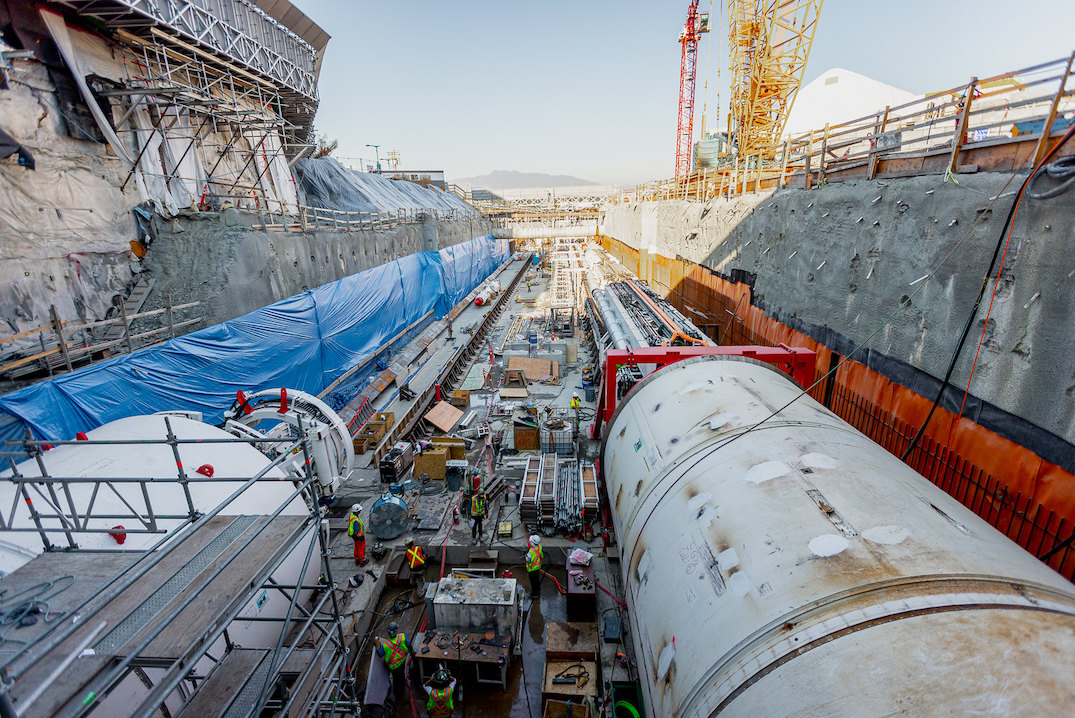




Why all the hype and hoopla?
We’re about 9 -14 months open to the public. Just starting the testing phase. Provinces provided access to businesses up to the customer visiting the business. If not competitive or offering unique items go bankrupt.
But, what about the costs?
Monthly update on their website on progress of BSP: https://www.broadwaysubway.ca/news-information/monthly-status-reports/
April 2026 spent: $2.215 B out $2.97 B
Sky Train Expansion Program($1.7B) is Modernized, integrating MK5 Train and capability expanding OCC2. Program entailed: Platform extensions, add emergency exit capacity, replacing fiber optic lines, upgrade communications, OMC1 upgrades, new trains, new maintenance shop and maintenance vehicles.
Small portion $1.7B go to Thales has 5 different contracts with BCRTC: OMC4, OMC5, BSP, SLS and OCC2.
2019 busiest day 99 B- Line and 9 bus ridership 90,000+ boardings. Skytrain estimates for daily ridership Monday to Friday: 120,000-140,000 +30,000-50,000 more boardings. Impossible to have the exact math on opening day ridership. A little over or it goes under the demand estimate. Only in the US and Canada, the 99B line is 1st daily bus boardings. Not combine the bus corridor with multiple lines connecting on and off of it. Low per person per vehicle with varying frequency per section like Ottawa busway.
Zwei replies: Two years ago in an international transportation magazine a CEO of Translink stated that the cost of the subway was past $3 billion. I have been told privately that the cost has surpassed $3.5 billion.
As for 90,000 boarding’s on the 99B, that works out to around 40,000 to 45,000 actual people using the bus (most customers board twice inbound and then outbound. Sorry, but you are wrong as there are several Express buses that carry higher loads. Remeber the maximum capacity of the B-99 is a mere 2,000 pphpd. Comapre that to the Pitsburgh’s Busway Network during both peaks sees 4500-4800 pass/hr/direction or the Gatineau’s Rapi-Bus Transitway which moves 4600 to 5000 pass/hr/direction in peak hours.
I don’t know who is feeding you false information, but can guess.
The bus totals Translink is using are from all bus routes that crossed the Broadway Corridor Study area, not just Broadway bound bus traffic. I know this because someone from Translink admitted that when I challenged him on the bogus busiest bus corridor on the continent statement . The truth is the current bus passenger numbers are nowhere near those 2019 levels and at least Translink admits that.
The point is that many of those bus passengers Translink thinks will be using the Broadway Skytrain won’t because if they are coming from north or south of the corridor and those existing buses will still be easier and faster, just more convienent. Legoman never underestimate how much people hate transferring from different skytrain lines and other bus routes.
That line is just too expensive and the extension to UBC will steal many of the resources that the province has for other transit projects. Even if the Feds kick in some money, it just won’t be at the level it used to be. There’s a $100 Billion + high speed line and a 5% of GDP defense budget to pay for now. The days of big multi-billion Skytrain budgets are going to be rare occurences. Most likely it will have to be mostly covered by the province. This means back to one big Skytrain project per decade, just like it used to be.
Just like I said many years ago, Skytrain is just too expensive for what it does. A Light Metro Line that moves at best, half the passenger capacity of a Montreal or Toronto Metro Line but costs 70% -80% of their building costs.
Zwei replies: And it gets worse. I have been told that Alstom and Translink have had meetings about the supply of cars and parts when Alstom has discontinued production. Can’t say too much but the gist of it is, Alstom told TransLink they will be SOL as the proprietary railway is not their product, they are not supporting the product and they had better look at converting the LIM lines to conventional trains.
The capacity will be same on both lines.
Zwei replies: Sorry no. According to Thales News Release; “When the programme is fully implemented, the Expo Line will be able to accommodate 17,500 passengers per hour per direction, and the Millennium Line will be able to handle 7500 passengers per hour per direction, a 32% and 96% increase respectively.
RftV did a post on July 8, 2022.
https://www.railforthevalley.com/latest-news/zweisystem/the-1-47-billion-solution/
You are wrong.
The Broadway subway is being designed for 5 car trains to Arbutus. At Maple street, is pictures of a 5 car train.
Millennium line already has 5 car trains to Production way station.
Zwei replies: I am not wrong, I am stating what is in Thale’s News Release of 2022, which appeared in major trade magazines around the world.
Obviously it is you who is wrong.
5-car train-sets have nothing to do with it as 80 metre long station platforms can accommodate them. It is about how many trains per hour per direction the signalling will allow.
If you have a beef, send an email to Thales and tell them that they are full of prunes.
Sorry Vancouver, the current lack of service on the existing Millennium Line is due to the same reason, the lack of capacity in the Automated operating system for the current line. It has nothing to do with train size, its primarily how many trains (with its associated passengers) per hour, per direction the line can handle, which is around 3825 to 3950 passengers per hour per direction for the Millennium Line. Hence why most of the time, they run two car trains.
Which means when the Thales system is fully installed, the Millennium line will be able to handle (7500 pass/hour/direction) or somewhere between 10 and 12 trains per hour or a 5 car train every 5 to 6 minutes, max at peak.
This is a quote from Haveacow: “Which means when the Thales system is fully installed, the Millennium line will be able to handle (7500 pass/hour/direction) or somewhere between 10 and 12 trains per hour or a 5 car train every 5 to 6 minutes, max at peak.” It is obvious that the Millennium line is going to run longer trains than it currently does but it makes no sense to reduce its frequency. Currently the Millennium line runs trains at a frequency of 3-4 minutes during peak hours, it makes no sense to reduce frequency to every 5-6 minutes during peak hours even with larger trains. The combination of larger trains along with its current frequency will lead to higher capacity than 7500 passengers per hour/per direction. If an upgraded signalling system has any significant impact on train frequency on the Millennium line it will likely lead to more frequent service during peak hours, perhaps every 2-3 minutes.
Zwei replies: When in doubt, read the News Release!
“control contracts
Contracts enable a 22km extension of the fully automated SkyTrain system.
TransLink awards Thales SkyTrain train control contracts – International Railway Journal (railjournal.com)
TransLink has awarded two contracts to Thales for upgrading the train control technology on the Expo and Millennium lines of Metro Vancouver.
TRANSLINK has awarded Thales two contracts to provide train control technology under the Expo and Millennium Line Upgrade Programme for the SkyTrain network in Vancouver.
The contracts include a new Operations Control Centre and a new fully automated depot, Operations Maintenance Centre 4. These two new facilities are key components of the upgrade programme.
The system will be expanded from 80km to 106km by 2028, with 41 new trains expected to be in service by the end of 2027.
TransLink says that in 2018 the Expo and Millennium lines saw on-time performance of 96.38% – the best punctuality on record for SkyTrain and higher than that achieved by most major metros in North America.
The government of Canada, the government of British Columbia, and the region have committed to investing $C 1.47bn ($US 1.1bn) in the Expo and Millennium Line Upgrade Programme until 2027.
When the programme is fully implemented, the Expo Line will be able to accommodate 17,500 passengers per hour per direction, and the Millennium Line will be able to handle 7500 passengers per hour per direction, a 32% and 96% increase respectively.”
This news relase was before Translink knew they were recieving the 5-car Innovia 300 train-sets, as they thought they were getting Innovia 200 cars. The Innovia 5-car train-sets are proving to be more expensive than what Translink budgeted for.
1. The problem is your getting too caught up in the numbers. Considereing the current operating frequency on the Millennium Line involves 2 car trains with 3-4 minute service at peak and frequency drop offs to 7-8 minutes in the evening, I don’t see a great frequency increase once you have the Mk. 5 units operating there, even with the improved signalling system which by the way, guides the Skytrain’s automation system. If this wasn’t the case the Millennium Line would have had a much bigger number attached to it in the Thales advertisement. This was obviously not corrected by Translink, regardless of when the actual adoption of 5 section Skytrains was actually done (probably a year before any announcement to the public). So this is what Translink can most likely afford to do.
2. Whether it is 7500, 10000 or 50,000 pasengers per hour per direction, you have to realize that anything near 85% – 90% of that threshold starts loosing you customers because its uncomfortable to be in those trains. The customers you loose are the choice riders. The ones who are captive riders and have no choice, have been long forgotten by Translink. I will use the new Langley extension as an example.
If you are a captive rider on the new extension to Langley then most likely your Expo Line train trips from Langley to any of the most likely end points (mathematically), during the morning peak period means you have a 47 to 1 hour+ long trip on just the Expo Line, regardless of earlier or later transfers to other transit vehicles. That isn’t going to get choice ridrs out of their cars. Especially, like the point I made with the Millennium Line, if it is above 85% – 90% capacity. A new idea and a cheaper one is needed, now.
The unfortunate thing is that, although the Mk. 5 trains are bigger they still don’t have that many seats. Its mostly extra standing room, big mistake, if you are trying to lure people away from cars.
Zwei Replies: I wasn’t going to get into the “seat” debate but you are correct about that. TransLink has always played the numbers game because it sounds good for the FOX Entertainment North Lot in our local media.
In recent conversation with a now retired Translink type (we have coffee at the local coffee bean) there is panic in TransLink’s and metro Vancouver’s Ivory towers because ridership is nosediving. Evidently the “ship of fools” other wise known as the Mayors Council on Transit has OK’ed hiring YouTube influencers to sell the system. Except for key routes, ridership is dropping (as per the last post on the blog) and there is a corresponding uptick in auto use.
Of great concern is the Broadway subway because there is zero funding to extend it and people are just beginning to ask questions about it, unpleasant questions for this falls Civic Elections.
I have been told (more than a rumour)that the full cost for the 21.7 km expansion (full program includes everything, including rehabs, cars, OMC#5 and more) is now past $17 billion and the treasury was banking on $12 to $13 billion and the provincial government is quietly cancelling major projects, especially in my local Delta.
Sadly, all was predicted a decade ago.
Just a note: Back in the day of the Expo Line planning there was a plan to have a third reverseable express track from Metro town to Broadway, but was canceled due to cost of adding a third guideway.
Zwei welcomes comments, but calling me a liar and then cut and pasting the comment using several Email accounts is just not on.
Many have taken great issue with Thales 2022 news release regarding the $1.47 billion resignalling contract.
The following is the full text of news release which appeared in several industrial magazines in North America and Europe.
****************************************************
TransLink awards Thales SkyTrain train control contracts
Contracts enable a 22km extension of the fully automated SkyTrain system.
TransLink awards Thales SkyTrain train control contracts – International Railway Journal (railjournal.com)
TransLink has awarded two contracts to Thales for upgrading the train control technology on the Expo and Millennium lines of Metro Vancouver.
TRANSLINK has awarded Thales two contracts to provide train control technology under the Expo and Millennium Line Upgrade Programme for the SkyTrain network in Vancouver.
The contracts include a new Operations Control Centre and a new fully automated depot, Operations Maintenance Centre 4. These two new facilities are key components of the upgrade programme.
The system will be expanded from 80km to 106km by 2028, with 41 new trains expected to be in service by the end of 2027.
TransLink says that in 2018 the Expo and Millennium lines saw on-time performance of 96.38% – the best punctuality on record for SkyTrain and higher than that achieved by most major metros in North America.
The government of Canada, the government of British Columbia, and the region have committed to investing $C 1.47bn ($US 1.1bn) in the Expo and Millennium Line Upgrade Programme until 2027.
When the programme is fully implemented, the Expo Line will be able to accommodate 17,500 passengers per hour per direction, and the Millennium Line will be able to handle 7500 passengers per hour per direction, a 32% and 96% increase respectively.
******************************************************************
Please not the lat paragraph:
When the programme is fully implemented, the Expo Line will be able to accommodate 17,500 passengers per hour per direction, and the Millennium Line will be able to handle 7500 passengers per hour per direction, a 32% and 96% increase respectively.
If you have any issues, please contact Thales.
Mr zwei Do you understand computers and software?
CBTC is software and hardware like trains, super computers and power. Software is not the limitation that BCRTC have CBTC it’s just not having enough trans or space. Still has ongoing delays for new trans. BCRTC looks to have a mixed fleet on the Expo line and M Line for now. Mean capacity numbers will be all over the place from day to day operation.
To day operations
– Expo line: 122 sec Frequency or 30 train per hour
– M Line : 3 min frequency or 20 trains per hour.
Future operations.
– Expo line: 138 sec Frequency or 26 train per hour.
– M Line: 4 min 17 sec Frequency or 14 train per hour.
The program is talking about the capacity increase in per train capacity(Interpretation of MK5). No increase in trains per hour.
The paper came out on skytrain capacity upgrades 18 years ago.
Ongoing projects:
– OCC2: added monetary km expansion and new lines.
– OMC 4 / 5 additional storage and maintenance new equipment.
– Miscellaneous projects like: Substation upgrades/new, additional instances or exits, additional super computers.
Not started
– Columbia station redesign: to separate the Expo Line and M line only tracks.
Hopefully clarifies skytrain capacity program.
You can contact Thales., Just tell you that they got the numbers from BC Translink.
Zwei replies: Obviously you don’t have a clue how signalling works. Also, I would not trust any numbers TransLink would give and to make matters worse, evidently MK.5 trains will not operate on the Millennium Line, so an Arbutus us Tri-Cites route will be made by MK.2/3 stock not the MK.5 stock.
Thales would not announce a maximum capacity of 7,500 pphpd out of thin air, it is from the information in the contract. Do you understand contract law? Maybe not.