List of Cities, With Populations Under 100,000 Operating Trams Or Light Rail
Zwei often hears the tired old saw that “we don’t have the population for light rail or the alternative, light rail does not have the capacity to deal with traffic flows that SkyTrain can.
The “Good Burghers” in Bath England are countering this debate by actually listing 40 cities that have populations of 100,000 (with a 10% margin for error) that operate stand alone tram systems.
The below list is by no means exhaustive – as in the Belgian Coastal Tram example above, many outlying towns are connected to trams but are not listed here as it is mainly the central city listed.
Ranked by population:
| Town/City | Country | Length of system, or to nearest large tram town, km | Population | |
| 1 | Molochne | Ukraine | 1.8 | 1,000 |
| 2 | Bad Schandau | Germany | 7.9 | 4,022 |
| 3 | Trenčianske Teplice | Slovakia | 5.9 | 4,197 |
| 4 | New Addington | UK | 8 | 10,000 |
| 5 | Bex–Villars–Bretaye railway | Switzerland | 17.1 | 12,000 |
| 6 | Beckenham | uk | 10 | 45,000 |
| 7 | Gmunden | Austria | 2.3 | 13,086 |
| 8 | Sóller, Mallorca | Spain | 4.9 | 13,882 |
| 9 | Blankenberge | Belgium | 67 | 19,897 |
| 11 | Strausberg | Germany | 6.2 | 25,591 |
| 12 | Sintra | Portugal | 12.7 | 25,630 |
| 13 | Avdiivka | Ukraine | 12 | 33,311 |
| 14 | Neuchâtel | Switzerland | 8.85 | 33,565 |
| 15 | Knokke | Belgium | 67 | 34,063 |
| 16 | Volchansk | Russia | 7.6 | 36,000 |
| 17 | Valenciennes | France | 18.3 | 44,043 |
| 18 | Gotha | Germany | 25 | 44,322 |
| 19 | Poprad-Štrbské pleso & Starý Smokovec-Tatranská Lomnica | Slovakia | 35 | 52,862 |
| 20 | Frankfurt (Oder) | Germany | 19.5 | 55,400 |
| 21 | Druzhkivka | Ukraine | 9.8 | 57,517 |
| 22 | Stourbridge | UK | 1.3 | 63,000 |
| 23 | Plauen | Germany | 30.1 | 64,468 |
| 24 | Liepaja | Latvia | 6.9 | 69,180 |
| 25 | Ostende | Belgium | 67 | 70,994 |
| 26 | Kostiantynivka | Ukraine | 25.4 | 71,853 |
| 27 | Konotop | Ukraine | 13.9 | 87,099 |
| 28 | Mestre | Italy | 6.3 | 89,373 |
| 29 | Schwerin | Germany | 21 | 91,293 |
| 30 | Zwickau | Germany | 18.5 | 93,081 |
| 31 | Daugavpils | Latvia | 25 | 93,312 |
| 32 | Norrköping | Sweden | 21 | 96,658 |
| 33 | Grudziądz | Poland | 9 | 98,726 |
| 34 | Olomouc | Czech Republic | 13.6 | 100,494 |
| 35 | BATH | UK | 29 | 100,000 |
| 36 | Cottbus | Germany | 20.1 | 103,300 |
| 37 | Liberec | Czech Republic | 21.5 | 103,979 |
| 38 | Nancy | France | 11.1 | 105,162 |
| 39 | Jena | Germany | 23.7 | 105,800 |
| 40 | Caen | France | 15.7 | 106,260 |
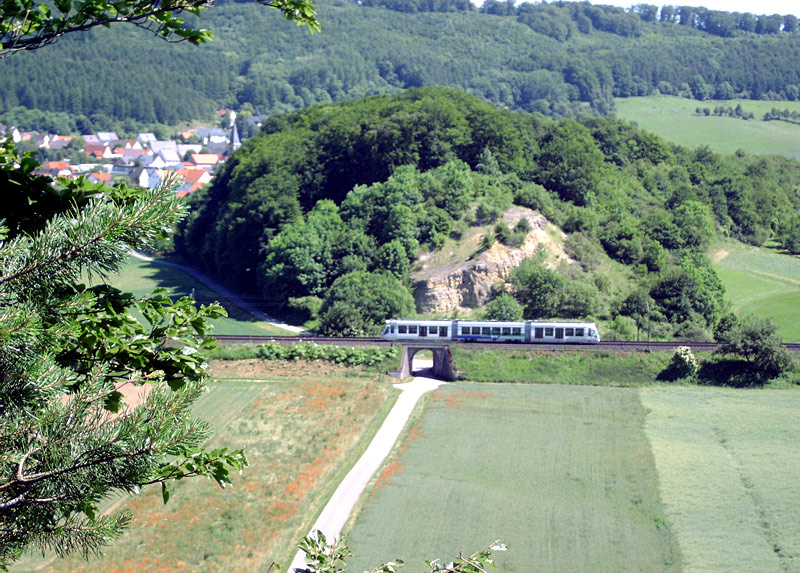
TramTrain, which is a tram, reminiscent of the interurban, so designed that it can operate on the mainline line railway, in mixed traffic, can also servcie small town on the mainline railway portion of its route very cheaply.
It is important to consider that the Vancouver metro region cannot afford to expand the SkyTrain light-metro system which base cost has now surpassed $400 million per km to build (over $700 million per km for subway construction). TramTrain and light rail can be expanded much more cheaply from costs ranging from $10 million/km to $50 million/km, depending on the quality of Right-of-Way used from track sharing with the mainline railway to operating on a dedicated R-o-W.
As a reminder, extensive viaduct or subway construction, drives up the cost and takes the “light” (light in cost) out of light rail!
Those who support continued SkyTrain expansion, must also accept a limited light metro network, ill equipped to deal with future expansion needs.



Unfortunately, number 13# on the list in Avdiivka in Ukraine has had its system pounded to dust and wreckage by Russian artillery rockets, heavy mortars and thermoberic warheads. I hope they can rebuild one day.
On a happier note, many of the towns menttioned on the list have multiple line networks. A large percentage of those multiple line communities were part of the Warsaw Pact Bloc of nations, which heavily invested what the west would call LRT much later. Many are due for vehicle replacements but soldier on with fleets that are still half late Soviet era LRV’s.
What’s amazing is the number of single line systems that have invested in modern LRV’s on this list. Many prefered new vehicles compared to outright bus replacement. Which would be easier.
I did a little quick count in 3 European countries yesterday, Italy Spain and France. Not only did I find a total of 5 French but 3 Italian and 3 Spanish communities all under 100,000. With the exception of 2, all the rest were new constructions of modern tram/LRT, by new I mean, built after 1990.
The most interesting thing I found (slightly off topic) was that France had built 9 all brand new, all after the year 2000, tram/LRT operations in communities of 100,000 – 225,000.