SkyTrain – The Multi Billion Dollar Voter Bribe
Originally posted in 2016, ten years and an estimated $16 billion later, the true costs of building SkyTrain does not resonate with our local politcans. I will add comments and give 2026 dollar figures where necessary. The graph is from Ontario’s MetroLinx, and our SkyTrain light metro system, falls in the “subway” category of 50 year costs.
Three Minutes Into The Future!
Posted by zweisystem on Tuesday, August 30, 2016
Originally published August 30, 2016

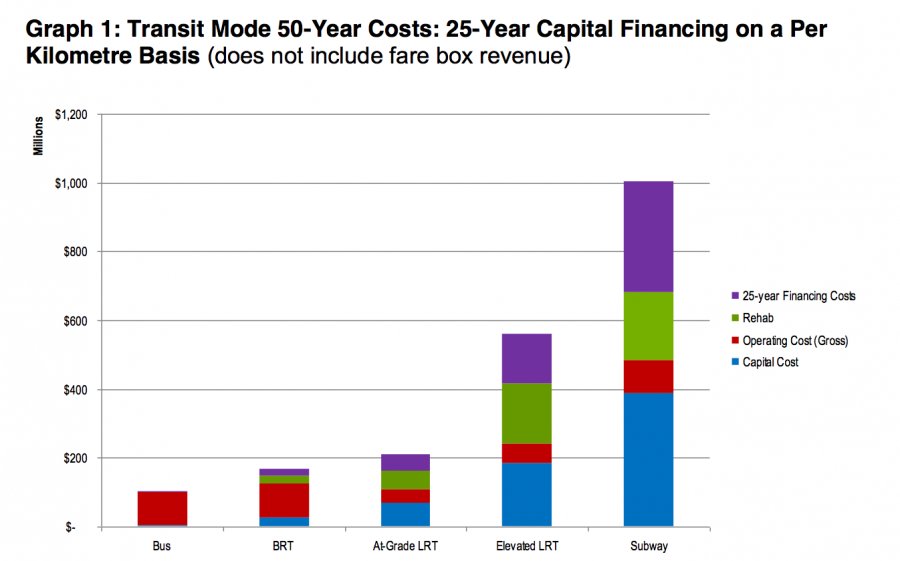
Our politcans seem to have fallen asleep in their arithmetic classes as their “back of the envelope” planning will cost both transit users and taxpayers dearly.
More wise words from Mr. ‘Haveacow’ who is an extremely experienced transit planner working on Ottawa’s new regional light rail line.
This was originally a post from the recent Calgary blog and contains a wealth of information that the powers that be don’t really want in the public realm.
Zwei replies: it is estimated that a minimum of $16 billion will be spent extending the Expo and millennium Lines a mere 21.7 km.
What this boils down to is that the Expo and Millennium Lines need a lot of investment for modernization, investment that will come from the expense of the Metro and Fraser Valley region.
As one transit expert told Zwei decades ago,”you can get any transit system to do anything you want , if you throw enough money at it.” The problem is, of course, the money thrown at the transit system generally comes from other transit projects.
This begs the question; “How much money is the taxpayer willing throw at SkyTrain”?
An Historical note: The initial ALRT line from Vancouver to New Westminster was originally designed to have a third “express line” through less well used stations, such as Royal Oak or 22nd Ave., to decrease travel time. Zwei was told by a retired GVRD planner some years ago that there were supposed to be five such stations along the route and the plan was to cut almost 10 minutes off the travel time in the peak hour, end to end. Cost constraints and signalling issues sidelined any thought of this type of operation.
Over to you, Mr. Cow!
Technically Skytrain can be expanded to do 28,000+ p/h/d. Actually any existing rapid transit system can be expanded to handle much greater passenger capacities. The real issue is how much you want to spend to do that.
Skytrain could with existing technology upgrade its signaling systems to a state of the art, high capacity multiple independent moving blocks signaling system with the newest version of Bombardier’s City Flo 650 Automation System operating as the system governor. But that’s expensive and Translink is only and very begrudgingly doing some of this, mostly because of cost issues and the time required.
Problem/Issue#1:
The electrical handling capacity of the system needs to be upgraded. Meaning, the existing electrical transformers (hidden behind the doors at nearly every station and what is mostly responsible for the mysterious size of most stations on the ground floor) needs to be upgraded in capacity or new ones have to be built and the corresponding cabling replaced, as well as the replacement of many of the system’s third rails and third rail connecting joints with each other and the cabling (can’t remember the technical name right now). Translink is trying to do this but its expensive and very time consuming however, it can easily be done at night when the system is closed and doesn’t necessarily. This is the first step in signal upgrades. Comment by Zwei: To date there has been no real hint of an electrical upgrade and now with the promised Rootin Tootin Newton extension, I would think an electrical upgrade would be mandatory. One wonders is there a budget for this or a cheap bandaid solution? Back of the envelope costing for transit promises tend to backfire on the taxpayer.
Problem/issue #2:
Next spending at a minimum of $500-700 Million ($660 to $910 million in 2026 dollars) and about 2-5 years with multiple daytime shutdowns to completely replace all the existing signaling software and hardware as well as the signals themselves. Toronto is replacing its 60 year old signaling system on line#1 (Yonge-University Spadina-York Subway Line). Its taken 4 years so far with major portions of the line getting shutdown on the weekends. This weekend its Lawrence Station to Yonge and Bloor, (the busiest stretch of rapid transit line in Canada and 2nd busiest in North America during peak hours). But it must be done to improve the lines top capacity limit and to keep the overall network in good repair. The traditional time the TTC does maintenance projects, the 6.5-7 hours a week from closing time Saturday night/Sunday morning to the traditional late start Sunday morning at 9am is just not enough time. So every weekend or at least every second weekend a section of the line is taken out of service to replace the thousands of km’s of cables and signaling infrastructure. Fall 2017 is the expected completion date.
Next, add new centre platforms to existing stations and or adding centre tracks with new passenger platforms either side and move the existing tracks to the outside wall limit which is also expanded. Except for the highest use stations, this eliminates the need to lengthen platforms and is cheaper option when dealing with an above grade rapid transit system.
Problem/Issue #3:
Man this time consuming and expensive and you really have to do step 1 and 2 first but it can work. Translink is doing a station by station approach which means it may have most of the original stations on the Expo line upgraded by 2041. Time to do all the stations depends on budgets and assuming we survive the asteroid impact we will be subject to in 2048 (I’m a back yard astronomer each time a particular well know asteroid passes by us it keeps getting closer and closer, I’m not kidding). However, after several expected close fly bys in 2020’s and 2030’s due to gravitational sheer, may change the final date or it may cause it to miss us altogether, we will see. Anyway back to point.
There are other issues such as, as your above grade Skytrain lines age, the structure between the stations will need significant structural upgrade. The longer you wait the bigger the bill. Translink has no budget or plan to deal with this issue. As we (me and employees of the company I was consulting with at the time) asked during our visit to there control centre a few years ago while we presented to the staff pieces of concrete right of way we found around Metrotown Station. What is your long term plan to deal with Expo line’s above grade structural renewal proposals we asked? Their answers were polite and diplomatic but you could tell we caught them off guard. It all depends on budgets and the availability time capital was the answer, so no plan until they have enough cash I guess.
Lastly, as any rapid transit system gets bigger and bigger, the cheap and easy to build lines will generally get built first. Each extension or new line becomes relatively speaking more and more expensive (regardless of inflation). Its not Translink’s fault this generally happens on any system, you pick the low hanging fruit first! Many of the new lines like the Millennium Line’s Broadway extension to Arbutus and eventually UBC, are very expensive (because of the tunnel) and will only produce for now and even into the future, meager passenger numbers. In my humble professional opinion, the overly optimistic predictions of Translink will never produce the numbers really needed to justify a below grade Skytrain line that costs only 20% less per km than a late, over budget, subway line in Toronto that will daily handle twice the capacity of the planned Skytrain line, using the present 60 year old signaling system not the new one which is being installed on the rest of the line and that will be ready to go when this extension is complete. All these cost predictions for the Broadway Extension are based on 6 year old planning data which needs to be seriously upgraded and will most likely go up in cost per km as well. (Comment by Zwei: The Broadway subway is now estimated to cost around $3.5 to $4 billion. The UBC subway around $8 billion)
There are very few other justifiable new line opportunities for the Skytrain System given current ridership and corridor passenger levels. There are some extensions planned or being discussed. One is the killing of the very poorly thought out LRT line in Surrey and replacing it Skytrain extension (Comment by Zwei: Well TransLink and the Provincial NDP killed off the planned light rail in 2017 and replaced it with the now $7 billion plus Langley extension (guideway only). One cannot, but opine that the surrey LRT was so designed to get cancelled in favour of more SkyTrain) but it brings about another issue that is not thought about in Vancouver yet but Toronto and Montreal have been facing for a while, that is the geographic scale of the service area. You can extend the Skytrain in Surrey but even Skytrain’s for Surrey, “Daryl”, missed this little issue. If you build the extension of the Skytrain as designed by Translink and Daryl you will have to sit for an hour just to get to the other side of the line, which is downtown. This still seems to be the largest passenger destination for the system. It will take an hour because of all the other existing stops you already have in between Surrey Skytrain extension and downtown Vancouver. You could have a local/ express train system operation but unless track infrastructure is severely upgraded, it just can’t happen. So a change in operational technology is needed, more commuter rail/regional rail or Zwei’s Tram Trains operation. Both Toronto and Montreal learned a long time ago you can’t extend subway/metro lines outward until they are 30-40 miles long its just too expensive to build and operate. Not to mention there would be just too many stations stops between where people want to go and where they will be getting on. Adding express services is expensive and difficult and ultimately lowers capacity. Even heavier capacity LRT lines have a distance/travel time limit. So soon a new form of longer distance rapid transit will be needed for Vancouver’s outer areas you can’t keep building Skytrain further and further out its also way too expensive to build and you still suffer the distance/time penalty for potential passenger numbers. So yes a change in rapid transit operating technology, due to the geographic operating scale, for the outer portions of your region is most likely imminent.
Final comment by Zwei: Both provincial and civic politcans have shown that they do not give a damn about the cost of SkyTrain, or the taxpayer as SkyTrain is built to win elections and the cost be damned, “we will just raise taxes on the rubes, they were the suckers that voted for this”.



Ten years ago… and how little has changed (except for incumbents defeated a week ago… and more to come tonight)!
From the ‘urbanist lens’ we see the Skytrains running hot in urban footprint (which is basically where the Skytrains operate). When Translink was formed, and Vancouver councillor George Puil was its first chairman, a deal was struck that all future skytrain expansions in Vancouver would be ‘in a tunnel.’
The problem there is that tunnels cost more than guideways which cost less than on-street operation with signal priority on medians. And there is one incontrovertible law in transit: more cost, less route.
The other problem is that the Skytrains are being run hot, so that the screeching the additional speed creates on the guideways exceeds WHO standards for residential neighborhoods or ‘urban footprint.’ Fine out in the farms and fields. Slower in town.
Forty years later, and with just 79.6 km of system built, we have the answer for the Housing Crisis staring us in the face: the Skytrain is too costly to get people where the NEED to go: into the periphery to find cheap land to build affordable houses.
That’s what I see when I look through the urbanist lens: a housing crisis created by government by building a compressive Skytrain technology rather than an expansive modern Tram one.
I am tickled pink by Surrey politicians waving the flag that “Surrey will surpass Vancouver.” Sure—in population, but not GDP. Vancouver will remain the “capital” of the lower mainland in that sense. Thus building out Surrey with Skytrain-and-Towers will. simply make a big slum. More local policing for sure.
And I am eagerly awaiting for the transit wonks to finally make the crucial connection: after 40 years of building the wrong technology, and spending like drunk sailors (draining the coffers for highway system upgrades, including HOV lanes, etc., not every trip will be on transit), there is a new imperative to build transit:
To deliver GAhP (guaranteed affordable houses in perpetuity) for all Canadians. Access to land in our amazing nordic geography is a tram-train opportunity first.
From the urbanist perspective, transit used to be about ‘getting people out of their cars’ to avoid gridlock and reduce pollution.
No more. It’s now about guaranteeing affordable houses to all Canadians in perpetuity.
That requires switching to a different technology capable of accessing the peripheral areas where the Skytrain will never go (at least not in time to save the economy and the middle class).
If we keep building the Skytrain-and-Towers what we are really building is a British Colombia.
The 10-year-old graph still tells the same story, and Transport Canada needs to get in the game of reporting costs bi-annually to keep the various Canadian transit operators on the up and up.
Reach, cost and capacity have kept the Skytrain in the ‘People Mover’ orbit. Reach (total corridor) is directly related to cost. Thus, by overspending on Skytrain, government has delivered just 79.6 km of Skytrain over the first 40 years. 2 km of service added per year is enough to keep the housing crisis raging out of control. A crisis 100% government made.
However, when it comes to capacity, new systems are challenging the traditional assumption that LRT tops out at 30,000 pphpd and subways at 40,000.
The first stop in this examination has nothing to do with the transit technology per se. Rather, it is a practical limit. Last I rode the Montreal subway, for example, I noted how the units of exit (street doors, corridor widths, escalators and elevators) did not appear to support heavy increases in transit capacity. Dido for platforms. In other words, handling more passenger throughput by adding cars rather than trains must be ruled out on most subways due to the cost of enlarging not trains, but platforms and stations.
That is not a technology issue, it is a concrete and steel issue. And it haunts all elevated and tunnel systems. Not from the technology side, but from the ‘architectural’ side of the coin.
On elevated systems like the Skytrain, adding cars was ruled out in 1980 at the time of system design. The elevated guideways were sized in 1980 according to 1980 train mass. Finished, caput. Adding cars in excess of 1980 design train mass would require beefing up elevated guideways, lengthening platforms, and likely adding units of exit to all stations.
Cheaper—and better—to build a new on-street line.
Surface systems have none such worries. The caution here is with ‘over-long trains.’ However, in Edmonton, the Valley Line—operating on transit medians—makes T-intersections of neighborhood streets but not arterials. The result? Calm neighborhood streets!; the possibility of supporting longer trains in the future; and neighborhood revitalization.
Urbanists prefer on-street technologies to tunnels and guideways because on top of providing better service, building on-street modern Tram revitalizes neighborhoods and helps to calm streets.
The handle on Capacity, starts at comparing vehicle widths: Rotem cars are 3.0m wide; ION 2.65; Skytrain 2.49. That is a 20% capacity advantage for Canada Line (a conventional electric railway). ION only realizes a 6% space advantage, but I can see that changing.
For cost, consider that surface transit is so much cheaper, that adding capacity in urban footprint can simply be done by adding a new line.
Contrast the difference of adding a new line to the new Surrey mayor’s proposal to send Skytrain to Newton via an already full Expo Line.
At peak, passengers loading at Newton will take away space from passengers already loading at King George. Thus, the new mayor’s proposal adds NO NET CAPACITY TO SURREY TRANSIT. It merely rearranges the deck chairs.
Beyond the expense of ‘expanding’ a network that is already full, we will have the following interlining scheme for the Expo Line once a Newton branch is operational (pphpd/gross):
6,375 – Newtown spur (every six minutes)
6,375 – Langley extension (every six minutes)
19,125 – King George (1.5 to 3 minutes)
6,375 – Arbutus-Waterfront (the ‘long one’ trains travelling on both levels of Commercial-Broadway every six minutes, reaching New West, but never crossing the Fraser)
Standing on a inbound platform at King George station, the first train arrives with Langley passengers on board, the second arrives with Newton passengers, with only the last of the three trains short-turning at King George and arriving empty. The fourth line on the Expo corridor never crosses the Fraser.
It will be simpler, far less expensive, and will add multiples more capacity to Surrey transit for the Newton service to ride on grade on the extant BCER ROW.