Trams Having Limited Capacity? – SURELY NOT!
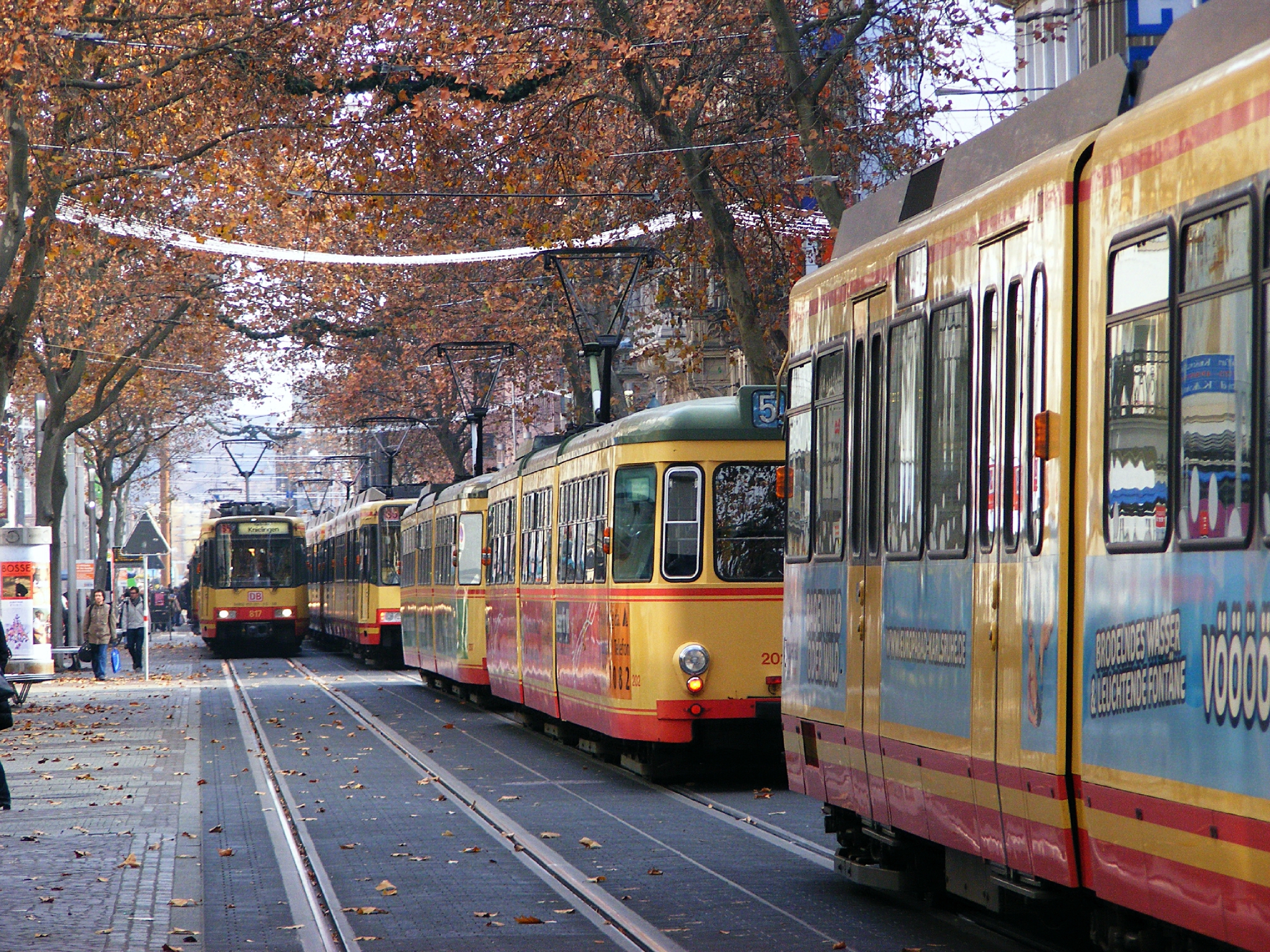
The “gelb wand” (yellow wall) of trams in Karlsruhe Germany
With the the Province; the City of Vancouver and TransLink continued selling big porkies about LRT, the following will be enlightening!
The ongoing planning and construction charade currently being played out by the usual suspects including cities of Vancouver & Surrey, TransLink and the provincial Minister of Transportation that the SkyTrain Light Metro System has shorter headway than light rail!
According to Thales’s 2022 news release, the Millennium Line (Broadway Subway) will only be signaled to allow a maximum capacity of only 7,500 pphpd, instantly puts a lie to these claims. Strange then Toronto’s TTC were obtaining capacities in excess of 12,000 pphpd on select tram/streetcar routes in the late 1940’s and early 1950’s.
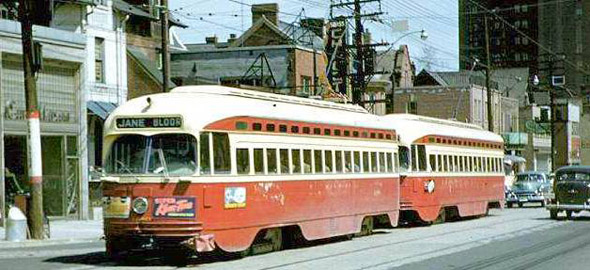
Couples sets of PCC cars, Toronto 1940’s
The following is an email from a transit engineer from Germany answering my questions regarding tram headway’s and capacity (Capacity is a function of headway). He is answering questions that were put to me by several local politicians claiming that LRT cannot obtain the same headway’s as SkyTrain. Remember the Millennium Line, after the $1.47 billion rehab by Thales, will only have a maximum capacity of 7,500 pphpd!
One should compare the maximum of 10 to 12 trains an hour on the Millennium Line after resignalling, with Leipzig’s 40 trains per hour or Prague’s 45 trains per hour in the peak hours!
Question: It is not possible to operate 36 trains per hour as traffic signals will hold them back.
Answer: That’s the whole point of traffic light pre-emption. Which does not *increase* the green phase for streetcars, but *shift* it in time. So automobile traffic does not wait longer, it’s just different drivers who
wait, statistically.
If there’s no significant automobile traffic parallel to the streetcar/light rail tracks (as typically the case in those “transit
malls”), you can even dynamically reduce the green phase for the trains to the strict minimum required to clear the crossing (less than ten seconds, even for a four-car set), which will actually *increase* the green phase for crossing automobile traffic.
Right here next door, Leipzig is easily running 40 trains per hour on sections shared by several routes. And the infrastructure is not nearly at capacity, neither concerning trainset length (platform length would allow 60m instead of 42m), nor concerning frequency. Other operators do as well or even better. Karlsruhe’s 80 trains per hour are running through a pedestrian street. Calgary’s transit mall preciselyseems to suffer from a lack of traffic light pre-emption, judging form the videos.
Another example, from Czechia, the streetcar at Prague. The sectio from Karlovo Namesti east to I.P.Pavolova carries the routes
4: 8 min 7.5 trains/h
6: 8 min 7.5 trains/h
10: 8 min 7.5 trains/h
16: 8 min 7.5 trains/h
22: 4 min 15 trains/h
That’s 45 trains per hour.
The tracks from Karlovo Namesti to the north carry the routes
3: 4 min 15 trains/h
6: 8 min 7.5 trains/h
14: 8 min 7.5 trains/h
18: 8 min 7.5 trains/h
22: 4 min 15 trains/h
24: 8 min 7.5 trains/h
That’s 60 trains per hour.
The tracks from Karlovo Namesti to the south carry the routes
3: 4 min 15 trains/h
4: 8 min 7.5 trains/h
10: 8 min 7.5 trains/h
14: 8 min 7.5 trains/h
16: 8 min 7.5 trains/h
18: 8 min 7.5 trains/h
24: 8 min 7.5 trains/h
That’s 45 trains per hour as well.
All figures given are for the morning peak. There are various other networks in Europe that have similarly dense operation on sections shared by several routes. 40 trains/h is not uncommon.
Question: with a subway, 31 trains are possible per hour with 14,640 passengers.
Answwer: Boston’s green line is running 40 trains per hour, 90 second frequency. Onsight in the tunnel, without ATC. Four branches, six minutes frequencyeach. They are running four-car trainsets for events so the platforms would be long enough.