The Broadway Transit Debate Continues. Has The Decision To Build A SkyTrain Subway Been Already Made For 2030?
Well, it seems TransLink is again having more public consultations for the proposed Broadway Rapid Transit project, but has the decision to build a subway been already made? Just the name, "Rapid Transit", means a metro and any reference to a light rail option is equated to a slow streetcar. TransLink hasn't a clue about modern light rail, nor its application or operating parameters, which is lost on Vancouver politicians, who want another politically prestigious, yet extremely expensive subway.

Will the spectre of the Cambie St. cut-and-cover subway debacle loom over Broadway merchants?
Bored tunnel, with costs exceeding $250 million/km. to build, coupled with tight funding, means that a cut-and-cover subway option will raise its ugly head again. With the debacle on Cambie St. Canada Line cut-and-cover subway fresh in their minds, merchants and other businesses along Broadway must have more than that 'uneasy' feeling every time they hear the phrase, "Broadway Rapid Transit Project." Cut and cover construction along Broadway is a real threat because it is much cheaper than a bored tunnel and TransLink is unique in the world, by not paying compensation to those whose businesses which are destroyed by cut and cover subway construction.

A simple reserved R-o-W on a raised median, accessible by emergency vehicles. in Portland Ore.
What of course TransLink doesn't tell the public is that a light rail line, operating on a reserved rights-of-way (reserved for the exclusive use of LRT), will carry as many passengers or more (surface transit tends to attract more ridership) as a SkyTrain light-metro, at a commercial speed comparable to SkyTrain at a cost up to one tenth less of that of SkyTrain!
The following document for the proposed Copenhagen LRT……..
http://www.letbaner.dk/docs/Radiallinie-folder3.3-uk.pdf
……..shows that for the cost of one metro (subway) line, one could build up to six light rail lines! Both metro and LRT has about the same capacity, with LRT being 30% faster than the bus and a metro a mere 2% faster than light rail! What is more interesting is that the proposed LRT for Copenhagen would reduce auto traffic by 20% to 25%, while a metro would would reduce auto traffic barely 1%!
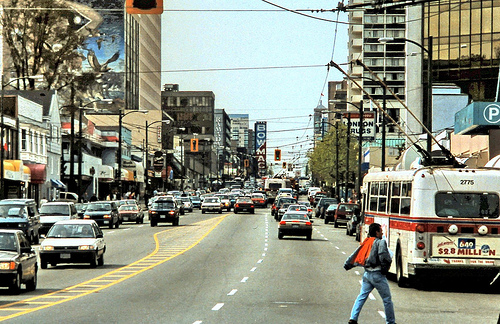
A surface light rail line along Broadway would reduce auto congestion, greatly increase the capacity
of the street while keeping all important vehicular access to merchants along Broadway.
Sadly, TransLink is out of its depth when it comes to light rail, or modern public transit philosophy and still believes that a SkyTrain subway is the only way to go. Sad that, as a Broadway SkyTrain subway maybe the straw that breaks the camels back, leading South Fraser municipalities to reject TransLink and secede from organization.
What is more important, there is no money for any 'rail' transit expansion in the region, which begs the question; "Why is TransLink wasting money for transit planning that will not happen for decades?" Could it be that this so called public consultation process nothing more than a make work project for under employees TransLink employees?



seriously what a load of [Edited for taste]. I laughed when I saw this: “A surface light rail line along Broadway would reduce auto congestion, greatly increase the capacity of the street while keeping all important vehicular access to merchants along Broadway.”
good luck, zwei, good luck.
Again, a new hotmail address, but the same old anti-LRT nonsense. Have you ever read a book on the subject? Can you even read? Did you have someone post this for you?
That’s the biggest problem with you Wow, the Translink/Skytrain children and the population of Canada in general – you are still wedded to the automobile and whatever form of transit is designed it must not interfere with traffic flows. One in three Canadians are clinically obese because they drive everywhere, will not walk, take exercise or travel by public transit.
The argument in favour of Skytrain was to elevate the line so it wouldn’t impede traffic flow and, most important for the government of the day, there would be no personnel required to run the trains and therefore they would not have to deal with labour laws, wage negotiations and perhaps a strike or two. The unions were in opposition to the SoCred government of the day. So they went with the most expensive option. Now we’re all paying through the nose.