BRT- “just like light rail only cheaper” – NOT!
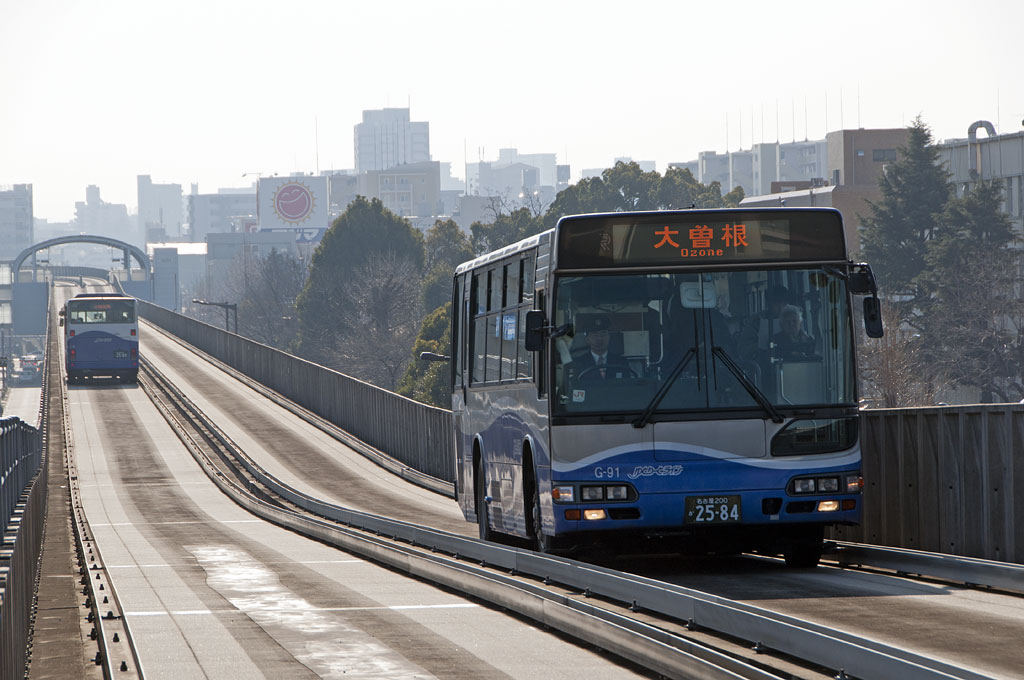
For Bus Rapid Transit, to be real BRT is must either have its own road or busway or it must be guided, using an exclusive guideway. Express buses, which operate in mixed traffic, with autos and commercial vehicles suffer the same issues as streetcars only slightly worse. Streetcars are cheaper to operate.
In the UK, transit officials in Cambridgeshire were persuaded by the BRT Lobby to build a BRT line instead of using rail on an abandoned railway formation.
First touted to be cheaper than rail, the Cambridgeshire busway is now looking like becoming a money pit, compared with rail.
What should be remembered is that when politicians and bureaucrats start touting BRT as a “rapid transit solution“, one should consider that what is being offered is a very expensive pig in a poke.
ai???Deterioratingai??i?? Cambridgeshire guided busway may need to be ripped up
10 April 2015

Guided bus,
The guided busway may need to be ripped up and re-done, a county council official has warned.
The busway, which runs between Cambridge and Huntingdon, has had 11 million passengers since it opened four years ago, but it has been plagued with defects.
A technical report six months ago said the busway, which was built by contractor BAM Nuttall, had A?31 million worth of defects – in some places the track has risen four inches – which need to be addressed to tackle the ai???deterioratingai??? ride quality.
Next weekend, the section from Addenbrookesai??i??s Hospital to Trumpington will be shut for maintenance.
Speaking to BBC Radio Cambridgeshire, Bob Menzies, service director for strategy and development at Cambridgeshire County Council, said they may be forced to put rubber pads under every beam of the track.
ai???The ride quality has deteriorated since it opened, and the joints are moving. The last thing we want to do is to have to do this work. But on the other hand we have to make sure itai??i??s maintained and kept safe,ai??? he said.
ai???Itai??i??s a real shame we have this problem, that weai??i??re having to close it over a weekend, having to divert the buses round, and we many have to do more of this in the future.
ai???Our expertsai??i?? view is that eventually weai??i??ll need to fix it all. And itai??i??s a real shame.
ai???If we (the county council) have to weai??i??ll lift every beam up and put these rubber pads back under each one of them as they should have been done properly in the first place.ai???
Replacing beams cost several thousand pounds at a time, so replacing 6 million joints could add up to a ai???very big figureai???, Mr Menzies admitted.
The council has already spent A?1 million on legal action against Bam Nuttall in a bid to get them to take responsibility over the repairs, Mr Menzies added.
He said: ai???What we believe should happen is Bam Nuttall should come back and fix it all, and get the ride quality back to where it should have been.
ai???Theyai??i??re quite clearly defects. It quite clearly doesnai??i??t comply with the terms of the contract. Iai??i??m absolutely clear about that, and so are our lawyers. Thereai??i??s six thousand joints along the busway – that could add up to a very big figure if you have to fix every one over the course of a number of years. Thatai??i??s why weai??i??re taking legal action against Bam Nuttall.
ai???Iai??i??d like Bam Nuttall to come clean and accept their responsibilities. But I suspect it wonai??i??t. In effect it will take a lot longer than that, knowing the previous history.ai???
FACTFILE
The initial contract between Cambridgeshire County Council and BAM Nuttall was for 130 weeks of work, with the completion date on February 27, 2009.
But the busway construction was not completed until April 2011 and not open for use until August of that year as the council raised concerns about defects along the guideway.
The council instigated the review into the contract after the project ran into problems and delays, resulting in BAM Nuttall, repaying A?33million of the A?147m costs to settle a long-running dispute about who should pay for the overspend for the concrete route.
The report found BAM Nuttall did not think the design was as complete as it expected it to be when the contract was awarded.
Involving a consultant to review the design was not value for money and removed responsibility from the contractorai??i??s designer, the report added.



BRT = stupid = always.
Oh it can be quite effective but you have to actually want to run a BRT system not a rail line with buses, this is the first big planning/design mistake IMHO.
If I appear to be giving quick curt responses its because I am currently trying to fake interest in my daughter’s Sunday morning ballet class. I am quite sure that someday she will be a fine dancer but its a long painful process. Her partial black eye is testimony to this point. A collision between her and her younger brother at home while she was practicing and he was playing, both blissfully unaware of each other.
The Cambridgeshire BRT has been a project I have gleefully followed from the beginning. This is the classic example of what happens when a technology is chosen far to early in the design and planning process. The technology begins to drive the process not the other way around. This is also what happens when one starts to think that certain design constraints can be solved by just a single technology. For example, they could have had just a standard 2 lane Busway costing somewhere between 50-60 million pounds plus the cost of wiping out the seriously out of date right of way. The cost of really eliminating the railway right of way design constraints for a standard busway was thought to be so high that, (though they realized too late that it really would not have been) it forced the adoption of guided bus technology. The unusual technology began to take over the engineering process and the capital costs soared. It didn’t matter that, the technology like the concrete beams had to be produced locally in a classic government make work project that was really only viable as long as you needed to make concrete beams for this project, because no one else was buying this turkey system!
You had local politics and railway people saying that the line should have stayed a rail line, me included. Unfortunately, after looking at the raw data, there was really no way a new rail line could be built there for less than 300 million pounds at the time. A diesel LRT line was not looked at favorably because had a rail line actually been rebuilt there the main line railways wanted to use it as a branch for main line trains to leave the east coast mainline to cut through to the central midlands mainline. This would make operating an LRT service difficult, not impossible but difficult. A DMU operating like a diesel LRT was also considered but could only operate at one train every 15 minutes per direction, a big loser when considered that buses were planned to operate 5-8 minute frequencies per direction. Tram-Train unfortunately was outright dropped because of the same mainline scheduling difficulties.
So even I had to admit that a bus based system was probably the best option given the low area population 800,000 (535,000 in Cambridge alone). The main draw was towards Cambridge in the mourning and way from it during the evening. The non peak travel would mirror this at much lower passenger and service levels. The local Cambridgeshire government despite it being associated with a world famous university, was not a rich one and there was no local desire to spend more money. The local highway, the overcrowded A14 is overcrowded because it is only 2 lanes wide and any significant widening was going to cost 300-500 Million pounds at the minimum an also not a preferred option.
So the Guided BRT was a cock up right from the beginning and no one, including me who had been following this story really expected anything more than this result. The fact that it continues shows how just invested/wrapped up/trapped the local PTB’s are in this project.