Battery Trains For “Rail for the Valley”?
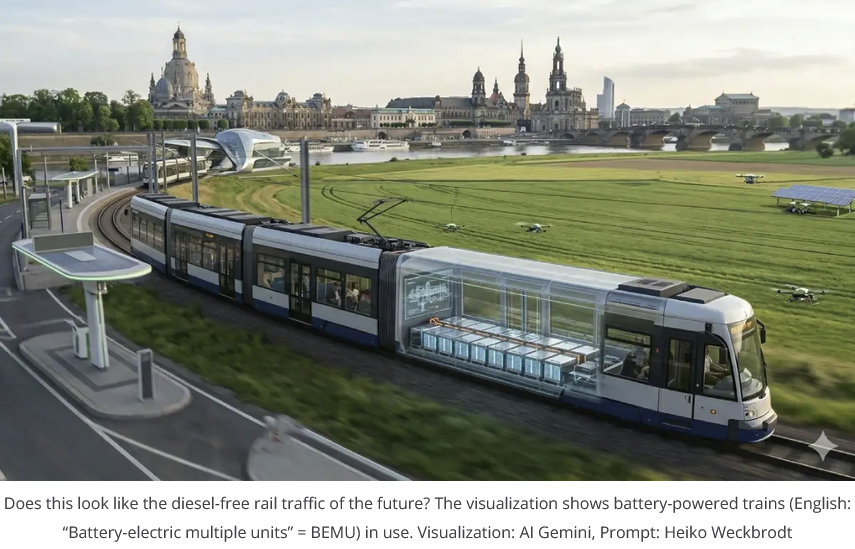
Battery trains have been around a long time.
In New Zealand, a battery-electric Edison railcar with a range of 160 km (99 mi) operated from 1926 to 1934 on the 34 km (21 mi) long Little River Branch line. The Drumm nickel-zinc battery was used on four 2-car sets between 1932 and 1949 on the Harcourt Street Line in Ireland. British Railways used lead-acid batteries in a British Rail BEMU from 1958 to 1966 on the 38 mile long Aberdeen to Ballater line in Scotland. The BEMU was a success, but decommissioned as the line was closed.
Battery trains are more expensive than diesel trains or overhead line electric vehicles
Although battery trains are considered to be more environmentally friendly than, for example, diesel railways, are significantly more expensive to purchase than diesel multiple units or pure electric multiple units – precisely because they have heavy and large batteries on board. On average, investments of around CAD $256,600 per train meter are to be expected, while standard electric multiple units cost about CAD $120,300 to CAD $160,300 per meter. A battery train with a usual length costs about CAD $$10.4 million according to “German Aerospace Centre”. “Diesel-powered trains (DMU) and overhead line multiple units (EMU) with the same seat capacity” cost about CAD $6.4 to CAD $8 million. For small batteries – such as those that are sufficient on routes that have partial overhead lines – “the additional costs of a BEMU are likely to be rather low compared to a pure overhead line train, however, required infrastructure costs for recharging must be included.
The running costs depend on the current electricity prices, which are currently below the diesel prices – but are still very high in international comparison in Germany. The batteries are usually recharged both at charging stations and on the contact wire, as far as it is applied.
The CAF trains are the latest example of the ongoing evolution of the Battery train and certainly the range fits well with both the Rail for the Valley Marpole to Chilliwack modern interurban servcie and the restatement of passenger servcie on the E&N.
CAF battery train achieves 273 km in test runs ahead of German deployment
By Railway Gazette International | September 2 2026

GERMANY: CAF has demonstrated a battery-only range of 273 km with its Class 557 BEMU. The manufacturer hopes that this will enable the production fleet to run further than they will typically need to without overhead power on the Niederrhein-Münsterland network.
CAF announced in late August that its Class 557 battery-electric multiple unit had achieved a range of 273 km during testing at the Siemens Mobility-owned test circuit at Wildenrath in the northwest of the country. The Civity BEMU, equipped with lithium-titanate-oxide batteries, operated entirely on battery power during the trials. The result is around 24% above the 220 km range specified by Verkehrsverbund Rhein-Ruhr for the batch of trains it has ordered for RE10 and RB37 services.
The 220 km requirement applies to the longest sections that the trains are expected to cover on battery power, with a 10 min recharge permitted after 110 km. On RE10, which runs from Kleve through Krefeld to Düsseldorf, the approximately 65 km section between Krefeld and Kleve is non-electrified; an overhead charging facility is being provided at Kleve to supplement the batteries. Other services require battery ranges of 90 km or 65 km, depending on the operating diagram.
VRR and Zweckverband Nahverkehr Westfalen-Lippe ordered 63 Civity BEMUs from CAF in 2021, comprising 15 short units of 45 m in length and 48 long units of 55 m. CAF is also responsible for maintenance for 30 years. NWL subsequently ordered a further 10 trains for routes RB68 and RB76, with later additions taking the fleet to 76, including 15 short and 61 long units, making this Germany’s largest BEMU procurement to date.
Delayed entry
The trains were originally due to begin entering service in 2025, but the programme has since been pushed back. The first Class 557s are now scheduled to enter passenger service in December 2027, with the rollout continuing in stages until December 2029. The revised programme followed a decision by CAF, VRR and NWL to equip all 76 trains so that their traction batteries can also be charged from a 400 V low-voltage supply while stabled, reducing their dependence on overhead charging infrastructure.
Alongside the range test, CAF has assessed traction performance under extreme operating conditions and collected data on energy management, vehicle control and battery behaviour, which will be compared with the simulation models used during the design phase.
A battery-electric Class 557 multiple unit will be exhibited at InnoTrans 2026 in Berlin, where CAF says it will be presented to the international rail industry for the first time.