BCIT to UBC and Picnics in the Park, by tram
First published in 2009. Updated 2014.
A Wee Bit Of Local History
In early 1996, during BC Transitai??i??s meaningless public consultation period for the Broadway Lougheed Rapid Transit Project which later morphed into the Millennium Line, Zweisystem received a phone call from an European Transit specialist, who worked for Asea Brown Boverai (later absorbed by Bombardier Inc.) regarding the project.
The European transit specialist, wanting to make contact with those planning for light-rail, had phoned BC Transit to arrange a meeting regarding the then proposed Broadway/LougheedAi?? LRT project and was given Zweiai??i??s phone number instead!
After his initial shock and displeasure being fobbed-off by BC Transit, the transit specialist entered into a long conversation with me on transit issues in the region and how modern light rail could help solve them. To make a long story short, he proposed a classic European style tramway for Broadway, with stops every 500m to 600m, going from BCIT to UBC, replacing all Broadway bus services and a second line via Main Street, Hastings St. to Stanley Park, that, he claimed would double present bus ridership on the two routes within two years, providing enough fare revenue for the tram to operate without any subsidy, with fares covering not only operating costs but debt servicing costs as well. By doing so, a private company could build and operate the light rail line at no cost to the taxpayer.
The rest is history as they say and the SkyTrain Millennium Line was built instead and is subsidized by over $80 million annually!
The Light Rail Committee Proposes the BCIT to UBC and Stanley Park Light Rail Project.
In late 1996 the Light Rail Committee (now defunct) proposed a bold Broadway light rail plan: a tram/light rail line from BCIT to UBC via the Lougheed Hwy., Broadway, 10th Ave. and University Blvd. with a second line via Main street to Hastings Street to the Aquarium in Stanley Park. The plan consisted of lawned reserved rights-of-ways and on-street running; priority signaling on traffic calmed Broadway and Hastings Streets; tram/streetcar stops every 500 metres; a single track Vancouver General Hospital Loop via Fraser St., 10th Ave. and Cambie St., providing front door service to the hospital.
Commercial speed would be about 20 kph to 25 kph (depending on the number or tram-stops per km.) and the construction costs in the region of $25 million/km to $35 million/km; maximum hourly capacity 18,000 to 20,000 persons per hour per direction using modern low-floor trams.
Signaling would be line of sight with intersections and switches protected by local signaling. Headway’s could be as low as 60 seconds in peak hours.
What the LRCai??i??s plan would do is service many important transit destinations (UBC, BCIT, VGH, downtown Vancouver, Stanley Park, etc.), while providing economy of operation by replacing all bus services on Broadway and many in Vancouver, thus reducing operating costs by about half. Further economies are made by using existing masts and span wires along the proposed transit routes. The new LRT would be merely seen as the reinstatement of ai???railai??i?? service by modern streetcars, operating on 21st century rights-of-ways.
The concept of a private operator, by securing financingAi?? to build the line at no or little cost to the taxpayer must be looked at by politicians. This type of P-3, not to be confused with the Canada Line scam, would see little or no subsides from government, unlike the Canada line which in 2012 TransLink paid the SNC Lavalin lead consortium operating the mini-metro line $145 million!
The plan would reduce Broadway to one lane of traffic in each direction (passive traffic calming) except in areas of mixed operation, while keeping the all important on-street parking for local merchants. The plan would have offered a minimum of five transit routes: BCIT to UBC; BCIT to Stanley Park; UBC to Stanley Park; UBC and BCIT to VGH loop.
The plan incorporated modern European light rail and tram philosophy of the day; lawned reserved rights-of-ways, modular cars, high capacity, passenger comfort, and affordable cost. It was not to be, as the Glen Clark NDP government, for reasons that can only be speculated, dismissed LRT out-of-hand and went for a truncated SkyTrain light metro line, the only metro in the world that went nowhere to nowhere.
In 2014, the Millennium Line is seeing another $1.4 billion spent on it, in the guise of the Evergreen Line, to see its completion.
In 2014 there is no rumour of a SkyTrain subway to UBC instead both the City of Vancouver and TransLink are demanding a multi-billion dollar subway under Broadway.
It is time to again to consider again a BCIT ai??i?? UBC ai??i?? Stanley Park light-rail network, that could cost the taxpayer little or no money instead of a $3 billion subway to Arbutus or a $5 billion plus subway to UBC that ignores transit concerns East of commercial Drive.




This is a smarter plan than Translink’s costly proposal. A simple right-of-way with short metal barriers and stations with ticket-vending machines, trash bins, and seats cost far less than an overrated SkyTrain line.
Zwei replies: I believe so too. This plan came from a transit professional, whose job it was to help cities plan for affordable transit lines (the VGH loop is Zwei’s idea). The plan connects major destinations with an affordable light rail solution.
Great story and with any luck after the election, the NPA will look at it.
Visionless Vancouver must fall, and NPA will help with the rise of light rail.
Time for a bit of reality guys. High capacity transit systems are expensive regardless of the technology used. You often forget to even include the cost of the vehicles and yards to store them in. For the UBC Line, that accounts for around $400 million of the cost estimated for LRT.
The Sydney LRT, which is the same length as the UBC Line is coming in at $2.2 billion. It increased by $600 million as a result of the capacity increasing from 9000 ppdph to 13500 ppdph.
http://m.smh.com.au/nsw/sydney-light-rail-line-costs-blow-out-to-22-billion-8211-600-million-more-than-budgeted-20141109-11jazn.html
And still it will only have about half the capacity of a SkyTrain line.
Zwei replies: Not so fast Richard – $400 million is an exaggerated price, I would wager that one would need 25 trams for Broadway @ a cost of $5 mil. per tram $125 million + Stabling and maintenance @ $125 mil. Real cost for trams and yards/maintenance $250 million. Most modern trams today are modular and as are the components and in most cases an component is taken out for repaid and anew component is replaced, which translates in little down time for the tram.
Not familiar with Sydney’s new LRT I would surmise that the $600 million is for new cars, new signalling, and additional track and engineering work. Also be advised that most new tram cars come with spare parts etc. The ultimate capacity of Sydney’s LRT is 20,000 + pphpd. Skytrain’s present capacity is 15,000 pphpd and the mini-metro needs $2 billion to $3 billion more to increase capacity! So we have to date, invested over $9 billion on SkyTrain and we can only carry 15,000 pphpd (Canada Line 7,500 pphpd), which is just a little more than what is advertised for Sydney.
Also part of the cost of Sydney’s LRT includes the dismantling of the monorail.
It seems that Sydney’s expensive LRT costs has to do with over-engineering and extravagant decisions, which is political in nature. Part of the high cost is wire free operation.
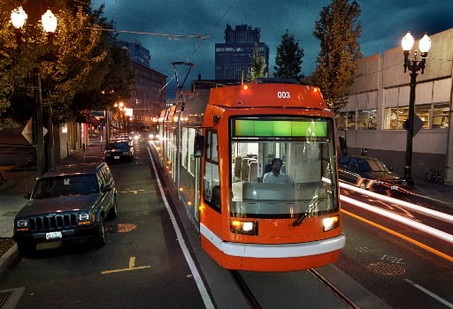
Alstom’s Citadis tramway, Wilson bridge, Tours (France).
Could Sydney’s George Street tram be wire-free?
“Sydney light rail: cheaper without wire-free lines, expert says
Date November 10, 2014 – 8:53PM
Jacob SaulwickJacob Saulwick
Transport Reporter
The light rail in Bordeaux, France is wire-free.
The light rail in Bordeaux, France is wire-free.
The light rail line between central Sydney and the eastern suburbs could be built cheaper if the government abandoned plans to run trams without overhead wires down George Street, according to a light rail expert.
Fairfax Media reported on Monday the cost of the project was expected to blow out from $1.6 billion to $2.2 billion (USD $1.38 billion to $1.89 billion) when the government signs terms later this year on the contract to deliver the light rail line.
The blow-out has dismayed light rail advocates, who view it as typical of a disturbing trend in NSW to put outsized cost estimates on public transport projects.
Greg Sutherland, a former adviser to a NSW transport minister and a director of the Sydney Tramway Museum, says the cost of the project could be partly reduced by removing the requirement for trams to run without overhead wires between Circular Quay and Town Hall.
“When you’ve got a major product you don’t introduce unnecessary enhancements that actually make the system less able to perform,” said Mr Sutherland, also an electrical engineer.
Transport Minister Gladys Berejiklian has named the preferred tenderer for the light rail project as a consortium called “Connecting Sydney”, which includes the French rail manufacturer Alstom.
Alstom’s wire-free light rail system, which powers trams on an energised third track, is the dominant product of this type in the world.
It has been installed in the French cities Bordeaux and Reims, as well as Dubai, and is planned for Rio de Janeiro in Brazil.
The company says that trams running on its wire-free lines perform the same as trams powered overhead.
But Mr Sutherland said the system would add to the price of each tram, and also add to the cost of providing power to the light rail system.
In the Scottish city of Edinburgh, which decided against installing a wire-free section of tramway, the city estimated that wire-free running would add 20 per cent to the cost of electricity.
Transport for NSW and the City of Sydney Council both back a wire-free stretch along George Street for aesthetic reasons.
“This is a once in a lifetime chance to transform George Street into a beautiful public space that is welcoming and attractive,” a spokeswoman said.
In Alstom’s system, the third energised rail is powered only when a tram runs over it.
Gavin Gatenby, from the advocacy group EcoTransit, said the government risked locking itself in to products from one manufacturer by adopting wire-free technology.
Really surprised that you are just guessing on this. As an advocate, you should know or at least know where to go to find the numbers on what you are criticizing or commenting on. It only takes a few seconds and would give you much more credibity. Plus it would also lead to a more informed debate and better transit decisions in the end.
This time I’ll help you out a bit. It’s all at page 72 at:
http://www.translink.ca/~/media/Documents/plans_and_projects/rapid_transit_projects/UBC/alternatives_evaluation/UBC_Line_Rapid_Transit_Study_Phase_2_Alternatives_Evaluation.ashx
First of all, the numbers all systems are 30 year lifecycle capital costs.
The number of vehicles is 36, not 25. The cost for just the property is 96 million (don’t forget that this is Vancouver).
Once you add in contigency and inflation, the cost of the vehicles, yards, and property for the yard, it is around $400.
Before you complain that is too much, they have used the same methods for SkyTrain too. The contigency for the SkyTrain is $536 million.
Also note that the vehicle costs are higher for SkyTrain because the projected ridership is much higher. Now, you might disagree with that but then you need to subtract the cost of the extra vehicles when comparing the costs.
Zwei replies: Oh yes Richard, I am supposed to study 24/7 transit issues around the world unpaid – ya right.
The high costs in Sydney are due to wireless operation.
Skytrain cars are more expensive than LRT because they are smaller and you need more of them. One tram for Ottawa has about the same capacity of 3 MK.2 SkyTrain cars! Do the math.
Your arguments are moot, no one builds with SkyTrain anymore and you better hit the books to understand why!
Note: TransLink has completely failed to understand modern LRT and still treat LRT as some sort of 1940’s streetcar. TransLink’s LRT planning is not worth the paper it is printed on.
It’s not over engineering, it is what people want. Getting rid of the wires and the poles, makes the system more comparable to an underground system, which of course doesn’t have poles a wires.
It’s also a benifit to users of the system not blocking the sidewalks with poles. On high ridership systems, this helps improve access to the system.
Zwei replies: The poles you talk about are lamp standards, all streets have them you haven’t a clue and make it up as you go along.
Zwei’s right. If no one is disturbed by streetlights, then we could simply add wires in all four directions installed on the lamp posts. Easy.
Just finished a Navy Rum with a few of my old friends (all of us proud RCN Vets) here in Ottawa. Remember this point I made a few days ago. The cost of all types of concrete are going up at about 8-10% a year and has doubled in price between 2006-2014. Like I said before, this rate of growth in the price of concrete shows no sign of stopping. These catastrophic increases in price has been occurring since the 90’s. European countries subsidize concrete and steel costs for large infrastructure projects something I know the boys in Sydney don’t do. Plus, I was figuring out last night just how much the Broadway Skytrain Line project has gone up since they first quoted the costs in 2010-2011 simply due to the rising cost of concrete (average quoted price given to me by Translink is $3 Billion) . The cost I came to last night was an increase of $175,000,000-200,000,000 simply due to the rise in the cost of concrete alone, I did not include the meteoric increase in steel since 2002.The national price for range for concrete including the costs of forms, aggregate, gravel reinforcement application and materials, site preparation and other costs is $210-270 /cubic metre. My point is Translink and other transit systems have to make bloody sure that, the lines they are planning whatever the technological mode they choose are going to be the best investment over time. Spending on a technology which is heavily structurally dependent on a material which is consistently increasing in cost at a rate, which is 2-4 times the rate of inflation, every year. Also unlike what Eric pointed out, here in Ontario we are at the lower end of the cost range I mentioned and we are awash in sand, in fact we have so much were shipping it across the country we have so much yet, the cost of concrete and other construction materials continue to increase at a an alarming rate all across the continent.
Zwei replies: Just to let you know, my dad (d.1994) served on HMCS Levis in the North Atlantic from Nov. 1944 to April 45 and proudly was involved in the “Battle of Halifax” where the RCN got even!
We will always need concrete and materials like it but, so much of what the skytrain sits on requires enormous amounts of the stuff compared to other rail and transit technology modes. Even Translink’s own figures say that the Broadway Skytrain extension will only have a peak hour ridership of 6000-7000 p/h/d by 2041. The highest peak hour level of traffic on the Millennium line will be on the sections already built. As I said before, in my professional opinion, there is just not enough ridership now or in the near future to justify spending Billions on a Tunnel, when a surface LRT is significantly cheaper and is more scalable to the current and future passenger levels and travel needs on the corridor. A surface LRT line makes a real statement about how you see your area developing into the future with a more balanced transportation modal mix.
A new but serious issue has arisen with the Skytrain technology owned by Bombardier. All the Skytrain supporters are assuming that, Bombardier will still be building this technology and does not sell its patents and vehicle design rights to another transit vehicle builder very soon. I can tell you this, after a conversation I had with a college from Bombardier this past weekend its not looking good. Unless someone else who does not currently use the technology starts a new line or a current user announces a major contract for no less than 100 vehicles or more from this product line, production will end when the units that are being built for Vancouver and Kaula Lampur are delivered between 2016-18. Bombardier is not hiding it anymore, they have been trying to sell the Skytrain and its component technology to other builders and select transit properties, like Translink. It’s not making enough money for Bombardier and is holding up production in facilities that could be making something else which is making money, like the Flexity LRT products, larger scale Movia Metro/Subway line or many of their full scale passenger regional railway and intercity railway rolling stock lines!!!
Sorry Zwei could you remove the first version of my second message I am having computer issues and its posting these messages before I finish writing them.
@ Richard, thanks for the study “paid for” by TransLink, much appreciated. If all you can do is quote propaganda from TransLink, don’t bother. Assumptions in the study prepared by SNC Lavalin and Steer Davies Gleave are wrong and therefore all the conclusions in their garbage study for TransLink which paid for it are false.
Elevated or buried s-train (RRT or whatever other crap TransLink prefers to call it) does not have more capacity (page x in the summary of the report by TransLink) than LRT or trams which were not considered. Environmental impacts of s-train are off the map compared to LRT or trams, as the unbiased and thorough study by UBC in 2009 showed, maybe RFTV can post the environmental comparison, Figure 16.
Moreover, the net present value (NPV) of s-train is grossly under estimated and the NPV for LRT is grossly exaggerated (page x in the summary of the report by TransLink). I graduated top in my class in finance (perfect 9 out of 9) during engineering and am confident of this.
Trams have just as much capacity as s-train, and trams are self-financing. Trams reduce the carbon footprint of transit but most importantly: trams do not add more expensive transit infrastructure bleeding taxpayers dry. Trams make better use of the existing transportation network to take buses off the roads to cut operating costs while making the commuting time shorter – for the majority of transit users – based on real statistics.
Let me reiterate as this is of the utmost significance and at the root of our transit debacle here: trams do not add more expensive transit infrastructure bleeding taxpayers dry. Trams make better use of the existing transportation network. Trams improve the efficiency of the transportation network at no cost by reducing operating costs!
Richard, you’re a fool and a pain. There is only one solution to the rot at TransLink – TransLink’s elimination for the municipalities to run trams and save $45 million in salaries paid every year to the maggots at TransLink. TransLink is a hoax pretending that spending billions of dollars on s-train is somehow reducing road congestion – it isn’t. I’m sick of morons like you spreading misinformation to aid your cause or further your agenda – concrete sales to TransLink or whatever else motivates you.
http://www.railforthevalley.com/latest-news/zweisystem/a-tale-of-two-letters-3/?utm_source=twitterfeed&utm_medium=facebook&utm_campaign=Rail+for+the+Valley
First:
Despite the millions of dollars squandered by Ed Storm of the Ministry of Transportation and Infrastructure, Jerry Dobrovolny of the City of Vancouver and Ian Jarvis of TransLink on the myriad of combinations and permutations for transit from Commercial Drive to UBC, beyond buses having limited passenger capacity, there are really only three transit modes which can adequately meet the future demand for transit along Broadway in the coming decades – for the planned high density development on Broadway. They are the s-train line, LRT line and tram line.
SNC Lavalin and Steer Davies Gleave never looked at trams. Trams can run on virtually any road and blend into the community. Regardless of the mode of transit (s-train, LRT or tram) used, all transit modes can be designed for same passenger capacity and no transit mode has more passenger capacity than the other.
Transit time for the subway line is short but the commuting time, which matters, with the s-train line is long. For someone with a car parked in the driveway: transit by tram adds 63% to the commuting time, transit by LRT adds 66% to the commuting time and transit by s-train adds 69% to the commuting time. When it comes to the commuting time, no one transit mode significantly attracts drivers better than the other, and if transit is selected for speed, the tram line has the advantage over the LRT line or s-train line, statistically. Based on the same passenger capacity, the tram line having a construction cost of $60 million is essentially free compared to $600 million for the LRT line and $5,000 million for the subway line.
Second:
Transit time is not relevant for drivers who can travel much faster without transit. However, transit time is very relevant when it comes to the rolling stock required for rail transit (tram, LRT or s-train). Rolling stock required (number of tram, LRT or s-train cars) is directly proportional to the transit time. Compared to the s-train line, the LRT line requires 50% more rolling stock and the tram line requires 100% more rolling stock.
While the rolling stock for the s-train line is from only one supplier (monopoly) driving up the cost of the rolling stock for the s-train line, the rolling stock for the tram line or LRT line is from numerous suppliers competing against each other for business. This not only keeps the cost of the rolling stock low but also ensures high quality and innovation in the rolling stock for the tram line or LRT line. As a result, the cost of the rolling stock for the tram line or LRT line is not necessarily more than the cost of the rolling stock for the s-train line.
In short, SNC Lavalin and Steer Davies Gleave wrote what TransLink wanted them to write and you can use their study to wipe your @$$ next time you crap. Okay?
All streets don’t have lamp standards. In streets with lots of peds in Europe, they often string the lights from the buildings to get rid of the poles.
Zwei replies: you have it all wrong Richard, tram systems in Europe has always strung span-wires from buildings and has nothing to do about the poles. Your argument is moot because Broadway has the lamp standards that once held the span wired for streetcars and now do the same for the trolleybuses.
@Haveacow
Actually, read the report. 2041 Forecast Peak Load (passengers per hour per direction, pphpd) of Broadway Subway to UBC is 12,500. And that will only be 15 years after completion. They should really be doing 30 year projections. No way LRT will have enough capacity unless train frequency is increased to the point that it really disrupts north south bus and pedestrian traffic and or slows down service along Broadway.
Also note that extending SkyTrain is projected to reduce demand on the busiest section of the Expo Line by around 4,000 ppdph likely delaying the need to purchase more vehicles for the Expo Line, delaying the need for costly upgrades and delaying the Expo Line from reaching capacity. All and all, the more you look at it, there is a very strong business case for the Broadway Subway.
http://www.translink.ca/~/media/Documents/plans_and_projects/rapid_transit_projects/UBC/alternatives_evaluation/UBC_Line_Rapid_Transit_Study_Phase_2_Alternatives_Evaluation.ashx
Zwei replies: Again Richard, you are wrong, but then you have been wrong all along. Two modern trams, operating in coupled sets, could handle 15,000 pphpd at two minute headway’s. Easy for LRT, maybe not so easy for Skytrain. Oh by the way, the maximum capacity of SkyTrain today is 15,000 pphpd, unless one wants to spend $2 million to $3 billion more to update and retrofit the rest of the network..
The problem with TransLink’s documents is that they are so biased against LRT, they are not worth the paper they are printed on. Evr notice no one builds with Skytrain anymore? Ever wonder why only 7 such systems have been built? One would never guess this if one listened to TransLink.
Hello Everybody including Richard,
I am quite surprised at the Phase 2 Report for Translink’s Broadway Skyrain Subway Line.
From a quick read (about 2hrs and 155 pages plus scanning the rest) of the results I can see two really big issues one of which has not changed from the earlier reports and the other is based on questionable if not outright incorrect assumptions that would change large parts of the outcomes.
When you look at the report’s conclusions there are some surprises but, most were unchanged from the last time. However there is a whopper in there that would lead to the deaths of most planners by their bosses. They have chosen that overall the Skytrain is the best choice (no surprise there). The whopper comes form the admission that LRT is cheaper and does provide better service over the status quo but the cost is significantly less expensive to build than Skytrain. To justify this, the following gem of a statement is included,” Of the alternatives that meet the forecast demand for the corridor, capital costs range from $1.1 billion for LRT1 (100% Surface LRT) to $3.0 billion for RRT (Skytrain in a Tunnel). An assessment of affordability will be made outside this study by considering regional investment needs relative to available funding.” This is a game changer folks. In simple terms, I could produce a report that said, “we believe the best choice for transit in the Broadway corridor is genetically engineered flying solid gold unicorns however, an assessment of affordability will be made outside of this study by considering regional investment needs relative to available funding”. The next sound I would here is the ax coming out of its sheath being wielded by the people who hired me, just before it came in contact with my neck. Sorry guys, I will continue later I have to pick up my kids!
This entire report is based on what could be, given that 2 major sets of assumptions come true. The first set of assumptions is the economic growth model of the Vancouver region. The growth that is expected for the Broadway Corridor is based around a 40% increase in population and subsequent increase in density by 2041 and a 20% increase in the numbers of jobs in the Broadway Corridor by 2041. But there is a crucial piece missing information from the report that drives this assumption. Are they expecting a similar growth model for the whole region or just the corridor? When you study an area in isolation it is very easy to take existing trends and extend that growth into the future because you are not considering the effect that different growth rates in other areas will have on this corridor. If the higher levels of growth occur initially in this particular corridor (Broadway) and not others that already have a Rapid transit lines and areas primed for development then the cost of land goes higher in the Broadway Corridor relative to other areas. Higher land costs produce more expensive development and companies or people that are more budget cautious may just decide its easier to go to an area that has cheaper developments to save money on a already existing rapid transit line. Why wait for the cost of land to really shoot up during the planning and construction period of a rapid transit line in the Broadway Corridor when Metrotown or Surrey or wherever, has a line that already exists and maybe will be cheaper in the long term. This causes a slowing in the rush to develop the Broadway Corridor. The blind assumptions of this report do not show the relationship with other areas and thus disregard many real alternatives to their growth model. The functional relationship between different areas that are primed for possible development in Vancouver can have a profound effect on any single one. Currently 17% of all jobs in the Vancouver Region were located in the Broadway Corridor, it is very hard for even a fast growing area like Broadway to suddenly change its relationship to the rest of the region simply because current growth rates show it will. Even a small increase in the number of total jobs in Broadway Corridor relative to say Downtown, could have serious real world policy effects on the region as a whole. Once you understand the full relationship between the different areas of the region then you can interpret growth rates in one area and its effect on transportation.
The other serious flaw in the regional growth model for the area is that, any growth model worth its salt has at the least 3 major growth prediction levels. Low, Medium and High Growth forecasts. This report only assumes growth at one level, therefore it is highly effected by uneven growth and its predictions could easily fail for a great number of reasons. This report only comes to term with variations in their growth assumptions at the end of the report. Thus very little of the report deals with the possibility that, whatever the mode of the rapid transit that is chosen, for reason of cost and differing levels of expected ridership (especially at peak) the need for phasing my be needed.
Most of this report assumes that the whole line will be built at a single shot. The report does not even to begin to deal with the many possibilities and realities that force phasing on a project. The lack of any clear planning in this regard only shows how much reality this report is really willing to deal with. They only briefly mention the effect of having to phase the construction of their chosen line. If your growth predictions are off it may force new and unexpected costs on the project thus, they may need to build in phases. These have massive effects on the end product. The Sheppard Subway in Toronto comes to mind. Had they built the first phase of the line 1.3 km further to the east, to Victoria Park Ave, instead of ending it at Don Mills Rd, they would have increased ridership anywhere from 50-75% because they missed the county’s busiest and most employee dense business parks, The Consumer’s Road Business Park. It is home to over 40,000 employees, several national head offices 2 major hotels and a national cable television station as well as all its ancillary Studios (TSN).
The second set of assumptions is the mathematical model that has been chosen by the people in this report. Oops got to go again guys the boys are fighting (including biting each other) and I better break this up see you later!
@Richard, forecast peak of 12,500 pph along Broadway in 15 years? How, by turning Vancouver into another Hong Kong?
According to Gregor (hopefully by the election tomorrow we’ll be hearing less of him) there will be 250,000 people (transit users) on Broadway if we build the subway! For every transit user there are four drivers. If Gregor is correct, building 100 story condo towers to increase density enough to get the 250,000 transit users will also result in 1,000,000 more drivers!
Do you believe this, Richard? Anyhow, tomorrow, Gregor will be a distant bad memory – god willing, as his Muslim buddy in Calgary, Nuhmeesh or whatever, says.
http://www.theprovince.com/news/Vancouver+voters+ponder+really+nice/10379193/story.html
As I was saying the second set of assumptions is limits put in the transportation model itself. This type of computer modeling is considered “open” or without limits. These type of models assume the user of the model will not only set the limits of the model but made sure that there is a consistent set of limits based around a central theme or set around a consistent mathematical or technical structure. For example, the model uses travel times of various transportation modes to come to some sort of comparable performance measure. The travel time of BRT, LRT or RRT is partly determined by how fast a particular mode of public transport can accelerate or decelerate when coming to and starting again from a stop. This leads to a model of total dwell time, (the time in seconds it takes to slow down stop at station and return to a lower limit of operating cruising velocity) which in turn effects the total time it takes to travel a predicted route. All the acceleration and decoration rates were way off from reality, especially acceleration. Skytrain was 10% to slow, LRT was, depending on the particular model of vehicle, off by 20-30%. The BRT vehicle rate was almost 90% slower than reality.
Other measures like the passenger carrying capacity of certain modes were over estimated in Skytrain and under estimated by 20-25% in LRT. All the mode total right of way capacity choices seemed to be very low and completely arbitrary in there choice. This fact alone would make them appear to be open to a high degree of bias. Skytrain was capped 13000 p/h/d and LRT as well as BRT were artificially low compared to what other transit properties have achieved in similar operating environments. The frequency of service between vehicles was also completely arbitrary. For example, the frequency for BRT was lower than what is currently running on the corridor and it’s produced a output passenger demand level that, was also lower than the current bus service. What is particularly confusing is the BRT example is defined to have entirely its own private right of way, that alone should produce a slightly increased passenger demand level compared to what is already existing yet,it is actually a little lower than the reality. One other problem with the modeling was that all the frequencies for each mode were completely different. This not only leads to problems and issues regarding the quality of the modelling outcomes but it becomes a general problem of data consistency. At this point you are now arbitrarily comparing apples to oranges What is particularly frustrating is that I don’t think that the consultants doing the modeling were trying to be particularly evil or dishonest. I just think that they had complex modelling choices and ran out of time.
In modeling its not just how you model and your choices around that but, what you choose to model. Consistency is important. Why model one rail transit mode completely in a tunnel but choose not to model another in the same environment. It was clear when it was suggested in the wider community by a certain person that, his proposed LRT right of way could be partially in a tunnel and not entirely on Broadway and this right of way itself could make a difference in the quality of the service. But none of this had ever been modeled before. Finally, at the end of the report in the conclusion they did choose to model a partially tunneled right of way on Broadway and the result was obvious, it had some improvements over a completely surface right of way. Yet they still did not choose to model a LRT right of way completely in a tunnel or a partially tunneled right of way off not entirely on the Broadway Corridor. What was clear was that, someone involved with the project had obviously realized that there were major inconsistencies in the choices made regarding possible rights of ways for different modes. For example, if a below grade right of way is so desirable, why was LRT or BRT also modelled in those environments. Considering Vancouver’s vast experience with Trolley Buses, why were they not put in as part of a BRT option and chosen to be modeled. There were also very few surface options studied as well. Parallel low cost surface LRT/BRT options were never modeled as even as a middle step between the current situation and expensive below grade option. What is clear to me is that, there were real attempts to limit options being studied early on in the whole process that could have made big differences later on.
Lastly, even though I have just spent several minutes pointing out problems with the modelling I make this final point to all of you. If you believe their numbers regardless of what Richard says, the maximum passenger demand for a Skytrain line extension under Broadway traveling westbound to UBC during the AM peak hour is below 10000 p/h/d for a vast majority of the operating line. In fact the peak hour passenger demand profile shows that in 2041, west of Granville the peak passenger demand profile line westbound in the AM peak period, never goes above 4000 p/h/d. I have sent a copy of this to Zwei! Is this really the best way to spend no less than $3 Billion, I leave it to you to decide?