IS IT TIME TO HAVE A ROYAL COMMISSION ON URBAN TRANSPORTATION?
Recent angst and confusion in local and national blogs concerning bus, light rail, metro, and commuter train makes Zwei wonder if a Royal Commission on Urban Transportation is needed. There are no national standards that readily defines transit mode and one is needed, so the average Canadian (read Canadian taxpayer) can engage in honest debate on urban transportation. To date, most transit modes are defined by those promoting particular transit projects and the mode chosen for that project. There is no national definition for light rail, metro and bus and confusion is endemic in the mainstream media, the political arena, as well in academic circles.
 A good example of this confusion is BRT or Bus Rapid Transit. Outside of BC, BRT is a an express bus system that is either guided by rail like the GLT (Guided Light Transit) bus systems; a bus system guided by a raised curb, like the German O-bahn; or a bus system that has the exclusive use of busways, such as used in Ottawa. In BC, BRT is merely a limited stop express bus service, such as the B-Line express buses, which is not BRT at all.
Light rail also needs a standard definition as there are many different definitions given to modern LRT. Example: in BC, TransLink claims that modern LRT can not carry more than 10,000 persons per hour per direction, yet in Europe many LRT type installations carry more than double this number in daily revenue service!
The North American variant of LRT, the streetcar also needs a standard definition. In Europe there is no distinction between a tram operated as a streetcar or a tram operated as LRT, the only difference between the two is that one operates in mixed traffic, while the other operates on a reserved rights-of-ways. One tram line in Europe can operate as a streetcar and LRT combined.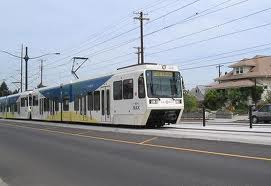
The newest variant of LRT, the TramTrain also needs a new definition and a completely new understanding of the application of light rail in alleviating traffic congestion and pollution. TramTrain has created a new dynamic to urban transportation planners in Europe, as TramTrain can operate as a streetcar, LRT and a passenger/commuter train. Operating TramTrains in Canada will require a overhaul of the Canadian Transportation Act, which governs how our railways operate.
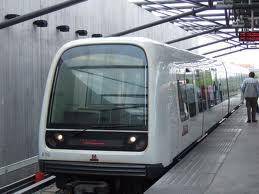 What constitutes a metro also needs to be discussed as there are several variations including light metro and monorail. In BC, our automatic proprietary light-metro (SkyTrain) system is sometimes called advanced light rail and not a metro. As the SkyTrain system is driverless, it can't operate in mixed traffic and definitely not of the light rail family. Also the terms rapid rail and rapid transit are used to describe transit projects, yet there is no official definition what rapid rail or rapid transit is.
"Why do we build public transit?" and "What do we wish to achieve with new transit installations", are questions that are mostly ignored by the powers that be, as most politicians regard transit projects, mega-projects built to secure photo-ops for the next election.
Do we build public transit to shape growth, as the TOD transit philosophy dictates, or do we build transit to move people, with a customer comes first policy, as what is evolving in Europe?
Should a transit project achieve a minimum modal change from car to transit? If there is to be a modal shift, what numbers should we be aiming for? And what would be the consequences if a planned new transit line failed to achieve minimum standards of operation?
The lame statement that the Canada Line would take 200,000 car trips off the road each day, may never be achieved in the foreseeable future and the claim probably would not have been made if their were guidelines for transit mode and implementation.
The question should be asked, "Should metro or light-metro be built on routes with passenger loads that can be easily handled by LRT?" Presently the Vancouver Metro area is spending four or five or more times more money for a transit line that could have been built with a much cheaper, but just as effective alternative. TransLink has spent at least six times more for two SkyTrain metro lines, yet the two lines carry about the same ridership as Calgary's three line LRT system. Another question that needs to be answered, "Is tunneling necessarily good for LRT projects or do they turn affordable LRT into unaffordable metro?"
What we are lacking in Canada is a national standard for building enhanced transit projects, with many being built strictly for political whim, like TransLink's Canada Line. To rectify the the current situation a Royal Commission on urban transportation may just be the ticket for a more affordable and more customer friendly urban transportation for more urban and suburban customers.