Bob Mackin
One of the three people hurt in a Granville Station escalator pileup Sept. 29 was a 71-year-old woman who suffered head, shoulder and knee injuries.
That is according to a SkyTrain attendant’s incident report, obtained under the freedom of information law.
The second and third persons “did not wish to wait for medical attendant and exited the station after giving their account of the occurrence and contact information,” said the report by attendant Greg Thomas.
A SkyTrain engineering assets technical investigation report said that Granville escalator number three had a “runaway condition where the handrail was stopped but the steps kept speeding down with passengers on the escalator. Many passengers fell on and at the bottom of the escalator.”
A timeline said the problem began at 2:54 p.m. when the escalator briefly sped up, causing passengers to run or jump off when they reached the bottom.
Two minutes later, it appeared to speed up with medium passenger loading and slow down when passengers exited the escalator. The cycle repeated at 2:57 p.m. and 2:58 p.m.
At 3 p.m., the steps started to briefly speed up and the handrail appeared to be going slower or at normal speed. Again, passengers were running and jumping off when they reached the bottom.
At 3:01 p.m., however, it sped up again. “The handrail stops but the steps appear to be speeding out of control.”
A customer pressed the emergency stop at the top, but passengers continued to go down the now-stopped escalator at 3:02 p.m.
“With 16 passengers on the escalator, it starts to move very fast down and dumps all the passengers in a pile at the bottom,” the report said.
“Customer that pressed the [emergency] stop is now keeping passengers from getting on the escalator and used a nearby sandwich board to block the top of the escalator.”
At 3:05 p.m., a SkyTrain attendant arrived and barricaded the top and bottom of the escalator and began taking witness statements. A service request was made to escalator contractor Kone at 3:15 p.m. A Kone technician arrived at 6 p.m.
Kone later sent a service operations technical support team from the U.S. to “bolster the efforts” of Kone’s local team.
The initial visual inspections of the drive revealed no irregularities, but a detailed disassembly was undertaken for a closer look from Oct. 6-10 and a new drive assembly installed Oct. 13. The old one was handed over Oct. 18 to testing and engineering consultant Acuren to determine the root cause.
Meanwhile, the other two escalators continued to operate “smoothly based on ongoing visual assessments.”
TransLink said Dec. 7 that repair costs are covered by Kone.
“Following repairs, the Granville Station escalator was put back in service on Oct. 27. The cause of the incident is still being determined by the manufacturer and Technical Safety BC.”
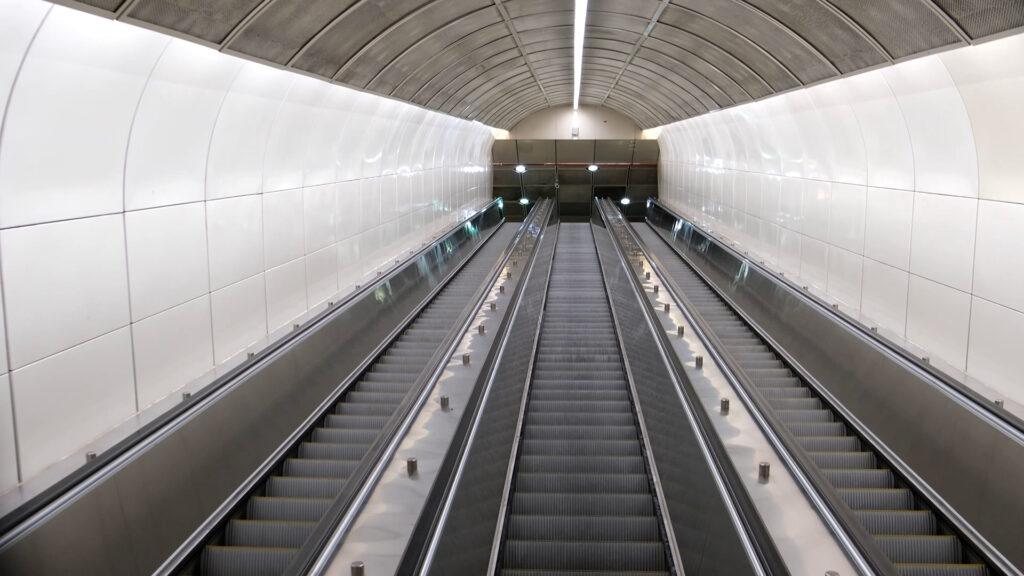
In July 2020, TransLink finished a $14.52 million project to replace the Granville Station escalators. The “big three” escalators, the longest in Metro Vancouver, are 35 metres long each, with 500 steps.
Granville Station was the start of a 13-station program to replace 37 Expo Line and West Coast Express escalators that are more than 30 years old. Last year, TransLink began to replace five escalators at Burrard Station in a project that is scheduled to be completed in spring 2024.
In its 2022 statement of financial information, TransLink reported paying escalator and elevator company Kone Inc. $6.65 million. The B.C. Rapid Transit Co. (BCRTC) rail division paid $1.3 million.
According to the TransLink website, the new escalators are supposed to provide smoother operation and braking for passenger safety, a variable speed option to save energy, LED step lighting and improved accessibility for maintenance so as to reduce downtime.
TransLink’s safety report does not separate onboard and off-board injuries. The customer injury rate on the Expo and Millennium lines have fluctuated above and below the rate of one customer injury claim per million boardings since 2018.
Granville Station had 4.8 million boardings in 2022 and was the fifth busiest station of the year. TransLink reported 83 million riders in 2022 on the two lines. In 2019, before the pandemic, it was 115 million.
On Sept. 27, just two days before the Granville Station escalator incident, BCRTC president Sany Zein reported to the TransLink board meeting that during the second quarter of 2023, there were 27 incidents reported by customers. Over half were slips, trips and falls on “elevating devices.”
Escalating to an Accident
Here is a story which, reported in the Breaker News which was ignored by the mainstream media, which panders to TransLink, which has now been revealed by Bob Mackin.
But what I want to point out is something different.
I lived in London England in 1980 and took the ‘tube’ regularly (even supped a few pints on the last Tube platform Pub’ and I was never bothered by the long escalators for the deep tube stations.
The longest escalator is descends 60 metres and is located at Angel Station.

Angel Station
If one notices, the escalator is so designed to prevent any sort of disorientation while using it.
The Broadway Station escalator descends a mere 35 metre but the design invites vertigo.
If an issue with the escalator causes problems, as it evidently did at the Broadway station, the design of the panels would invite disorientation at the exact moment, when one wants to avoid any sort of disorientation.
During the RAV/Canada Line era, I was told by one of the engineers bidding for the P-3, how badly designed the escalator was and a simple remedy, which would pay for itself through advertising would be of great benefit in an emergency.
After
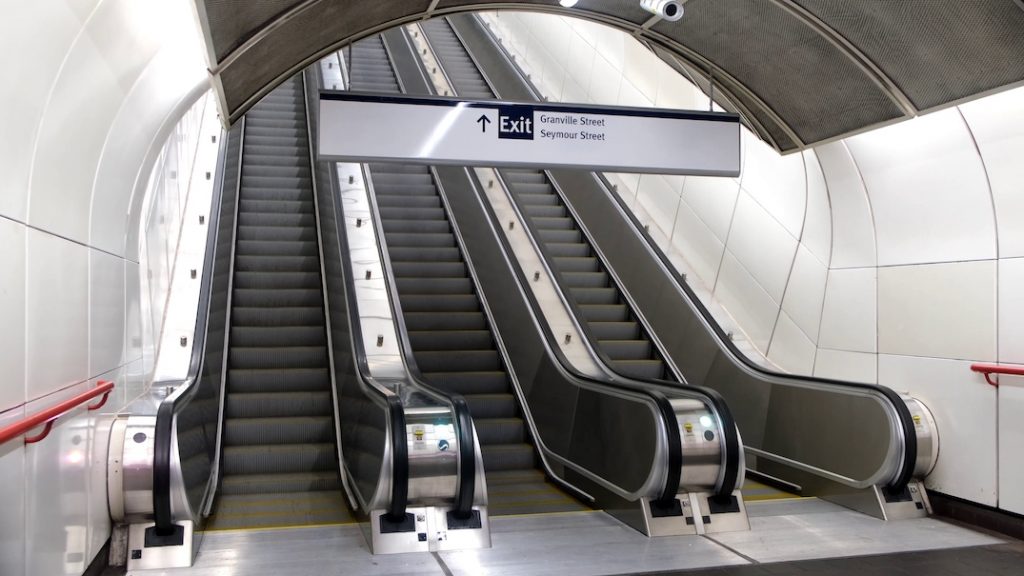
Broadway Station
The panels on the escalator are not level but are placed at the angle of descent. This causes disorientation, akin to a pilot flying in a fog.
In the UK, advertising panels are placed on “plumb level” to avoid any sort of disorientation or vertigo by customers, so important in an emergency.
during the RAV/Canada Line P-3 bid, I was told by an European engineer, working on his company’s bid, at how badly designed the Broadway station’s escalators were. Just a simple solution, using revenue generating advertising to prevent disorientation and/or vertigo, especially in an emegancy, may prevent serious injury.
I even sent a letter to TransLink on the subject, but never heard back.
Makes one wonder if the ill designed Broadway escalators contributed to the accident?

Details of passenger pileup on SkyTrain station escalator revealed