Karlsruhe Revisited
Let us not forget, the birthplace of what is now called TramTrain, was in Karlsruhe Germany.
When it comes to denial, the following statistic is greeted with hoots and howls of disbelief from the anti-tram crowd, yet it is the very basis for the success of TramTrain today.
Ridership of the Karlsruhe-Bretton route went from 533,600 per week, when transit customers took a commuter rain and then transferred to a tram, to 2,554,976 per week with the seamless (no transfer) journey provided by TramTrain. A 479% increase in ridership in just six months!
I would not predict such a ridership increase on the Fraser Valley interurban, but I believe the naysayers, both at TransLink and in Victoria and of course the SkyTrain Lobby, are deathly afraid that the TramTrain will prove popular and statistics, will put their transit plans in an unfavorable light.
From 2012…….
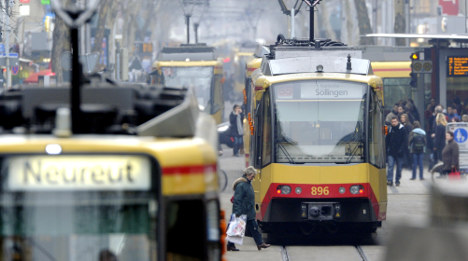
A few weeks back, Zwei created a firestorm of denial by the anti-tram crowd, when I reported that the main tram route in the city was being replaced by a subway; “because of the success of Karlsruhe’sAi??regional tramtrain service, the main tram route through the city was seeing 45 second headways“. All Zwei did was calculate the capacity offered by Karlsruhe’s trams and tramtrain and came up with a figure of over 40,000 persons per hour per direction, with 45 second (90 trips per hour) headways, with coupled sets.
Impossible screamed the SkyTrain crowd; Karlsruhe can’t operate coupled sets of trams, claimed a planner from TransLink.
Yet, 45 second headways, with a mix of single cars and coupled sets could give peak hour capacities in Karlsruhe well in excess of 35,000 persons per hour per direction.
Well the following quote from the Light Rail Transit Associations Topic Sheet No 5 – A Question of Capacity tells the story.
THE CAPACITIES of different modes of
transport are generally quoted as
0-10 000 passengers per hour for bus,
2000-20 000 for light rail, and 15 000
upwards for heavy rail.
It is city centres where several routes combine
that the most capacity is required. A typical
situation could be a pedestrian street with six
routes operating at 10-minute headway giving 36
double coupled trams per hour each with a
capacity of 225. This gives a nominal capacity of
16 200 passengers per hour which can be
increased to 25 200 pph in extremis without extra
vehicles. Light rail is unique in this ability to
operate on the surface with its capacity without
detracting from the amenities which it serves
Note Statistics are based on Karlsruhe, using GT8-l00c/2 cars.



