Subways Are Very Expensive
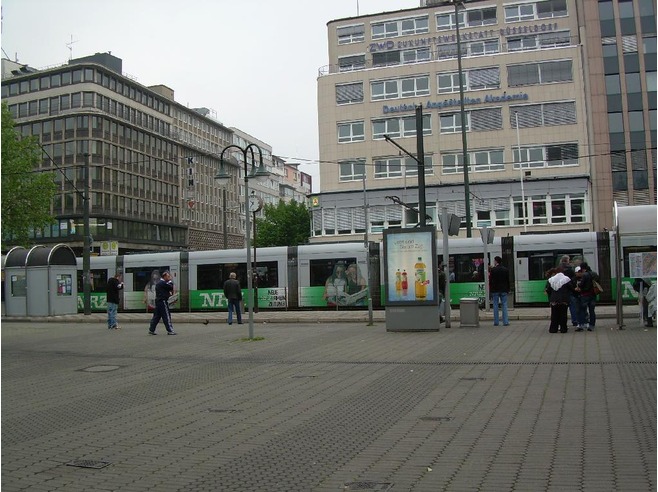
DUSSELDORF, the seventh largest city in Germany situated in the west-central part of the country with an urban population of 1.2 million, has opened a new USD $960.6 million, 2.11-mile light rail subway, the “international railway journal” reported Monday. It replaces street running tramway sections which will be removed. Here is the system map (scroll down for rolling stock photos):Under “Recent History” this site notes: “20 Feb 2016:Ai??so-called “Wehrhahn”-Line – a cross-city tram tunnel, between S-Bahn stationsAi??WehrhahnAi??andAi??BilkAi??(3.4 km with 6 underground stations), replaced some surface lines through city centre”“Monday, February 22, 2016DA?sseldorf opens ai??i??843.6m underground Wehrhahn lineWritten by Keith Fender
DUSSELDORF’s ai??i??843.6m underground Wehrhahn Line light rail line opened on February 20. Regular operation and closure of the previous on-street route followed overnight with services starting via the new route on February 21.
The 3.4km route from the S-Bahn station at Wehrhahn in the north to the S-Bahn station at Bilk in the south has six intermediate underground stations equipped with 90m-long platforms suitable for use by low-floor trams and LRVs.
The line was built by the City of DA?sseldorf with funding from the state of North Rhine Westphalia and the German federal government. It replaces former tram street running on the core section through the city centre, providing connections with existing underground light rail lines at Heinrich Heine Allee station. The tram street running sections replaced by the new line will be removed.
The Wehrhahn Line was planned as part of a network of new underground routes for DA?sseldorf in the 1970s and the first construction work – the 200m station box below the other underground light rail routes at Heinrich Heine Allee station – was built in the early 1980s. Final planning approval for the construction of the line was granted in 2007. Tunnel boring machines were used to excavate the single-bore tunnel under the city centre from 2008 to 2012.
More than 53,000 passengers are expected to use the new line daily. Siemens has supplied 76 NF8U trams to operator Rheinbahn to replace older vehicles and these will also operate elsewhere in the city. The light rail network serving DA?sseldorf has been revised as a result of the new line opening: four U-Bahn lines replacing former tram routes will use the Wehrhahn line.



Well, obviously someone felt that this subway was necessary. At least it has stops spaced 567 metres apart for LRT in the subway.
Building the subway for six kilometres under Broadway to extend the Millennium Line (s-train) in Vancouver is mired in politics and intrigue. Bomb-ardier propped up by taxpayers filling the pockets of the Quebec oligarchy wants to sell its lousy s-trains which can’t compete with LRT by Siemens and Alstom.
I have no problem with buying Canadian to employ Canadians. You know what? If Siemens and Alstom ran trams on Broadway, they could be enticed to construct their trains in the old Bomb-ardier assembly plants, if we let Bomb-ardier fail. As far as I’m concerned, the oligarchy in Quebec can go back to being commoners, to join the majority of us peasants in Canada. If taxpayers are going to feed billions of dollars to keep Bomb-ardier afloat, we’d better nationalize Bomb-ardier and tell the family running Bomb-ardier producing crappy products and screwing over the citizenry paying to keep them rich – to apply for welfare.
Anyhowzzz, enough of my political rant. Ten years ago, I attended some transportation planning season at UBC. It was put on by TransLink “planners”, Ian Fisher and friends. I asked them point blank, to explain the rationale for the 99 bees on the trolleybus routes. Their response: Burnaby does not have trolleybus lines and passengers catching the 99 bee (which ran from Burnaby to UBC over 25 km back then) would have to switch to trolleybuses in Vancouver. It was so that their passengers would not be inconvenienced with the added transfer.
This is no longer the case and the Millennium Line has been extended to Vancouver at Commercial Drive, where passengers from Burnaby have to transfer to the 99 bees running totally underneath trolleybus lines, now. So, obviously, the TransLink planners were lying to me and about 100 other people who were at the meeting (looking to get rid of the soot-blowing and thunderingly-noisy 99 bees wreaking havoc on their lives). All these people voted against the transit tax, by the way.
If the Millennium Line is extended to Arbutus Street in Vancouver, the 99 bees will continue to run and students will have to transfer to the 99 bees at Arbutus Street. This is asinine – all for the family in Quebec to sell their crappy s-trains. This greatly annoys me and the other 100 people who I am aligned with in Kits and Point Grey (Kits WPG Citizens’ Group). These people are not happy with the idea of TransLink plopping another massive subway station in their neighbourhood for developers to then buy up homes and build another condo village around the subway station.
In Kits and Point Grey, TransLink plans to build one subway stations at Arbutus Street, Alma Street and Blanca Street near the current 99 bee stops. How many people actually know this? Not too many people know what the long term master plan by TransLink running transit is for the communities of Kits and Point Grey in Vancouver. TransLink planners who are unelected are the ones who decide the housing density to suit their agenda in Vancouver. This is overthrowing democracy and letting people having a vested interest in s-train to shape communities in order to generate sales for s-train. Fundamentally, this is wrong and steeped in corruption.
Unlike the subway in Germany in this post, the subway stations for the Millennium Line extension in Kits and Point Grey are thousands of metres apart in distance. TransLink is going to maintain practically all the buses that it has on the roads to transfer people to the subway due to the very low housing density for the next 30 years to 50 years while the developers make their billions of dollars to build their condos to increase housing density in Vancouver.
Along Broadway, the very short six kilometre subway at the astounding and inflated cost of about $2 billion to $3 billion to construct by SNC Lavalin (run by another bunch of shady losers from Quebec) will only transport 13,000 pphpd due to the limit of the Millennium Line which it connects to at Commercial Drive. This is pitiful for a subway line and moves less than the tram or LRT line, at grade, instead. In March, the Kits WPG Citizens’ Group which is comprised of anonymous lawyers, engineers, housewives, retirees, academics… is going to blow the whole putrid s-train conspiracy wide open. My prediction is that Gregor Robertson and his stooges at the COV are not going to survive it.
Adios hard ball playing TransLink and COV dirtbags. TransLink does not know where TransLink go…
http://www.tvcommercialspots.com/insurance-and-services/geico-tv-commercial-tarzan-and-jane-get-lost-and-look-for-directions-in-the-jungle-do-you-know-where-the-waterfall-is-if-your-a-couple-you-fight-over-direction-its-what-you-do-tarzan-does-no/
That was a interesting article! Leave it to the Germans to get at the heart of the debate very quickly. After a little talk with some friends and a bit of research, I get the problem. The German political right wanted to remove an Ottawa or I guess in their case, a Karlsruhe like,traffic jam of LRV’s and buses on certain downtown streets that was doing everything to stifle passenger flow and growth in central Dusseldorf. The left not disagreeing that something should be done was really upset at the real loss of transit access that usually happens when you remove many surface stops and concentrate them into a lot fewer and expensive underground stations. Everybody disliked the price of it! My experience with Dusseldorf was really too brief to get a good read on it so, I asked friends who have spent a significant amount of time there. Although, my contacts said that surface conditions were really bad (horrific from one friend) during the peak periods, it was manageable off peak. One commented, “it wasn’t as bad as say Karlsruhe or Ottawa” but she followed with”it sure wasn’t pretty”. I snickered and smiled as a response.
These decisions are never easy, its really a balance between the cost of the tunnel and what you plan to put in it. Combined with what will happen afterwards. The passenger levels are expected to actually be up to nearly 100,000 a day within a decade. One of the invisible problems was the lack of capacity in the street scape itself, which was one of the primary reason passenger levels were pegged at only 50,000 a day. That being said, this tunnel will force a much longer trip to transit or completely bypass transit access for large amounts of central Dusseldorf’s poorest people. Up until now, these people had pretty good transit service. Buses and improvements to existing tram lines are expected to make up the difference for these people but, I sure bet it won’t ever be as good as what they had before. Its never an easy decision!
I have said this before, a tunnel, any tunnel that is of any significant length will be very expensive relative to running things on the surface. So, if you are going to put something in the ground it better be really, really worth it! Vancouver’s Broadway for example, will eventually have to have something done with it. For now, you can get away with making the bus service a lot more efficient. Something that really hasn’t been done yet! For example, here in Ottawa, Rideau Street (not part of our Transitway BRT System) has 120-130 buses per hour per direction during the peak hours, and that’s actually down by 30-40 buses per hour compared to what it used to be. The improvement has been because of the STO (Gatineau’s Transit service) Rapibus BRT system and the purchase of 18 metre articulated buses, instead of running nothing but 12 metre (“40 footers”). These numbers are still over double the current bus flow of Broadway. This is an important city street in Ottawa and not part of BRT system, it has endured these numbers for 30+ years with only a rush hour only bus lanes. Thankfully, the building of the LRT Tunnel has finally forced a big change and what will be a major redeployment of buses in the area. Keep in mind the LRT Tunnel is also eliminating the need for most of the 185-200 buses per hour per direction during the both peak periods a few blocks away from Rideau Street on the Transitway (Albert and Slater Streets) as well.
Putting a Skytrain line underground with a cost almost as much per kilometer as a late and over budget full subway/metro line in Toronto, is not a great answer to Broadway’s issues. That over budget subway line I’m talking about, has a capacity twice that of the Skytrain, using a 60 year old signaling system, not the modern one that will soon be replacing it. For now in my opinion, a tunnel option it isn’t a good idea. Especially considering the current passenger flow numbers on Broadway. Yes, they are high for a surface bus route but not if you are going to spend $300+ /km on a tunnel, there are other surface options that haven’t been considered at all. Note to all Skytrain supporters, I haven’t even mentioned or surface LRT yet. Efficiencies in the current bus operations have not been attempted nor have high volume platooning of buses been properly attempted.
Regardless of the new federal Government’s infrastructure program. Asking the Feds that locally you should only need to pay only 20% for a major infrastructure project is asking for trouble. The federal Liberals will have to answer to everyone they planned to give money too. All their promises in the election were based on a equal 3 way split between the levels of government. Changing that would be politically speaking very difficult. When Ontario’s government caught a lot of political heat for paying 100% of the capital costs for certain rail transit projects in Toronto, Mississauga and Hamilton, when Waterloo and Ottawa had to pay up to 40% themselves they were able to counter with an answer that stated, it was desperately important to the entire provincial economy that these projects had to begin immediately. The local transit systems were maxed out and waiting for the cities to come up with their 1/3 would cause more unneeded damage to the provincial wide economy. The figure used is that, Toronto and the Greater Golden Horseshoe’s traffic woes cost at the minimum, $6 Billion a year to the provincial economy. The Feds can’t make the same argument nationally for Vancouver, although your provincial government could do something similar.
At the moment, you guys can’t afford the your local portion or 1/3 of the capital work program for a Broadway tunnel. Consider the financial gymnastics Translink had to do with both its operating and capital budgets to afford the 1/3 portion of the Evergreen Line, costing only $1.4 Billion. Something else to keep in mind, whether it is the $2.1 Billion for going to just to Arbutus or the $3 Billion + to go all the way to UBC. All these cost estimates are low level estimates that can swing up or down by a value of 25%. Even with that built in 25% price swing, all these estimates are unfortunately based on engineering and development capital costs that are now almost 6 years old and growing more and more out of date, every day. Heavy structural concrete is still increasing at a cost of 2 to 3 times that of inflation per year and shows no sign of stopping. Steel is still wildly bouncing up and down on a weekly basis as well as with the current drop in the relative value of the dollar has produced a condition that in my opinion, has made the need to update these capital cost estimates right now, very important!
I give this last piece of advice. Before going forward with any program for building a below surface rail right of way using an operating technology that by its automated nature, instantly increases capital costs due to legal and operational reasons, please think again and take another look at other options before making this investment.
Zwei replies: I do not disagree about the Karlsruhe subway, certainly the traffic flows in excess of 30,000 pphpd demanded a subway, while current traffic flows along Broadway are under 4,000 pphpd. I have been told, there is serious thought in restating Katlsruhe’s tram lines on the surface for local traffic while the subway will be used by through traffic TramTrains. Munich’s transit history cn be traced with right-wing mayors building subways and left-wing mayors extending the tram network.
The big problem in Vancouver is that politicians, bureaucrats, and certain academics think that subways are the cure all for good transit and just by building a subway, viola, all your transit problems disappear – NOT.
That dang submit comment button went off while I was fixing something, part of the 4th paragraph was going to read, Yes, those passenger flow numbers are high for a surface bus route but not if you are going to spend $300 Million+/km on a rail transit tunnel, there are other cheaper surface bus options that have not been considered at all, that would stall the need for a tunnel until passenger levels get high enough to warrant an expensive capital project like this. Note to all Skytrain supporters, I haven’t even mentioned surface LRT yet. Efficiencies and improvements to the current bus operations have not been even attempted yet. True high volume bus platooning has yet to be fully implemented as well as stop rationalization (including forms of skip stop operations) hasn’t been attempted. Although they are beginning to address the need for increased bus frequency outside of peak but, before 22:00, there is still an over abundance of service past midnight. No attempt has been made to make Trolley Bus operation more efficient by adding on street facilities for off wire operations, common with all new Trolley Bus designs. The Trolley Buses are causing a growing amount of problems there (according to your guys not me) and freeing them up to go around delays would greatly enhance Broadway’s transit operations.
Eric, the core of Bombardier’s problems are in the Aerospace Division. They attempted to break into the small to medium haul airliner market held almost completely by both Air Bus and Boeing. They thought they could enter the market by stretching the length of the body of an existing commuter and luxury jet design by about 40%. They also assumed that the development costs would only increase accordingly if they followed their tried and true development process. What they forgot is why so few aircraft manufacturers have been able to stay in that market. Going into this market doesn’t require just a 40% cost increase in aircraft development, similar what they did to their jet body size. It requires a quantum leap in complexity and aircraft quality. That unfortunately means that a development program they thought would cost between $6-9 Billion actually costs somewhere between $12-15 Billion. An unnamed executive from Boeing laughed out loud initially, when he heard Bombardier thought they could build a jet airliner for this market by simply upsizing a commuter aircraft development program. Well he was right, this why so few companies worldwide are in this market and very few stay there long unless governments give Billions in development grants. Companies like Embraer, Fokker, Tupolev and Anatov received far, far more than Bombardier ever got from Quebec or the Canadian Government for their aircraft designs. Chinese manufacturers are spending double what Bombardier has spent on aircraft development programs trying to enter this market and still have barely made a dent. All with money paid interest free from the Chinese Government. The fact that Bombardier got this far and spending so little, is a glowing testament to their actual aircraft building abilities!
@Haveacow, you’re right about the backlash from other cities in Canada if Gregor worms his way into special treatment for his subway from his new pal, Justin. Subways in downtown cores might be justified to avoid all the messy utility relocations and other headaches. If you Google Vancouver (street view) from Arbutus Street to UBC, there is nothing but green grass and open spaces. It is retarded to bore under grass.
TransLink is boring because there is no way that the residents in Point Grey and Kits are going to tolerate concrete viaducts scarring their high end neighbourhoods. To extend the s-train “technology” west means boring. Hence the extra, I’d say, $4 billion to pander to Bomb-ardier and SNC Lavalin looking to cash in on s-train business. There is the very real political undertone that these two “Quebec” firms are being given very pricey federal contracts to keep the separatists at bay in Quebec – it is politically complicated. I better shut-up and not say more, this is a very sensitive and touchy topic in Canada, from what I have gleaned in my time here.
@Haveacow, your comment about making trolleybus routes more efficient as the prelude to LRT is spot-on. I’m sick of the propaganda about the 99 bee lines being so crowded and over used. What you actually have during peak hours is alternating packed 99 bees and mostly empty 99 bees. At the same time, there is the ridiculous spectacle of practically empty trolleybuses running right beside the “fast” 99 express bees. It’s common to be on the trolleybus and not be passed by the “express” 99 bee.
One councilor (fuzzy faced, uh what’s his name) was going to make a big publicity stunt and take the “crowded” 99 bee one day. All the cameras were there and guess what? He hopped on the practically empty 99 bee and his story was foiled. Since then, no Vancouver councilor has tried the same thing. It was pure entertainment to see student after student on TV say how good transit to UBC is, in fact.
“I gave Meggs a call shortly after his trip and discovered the journey wasn’t as hellish as you might think. He did, however, leave at the tail end of rush hour.”
http://www.vancourier.com/news/12th-cambie-35-minutes-too-long-for-meggs-1.613717
By simply reconfiguring the 80 trolleybuses and express diesel buses (running every 90 seconds on average on Broadway) into one articulated-trolleybus route in operation every 90 seconds on average, instead, the number of passengers transported to UBC can be increased from 2,700 people to 4,800 people every hour. This is an increase of 78% in passenger capacity.
Express buses traveling along Broadway and onto UBC over 13 kilometres pass through 50 traffic lights and are essentially no speedier than articulated-trolleybuses in operation every 90 seconds on average. To save riders practically no time with express bus service, TransLink cost riders 15 minutes to make riders transfer from regular trolleybuses to the express 99 diesel buses – to make transit appear so-so “busy and chaotic”.
This is all a big show for TransLink to get billions of dollars in new funding to: pay off its $3.6 billion debt, by announcing projects costing $7.5 billion to skim off $3.6 billion to pay off its debt. Smart eh?
Back in the early 90’s, with BC Transit types frustrated by my searing attacks on their claims about SkyTrain (courtesy by the LRTA) challenged me to bring affordable ‘rapid transit’ to Richmond.
In pre email and Fax days, I mailed transit types in the UK and Europe my problem and challenge.
Within 8 weeks, I had a credible plan, mainly thought out by real transit experts who cared to reply and most did very promptly. The plan entailed turning the Oak St. trolleybus into an European style trolley line from downtown Vancouver to Steveston, via Oak. the Oak St. Bridge, #3 Road, Railway Ave to Steveston. The line would entail stops every 500 to 600 metres, using articulated trolleybuses, bus priority at 4 strategic intersections, a bus way on #3 Road and to the Oak St. Bridge from Richmond and express service on Broadway.
This caused some minor guffaws at BC Transit and they kept my only copy, but ultimately I was told that some liked the plan but it would never fly because Richmond did not want unsightly OHLE wires obstructing views and that Vancouver would not allow 500m to 600m spaced bus stops on Oak St.
If my memory serves me correctly, the cost for such an operation would have been under $400 million, all included, but that was 1990 or 91.