What is now called Movia Automatic Light Metro is known as Airtrain in New York.
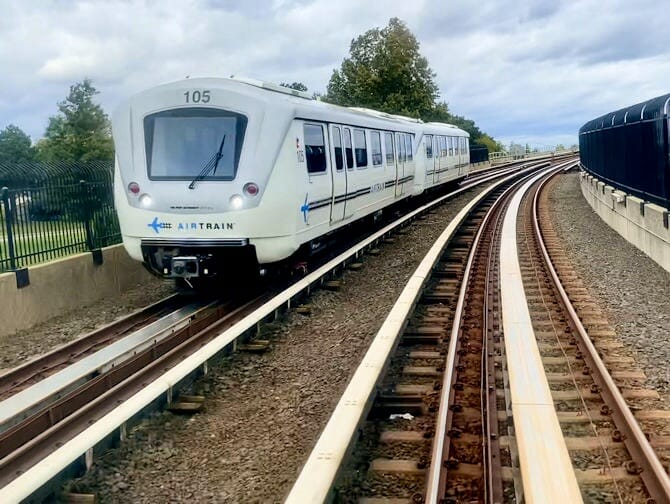
AirTrain JFK, is a 13 km elevated, ART system built by Bombardier serving John F. Kennedy International Airport (JFK Airport) in New York City. The system consists of three lines and ten stations within the New York City borough of Queens. It connects the airport’s terminals with the New York City Subway in Howard Beach, Queens, and with the Long Island Rail Road and the subway in Jamaica, Queens. Bombardier Transportation operates AirTrain JFK under contract to the airport’s operator, the Port Authority of New York and New Jersey.
The often rebranded Advanced Rapid Transit (ART) system was owned by Bombardier Inc. and was built with largely Canadian government funding. By doing so, AirTrain escaped scrutiny from the US Federal government.
The system opened on December 17, 2003 and is operated by Bombardier.
All passengers entering or exiting at either Jamaica or Howard Beach must pay a $8.00 (CAD $10.25) fare, while passengers traveling within the airport can ride for free. The system was originally projected to carry 4 million annual paying passengers and 8.4 million annual inter-terminal passengers every year. The AirTrain has consistently exceeded these projections since opening. In 2019, the system had over 8.7 million paying passengers and 12.2 million inter-terminal passengers.
Sound familiar? Surrey’s mayor claimed he could build the Expo Line extension to Langley for $1.65 billion, yet the budgeted cost is now $3.95 billion and is expected to even reach $4.5 billion.
It seems fiscally responsible politicians put a stop to this, unfortunately our local politicians in Metro Vancouver and Victoria are not fiscally responsible and believes the taxpayer has deep pockets and willing to pay higher taxes to fund politically prestigious transit projects.
Like the folks in New York, maybe local folks should start looking at cheaper and just effective transit options, other than the extremely expensive SkyTrain light metro!
JFK AirTrain
After scrapping Cuomo’s AirTrain, Port Authority releases 14 other options
The old AirTrain proposal for LaGuardia Airport, which is now scrapped Courtesy Governor Andrew Cuomo’s Office
One of Governor Kathy Hochul’s first moves in office was to pause her predecessor’s plans for a $2 billion (CAD $2.56 billion) AirTrain at LaGuardia Airport and ask the Port Authority of New York and New Jersey to come up with other options.
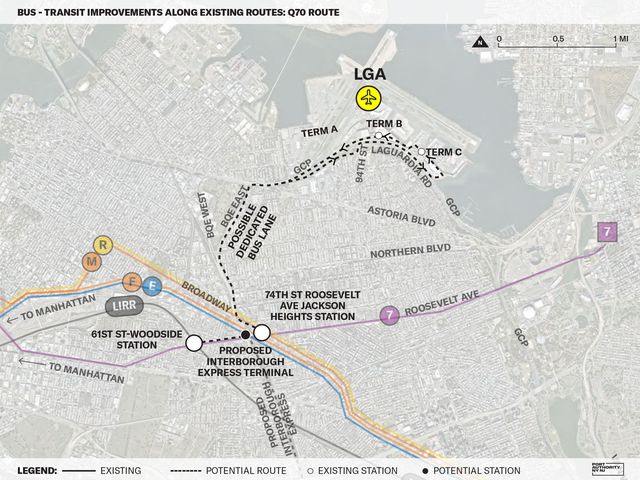
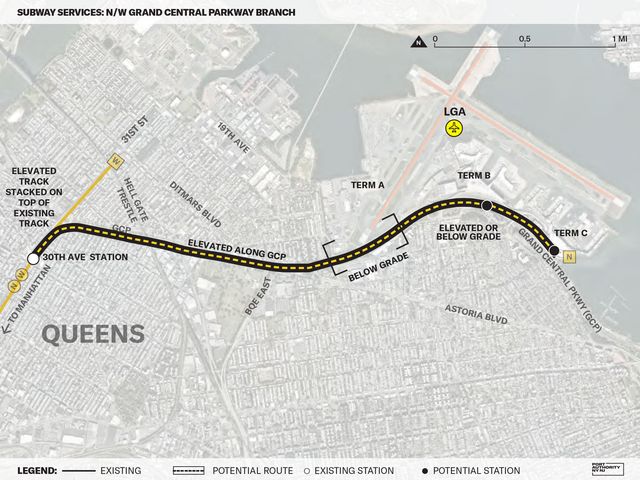
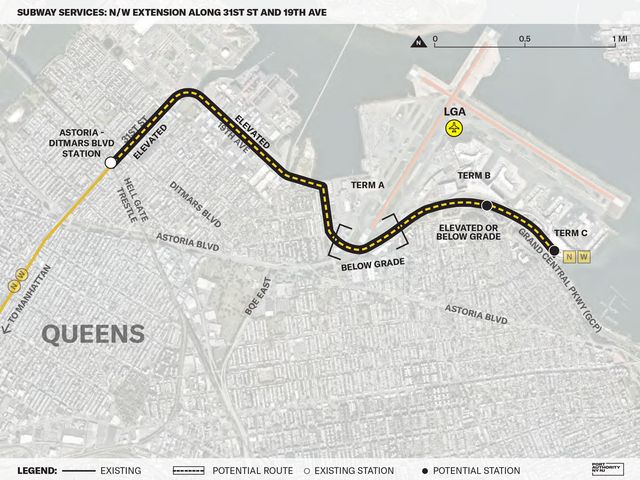
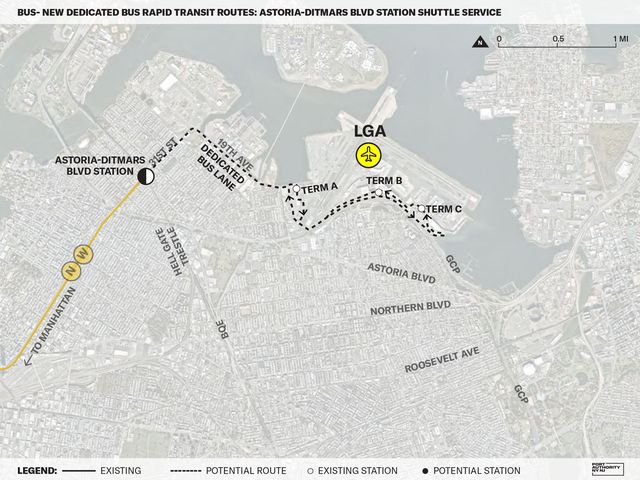
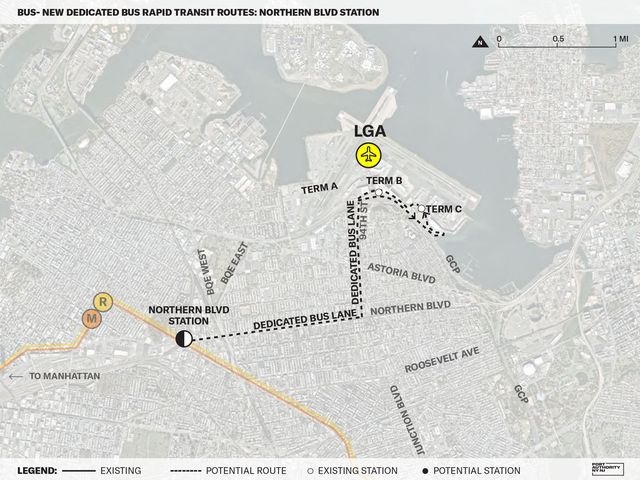
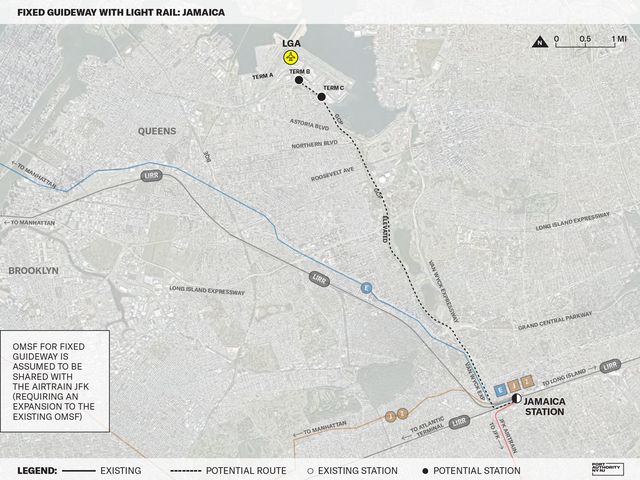
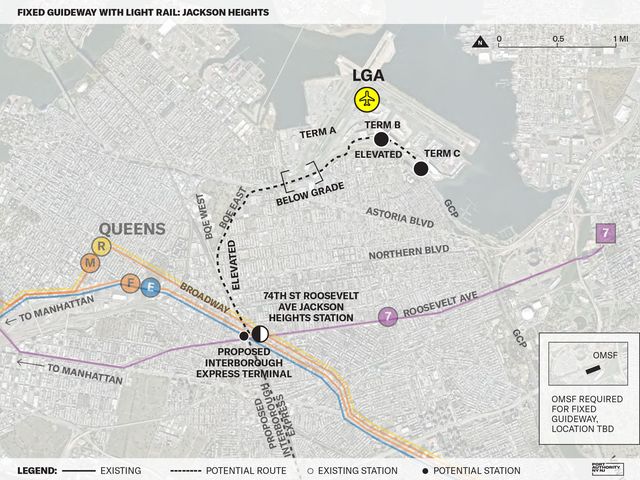
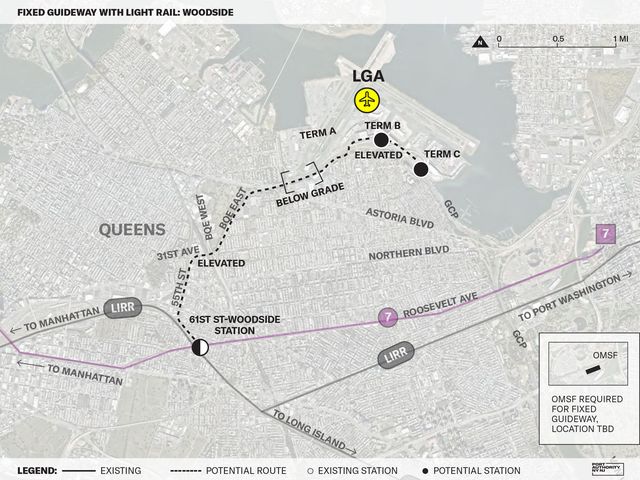
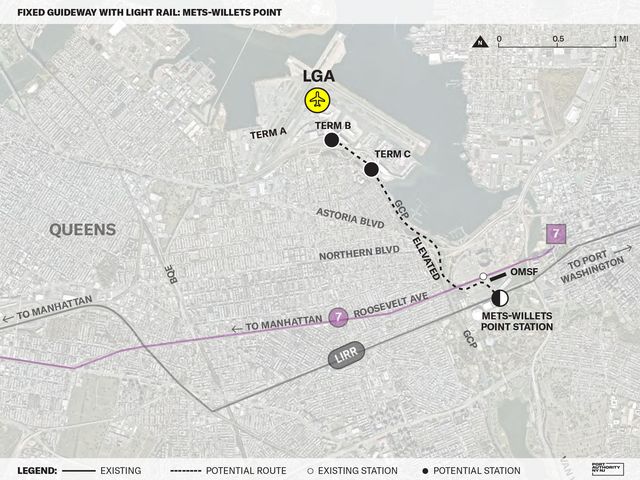
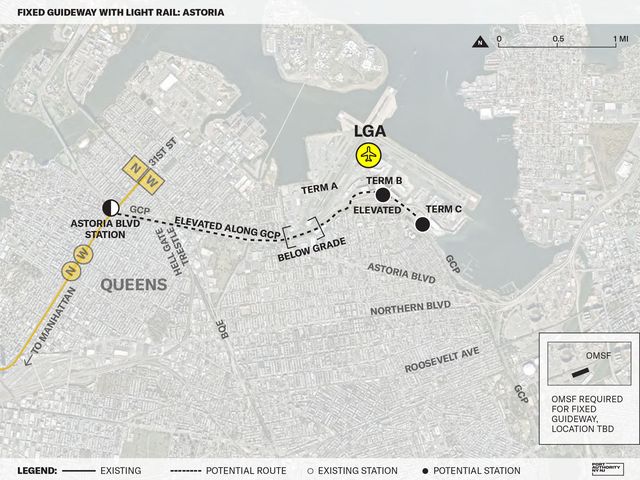
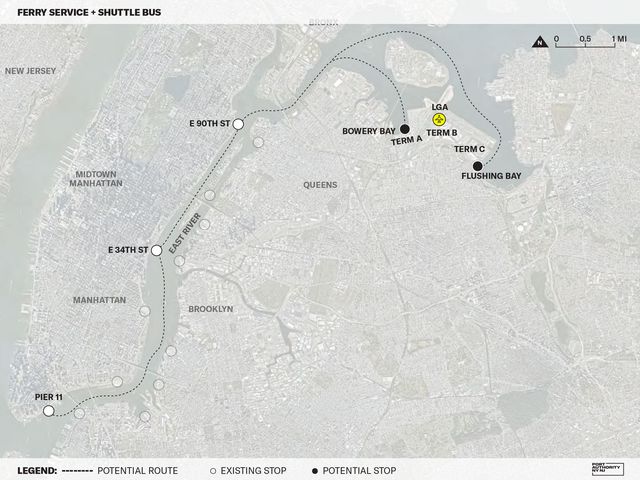
On Wednesday, the Port Authority released sketches for 14 alternatives, including light rail, bus routes and subway extensions. It’s now seeking community input before moving forward.
Renderings from the Port Authority showing possible routes to LaGuardia Airport
Port Authority of New York and New Jersey
Renderings from the Port Authority showing possible routes to LaGuardia Airport
Port Authority of New York and New Jersey
The ideas include several new bus routes, which advocates have said are a low-cost, efficient way to move many people to the airport, as long as the routes are clear of traffic. The proposed bus lines to the airport include a new dedicated route along the Q70 line, which connects to the 7 train’s Roosevelt Avenue station in Jackson Heights, a route for the M60 from Manhattan across 125th Street, the RFK Bridge and down Astoria Boulevard to LaGuardia, as well a a dedicated bus lane from Astoria to the airport.
There are other proposals for new bus routes that would connect to existing N/W subway lines in Astoria
Renderings from the Port Authority showing possible routes to LaGuardia Airport
Port Authority of New York and New Jersey
Renderings from the Port Authority showing possible routes to LaGuardia Airport
Port Authority of New York and New Jersey
Transit advocates cheered when Hochul called on the PANYNJ to find an alternative to former Gov. Andrew Cuomo’s AirTrain project. They said, for $2 billion, there are cheaper, more equitable options. And environmentalists were concerned that Jamaica Bay and Corona neighborhoods would be unfairly burdened by the construction of a new AirTrain.
Still, the new options include light rail routes that would run above and below ground through Woodside, Jamaica Station, Astoria and Jackson Heights. Another would connect to the Mets-Willets Point 7 train stop, along a similar route as the original AirTrain proposal.
Renderings from the Port Authority showing possible routes to LaGuardia Airport
Port Authority of New York and New Jersey
Renderings from the Port Authority showing possible routes to LaGuardia Airport
Port Authority of New York and New Jersey
Renderings from the Port Authority showing possible routes to LaGuardia Airport
Port Authority of New York and New Jersey
“It’s so refreshing to see state leaders acknowledge that there actually are options — besides a backwards parking lot shuttle for better transit access to the airport,” Danny Pearlstein, policy and communications director with Riders Alliance, wrote in an email. “Even if the governor ultimately directs the Port Authority or MTA to build a new rail line, she should opt for one or more of the bus priority projects to roll out in the immediate future. Better buses to La Guardia, with multiple rail connections and dedicated lanes, could begin running in a matter of months, for a tiny fraction of the cost of new rail.”
There are no costs pegged to the proposals yet.
“Governor Hochul directed the Port Authority to thoroughly examine alternative mass transit solutions to increase connectivity to LaGuardia Airport, and we look forward to reviewing input on these options to help ensure world-class transportation to our airport,” Hazel Crampton-Hayes, a spokesperson for the Governor said in a statement.
Given the cost of MTA construction, the proposal to extend the N/W line from 30th Street Station, or Astoria-Ditmars Boulevard to LaGuardia would likely be among the most costly.
Renderings from the Port Authority showing possible routes to LaGuardia Airport
Port Authority of New York and New Jersey
Renderings from the Port Authority showing possible routes to LaGuardia Airport
Port Authority of New York and New Jersey
Renderings from the Port Authority showing possible routes to LaGuardia Airport
Port Authority of New York and New Jersey
Renderings from the Port Authority showing possible routes to LaGuardia Airport
Port Authority of New York and New Jersey
Renderings from the Port Authority showing possible routes to LaGuardia Airport
Port Authority of New York and New Jersey
Ferry options are on the table as well. Advocates previously complained the Port Authority “cherry picked” its criteria to favor Cuomo’s plan, excluding options like ferries the first time.
“There are a lot of promising options before us, but I’ll reiterate what I said when we were fighting the original plan: this needs community input,” State Senator Jessica Ramos wrote in an email. “I need to hear more from my neighbors, so before I endorse a particular option, my office will conduct additional outreach and host opportunities for my community to discuss each of the plans in turn.”
Renderings from the Port Authority showing possible routes to LaGuardia Airport
Port Authority of New York and New Jersey
Renderings from the Port Authority showing possible routes to LaGuardia Airport
Port Authority of New York and New Jersey
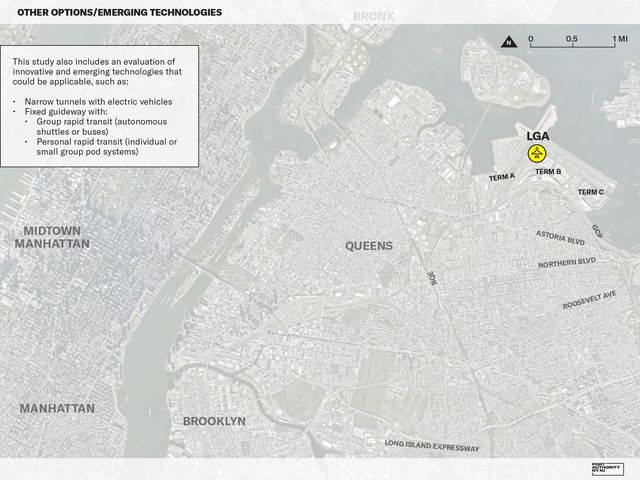
On the last page of the plans, the Port Authority leaves open the possibility that new technologies, which haven’t been proven effective may still be considered, such as “narrow tunnels with electric vehicles” — an idea pushed by Tesla founder Elon Musk. Other ideas such as autonomous buses are being piloted in other cities, but have yet to be tried in New York City.
The government transparency group Reinvent Albany had released a report analyzing the original AirTrain plans and found that per rider, at $2 billion, it would’ve been one of the most expensive transit projects in the world. But now, Jon Orcutt, a consultant for the group, believes the 14 options are more realistic, and affordable.
“I think if you want to get a lot of people to ride transit to the airport, you keep it simple — and to us, that means fix some bus options now and extend the subway later,” Orcutt said. He said a ferry could work, although it’s not clear how people would walk to their destinations. He said adding a light rail option would be too costly and take too long to complete.
“We have a big transit system, let’s just make use of it, “ he said. “In Washington you can take Metro to National, in San Francisco you can take BART into SFO, that’s how you do it.”
The PANYNJ wrote that a questionnaire was sent to 70 key stakeholders, including elected officials and community organizations about these options. In March, there will be two public meetings to discuss the 14 new options.
The in-person public workshops will be held at the LaGuardia Marriott Hotel in East Elmhurst on Wednesday, March 16, from 6 p.m. to 8 p.m., and on Thursday, March 24, at the Astoria World Manor, from 6 p.m. to 8 pm. Attendees will be able to record comments for consideration in the evaluation process.
The business case for the 16 km Surrey Langley Rapid Transit Line will be released by Fall of 2022. However it will not compare the SkyTrain vs other modes like the study in NYC. All the business case will do is give the up to date estimate for constructing a SkyTrain system. Those estimates will allow the project to be tendered.
The staff of TransLink, MOTI and Cities of Surrey and Langley do not want to tell us the truth. The truth is that there are other modes of rapid transit that are better than SkyTrain.
Overall you need a much better bus system to attract more riders to use TRANSIT. Buses in Metro Vancouver carry 70% of the riders. Unless we massively increase our bus service adding few rapid transit stations will do very little to increase the mode split of TRANSIT from the very low of 20% of all trips in the Lower Mainland.
This airtram in New york has nothing to do with Vancouver. Surrey mayor said he would build skytrain part way to Langley for $1.65 billion. This is still true. Partway means within Surrey. That was the cost in 2018. It is four years later, inflation push up the price and still haven’t started construction because government keep bickering about it. Just get it done and build it to Surrey or Langley. It was supposed to be finised by 2025. If they keep delaying, costs will go up. Skytrain to Langley is more direct than the old interurban route through south surrey. It will be much faster. BC transit is extending bus from chiliwack to Burnaby to connect with expo line.
Zwei replies: Do not change history, the Mayor of Surrey said he could build Skytrain to Langley for $1.65 billion.
Basically, you haven’t clue what you are talking about. By the way, how is the weather in New York and why are you bothering to comment on transit issues 4000km away?
@Marriott, the point is that the JFK Air-Train, is using the same technology as the Skytrain, built by the same manufacturer Bombardier.
The La Guardia Airport Air-Train was to be the same or very similar technology as well. A technology which started off cheap but when a real operating needs were taken into account plus an expensive above grade, rail right of way was designed and built, instead of a surface one, the costs grew to gigantic proportions, just like the Surrey to Langley Expo Line Skytrain Extension.
Considering the tight finances of the province of B.C. and the fact that, Translink had to completely back out because it could no longer afford its portion of the SLS project, making it a completely provincially run project, the SLS , is probably going to be delayed long past its planned 2028 start date.
The JFK Air-Train project had to be rescued by our federal government backed, Business Development Bank of Canada because construction costs kept growing and or being added on to the project. Originally, the JFK project was going to be finaced mainly by Bombardier and the Kennedy Airport Authority (as a junior partner). The point was to showcase the LIM propulsion and Automatic Train Control System.
The airport authority, the City of New York , the New York State government, the US Department of Transportation kept forcing more and more add-ons to the project and then acted so surprised when the costs had more than doubled. The Federal Government in the US was going to cancel all the project’s approvals, so to save Bombardier from an international embarrassment, our Federal Government stepped in and under-wrote the majority of the capital cost (accepted the financial risk for the project) and then gave grants and loans to Bombardier to finish the project. I use to work there (Bombardier), when this was going on.
To be fair, that is essentially what the BDC is supposed to do. The BDC is there to give financial aid and support to projects by Canadian companies taking place outside of Canada. Bombardier unfortunately used its connections to bail out the JFK Air-Train Project. The BDC wasn’t supposed to rescue international projects that had started without them. They would have insisted on much greater cost and scope control, immediately, if they had been involved from the beginning of the project.
Airport authorities are notorious for raising the costs on airport rail lines because they generally want multi-story structures supporting those rail lines instead of simple surface lines, that can take away space for parking lots and parking garages, hotels and shopping malls. The resulting railway viaducts are expensive and time consuming to build and mostly unneeded. Remember, structural concrete has been going up in price 2 to 3 times the rate of inflation in North America every year since the middle of the 1990’s. The only thing that stopped it was the pandemic and the worldwide slowdown of construction projects. With everything opening up again (hopefully) expect that price to spike especially because of the current war and the increase in the price in oil. Steel reinforcement rods in reinforced structural concrete are coated in plastic (which is made from oil) to keep out moisture, hence their price will increase as well.






The business case for the 16 km Surrey Langley Rapid Transit Line will be released by Fall of 2022. However it will not compare the SkyTrain vs other modes like the study in NYC. All the business case will do is give the up to date estimate for constructing a SkyTrain system. Those estimates will allow the project to be tendered.
The staff of TransLink, MOTI and Cities of Surrey and Langley do not want to tell us the truth. The truth is that there are other modes of rapid transit that are better than SkyTrain.
Overall you need a much better bus system to attract more riders to use TRANSIT. Buses in Metro Vancouver carry 70% of the riders. Unless we massively increase our bus service adding few rapid transit stations will do very little to increase the mode split of TRANSIT from the very low of 20% of all trips in the Lower Mainland.
This airtram in New york has nothing to do with Vancouver. Surrey mayor said he would build skytrain part way to Langley for $1.65 billion. This is still true. Partway means within Surrey. That was the cost in 2018. It is four years later, inflation push up the price and still haven’t started construction because government keep bickering about it. Just get it done and build it to Surrey or Langley. It was supposed to be finised by 2025. If they keep delaying, costs will go up. Skytrain to Langley is more direct than the old interurban route through south surrey. It will be much faster. BC transit is extending bus from chiliwack to Burnaby to connect with expo line.
Zwei replies: Do not change history, the Mayor of Surrey said he could build Skytrain to Langley for $1.65 billion.
Basically, you haven’t clue what you are talking about. By the way, how is the weather in New York and why are you bothering to comment on transit issues 4000km away?
@Marriott, the point is that the JFK Air-Train, is using the same technology as the Skytrain, built by the same manufacturer Bombardier.
The La Guardia Airport Air-Train was to be the same or very similar technology as well. A technology which started off cheap but when a real operating needs were taken into account plus an expensive above grade, rail right of way was designed and built, instead of a surface one, the costs grew to gigantic proportions, just like the Surrey to Langley Expo Line Skytrain Extension.
Considering the tight finances of the province of B.C. and the fact that, Translink had to completely back out because it could no longer afford its portion of the SLS project, making it a completely provincially run project, the SLS , is probably going to be delayed long past its planned 2028 start date.
The JFK Air-Train project had to be rescued by our federal government backed, Business Development Bank of Canada because construction costs kept growing and or being added on to the project. Originally, the JFK project was going to be finaced mainly by Bombardier and the Kennedy Airport Authority (as a junior partner). The point was to showcase the LIM propulsion and Automatic Train Control System.
The airport authority, the City of New York , the New York State government, the US Department of Transportation kept forcing more and more add-ons to the project and then acted so surprised when the costs had more than doubled. The Federal Government in the US was going to cancel all the project’s approvals, so to save Bombardier from an international embarrassment, our Federal Government stepped in and under-wrote the majority of the capital cost (accepted the financial risk for the project) and then gave grants and loans to Bombardier to finish the project. I use to work there (Bombardier), when this was going on.
To be fair, that is essentially what the BDC is supposed to do. The BDC is there to give financial aid and support to projects by Canadian companies taking place outside of Canada. Bombardier unfortunately used its connections to bail out the JFK Air-Train Project. The BDC wasn’t supposed to rescue international projects that had started without them. They would have insisted on much greater cost and scope control, immediately, if they had been involved from the beginning of the project.
Airport authorities are notorious for raising the costs on airport rail lines because they generally want multi-story structures supporting those rail lines instead of simple surface lines, that can take away space for parking lots and parking garages, hotels and shopping malls. The resulting railway viaducts are expensive and time consuming to build and mostly unneeded. Remember, structural concrete has been going up in price 2 to 3 times the rate of inflation in North America every year since the middle of the 1990’s. The only thing that stopped it was the pandemic and the worldwide slowdown of construction projects. With everything opening up again (hopefully) expect that price to spike especially because of the current war and the increase in the price in oil. Steel reinforcement rods in reinforced structural concrete are coated in plastic (which is made from oil) to keep out moisture, hence their price will increase as well.