Old Zwei has told you so, operating driverless trains is very expensive.
In December 2019, it was reveled that the SkyTrain Light metro system (Expo and millennium Lines, had over 900 employees.
That is over 900 workers for just two rail lines.
The Canada line, being a P-3, has it own employees and the number of people working on the SNC Lavalin.Caisse du’Depot lead concession operating the light metro line is deemed proprietary and not released.
In 201 it was revealed that the driverless Canada Line had 180 control room workers, maintenance people and attendants and are represented by B.C. Government and Service Employees Union who are currently negotiating a new contract.
Thus the SkyTrain light metro line has over 1,080 unionized workers and this does not include management.
What what is even more expensive is extending driverless trains into areas of smaller populations simply because the huge maintenance costs to keep a driverless train operating far outweighs any transportation benefits. This is the problem facing the Expo line extension to Langley as the $40 million annually in extra operation and maintenance costs (TransLink’s estimates) and the $500 million to $1 billion Operations and maintenance centre, far outweigh any benefits.
What will happen is simple, the now $5 billion Expo line extension will cannibalize the rest of the transit system and with inflation and a general reluctance of the taxpayer to pay more taxes will mean the money must come from the rest of the transit system in higher fares and user fees.
And to think, that because of the actions of the current idiot Mayor of Surrey, who said he could build the Expo line extension to Langley for $1.63 billion, supported by the other idiot mayors on the Mayor’s Council for Transit, yet for a little more than half the cost of the current 16 km, $5 billion light metro extension to langley, a larger light rail network, extending to Langley would be opening in 2024!
Driverless train, operating at-grade also need to be protected by 3 metre, razor wire topped fencing.
Costs of Sydney’s driverless train conversion outweigh the benefits
The NSW government’s industrial dispute with rail unions over the new intercity trains is tipped to add hundreds of millions of dollars to costs on Australia’s largest infrastructure project that has already blown out by billions.
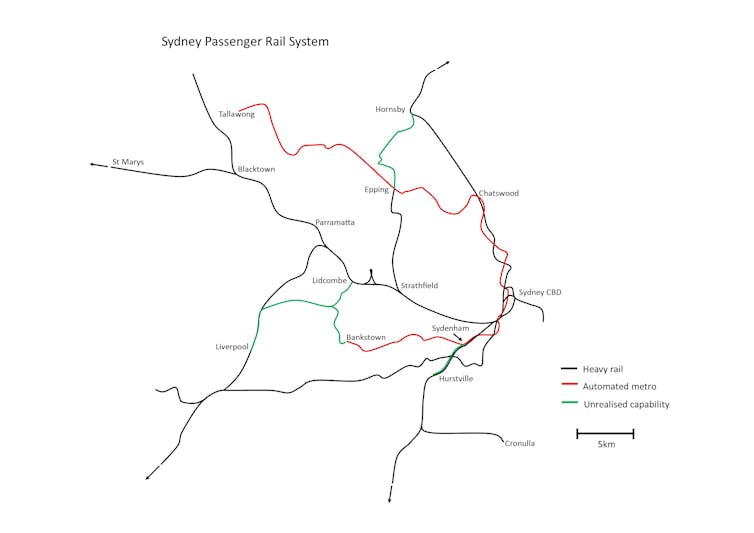
But even without overruns pushing the cost of the driverless-train project to more than A$55 billion, the economics of the “Sydney Metro” project are questionable – in particular the decision to cannibalise parts of the existing Sydney train network to create one of the four planned automated routes.
The new driverless trains – as used in megacities throughout the world – have fewer seats, increased standing room, and more doors than Sydney’s main fleet of double-decker trains, making them better suited to peak-time congestion.
The Metro project promises to deliver up to 15 services an hour (every four minutes) to cope with Sydney’s growing population.
Driverless trains will eventually operate on three lines from the CBD (to the northwest, west and southwest) and one in far-western Sydney, connecting to the city’s second airport site at Badgery’s Creek.
By far the biggest cost for the project are new tunnels under the harbour and CBD. Our focus, however, is on the merits of cannibalising existing rail infrastructure – namely the rail line to Bankstown, about 16km southwest of the Sydney CBD – for the southwest Metro line.
This part of the project involves converting 11 stations between Bankstown and the inner-eastern suburb of Sydenham. (A new tunnel has been built from Sydenham into the CBD, where the line links to the Northwest Metro line).
Our analysis shows the costs, disruptions and lost opportunities associated with converting this line for the Metro network outweigh the benefits and potential savings, largely achieved from replacing drivers.
Straightening the line
Automated trains are now commonplace in cities throughout Asia, Europe and the Middle East. Their high-frequency services and platform screen doors enable the transport of large numbers of commuters with minimal staff supervision. They have proven safe and effective
The issue is whether they are worth cannibalizing existing services for. There are two main calculations to consider: the initial cost; and the ongoing costs.
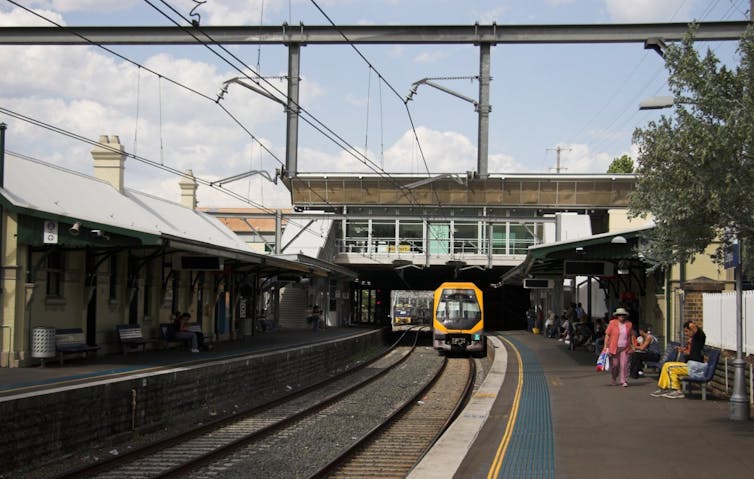
In terms of initial costs, the Bankstown line is not well-suited for automatic trains. Automatic trains, which stop precisely at gateways on enclosed platforms, require straight platforms. The Bankstown line, and five of its station platforms, are sharply curved.
Straightening up: the curved platform of Campsie train station, on the Bankstown line in south-western Sydney, is being converted for automatic trains as part the NSW government’s Sydney Metro rail project.Wikimedia Commons, CC BY
Calculating the full cost of making these right for driverless trains is complicated, because maintenance and renovations to improve accessibility and amenity would have happened in any circumstance.
Based on the NSW government’s public announcements, we estimate converting the line and stations to driverless trains will cost about A$1 billion. We conservatively estimate $500 million of that is purely to meet the operating requirements of driverless trains. This excludes the cost of new train storage, control systems and power upgrades specifically incurred by the choice of automated trains.
Savings on drivers
On the other side of the ledger are potential savings – notably on driver costs. We estimate operating the Bankstown railway as an automated metro will save about $15 million a year on driver costs.
This is based on the driver cost of providing train services at least every 10 minutes all week, and every five minutes during peak times. The NSW government has indicated Metro services will operate up to every four minutes, but the timetable for the Bankstown line metro is not yet public.
We estimated driver costs based on the May 2022 timetable for the Bankstown line – about 1,500 services a week (1,210 during the week, and 324 at weekends). To approximate matching the higher frequency promised by the Metro trains, we calculated driver costs for 1,900 services a week.
This would require employing about 100 drivers, allowing for normal working hours, holidays and other leave. Based on the cost of employing a driver, including administrative overheads, being about $150,000 a year, the savings from replacing drivers on this line is about $15 million a year.
Assuming a 5% rate of return on the $500 million cost to automate the line, this saving is offset by the $25 million a year in opportunity costs on the $500 million line conversion.
Time for a rethink
Augmenting established rail networks with new automated rail services is one thing. Cannibalising existing infrastructure to build those new lines is quite another.
Fortunately for taxpayers, the NSW government is not repeating this conversion approach with the other Metro lines.
By our calculation, Sydney would be better served by following the approach adopted in Melbourne and Brisbane. Both cities are investing heavily in new rail lines, but they are acquiring new trains compatible with their existing railway systems.
This would make much more sense for the Metro line yet to be built between the CBD and the western-Sydney centre of Parramatta.
Greater compatibility will enable services to be readily extended onto existing tracks west of Parramatta while avoiding the cost and complexities of the Bankstown line conversion.
I have always said that there is little if any savings when you automate rail lines. The more expensive and operationally complex infrastructure compared to non automated rail line infrastructure, eats up any savings you actually get by automation. Especially, as the line or network of lines ages, requiring considerably more maintenance and upgrades, like the current and rapidly aging Expo Line needs, than non automated rail transit lines. I have seen this story for 25 years. Any talk about the automation of rapid transit, usually comes down to trying to “control union costs” and “union bashing”. This approach rarely saves any money. Many of the people who make these automation decisions have little idea how rail based rapid transit lines and networked rail rapid transit lines actually function. Simply getting rid of operators (drivers) saves very little money. The big costs are rail vehicle maintenance and right of way maintenance, something that the current automated LIM propulsion driven Skytrains and their associated infrastructure are notorious for.
Zwei replies: I agree 100%. This post was to counter what a current politician said on the radio, a few weeks ago, “That everyone knows driverless railways are always cheaper to operate, SkyTrain has virtually no operating costs!”




I have always said that there is little if any savings when you automate rail lines. The more expensive and operationally complex infrastructure compared to non automated rail line infrastructure, eats up any savings you actually get by automation. Especially, as the line or network of lines ages, requiring considerably more maintenance and upgrades, like the current and rapidly aging Expo Line needs, than non automated rail transit lines. I have seen this story for 25 years. Any talk about the automation of rapid transit, usually comes down to trying to “control union costs” and “union bashing”. This approach rarely saves any money. Many of the people who make these automation decisions have little idea how rail based rapid transit lines and networked rail rapid transit lines actually function. Simply getting rid of operators (drivers) saves very little money. The big costs are rail vehicle maintenance and right of way maintenance, something that the current automated LIM propulsion driven Skytrains and their associated infrastructure are notorious for.
Zwei replies: I agree 100%. This post was to counter what a current politician said on the radio, a few weeks ago, “That everyone knows driverless railways are always cheaper to operate, SkyTrain has virtually no operating costs!”