Tours ‘architecture in motion’ tram unveiled
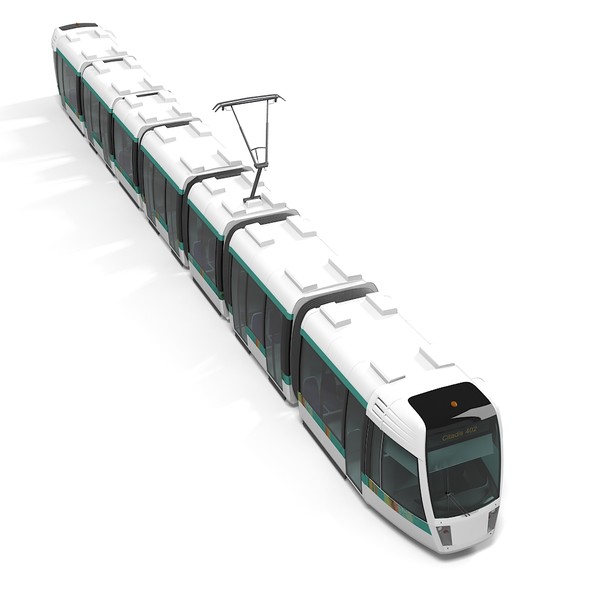
The new Alstolm trams being delivered to Tours certainly demonstrates the 21st century streetcar or tram. The 43.7 metre (143.3 feet), seven section articulated tram has a nominals capacity of 300 persons, with seating for 88. This equals the capacity of a four car rake of Mk.1 vehicles.
Being 100% low-floor, means easy access for the mobility impaired without the need of complicated and expensive lifts and elevators, something that is generally overlooked by TransLink’s planners and engineers.
The Citidis 402 tram, operating on Broadway eacould move over 9,000 persons per hour per direction at 2 minute headways;Ai?? 13,500 pphpd at 90 second headways and 18,000 pphpd at 1 minute headways.
Tours ‘architecture in motion’ tram unveiled
October 2, 2012
FRANCE: The first Alstom Citadis 402 tram for the line under construction in Tours was unveiled to the public during an open day at the maintenance depot on September 30.
Transport authority SITCAT awarded Alstom a ai??i??73m contract to supply 21 of the seven-section trams in September 2010, and the first was delivered from Alstom’s La Rochelle plant two years later. The Tours cars are 43Ai??7 m long and 2 400 mm wide, with 12 double doors, four single doors and a capacity of about 300 passengers, including 88 seated.
Styling agency RCP developed the ‘architecture in motion’ theme for the trams. A mirrored outer covering applied as 300 pre-cut pieces of adhesive film is intended to reflect the surrounding urban environment and resemble the River Loire. The tram fronts feature two vertical strips of LEDs aligned with the rails.
Construction of the 15 km north-south line from LycAi??e Vaucanson to LycAi??e Jean Monnet with 29 stops began in 2010, and opening is planned for September 2013. APS catenary free-operation will be used on a 1Ai??8 km section where the line runs through the World Heritage city centre.



This would do wonders on Broadway in Vancouver to not only solve the poor service to UBC (occasional overcrowding in the morning) but also do away with the horrendous noise and emissions from the 99 B-Line diesel buses which are not even meeting national and international noise and emission standards.
Along the Broadway corridor, the 99 B-Line has the ability to carry “up to” about 100 people every two minutes (3,000 people every hour, one way at peak times). Even though, there are other buses on the Broadway corridor, many of the other buses merely transfer riders to the 99 B-Line, and TransLink is counting these riders twice to exaggerate the actual “transit demand by living people” as opposed to cloned and imagined people along the Broadway corridor.
A tram line with the ability to carry 9,000 to 18,000 people per hour would eliminate every bus on the Broadway corridor and transit users would all likely have an air conditioned seat.
My only suggestion for the City of Vancouver is to kindly tell TransLink to quit wasting our time with more planning for another $3.5 billion SkyTrain line to UBC and to transfer payments from the province to the City of Vancouver so that the City of Vancouver engineers can use the money to build and operate a $300 million tram line along the Broadway corridor – before TransLink is sued by disgruntled residents who are being harassed by crazy noise levels and poisoned by the excessive toxic emissions on the 99 B-Line diesel bus route.
The Citadis 402 is a modular LRV system that can have 2 – 7 sections and can operate in 3 car trains. The only real limit is the modern LRV’s very poor turning radius compaired to the much smaller traditional streetcar. The TTC had to severely alter the trucks and their relative position so that they could fit in the tight city curves as well as never operate multiple car trains. The Toronto LRT lines will use unaltered versions of this vehicle. Does TransLink have tight curves on the Sky Train and the Canada Line systems? Most new LRV’s have a minimum turning radius of 25 metres and higher if cars are coupled together. The TTC have to build a new carhouse due to the tight curves and small spaces of the existing ones.
Zweisystem replies: Except for some very tight curvature in the maintenance yard, the tightest curvature on the SkyTrain system is the very tight chicane immediately West of Main street station. The rails have been replaced many times there.