TransLink Decieves Surrey – Planning Flim-Flam Continues
Hey buddy, want to buy a good used car” Then go to ‘Honest‘ TransLink and they will fit you up nicely.
Well it seems that TransLink has fitted up Surrey and Langley nicely with their very questionable “rapid transit plans“. As usual TransLink deceives the public about LRT and one has to ask the question why?
Why is TransLink ignore over thirty years of LRT development including modular cars, TramTrain, freight trams and much more?
Why does TransLink discounts the ability of LRT to carry high volumes of ridership?
Why does TransLink misinform the public about the economy of LRT?
It is truly sad that TransLink’s massive economies of the truth are allowed to stand and South Fraser politicians should demand an independent review of TransLink’s planning.
To quote American transit expert, Gerald Fox, with a review of the Evergreen Line’s business case;
“It is interesting how TransLink has used this cunning method of manipulating analysis to justify SkyTrain in corridor after corridor, and has thus succeeded in keeping its proprietary rail system expanding. In the US, all new transit projects that seek federal support are now subjected to scrutiny by a panel of transit peers, selected and monitored by the federal government, to ensure that projects are analyzed honestly, and the taxpayersai??i?? interests are protected. No SkyTrain project has ever passed this scrutiny in the US.
Post Script: I still see Surrey high school student, Daryl Cruz, is still pretending to be a transit annalist, as Zweisystem has said before, when dealing with TransLink and the SkyTrain lobby it is strictly caveat emptor!
PPS: It is time for the South Surrey municipalities and cities to secede from TransLink.

SkyTrain to Langley top rapid transit option for Surrey: TransLink
By Jeff Nagel – Surrey North Delta Leader
Published: March 06, 2013 12:00 PM
Updated: March 06, 2013 2:57 PM
New rapid transit studies released by TransLink have handed more ammunition to backers of SkyTrain technology through Surrey to Langley as well as on Vancouver’s Broadway corridor toward UBC.
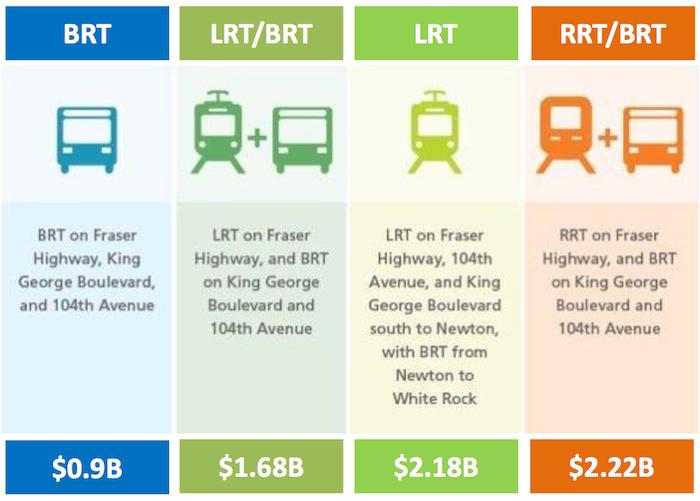
A SkyTrain line running above Fraser Highway from Surrey City Centre to Langley, coupled with Bus Rapid Transit (BRT) lines running south to White Rock on King George Boulevard and east to Guildford on 104 Avenue is the most expensive of four short-listed options at $2.22 billion, but TransLink found it delivers the most transportation benefits and by far the highest ridership.
It would also be the fastest, carrying passengers from Langley to Surrey Central station in just 22 minutes, compared to 29 or 30 minutes for the other three options.
Surrey council has lobbied for a network of ground-level light rail (LRT) lines, rather than BRT or elevated SkyTrain, arguing LRT would be a better fit for the city’s neighbourhoods.
TransLink previously studied a dozen different technology permutations in Surrey before winnowing them to the four front runners.
The option closest to the city’s preference would run light rail trains on all three corridors radiating from downtown Surrey, with BRT rapid buses running on the southern section of King George from Newton to White Rock as light rail isn’t considered justifiable there.
At $2.18 billion, that would be only slightly cheaper than the SkyTrain/BRT option, but is estimated to attract only half the new transit riders as SkyTrain because light rail trains run more slowly and less reliably at street level with traffic.
The main downside of SkyTrain is the elevated guideway down Fraser Highway would be an eyesore, while BRT and LRT offer more scope to improve urban design.
Surrey transit advocate Paul Hillsdon, who previously backed light rail, now prefers the SkyTrain option (with BRT running to Guildford, Newton and White Rock), adding it clearly outperforms LRT at virtually the same cost.
“Based on the cost, there seems to be very little benefit to pursuing the light rail system as the city has advocated,” Hillsdon said.
He added TransLink may have inflated the light rail costs somewhat compared to systems built elsewhere, but he accepts the findings.
“There are huge travel time savings with SkyTrain and double the ridership, for basically the exact same price.”
But he said SkyTrain on Fraser Highway would depend on neighbourhood acceptance of denser development ai??i?? SkyTrain could bring high-rise towers, not just mid-rises, to Fleetwood and Clayton.
Despite the city’s goal of densifying King George, Hillsdon noted that hasn’t happened, while growth has concentrated in areas like Clayton and Grandview instead.
BRT, which delivers the southern leg to South Surrey/White Rock in all options, does not simply mean adding more buses.
A BRT line would run high-capacity articulated buses in their own dedicated lanes, with traffic priority ai??i??Ai??functioning much like a light rail system on rubber wheels instead of tracks.
Surrey Coun. Barinder Rasode said council definitely wants light rail, not just express-bus BRT, on King George to densify that corridor, in line with city plans.
“We’ve been very clear that our option would be LRT, not just because of the cost but because it is less intrusive to the community,” Rasode said.
Light rail passengers riding at street level would be more likely to stop and shop at Surrey businesses, she said, than an overhead Skytrain whisking residents to other cities.
“It’s about economic investment in our own city,” Rasode said. “We don’t want mass rapid transit running right out of the city every time. We don’t want people to just be transported straight out to Langley.”
The $2.18-billion LRT scenario would still require passengers arriving from South Surrey and White Rock on BRT buses to transfer to trains in Newton.
A cheaper option, at $1.68 billion, would run light rail on Fraser Highway to Langley and BRT on the King George and 104 corridors.
The cheapest scenario still on the table is running BRT on all three corridors at a cost of $900 million.
Also released was a study of options for rapid transit on Vancouver’s heavily congested Broadway corridor to UBC.
Again, the most expensive option ai??i??Ai??a $3-billion underground SkyTrain line down Broadway ai??i?? also ranks as having the highest benefit, most ridership and best speed and reliability.
At-grade LRT could be built to UBC for $1.1 billion, while tunnelled LRT or a combo LRT/subway scenario could run $1.4 to $2.7 billion.
TransLink plans to lead regional discussions with the public, elected officials and other stakeholders to examine the trade-offs of the options and decide on preferred options for the Surrey and Vancouver expansions.
“We’re not picking one over the other,” said Bob Paddon, TransLink’s executive vice-president of strategic planning and public affairs. “We’re nowhere near identifying a preference.”
Paddon said the short-listed options perform differently depending on what criteria is considered and the goals of the local communities, adding more detail on TransLink’s findings will be released in the weeks ahead.
Nor is it clear yet how either new transit line will be financed.
Area mayors are pressing the province for new funding sources for TransLink, but Paddon noted there would also have to be large capital contributions to the new linesAi?? from the federal and provincial governments.
“You can’t do rapid transit without senior government involvement.”
No decision has been made on whether a Surrey or Vancouver rapid transit expansion should be built first.




TransLink studies by UBC Sauder economists who receive grants and data from TransLink and who are not engineers show sky train to be superior to at grade light rail transit and trams used in the rest of Canada says Jeff whose newspaper receives advertising money for publishing the right facts from TransLink. Jeff isn’t a journalist. He is one of many media stooges working for TransLink.
Accountants at TransLink and low calibre transportation engineers at the COV have managed to alienate academics and draw the ire of fellow chemical, mechanical and electrical engineers who do engineering designs for their projects and who can think circles around them. Rogue TransLink is on the same path as North Korea and Iran. This can only end in one way.
TransLink is flooding the media with lies and is using taxpayer money to spread misinformation. This will haunt TransLink soon and TransLink’s NDP friends won’t be able to save TransLink.
@Eric
Really need to do your research. The rest of Canada is building LRT systems with a lot of grade separation that end up costing more per km than SkyTrain. Check the latest LRT in Calgary plus the lines under construction in Ottawa and Toronto. While Ottawa has essentially the same capacity as SkyTrain due much longer stations and pretty much total grade separation, the Toronto Eginton LRT has significant less capacity.
Zweisystem replies: Once you grade separate LRT, it ceases to be LRT but instead it becomes a hybrid light-metro. In North America, dishonest transit planning by engineers and pseudo transit planners call many hybrid light-metro schemes LRT because it is more politically accepted. It is not the vehicle that defines LRT, rather the quality of rights-of-way.
@Zweisystem
Then when you are counting LRT systems, don’t include those systems. Include them in a separate category or with light metro. That would even up the numbers somewhat.
So in Canada, that would mean currently no LRT systems are under construction but 3 light metros. That would make 4 metros including the one under construction Toronto.
Zweisystem replies: Richard you love affair with SkyTrain and light-metro knows no bounds; who is paying your continued association with SkyTrain?
poking Richard or Dick;
pray Dick, why on earth should we do what you are aking us to do, if you are counting up you are looking to establish a total, not to even up scores?
Your method sounds like a right old screw up, does it not?
So how many Streetcar, Tramway, LRT or Light-Metro systems in total are currently being built?
Zweisystem replies: I’m afraid the SkyTrain lobby are a one trick pony.
@Zwei
How come whenever someone presents you with facts or a good argument inconsistent with your beliefs, you resort to personal attacks? How about sticking to the issue and the facts.
Zweisystem replies: I do stick to the facts, in fact this blog is vetted by “real” transit experts and if I say anything that is not true, it is corrected. Sadly it is your argument that has a basis of questionable facts.
One wonders at the dearth of knowledge that those proposing a subway in Vancouver possess. The Canada Line was seen as a one off, to satisfy a colonial mind-set at having a subway because the mother country has a subway, but a subway under Broadway is more than a joke, it makes transit planning in Vancouver a farce.
Has anyone actually looked at the traffic flows along Broadway? It seems only Zweisystem has, which certainly shows that those in charge really don’t have a clue what they are talking about.
I do not think that politicians and planners in Vancouver clearly understand how silly they look with the wider transit fraternity around the world. At least in the United States, they have ten times the population to fund gold-plated transit projects but not so in Canada.
The quest for grade separation is a mantra that is decades out of date, as it has priced itself out of the market. To bad for the taxpayer, they are being taken for a very expensive ride.
@Zwei
Your posts and comment responses are filled with insults of and attacks on commenters, politicians, staff, experts and consultants. The majority of arguments that are presented are easily disproved or are based on logical fallacies. This has been pointed out over and over again. As such, the likelihood on convincing anyone in a position of authority is practically nil. After 30 years of getting nowhere, maybe it is time to revalute.
Zweisystem replies: Richard, you follow the Goebbels Gambit, you repeat lies so often that the public begin to believe it. One can’t reevaluate the truth. Why post here if you don’t like it? oh yes, you are a troll, spewing misinformation.
I.k. Brunel, you know I read a fair amount of international transit blogs and off the top of my head the only negative international comments I can recall are old and out of date (1980’s). At that time Gerald Fox did a study comparing operating costs of automated systems in N. America to LRT and the data from skytrain at 2 years old did not look good…my how times have changed, skytrain went from the highest to the lowest operating and maintanance costs. And with that change people started to take Vancouvers transit system seriously. I am truely interested and would love to read some recent (2000 or newer?) international critics of Vancouvers system could you provide a few links?
The reason I have not commented about the pphpd on the Broadway corridor now or in the future is The numbers have not been published and to calculate pphpd based on the information available (you need to know a lot about travel patterns on the corridor) is difficult. So although Zei is making a wild assed guess there is a possibility he is correct. That said my best guess for the Broadway corridor (Broadway and associated routes) is between 7000 and 10000pphpd currently. A related issue is of course do we care? Obviously we do care if the system can not handle the required capacity but other than that it is only one factor in a cost benefit analysis. We care a whole lot more about the number of riders or the numbers of boardings because from those we can estimate the revenue side of the equation
Sorry, toddler helping and submit was pressed early.
The numbers we do know 150,000 boardings a day at opening are pretty good, especially if you consider it will be well over 300,000 in 2041.
As far as I can tell most medium to high capacity routes recently built or proposed have a high degree of grade seperation.
Zei, thank you for funny comments. I love it when YOU accuse someone of using propaganda. And the line about ‘real’ transit experts vetting your comments is a zinger too.
Zweisystem replies: Most grade separation occurs when out of control engineers, bamboozle politicians to ante up scads of taxpayer’s monies to gold plate a transit line. Today, the engineering fraternity is more interested feathering their own financial well being instead of the taxpayer.
Who is a transit professional in Metro Vancouver, oh they don’t work for TransLink, which has now become the repository of the inept.
The Fox study comparing AGT and LRT is not out of date and the findings have been borne out in revenue service; small automatic light metros are not cost effective when compared to light rail. You should notice that no one actually builds with Vancouver’s SkyTrain today and if a light metro is being built, such as Honolulu, it is only after tens of millions of dollars have been spent by by the owners of such metros, grooming politicians and planners to select an automatic metro.
You have fooled yourself Mr. Rico, from what the transit fraternity has seen of Skytrain, it is very expensive to maintain, again lack of sales shows that SkyTrain is not economically viable unless there is rather large subsidies.
There is not much to read about Vancouver’s transit machinations and no one really cares. I do not think that the transit alchemists are able to turn SkyTrain lead into LRT gold, without much smoke and mirrors, certainly they have not fooled planners on this side of the pond, nor below the 49th. Again, lack of sales point to the fact that not all is what it seems, with TransLink and SkyTrain.
SkyTrain is and forever will be a ‘gadgetbahnen’, costing more to build and maintain than it competitors. Surely the Canada line has demonstrated that to politicians in Vancouver.
To answer this post, I researched the bus service along Broadway and from TransLink’s timetables, it certainly looks like traffic flows are less than 5,000 persons per hour per direction and nowhere near the 7,000 to 10,000 an hour you claim. The complete lack of real ridership figures from TransLink makes me think that they are hiding something.
What is most disturbing is the out right distortions presented by TransLink and Vancouver officials about the ability of LRT to cater to high loadings. This is dishonest and I am afraid to say, if you support this dishonesty, then your argument becomes dishonest and no more discussion is needed.
I also find it disturbing that so many supporting SkyTrain depend on ‘links’ rather than hard copy studies and plans. Most of the research on modern urban transit is not on line, rather in large books or texts, which are quite costly to purchase.
The Hass-Klau series of studies starting with ‘Bus or Light Rail Making the right Choice’ is a good example, as there is no links except for this.
http://www.etphassklau.co.uk/books/bus-or-light-rail-making-the-right-choice-second-edition/
You want to read the study, you must buy it.
Links are for amateurs, texts are for professionals, which I think well describes the SkyTrain types very well as they do not provide ‘hard’ case studies, but rely on links, which for many are not very professional at all.
I.K.Brunell, so what you are saying is you’ve got nothing. Typical.
Zweisystem replies: It is you Rico that has nothing, but come here to do troll posts. It is obvious you have never read much on the subject, nor want to. Your sole job is to nay say light rail and the job is easier to do when you are ignorant on the subject.
On the computer today, by using various links, I can prove:
1) The holocaust did not happen.
2) 9-11 was a CIA inside job.
3) President Kennedy was assassinated by the CIA, on orders from the US military or Moscow, or IBM or all three.
4) and the lists go on and on.
Links mean nothing much these days, except sound bites of limited information. The real studies are very expensive texts and if you had taken the time to read and understand them, you would better understand the transit issue.
Indeed all sorts of conspiracy wackos link to ‘Rail for the Valley,’ the thing about links is they should be referenced and people can determine whether the source is reliable or not. Claiming expensive textbooks are the only source of your mythical knowledge is a cop out (since you claim to have an extensive transit library (and I see no reason to disbelieve you on that) reference the appropriate text to support your claims (text, author, date and page would work for me)). The important thing I learned in University is how to look for the knowledge I need….and that was before the internet was as useful as today. The internet is a big and wonderful place and although many texts are not available online many are, and of those that are not fully available online many are partially available on line and most have abstracts and summaries on line. Indead if you can’t find any valid sources to support your positions maybe you should consider whether you hold valid positions.
Zei and IK Brunell, since you both seem to be so confident in your statements about the current pphpd of the current Broadway corridor perhaps you could explain how you came up with your numbers….without I assume an intimate knowledge about the traffic flows…how long the peak is, how much traffic in the other direction, how long the trips etc. I am assuming a wild assed guess but maybe you have information I don’t.
IK Brunell, I don’t care enough to reread the Fox study but I seem to recall the sample size of automated metros was small and at the time (a mere two years into Skytrain) Skytrain had costs slightly higher than comparable LRT systems in North America….however if you bothered to look operating/maintainance costs for skytrain (cost per boarding) has steadly DECLINED while the average cost per boarding for LRT in North America has close to tripled over the same period. Pretty sure Skytrain also has the lowest operation/maintainance cost per revenue km in North America. If I have to I can find and link to sources (then people can determine if they are trustworthy sources). It is possible the Fox study is still relevant to the debate and Vancouver is just an outlier but I would bet the trends on other automatic metros are similar.
Zweisystem replies: Rico, I don’t know if you are just stupid or a paid troll by TransLink, but one tires of your blatant ignorance about transit issues, especially light rail. Here is a hint, in an age of unprecedented investment in regional transit around the world, SkyTrain (and the VAL system) have failed to find a market. Both mini-metros are now being touted as “rapid transit”, somehow thinking this will fool the punters.
Rico, you remind me of the “Tea Party” types in the USA, grossly ignorant and will shout down anyone who dares to have a contradictory opinion. Again you rely on TransLink’s accounting, accounting methods that do not include an over $300 million annual provincial subsidy.
Rico, read a book, invest in transit research, take a degree in “Urban transportation Systems”, don’t rely on links.
I can now see Mr. Zweisystem’s exasperation with Mr. Rico, as the arrogance of ignorance displayed is breathe taking.
Do you think that the many thousands of people who plan,design, build, and operate transit systems around the world rely on ‘links’ for their education; do you think it is that easy? Yet, you have the affrontery to call me and others names because we have the education to understand transit issues and you don’t.
I only pursue this blog because because it gives one insight at the hurdles one has in proposing affordable LRT, as the chorus of those opposing light rail is world wide. You are not alone Mr. Rico, as you belong to a rather large cadre of naysayers, flat earth society types and Luddites, who refuse to meet the challenges of today’s transit planner. Building subways is all too easy, all you have to do is throw huge amounts of money at the project. The real skill is designing regional transit cheaper, using skills learned in universities, colleges and polytechnics. Just to let you know, SkyTrain is not in the syllabus.
You are not worth continuing this debate, because you don’t know how, your mind is shut. Good day sir!
Without jumping into this particular fray, I would be interested in a list of good sources regarding transit planning. A list of books and journal articles would be great. I have access to university and municipal libraries which often provide access to esoteric journals. I may also have a few dollars to spend on particularly good articles if it comes to it. Even a list of authors would be helpful. At the very least, this would provide a head start on researching the topic in more depth.
A page of transit resources (links, books, journals/articles, studies, or others) including those that are not free would be great to have on the site (and more convenient than the current blog search feature). In addition, to facilitating research, it would also make it easier to respond to critics/proponents of various plans.
Cheers,
FtG
Zweisystem replies: I would start with Prof. of Urban Transit Hass-Klau’s “Bus or Light Rail, Making The Right Choice” and the other three volumes in the series. There is a lot of information contained in this series of transit studies and the hundred’s of sources used would give a comprehensive understanding of urban transit and the problems associated with urban transit. A membership in the Light Rail Transit Association http://www.LRTA.org would also be helpful.