TransLink’s Renumerations. A $270 Regional Transit Tax Well spent??

Ever wanted to know what Translink pays their erstwhile spin-doctor,Ken Hardie? Would you beleive $151,000 a year with $18,500 in expenses in 2008. Why was Better Environmentaly Sound Transportation (BEST) paid $61,886 in 2008? Are you appalled by the fact that Gordon Campbell’s and Keven Falcon’s TransLink Board of Ameutuers, which replaced theAi??Ai??previous board made up ofAi??Ai??regional mayors,Ai??Ai??now costs the taxpayer over $488,000 annually?
The following link gives the complete TransLink renumeration schedule for 2008, read and weep.
Canada Line Metro Reaches Capacity of 100,000 riders a day? Really, that little?
Here we have a classic Vancouver Sun ‘puff story’ about the Canada line, where real questions are not asked and $150 thousand a year man, the classic spin doctor himself, Ken Hardie shows why he is paid such a stipend.
The real question should be; “We just spent $2.5 billion on a metro and its capacity is a mere 100,000 a day, what bloody genius thought that one up?”
It seems only in Vancouver, metro systems pay their operating costs with such little ridership and one wonders why more cities don’t built subways? The answer of course is that they don’t and the entire article is one of stuff an nonsenses, that should have been printed on April 1, not June 1!
What the article does show is that TransLink is desperate for positive spin on the Canada Line and the Sun will print it almost verbatim what the highly paidAi??Ai??TransLink spin-doctors claim.
Certainly Hardie, doesn’t say how many bus riders are funneled onto the Canada Line, norAi??Ai??how TransLink apportions fares, if they even bother toAi??Ai??orAi??Ai??how TransLink factors in the deep discounted U-Pass used by Langara and UBC bound students, very important calculations that must be done before any claims of “paying its operating costs“, can be made. Certainly the claim that SkyTrain pays its operating costs is laughable because the province subsidizes the proprietary metro to a tune of over $230 million annually!
What is not surprising is the weak ridership numbers that go to YVR, which are in line with what other transit systems servicing airports carry.
The quote: “Hardie didn’t have a total count of how many new riders are taking the train……” is TransLink speak for, “The Canada Line is getting over 90% of its ridership from bus riders.” It must be remembered that 80% of SkyTrain’s customers first take a bus to the metro. In effect, we are giving bus riders a $2.5 billion metro ride, which for many, increases travel times.
What this story is all about is TransLink’s desire to build more metro and to fool the public in thinking that metro is doing a wonderful job, so let’s fund the Evergreen Line and the Broadway – UBC subway.
The sad fact is, if LRT were to have been built instead, it would be carrying more passengers to more destinations at a far cheaper cost; but of course no one would ever hear that from TransLink. 100,000 passengers a day is child’s play for LRT, yet it seems a big strain for a very expensive metro costing three times as much!
It is high time for BC Auditor General to audit TransLink and its metro operations to get at the real truth!

Canada Line races toward capacity
The SkyTrain branch nears 100,000 riders per day three years ahead of schedule after Olympics brought the crowds outBy Kelly Sinoski, Vancouver SunJune 1, 2010The new Canada Line is nearing capacity three years ahead of schedule, prompting TransLink to look at “tactical options” to help ease pressure on the 19-km route.The line has been recording an average of 94,000 trips per day A?ai??i??ai??? just shy of its capacity of 100,000 riders, a number TransLink had not expected to reach until 2013. It now anticipates it could reach that number as early as next year.
While immediate options to ease overcrowding include running an extra train from Brighouse during peak periods, passengers won’t see any more trains running regularly between Vancouver and Richmond until the summer of 2011.
TransLink believes passenger numbers are higher than projected due in part to the Olympic need to get drivers off the roads, as well as a push to funnel suburban bus commuters to the new line.
“You make your projections on what you know … years in advance of the project startup,” TransLink spokesman Ken Hardie said. “It’s probably the Olympics that have been the key difference [between] what we were expecting and what we have.”
Ridership on the $2-billion Canada Line has been growing steadily since it began operating last August.
Hardie didn’t have a total count of how many new riders are taking the train, but according to TransLink figures, the number of daily commuters from south Surrey and White Rock using the No. 351 bus was up 38.9 per cent in May from last June.
Weekend traffic also rose by 52.5 per cent on Saturdays and 53.2 per cent on Sundays.
That increase, as well as a rise in commuters from Richmond, Delta and Vancouver, has contributed to passenger crunches along the Canada Line.
The squeeze is particularly severe at Brighouse, the transit hub for all local Richmond buses, and Bridgeport, where buses shuttle long-haul commuters from Delta, south Surrey and White Rock, during rush hour.
For Percy Bond, this means he never gets a seat when he boards the train at Brighouse for his commute into Vancouver. The only way he can do so, he said, is to get off at Bridgeport and take the airport train, which is usually empty, into downtown.
“I like [Canada Line] except for the fact it’s always full,” he said. “What surprises me is they can’t put three cars on … it would be nice to see in the rush hour.”
Hardie said that now, TransLink typically runs 14 of its 20 Canada Line trains, each with two cars, at 3.5-minute intervals, with another two trains added at rush hour.
By August of 2011, the transit authority plans to regularly run 16 trains, which will represent a 12-per-cent lift in service, every 3.33 minutes.
Hardie wouldn’t say how much this would cost.
But he noted that when “we run more transit, we spend more money.”
But that doesn’t mean commuters won’t see any improvements this year, he said, as TransLink has the option to improve service during peak periods to deal with severe overcrowding or pass-ups.
Options include adding extra trains to the Brighouse line during “peak of peak” periods, he said, as well as having buses scheduled for Brighouse shifted to Bridgeport, where commuters can catch a second, nearly empty train, from the airport.
While the airport trains don’t have the same passenger numbers, Hardie said TransLink isn’t considering moving some of those trains to the Brighouse line. He noted a new park and ride facility at Templeton on the YVR line is drawing more transit users and airport traffic is expected to rise. The park and ride is for airport workers and passengers, who are travelling on the Sea Island route.
The YVR line carries an average 9,300 passengers per day, or 10 per cent of the total ridership, compared with 15 per cent on the Richmond line.
Hardie noted the Canada Line has only been running for less than 10 months so it’s still early days and variables such as high fuel costs or parking can have an effect on transit use.
Vancouver commuter Ken Law, who lives at 49th and Cambie, drove downtown regularly until the Olympics. He said transit has proven to be more convenient, faster and cheaper, especially with higher parking prices expected with the HST.
“I find it okay,” he said. “If you can save money and don’t have to drive, there’s less stress.”
Hardie noted he expects ridership to continue to grow, especially as municipalities continue to densify areas around the transit stations.
Richmond has been densifying its city centre since 2000 in anticipation of huge transit use of the Canada Line. “There was a pent-up demand for effective, reliable transit in the Richmond, Vancouver transit corridor,” Mayor Malcolm Brodie said.
Meanwhile, Hardie noted there is another silver lining for TransLink if the Canada Line reaches its capacity by next year.
The rapid transit line was built as a public-private partnership, with TransLink guaranteeing to subsidize ridership shortfalls of less than 100,000 per day. It must also provide operator InTransitBC with some capital, as well as debt-service costs of $38 million to $39 million over the life of the 35-year agreement.
Once it hits an average 100,000 riders, Canada Line will reach the break-even point in covering its own operating costs, similar to the Expo and Millennium lines.
“With a lift in capacity next year, that could move [ridership] pretty darn close,” Hardie said, but added: “All signs still point to TransLink having to hustle to meet up with the demand.”
Texas’s Newest ‘Rail’ Transit line, the Red Line
This article for Mass Transit should prove interesting to supporters of the “return of the interurban“, in the Fraser Valley. What should be of interest is the cost of the 32 mile (51.5 km)Ai??Ai??line is less than $5 million per mile or $3.1 million per km. (CAD $ 3.24 million)!
Let’s see, a Vancouver to Chilliwack interurban line is about 130 km., multiplied by $3.24 million/km. to buildAi??Ai??equals about CAD $421 million; or about the cost of about 2km. of bored tunnel under Broadway! I wonder if anyone at TransLink, especially those who are earning over $100k a year, are listening?

From Mass Transit
By Doug Allen
Interim president and CEO, Capital Metropolitan Transportation AuthorityBeginning this week, commuters in Central Texas have another transportation option from which to choose: the Capital MetroRail Red Line, which began service on Monday, March 22, with a week of free service. First-day boardings exceeded our expectations by nearly 50 percent.
The Capital MetroRail Red Line is a 32-mile system with nine stations using existing trackbed. The commuter line travels between Leander, through northwest, central and east Austin into downtown. Built for less than $5 million per mile, it is one of the most economically built systems in the country for the state-of-the-art features it employs. Given a skeptical community and in the wake of an unsuccessful light rail referendum in 2000, the MetroRail project was, by design, limited in scope. Using an existing rail line with only modest upgrades, limiting the number and length of sidings (or double track sections), constraining station size and budget, and buying a starter fleet of only six trainsets all contributed to the highly cost-effective nature of the project. These characteristics allowed for low cost and relatively quick startup, and may be a winning combination for similarly situated cities nationwide. Of course, these benefits are not without consequences, and it should be acknowledged that the level and quantity of service are constrained at the outset by the modest investment levels in the system. Fortunately the system was designed with expansion in mind and plans for doing so are in the works.
Six diesel multiple unit vehicles manufactured by Stadler Bussnang provide incredible safety features, such as state-of-the-art crash energy management systems and passenger amenities. Tray back tables, luggage racks, free Wi-Fi, plush high-back seats, and bike hooks make for a positive rider experience. The system also includes dynamic message boards at stations and onboard trains, and a new Centralized Traffic Control system. Railroad quiet zones have been established to reduce noise pollution through neighborhoods.
Because the system uses existing tracks that will still be used by freight trains A?ai??i??ai??? 32 miles of our 163-mile short line, the Llano to Giddings railroad A?ai??i??ai??? temporal separation is an important component of the system. As a commuter line, the three northernmost stations accommodate parking for 1,300 cars. At the southern end, two stations incorporate rail connector bus routes designed to be an extension of the train ride to deliver passengers to final destinations downtown and at the University of Texas. These quick bus routes meet the train at the station and drop off passengers at dense employment centers and the university within 10 minutes. Thus far, the rail connector routes are being well-used. More than two-thirds of riders deboarding at the MLK, Jr. Station are using one of two connectors that meet there.
MetroRailA?ai??i??ai???s successful launch was the result of the collaborative efforts of Capital Metro, the Federal Railroad Administration and our rail operations and maintenance partner, Herzog Transit Services, Inc., and their subcrontractors.
The development of MetroRail did experience challenges, however. We delayed the system for nearly a full year to address system components that were not functioning as they were intended. A commitment to cost and schedule very early in the process, before all engineering and planning had been completed, created problems for us early on. The design was enhanced with a Centralized Traffic Control system, but integrating that system with the other signal technologies being employed on the line was more complex than had been anticipated and staffed for. We brought in new expertise and better oversight to the project, and signed on a new MetroRail provider, Herzog Transit Services, Inc. With only a few months until our opening date, Herzog spread across our line like army ants, conducting an intensive analysis of the entire line, and systematically attacking and correcting the remaining problems.
The year-long delay was not without benefit. The Centralized Traffic Control System had been designed to operate in two modes, one for our freight operations, the other for MetroRail operations. Sensing that shifting between modes could be a weakness to the operation, the FRA asked that we consider redesigning the system to eliminate the possibility of human error initiating a shift between modes incorrectly, potentially creating dangerous results. We agreed, and subsequently took the time and effort to redesign and reprogram our entire signal network to put a safer system in place A?ai??i??ai??? one that we are more confident of and one that will reduce the potential of problems as we begin operating both freight and passenger service on the same track.
With the design modifications complete and the right team assembled, the FRA gave us final clearance to begin passenger service. Of course, Capital MetroRail is just the beginning. With full trains and demands for all-day and weekend service even prior to the first day of service, we will continue planning for expansion even before the trains lose their new car luster.
Capital Metro employees and volunteers are staffing all nine stations for the first two weeks to assist new riders and ensure they have a good first experience. Beginning March 29, valid fares will be required, and a one-way fare from end to end is $3. Capital Metro will celebrate its successful launch of commuter rail on March 27 with a commemorative A?ai??i??Ai??Safety TrainA?ai??i??A? ride of community officials and area students who have participated in our rail safety education program and a dedication ceremony at the Downtown Station.
We are savoring this historic moment for our transit agency and our community of bringing the first modern passenger rail system to this area. Our startup is going smoothly and now we are looking ahead to expansion of the service to meet the needs of our growing region.
Come on TransLink, stop doing "TransLink Speak!"

TransLink just can’t help themselves, they just can’t give a straight story without embellishing the truth. Really, if TransLink wishes to improve their public relationship, just tell it as it is, not like a $150,000.00+ a year carney huckster!
The quote from the following story,
A?ai??i??Ai??Anytime you have any debris of any kind, no matter what the source, you donA?ai??i??ai???t know what it might do,A?ai??i??A? he said, noting SkyTrain is already one of the few train systems in North America that has installed intrusion systems in rail tracks at platforms to alert oncoming trains if foreign objects fall onto the tracks.
fails to mention that all automatic (driverless) transit systems have anti intrusion alarms at stations, or better yet, platform gates, which only open when the train arrives at a station, to prevent passenger egress onto the tracks. Of course, light rail systems, which have drivers,Ai??Ai??don’t need such a system andAi??Ai??older subways and metro have suicide pits where the rail is raised from the floor so a train passes over an object. SkyTrain which uses Linear Induction Motor’s for motive power and needs a centre reaction rail which makes it impossible toAi??Ai??install a suicide pit.
SkyTrain’s anti-intrusion system at stations is a non story and has absolutely nothing to do with the main storyAi??Ai??of debris falling off a SkyTrain, fouling the line and derailing the next train to come along.
What has become an almost non-story, except for an eccentric few, has now become one of interest.
SkyTrain safe despite derailment: spokesman
By Cheryl Chan, The Province May 29, 2010
Ai??Ai??
TransLink has quarantined one SkyTrain and moved up inspections on sister units after a dislodged brake from one train caused a second train to jump off the track last week.The derailment, which occurred as the second train was going out of service at King George SkyTrain station, shut down a portion of the Expo Line track for several hours Wednesday afternoon.
No passengers were on board and no one was injured.
Doug Kelsey, president of B.C. Rapid Transit Co., said the company is still investigating what caused a brake caliper to break off from the first train, but that it has put measures in place to ensure passenger safety.
A?ai??i??Ai??We have quarantined the first train and inspected the whole fleet,A?ai??i??A? said Kelsey. A?ai??i??Ai??The rest are all running fine.A?ai??i??A?
All trains are inspected every six weeks, he said, but the inspection schedule of 36 other similar trains in the fleet has been bumped up to every three weeks A?ai??i??Ai??until we get a better read on things.A?ai??i??A?
The quarantined train has been in operation since 1996.
The second train was traveling at about three to five kilometres an hour when it hit the brake caliper.
It is the first derailment of a SkyTrain in 25 years.
Kelsey said debris is always a possibility on train tracks, as it is on roads or marine routes.
A?ai??i??Ai??Anytime you have any debris of any kind, no matter what the source, you donA?ai??i??ai???t know what it might do,A?ai??i??A? he said, noting SkyTrain is already one of the few train systems in North America that has installed intrusion systems in rail tracks at platforms to alert oncoming trains if foreign objects fall onto the tracks.
No such system was in place where the derailment occurred because it was a no-passenger zone.
Kelsey said SkyTrain passengers shouldn’t be worried about their safety on board the trains.
A?ai??i??Ai??The system is absolutely safe,A?ai??i??A? he said. A?ai??i??Ai??We will investigate this and if there is anything that needs to change to make the trains safer, weA?ai??i??ai???ll make sure that happens.A?ai??i??A?
http://www.theprovince.com/news/SkyTrain+safe+despite+derailment+spokesman/3088369/story.html
SkyTrain Derails In Surrey – Is This The Shape Of Things To Come?
TransLink was very lucky that this accident happened at the end of the line in Surrey, with an apparently empty train. A brake caliper fell onto the track and was large enough to derail the next train that passed by. Here lies the Achilles heel of automatic transit systems, they can’t see obstructions on the track andAi??Ai??proceed toAi??Ai??hit them, sometimes with disastrous results.
TransLink is now operating a fleet of 25 year old vehicles and as with most older transit vehicles, if preventive maintenance is not done more frequently, this sort of thing will happen and with increasing regularity.Ai??Ai??This should be a wake up call for TransLink, that yes, SkyTrain is railway and derailments do happen and the older fleet of Mk.1 cars will need a more intensive maintenance schedule, which of course will raise operating costs and that is something the cash strapped TransLink doesn’t wantAi??Ai??.
And now a final niggle at TransLink, if this was LRT and if there was a driver, a piece of scrap metal large enough to derail a SkyTrain car, would have probably have been seen by the driver,Ai??Ai??who would have stopped the tram, preventing a derailment.

TransLink investigates SkyTrain derailment
By Kelly Sinoski, Vancouver Sun
May 28, 2010 3:02 PM
METRO VANCOUVER — TransLink is trying to figure out how one of its SkyTrains lost a piece of its brake on the Expo line tracks Wednesday, leading to the derailment of a second train and the closure of a section of track for five hours.
Doug Kelsey, president of B.C. Rapid Transit Co., said the second train was out of service and pulling into the turnaround section of track A?ai??i??ai??? past the King George SkyTrain station A?ai??i??ai??? on Wednesday morning when it struck a brake caliper lodged in the track. The collision forced one of the train’s axles to jump out of the track and derail.
Ai??Ai??No one was aboard as the train was in the no-passenger zone, Kelsey said, so there was no risk to the public. The train had been travelling between four and eight kilometres an hour.
“This has never happened before, in 25 years,” Kelsey said. “We’re quite perplexed by it.”
Meanwhile, the first train, which had continued on the route, was stopped at either the King George or Surrey Central stations and placed in quarantine, Kelsey said, while the section of track between Gateway and King George stations was closed. A bus bridge set up to ferry passengers to the Surrey Central or King George stations.
The tracks were reopened at 4:05 p.m. just before rush hour.
Kelsey noted the travelling public was never in jeopardy as SkyTrains have a multiple braking system A?ai??i??ai??? including an emergency stop mechanism A?ai??i??ai??? in each car. The brake caliper was one of the original pieces on the SkyTrain, which has been operating since 1995.
All the trains are inspected every six weeks. The quarantined train was due for an inspection in two weeks’ time, Kelsey saidThe whole fleet has since been inspected and Kelsey said as a precaution the checks will now take place every three weeks.The train will remain in quarantine until technical staff figure out what happened. “We won’t be moving it until we determine what caused [the brake piece to fall off],” he said, but added: “The public is absolutely safe out there.”
http://www.vancouversun.com/TransLink+investigates+SkyTrain+derailment/3084244/story.html
Canada’s gridlocked mayors call for multi-level strategy on transit

The following news item shows that the issue of public and regional transit and funding of transit is beginning to creep into the politicians radar. Throwing more money at transit will not solve very much as politicians have a very strange habit of funding their ‘pet‘ projects. The federal government can help by rewriting the ‘Railways Act’ to take into account their almost total monopoly over railway infrastructure, the vast majority of it paid for by the Canadian taxpayer. Small commuter-rail lines and the advent of the TramTrain, means that the national and regional railways must make available (by statute or contract) train pathways for such services on their rails.
RFV makes the following suggestions for Canada’s ‘gridlocked‘ mayors to make of the federal government.
- Mandate by law that railway companies must allow passenger/commuter rail/tramtrain service on their lines.
- Mandate by law that all disused or abandoned rail routes, in urban areas,Ai??Ai??are kept for ‘rail‘ transit use.
- Mandate by law a funding cap of $25 million/km. be placed on all road and rail transit projects; all costs above the funding cap must be approved by local referendum.
- Mandate by law a full and openAi??Ai??independent review of all transit projects, which cost over $100 million.
- A review and implementation of new road and highway safety rules for railway crossings, with the onus placed on the auto driver to obey such rules.
Such laws in place in Canada would help curb the present mania for gold-plated transit projects so favoured by politicians and bureaucrats, as well leave open cheaper options for ‘rail‘ transit projects hitherto ignored in this country. We are nearing the precipice of ‘peak oil’ and ‘global warming’ and there will be a great need to utilize both existing railway lines and abandoned and disused rail lines. To prepare for the future, our politicos must act now.
Canada’s gridlocked mayors call for multi-level strategy on transit
By Mike De Souza, Canwest News ServiceOTTAWA A?ai??i??ai??? Gridlock and lack of federal funding for public transit is jeopardizing Canada’s economic recovery, say mayors from across the country.Heading into an annual conference this week in Toronto, the Federation of Canadian Municipalities is hoping the Harper government addresses some of their transit woes that have left some of the country’s largest urban centres at the bottom of a recent international ranking on traffic gridlock and the daily commute.
“Ultimately, it comes down to sustainable funding for transit because the federal government has been very good, along with the provincial governments across the country and in our region, at building infrastructure,” said Langley, B.C., Mayor Peter Fassbender. “But our challenge is the operating funds to ensure that we will meet the transit needs of the future.”
Fassbender said the three levels of government in Canada need to come up with a long-term plan that addresses not only the movement of passengers, but also the transportation of goods and services.
“That is going to feed into the economic strategy for the country, for the provinces and for each of the municipalities involved,” said Fassbender, also the chair of the mayor’s council for TransLink, Metro Vancouver’s regional transportation authority.
Meanwhile, a 19-city analysis by the Toronto Board of Trade concluded in April that five Canadian cities had some of the longest average commute times to and from work.
While Barcelona was on top with an average daily commute time of 48.4 minutes, Montreal and Toronto were at the bottom with commute times estimated at 76 minutes and 80 minutes respectively. Halifax was 10th in the analysis, with a 65-minute commute, while Calgary and Vancouver took both the 13th and 14th places, each with an average trek of 67 minutes.
The survey showed that Canadians in these cities were facing longer commutes than people in the busy centres of Milan, Los Angeles and Berlin.
Claude Dauphin, the mayor the Montreal borough of Lachine, noted that his region has one of the highest proportions of transit users for its population, but he said that cities across Canada all have enormous needs to upgrade and operate their services and reduce congestion.
He added that Canada is the only G8 country without a national transit strategy.
“Congestion is causing a lot of problems to our economy and that’s not the kind of thing we’ll solve tomorrow morning,” said Dauphin. “All the leaders of the different (federal) political parties will have to address this question, or we will have to ask them this question.”
The mayors, who are expecting to hear from Prime Minister Stephen Harper during their conference on Friday, said a new long-term strategy with funding for transit issues would also address pollution and climate change concerns.
While they acknowledge that federal and provincial governments have started to reinvest in infrastructure after a period of cuts in the 1990s, the municipal politicians say they need a long-term solution for revenues that goes beyond property taxes.
Regina Mayor Pat Fiacco said all forms of infrastructure require more investments in cities, including waste-water systems which are slated to meet new treatment standards that would require billions of dollars in new investments.
“There’s got to be a better way of conducting infrastructure business,” said Fiacco. “We are in the 21st century and we’re still living on a model from 1867, and that’s not right.”
The cities have maintained that they only have eight per cent of total government-tax revenues in Canada to work with, but must deliver more in terms of services and infrastructure investments.
“We (municipalities) have the most limited resources available to us and we need to look at what can be done differently,” said Fiacco. “What is it that we can do differently to ensure that we will not be in an infrastructure crisis? Some would say that we already are.”
TransLink’s Ridership Numbers – Can They Be Trusted?

Several local blogs have trumpeted TransLink’s claim thatAi??Ai??March’s ridership is up over 19% from the same time last year.
Yet ‘Zwei’ has some nagging questions as to how TransLinkAi??Ai??counts transitAi??Ai??ridership, especially on the metro system.
Back in BC Transit days, the transit agencyAi??Ai??proclaimed in annual news releases; “that ridership on the SkyTrain metro has increased by over 10%“, without giving actual ridership numbers. After a great deal of research, ‘Zwei’ found that the numbers claimed by BC Transit for SkyTrain’s ridershipAi??Ai??had no basis and in fact, were quite misleading. Unlike Calgary Transit’sAi??Ai??light rail system, which counted actual (all) boardings three times a year, BC Transit counted partial boardings and relied mainly on estimating car loadings at key points along the line. Further information revealed that bureaucrats were counting 100 persons per full (MK1) SkyTrain vehicle, instead of the at capacity of 75 persons. Also, after finding some base numbers to work with, if one added 10% increases every year as BC Transit claimed, ridership would be on par with what TransLink claims today!
In conversation with a high ranking BC Transit bureaucrat at the time, I was told that; “No way couldAi??Ai??BC TransitAi??Ai??count actual boardings three times a year, as we don’t have the manpower to do it.“
Welcome to 2010.
The SkyTrain metro systemAi??Ai??is a very expensive operation and needs every cent it can get fromAi??Ai??TransLink’s farepool, to maintain and operateAi??Ai??its ever expanding fleet of vehicles. TransLink has admitted that 80% of SkyTrain customers first use a bus to get to the metro, thus the fare pool shareAi??Ai??for SkyTrain must take in account this alarming number. Most fares are bought through agents such as grocery and convenience stores, thus revenue collected goes first into a farepool (or whatever you may wish to call it). If the SkyTrain bureaucrats still want to maintain the fairytale that SkyTrain pays its operating costs, it must get an increasing share of the farepool. By overstating ridership on the SkyTrain system, enables bureaucrats to get a larger share of TransLink’s farepool, with the result of robbing the buses of their rightful share of revenue.
TransLink is quite sensitive on the fare evasion issue and the installation of turnstiles; could it be that turnstiles, which are very good atAi??Ai??counting ridership, will reveal that TransLink has greatly exaggerated ridership, while at the same time gave a impression of massive fare evasion? It’s too simple, if fare revenueAi??Ai??is much less thanAi??Ai??claimed ridership numbers, then the only assumption is that of massive fare evasion!
Taking a portion of the farepool revenue is called apportioning fares.
With the Seabus, Canadian maritimeAi??Ai??law demands that exact boarding counts must be made for maritime safety, which was done by having customers pass through turnstiles.
The Canada Line, being a P-3 is even more revenue sensitive than SkyTrain and although it has laser style automatic passenger counters, TransLink doesn’t reveal that if those numbers are indeed the ones claimed for ridership purposes. If the automatic counters are not accurate and if are giving higher than real ridership figures, all is well as the Canada Line will receive more than its fair share from TransLink’s farepool. A nifty trick if you can get away with it.
Before we believe TransLink’s claims of increased ridership, the followingAi??Ai??questions must be asked:
- How is ridership counted on bus, Seabus, and the metro system? Are they full boarding counts?
- Is there an independent audit of ridership numbers done on an annual or bi annual basis?
- What are the annual fare evasion numbers? What percentage of ridership are they?
- What portion of the farepool is apportioned to bus; Seabus; the SkyTrain metro; the Canada line metro?
- Why will the provincial government not let BC’s Auditor General audit TransLink’s books?
- Are the Canada Line’s automatic passenger counters accurate? Has anyone audited their accuracy?
Before we invest any more money into the regions’ metro and bus system, the taxpayer must beAi??Ai??assured that the transitAi??Ai??systemAi??Ai??is giving good value for money.Ai??Ai??At present,Ai??Ai??all the public has is TransLink’s word for itAi??Ai??and past experience dictate that TransLink’s word is not worth a plugged nickle. Just go and ask Susan Heyes!
SkyTrain service shut down between two Surrey stations

From the Vancouver Sun.
According to the SkyTrain Lobby, SkyTrain operates trouble free; well not today it seems.
SkyTrain service shut down between two Surrey stations
May 25, 2010SURREY – A problem with a train near the end of the Surrey section has shut down SkyTrain service between Gateway and King George stations.
Coast Mountain is running a bus bridge from Gateway to help passengers complete their journey until the problem is corrected and normal service is restored.
http://www.vancouversun.com/SkyTrain+service+shut+down+between+Surrey+stations/3074377/story.html
Bad Practise!

From David CockleAi??Ai??in the UK.
Some interesting video clips.
http://www.youtube.com/watch?v=unhXEQQk8G8
and a few more;
http://www.youtube.com/watch?v=rETMf03JYL0&feature=related
http://www.youtube.com/watch?v=K9cf9dOqxjs&feature=related
http://www.youtube.com/watch?v=s5fjKwloMww&feature=related
http://www.youtube.com/watch?v=qfu3t68dzI8&feature=related
http://www.youtube.com/watch?v=XgCPPeYmyKw&feature=related
http://www.youtube.com/watch?v=Fh-NyFBWM6k&feature=fvw
http://www.youtube.com/watch?v=P2cBgqpllfw&feature=related
http://www.youtube.com/watch?v=v-6q6TI_7_U
and the good practise.
http://www.youtube.com/watch?v=FdB9xXzvsw8&feature=fvsr
http://www.youtube.com/watch?v=uGHyGQn98Z4&feature=channel
enjoy
The Failure To Understand Modern Light Rail = Public Transit Chaos
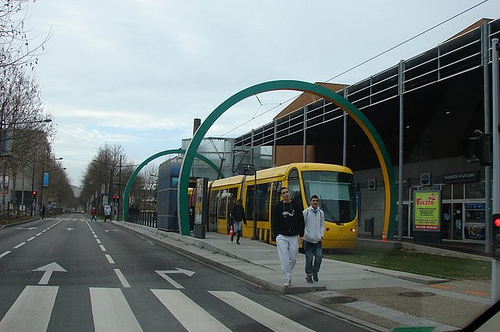
‘Zwei’ has been taken aback by the viciousness of the SkyTrain Lobby and the great lengths they haveAi??Ai??taken in discrediting the LRT, while at the same time refusing to acknowledge the marketing failure of the proprietary (ICTS/ALRT/ALM/ART ) light-metro system, known in Vancouver as SkyTrain.
‘Zwei’ is also taken aback by abject refusalAi??Ai??by many supposed experts to take the time to clearly understand modern light rail and/or modern LRT philosophy, Ai??Ai??instead treating itAi??Ai??the same as a glorified bus or a poor-man’s metro. Ai??Ai??As well, ‘Zwei is dumbfounded, byAi??Ai??many of the sameAi??Ai??supposed transit experts who do not understand the fundamentals of transit and or rail operation, especially from a customers point of view.Ai??Ai??In Metro Vancouver, manyAi??Ai??planning bureaucratsAi??Ai??abjectlyAi??Ai??refuse to acknowledge that Ai??Ai??modern light rail is a very strongAi??Ai??tool to mitigate congestion and pollution, whichAi??Ai??only exacerbates ourAi??Ai??regional transportation planning ennui.
A good example of not understanding ‘rail‘ operation are those who continue to pontificate that automatic transit systems have fewer employees, therefore cheaper to operate than light rail. This simplistic view is wrong andAi??Ai??except when traffic flows are in the order of 20,000 pphpd or more, then thereAi??Ai??are noticeable cost savings in automatic operation. The notion that automatic metros can operate 24/7 is just that, a notion as driverless metro need dailyAi??Ai??‘down time’ to adjust and check the signaling system for if something goes wrong, the driverless metro stops and until a real persons checks the system to see why the metro stopped and if it is safe to continue operation, will operation be started again.
Unlike LRT, with an on-board driver, automatic metros need a full complement of staff to operate at all hours to ensure the safety of passengers, on trains and in stations. Many LRT operations have service 24 hours a day and with the simplicity of the transit mode, very few staff are needed. Contrary to what many ‘bloggist’s’ post, modern light rail is much cheaper to operate than metro and driverless metro.
The hysterical wailings of those wishing grade separated transit systems also ignore the fact that moder LRT is one of the safest public transit modes in the world. The fact that SkyTrain has a higher annual death rate than comparable LRT operations is forgotten in their zeal to discredit modern trams. Yes, cars do crash into trams. Yes, car drivers do disobey stop signals and deliberately drive across tram lines in the path of an oncoming trams, with predictable results. Yet tram/LRT/streetcar road intersections are about ten times safer than a road – road intersection. In Europe, if a car driver ignores a stop signal and is in an accident with a tram, the car driver is heavily fined and may lose his right to drive. In Europe, autos seldom come to grief with a tram, as the legal consequences colliding with a tram is a strong deterrent.
The speed issue is another ‘man of straw’ argument as those who want SkyTrain. TheyAi??Ai??bang the ‘speed‘ drum loudly proclaimingAi??Ai??that SkyTrain is fast and speed trumps all in attracting ridership. Speed of ones journey is just one facet of the many reasons why people opt to take public transit.Ai??Ai??What is true, itAi??Ai??is that theAi??Ai??overall ambiance and convenience of a ‘rail‘ transit system hasAi??Ai??proven moreAi??Ai??importantAi??Ai??attracting new ridership. Contrary to what many believe,Ai??Ai??elevated and underground transit stations tend to deter ridership. The speed issue is a non-issue and fact is, if the Vancouver to Chilliwack tramtrain comes into operation, it will have a much faster commercial speed than SkyTrain, yet Zwei would never make the claim that tramtrain would be better because it was faster!
Studies have shown (Hass-Klau Bus or Light Rail, Making The right Choice)Ai??Ai??that in urban areas the most beneficial distance between transit stops is 450m to 600m and with any greater distances between stopsAi??Ai??tends to deterAi??Ai??ridership and stops closer than 450m tend to be too slow. Those want a fast subway under Broadway are commuting from the far reaches of the SkyTrain and or bus network and one would question why they would live so far away to commute to UBC, if they are at all?
In the real world, transit systems are designed and built to economically move people, not so in Vancouver where transit is built toAi??Ai??cater to the needs of land use, thus we continue to build hugely expensive metro lines on low ridership routes (for metro), whereAi??Ai??selected property owners make windfall profits from up-zoning residential properties to higher density condos and apartments. This is a ‘fools paradise’, because we are spending up to ten times more to install a metro onAi??Ai??transit routes that don’t have the ridership to sustain a metro, while at the same time failing upgrade manyAi??Ai??bus routes to LRT to cater to higher passenger flows, which now demand greater operational economies.Ai??Ai??Much neededAi??Ai??transit upgrades and improvements in the region go wanting to fulfill the extremely expensive and questionable SkyTrain/land use dream on only a few routes.
The failure to understand modernAi??Ai??light rail is leading the region into a massive financial black hole, by continually building extremely expensive metro while at the same time treating LRT as a yesterday’s transit mode. Today, Vancouver’s transit fares areAi??Ai??some of the highest in North AmericaAi??Ai??and fares will continue to rise, largely in part due to SkyTrain and light-metro. TransLink willAi??Ai??continue to be inAi??Ai??financial peril ifAi??Ai??planning bureaucratsAi??Ai??continues to plan and build with metro on the Evergreen Line and the Broadway subway.
Modern light rail has been crafted, with over 125 years of public transit experience, to fulfillAi??Ai?? human transit and transportation needs, unlike our automatic SkyTrain light metro, which original design and selling point was to mitigate the massive costs of heavy-rail metro in an age before modern LRT. To put SkyTrain in a subway is an oxymoron and demonstrates the modes proponents gross ignorance of transit history; to continue to build SkyTrain on routes that do not have the ridership to sustain metro demonstrates complete fiscal irresponsibility.
As Zweisystem has always observed, “Those who fail to read public transit history are doomed to make the same very expensive mistakes.”
The failure to understand the role of modern LRT, streetcars and trams, will lead the region into transit and transportation chaos, where the much needed ‘rail‘ network will be but patches of expensive politically prestigious metro linesAi??Ai??linked by buses: impractical, unsustainable, and fool-hardy.

Chaleroi light-metro station - Too expensive to complete and never used!



Recent Comments