Three Minutes Into The Future!

More wise words from Mr. ‘Haveacow’ who is an extremely experienced transit planner working on Ottawa’s new regional light rail line.
This was originally a post from the recent Calgary blog and contains a wealth of information that the powers that be don’t really want in the public realm.
What this boils down to is that the Expo and millennium Lines need a lot of investment for modernization, investment that will come from the expense of the Metro and Fraser Valley region.
As one transit expert told Zwei decades ago,”you can get any transit system to do anything you want , if you throw enough money at it.” The problem is, of course, the money thrown at the transit system generally comes from other transit projects.
This begs the question; “How much money is the taxpayer willing throw at SkyTrain”?
An Historical note: The initial ALRT line from Vancouver to New Westminster was originally designed to have a third “express line” through less well used stations, such as Royal Oak or 22nd Ave., to decrease travel time. Zwei was told by a retired GVRD planner some years ago that there were supposed to be five such stations along the route and the plan was to cut almost 10 minutes off the travel time in the peak hour, end to end. Cost constraints and signalling issues sidelined any thought of this type of operation.
Over to you, Mr. Cow!
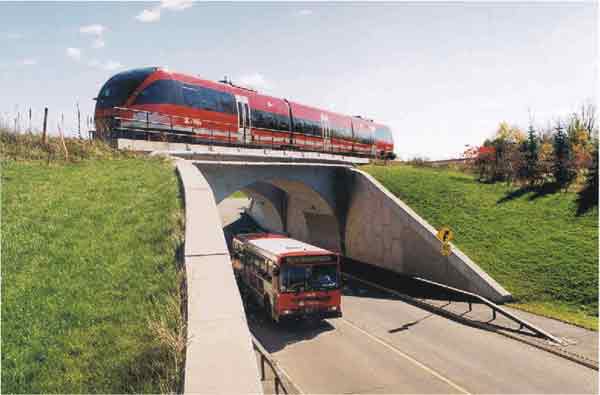
Technically Skytrain can be expanded to do 28,000+ p/h/d. Actually any existing rapid transit system can be expanded to handle much greater passenger capacities. The real issue is how much you want to spend to do that.
Skytrain could with existing technology upgrade its signaling systems to a state of the art, high capacity multiple independent moving blocks signaling system with the newest version of Bombardierai??i??s City Flo 650 Automation System operating as the system governor. But thatai??i??s expensive and Translink is only and very begrudgingly doing some of this, mostly because of cost issues and the time required.
Problem/Issue#1:
The electrical handling capacity of the system needs to be upgraded. Meaning, the existing electrical transformers (hidden behind the doors at nearly every station and what is mostly responsible for the mysterious size of most stations on the ground floor) needs to be upgraded in capacity or new ones have to be built and the corresponding cabling replaced, as well as the replacement of many of the systemai??i??s third rails and third rail connecting joints with each other and the cabling (canai??i??t remember the technical name right now). Translink is trying to do this but its expensive and very time consuming however, it can easily be done at night when the system is closed and doesnai??i??t necessarily. This is the first step in signal upgrades.
Problem/issue #2:
Next spending at a minimum of $500-700 Million and about 2-5 years with multiple daytime shutdowns to completely replace all the existing signaling software and hardware as well as the signals themselves. Toronto is replacing its 60 year old signaling system on line#1 (Yonge-University Spadina-York Subway Line). Its taken 4 years so far with major portions of the line getting shutdown on the weekends. This weekend its Lawrence Station to Yonge and Bloor, (the busiest stretch of rapid transit line in Canada and 2nd busiest in North America during peak hours). But it must be done to improve the lines top capacity limit and to keep the overall network in good repair. The traditional time the TTC does maintenance projects, the 6.5-7 hours a week from closing time Saturday night/Sunday morning to the traditional late start Sunday morning at 9am is just not enough time. So every weekend or at least every second weekend a section of the line is taken out of service to replace the thousands of kmai??i??s of cables and signaling infrastructure. Fall 2017 is the expected completion date.
Next, add new centre platforms to existing stations and or adding centre tracks with new passenger platforms either side and move the existing tracks to the outside wall limit which is also expanded. Except for the highest use stations, this eliminates the need to lengthen platforms and is cheaper optioin when dealing with an above grade rapid transit system.
Problem/Issue #3:
Man this time consuming and expensive and you really have to do step 1 and 2 first but it can work. Translink is doing a station by station approach which means it may have most of the original stations on the Expo line upgraded by 2041. Time to do all the stations depends on budgets and assuming we survive the asteroid impact we will be subject to in 2048 (Iai??i??m a back yard astronomer each time a particular well know asteroid passes by us it keeps getting closer and closer, Iai??i??m not kidding). However, after several expected close fly bys in 2020ai???s and 2030ai???s due to gravitational sheer, may change the final date or it may cause it to miss us altogether, we will see. Anyway back to point.
There are other issues such as, as your above grade Skytrain lines age, the structure between the stations will need significant structural upgrade. The longer you wait the bigger the bill. Translink has no budget or plan to deal with this issue. As we (me and employees of the company I was consulting with at the time) asked during our visit to there control centre a few years ago while we presented to the staff pieces of concrete right of way we found around Metrotown Station. What is your long term plan to deal with Expo lineai??i??s above grade structural renewal proposals we asked? Their answers were polite and diplomatic but you could tell we caught them off guard. It all depends on budgets and the availability time capital was the answer, so no plan until they have enough cash I guess.
Lastly, as any rapid transit system gets bigger and bigger, the cheap and easy to build lines will generally get built first. Each extension or new line becomes relatively speaking more and more expensive (regardless of inflation). Its not Translinkai??i??s fault this generally happens on any system, you pick the low hanging fruit first! Many of the new lines like the Millennium Lineai??i??s Broadway extension to Arbutus and eventually UBC, are very expensive (because of the tunnel) and will only produce for now and even into the future, meager passenger numbers. In my humble professional opinion, the overly optimistic predictions of Translink will never produce the numbers really needed to justify a below grade Skytrain line that costs only 20% less per km than a late, over budget, subway line in Toronto that will daily handle twice the capacity of the planned Skytrain line, using the present 60 year old signaling system not the new one which is being installed on the rest of the line and that will be ready to go when this extension is complete. All these cost predictions for the Broadway Extension are based on 6 year old planning data which needs to be seriously upgraded and will most likely go up in cost per km as well.
There are very few other justifiable new line opportunities for the Skytrain System given current ridership and corridor passenger levels. There are some extensions planned or being discussed. One is the killing of the very poorly thought out LRT line in Surrey and replacing it Skytrain extension but it brings about another issue that is not thought about in Vancouver yet but Toronto and Montreal have been facing for a while, that is the geographic scale of the service area. You can extend the Skytrain in Surrey but even Skytrainai??i??s for Surrey, ai???Darylai???, missed this little issue. If you build the extension of the Skytrain as designed by Translink and Daryl you will have to sit for an hour just to get to the other side of the line, which is downtown. This still seems to be the largest passenger destination for the system. It will take an hour because of all the other existing stops you already have in between Surrey Skytrain extension and downtown Vancouver. You could have a local/ express train system operation but unless track infrastructure is severely upgraded, it just canai??i??t happen. So a change in operational technology is needed, more commuter rail/regional rail or Zweiai??i??s Tram Trains operation. Both Toronto and Montreal learned a long time ago you canai??i??t extend subway/metro lines outward until they are 30-40 miles long its just too expensive to build and operate. Not to mention there would be just too many stations stops between where people want to go and where they will be getting on. Adding express services is expensive and difficult and ultimately lowers capacity. Even heavier capacity LRT lines have a distance/travel time limit. So soon a new form of longer distance rapid transit will be needed for Vancouverai??i??s outer areas you canai??i??t keep building Skytrain further and further out its also way too expensive to build and you still suffer the distance/time penalty for potential passenger numbers. So yes a change in rapid transit operating technology, due to the geographic operating scale, for the outer portions of your region is most likely imminent.



The site would not let me answer Eric on the previous article so here so the answer to Eric’s question.
Eric,
Headway is a very exact measurement but doesn’t technically include stopping and or safety margins required by law under Transport Canada so here are the planned service frequencies.
I know in Vancouver legally you guys can do a service frequency of 109 seconds, which is allowed under your current safety and operating certificate.
In Toronto the Yonge and Bloor Subway Lines have a service frequency of 2 minutes and 30 seconds or about 150 seconds with the current 50-60 year old signaling system. The new signaling system on the Yonge Subway Line (Line#1) will legally reduce service frequency down to around 90 seconds + the average safety margin of about 15-20 seconds so, technically less than 2 minutes or about 105-110 seconds.
When the Ottawa’s O-Train Confederation LRT begins Line begins full operation (our red line or line #1) will have a service frequency of 3 minutes and 15 seconds, with 15 2 car consists operating on the line and 2 in reserve.
However, that was before we got our Federal Infrastructure grant. We are purchasing 4 extra LRV’s as per contract at fixed price guaranteed at $5 Million per car. Or in operational terms 2 extra complete, 2 car consists. We can purchase 6 vehicles in the first 18 months and 10-12 more within the first 24 months from the system operator RTG (Rideau Transit Group of which Alstom is the car provider) at a guaranteed price of around $4.8-$5 Million per LRV. The rumor is that now we will be able to operate 16, 2 car consists with another 3 in reserve, which technically frequency with safety margin will be down to 3 minutes or 180 seconds at peak hours. According to my capacity model this gives us a capacity to operate at about 10,800-12,200 or about a mid point of 11500 passengers per hour per direction up from the initial starting limit of 10700. The ultimate capacity will be upwards of 22100-26000 if full vehicle expansion and platform expansion is allowed and a service frequency of 120 seconds.
Zwei replies: Sorry for closing comments but we had massive spam attack on the Calgary post over 1000 spam posts in 48 hours.
Dondi,
Mr. Cow, if you are reading, what are the manpower and other operating cost projections for Ottawa, once your system is up and running?
To answer you the planned system operating cost is presently given in a range around the same or slightly less than the Skytrain’s per km operating cost. However, the system really hasn’t started yet, and good or bad its really a meaningless estimate until operations really begin and the system has had 1-2 years to iron out any outstanding issues from beginning transit operations. Plus, when I asked O.C Transpo that exact question, a wonderfully helpful person told me to go fill out a Freedom of Information Request for such sensitive material. I told him that with the navy, I can ask and publically get the explosive power in Joules/m3 of our new Mk 48 Mod 5 ADCAP heavy torpedo warheads for our submarines but I as a transit professional, has to file a FOI request for the exact PLANNED operating costs for our new LRT line, a line that won’t really start service for another year and a half and a publicly funded rapid transit project on top of that, WOW!
Haveacow, thanks for the service frequencies in Ottawa, Toronto and Vancouver. Assuming that the pesky spammers and wipers of other people’s bottoms don’t flood this post, too: the 109 seconds for the service frequency in the safety certificate granted to TransLink does not appear to be attainable.
“Headway is a measurement of the minimum possible distance or time between vehicles in a transit system, without a reduction in the speed of vehicles. The precise definition varies depending on the application, but it is most commonly measured as the distance from the tip of one vehicle to the tip of the next one behind it, expressed as the time it will take for the trailing vehicle to cover that distance.”
https://en.wikipedia.org/wiki/Headway
Physics fixes the headway for s-train to about 89 second calculated in one of my other posts. With 20 seconds of margin for safety added to the headway, the possible headway corresponds to the service frequency in the safety certificate for s-train.
http://www.railforthevalley.com/reference-material-education/calgarys-c-train-development-operating-costs-2/#comment-118856
“Headway” and “frequency of service” tend to be bandied about loosely, and my reference to headway in my previous post wasn’t strictly precise. Correct me if I’m wrong, the practical frequency of service for s-train is comprised of the allowable headway for the s-train in motion (109 seconds by physics with the safety margin included) and the time which is necessary to board and alight the s-trains while the s-train is not in motion (static time allowance). Unless s-trains can be upgraded to run at hyper loop frequencies, the best possible frequency of service for s-train (c) is about 140 seconds which is what s-train currently achieves (two to three minute service frequency during peak hours).
Honestly, if TransLink could run at a service frequency of every 109 seconds, surely TransLink would already be doing so to cut down on the rolling stock and the cost of s-train. TransLink can’t.
Let:
a = allowable headway with safety margin for s-train in motion = 109 seconds
b = average practical dwell and other static times for s-train = 31 seconds
Then:
c = possible frequency of s-train service = a + b = 109 seconds + 31 seconds = 140 seconds
With c = 140 seconds at best, the pig-dogs at TransLink need each s-train to hold 1,167 passengers (or small hamsters) to be able to move 30,000 pphpd which is what the pig-dogs at TransLink claim or imply can be achieved by s-train. At the optimistically high 6.7 passengers per metre for s-train length, the pig-dogs at TransLink have to build platforms to accommodate 174 metre long s-trains. This isn’t an upgrade.
It is a tear down and reconstruction of all the major s-train stations (above and below grade) in Vancouver. I get it that it can be done. Practically, this isn’t going to happen, and s-train can’t be expanded. Pig-dogs whose mothers were hamsters at TransLink are lying, and s-train is limited to about 13,000 pphpd until billions of additional dollars are spent to rebuild the entire s-train network (electrical, mechanical and structural).
https://www.youtube.com/watch?v=M9DCAFUerzs
This is really the point that I am trying to make. Even the lowly BRT service can achieve 45,000 pphpd which is far more than what s-train can realistically ever achieve. Pig-dogs at TransLink have spent billions of dollars on s-train which can’t move as many people as BRT. Based on capacity, s-train service is inferior to BRT service, and nothing is stopping us from firing the pig-dogs at TransLink to implement BRT with light trams (200 passenger trolleybuses) if passenger capacity is the primary criterion for public transit to UBC.
http://www.hess-ag.ch/en/busse/trolleybusse/lightram.php
http://iti.northwestern.edu/publications/Lipinski/2010/Menckoff.pdf
Vancouver, Canada is not Tokyo, Japan or London, England having the necessary population density to sustain subways having their stations spaced thousands of metres apart in distance. In Vancouver, TransLink must, therefore, bus-transfer (recycle) passengers from transit buses to its subway lines so that the s-trains don’t run empty. Subways for cities of the size of Vancouver, Canada are not fit for purpose. They result in bus routes being detoured to the subways and make people abandon public transit to drive short distances and save time. Subways for cities of the size of Vancouver are inefficient and dumb public transit. They don’t take buses off the roads like trams; subways in Vancouver put buses on the roads. Stupid.
We just can’t keep closing schools and hospitals to fund s-train lines by overpaid idiots at TransLink. We need to rid Vancouver of TransLink and the pig-dogs at TransLink.
Eric,
45000 p/h/d is possible with BRT and buses but its not affordable in the first world. For example, Brisbane Austrailia’s Busway System which was built and designed by the same people who built and designed Ottawa’s Transitway Network, the wonderous people at MMM Consulting formerly, McCormick Rankin International Consulting, are able to move about 14000-15000 p/h/d direction at peak. They can do this in Brisbane because unlike its grandfather system the Ottawa Transitway Network, they were able to build a grade separated Busway through their downtown in Brisbane and move 220-240 buses /h/d on it. Over half of these are very large articulated buses, 18-20 metres long. They fortunately in Brisbane have a very large and well developed Commuter Rail System to rely on to take the edge off at peak.
Brisbane’s downtown busway right of way is a mixture of below and above grade right of way which, in regards to its above grade right of way, had it been located in Ottawa would ether be too unsightly and as well as in Brisbane needing to be located on a massively over built, raised platform that is so large and wide, it not only blocks out the sun, it blocks out the side of an entire major Hospital. See Royal Brisbane Women’s Hospital Station. The below grade part of the right of way for their busway had the same problem as the planned bus tunnel in Ottawa. The tunnel in Ottawa would have to be over twice the width of the equivalent LRT or Subway/Metro tunnel and because of the high number of buses, would require enormously long (at the least 150 metres+) passenger station platforms capable of docking more than 8 articulated buses simultaneously which also implies great cost to build. The surface version of this kind of soul sucking downtown transit station exists in Brisbane at the Cultural Centre Busway Station during peak hours and or most of the stations in China’s Guangzhou BRT System, look them up. No downtown business in Brisbane, Ottawa or Vancouver would really want to be near these large surface BRT stations, especially at peak hours. They literally would suck dry any positive streetscape environment that most first world central cities and its businesses need to survive. Just as it does here in Ottawa when, we try to move 10500 p/h/d using 185-200 buses per hour on painted bus lanes on a couplet of one way streets. Both one way streets and these extremely crowded surface busways destroy completely, the sidewalk environment for passengers and businesses. The below grade versions of these stations would require great amounts space and cost huge sums to build. On top of that, you would also still be stuck with the huge operating costs required when operating enormous numbers of buses at peak, all of them very large buses, especially if you hope to come close to being able to move 40000+ p/h/d during peak hours every day, around 400-500+ buses per hour per direction all of them single articulated or buses or larger. Sorry Eric that style of BRT is just not an option in most North American cities, it would too much damage.