Transit History That Politicians Would Like The Public To Forget
Election Special
First posted November 2024
The history of Vancouver’s SkyTrain light-metro system has been somewhat altered to fit today’s politcal narrative; the following is a brief but concise history of how metro Vancouver got saddled with the SkyTrain light metro system.
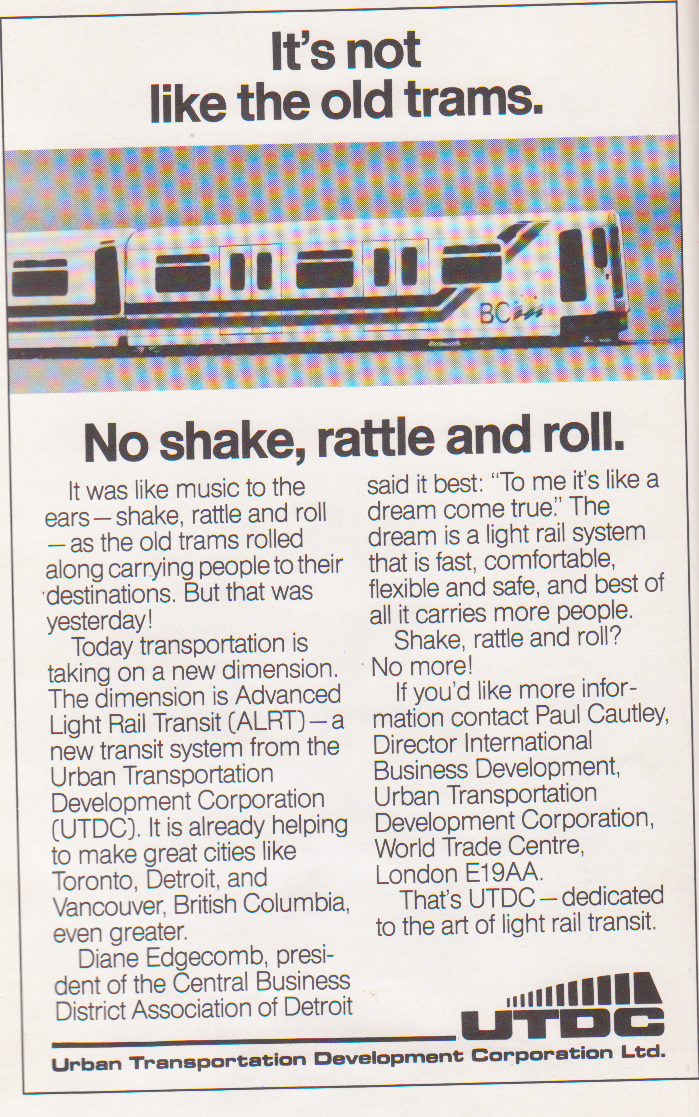
Prior to the Social Credit government forcing the then called Advanced Light Rail Transit (ALRT) system onto Metro Vancouver (To quote then premier Bill Bennett; “you will get SkyTrain whether you like it or not”, which was quoted again when then NDP Premier, Glen Clark echoes the same threat for the Millennium Line), there was a well studied plan to implement a modern light rail system for Canada.
Just weeks before the plan was to be accepted by the GVRD, the Bill Bennett government entered into a private agreement with the Government of Ontario to buy their unsalable Intermediate Capacity Transit System (ICTS) system, which was renamed ALRT for the sale to Vancouver, to acquire the services of the then famous “Blue Machine”, to win the next election, which like today, saw a one seat majority in the legislature in Victoria.
Only one ALRT system (Vancouver) was built and the proprietary transit system remained unsalable domestically and internationally.
Bill Van der Zalm was merely the government “points-man” to sell ALRT to the public and had little to do with the decision. He is on record stating that, except for the Expo Line, ALRT or SkyTrain, was unsuitable for the lower mainland rapid transit and supports the Valley rail scheme.
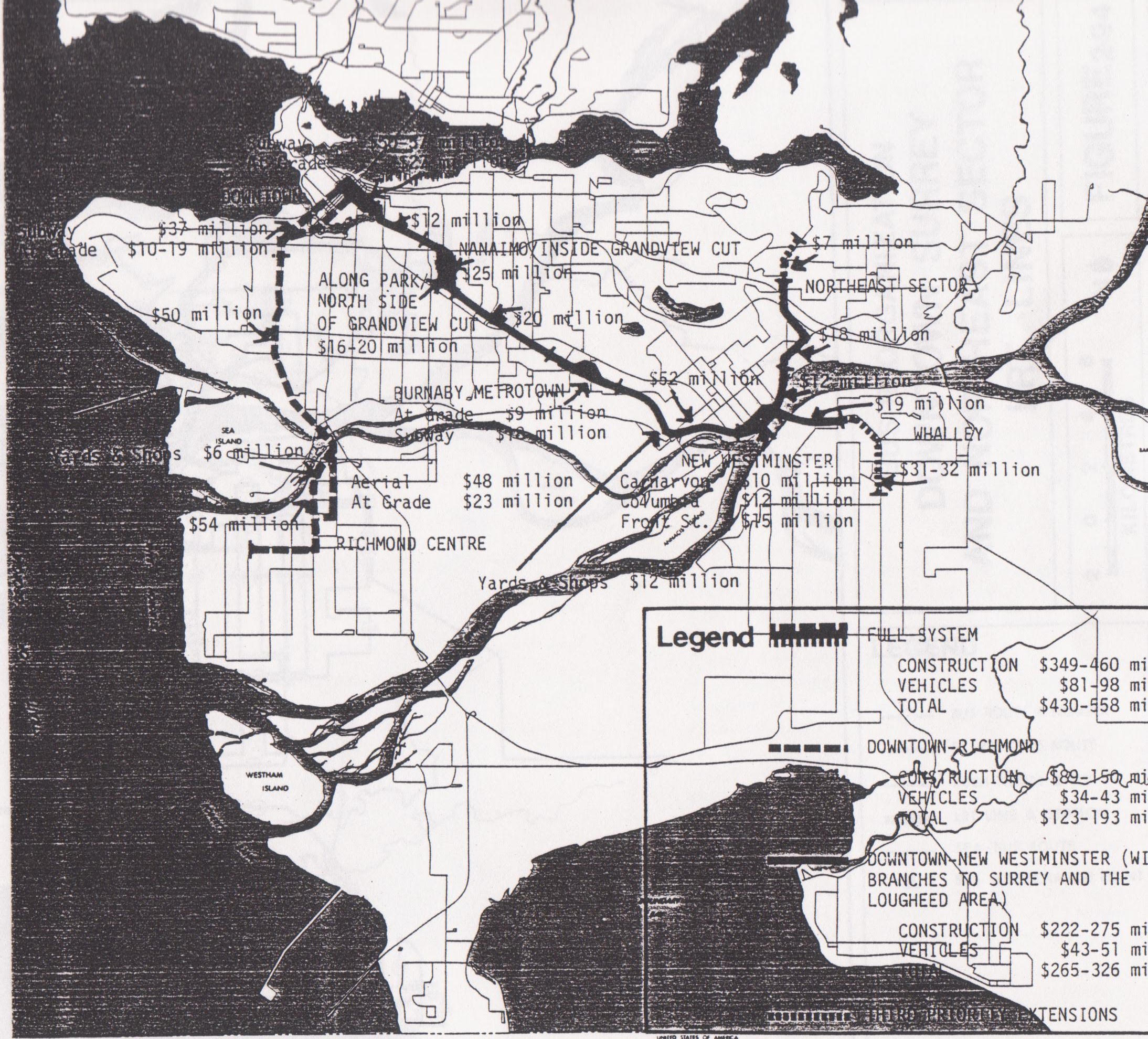
The original LRT plans saw LRT from Vancouver to Richmond; Vancouver to New Westminster/Lougheed Mall and Whalley.
The following is a map, with costs (1978 dollars) of the proposed LRT lines, but for a somewhat higher cost we got ALRT to New Westminster.
Adjusting for inflation, the $430 Million to $558 Million would be $1.88 Billion to $2.45 Billion. Compare to the $7 to $8 Billion (2026 estimates), 16 km extension of the Expo Line to Langley or the now $4 billion, 5.7 km Broadway subway!
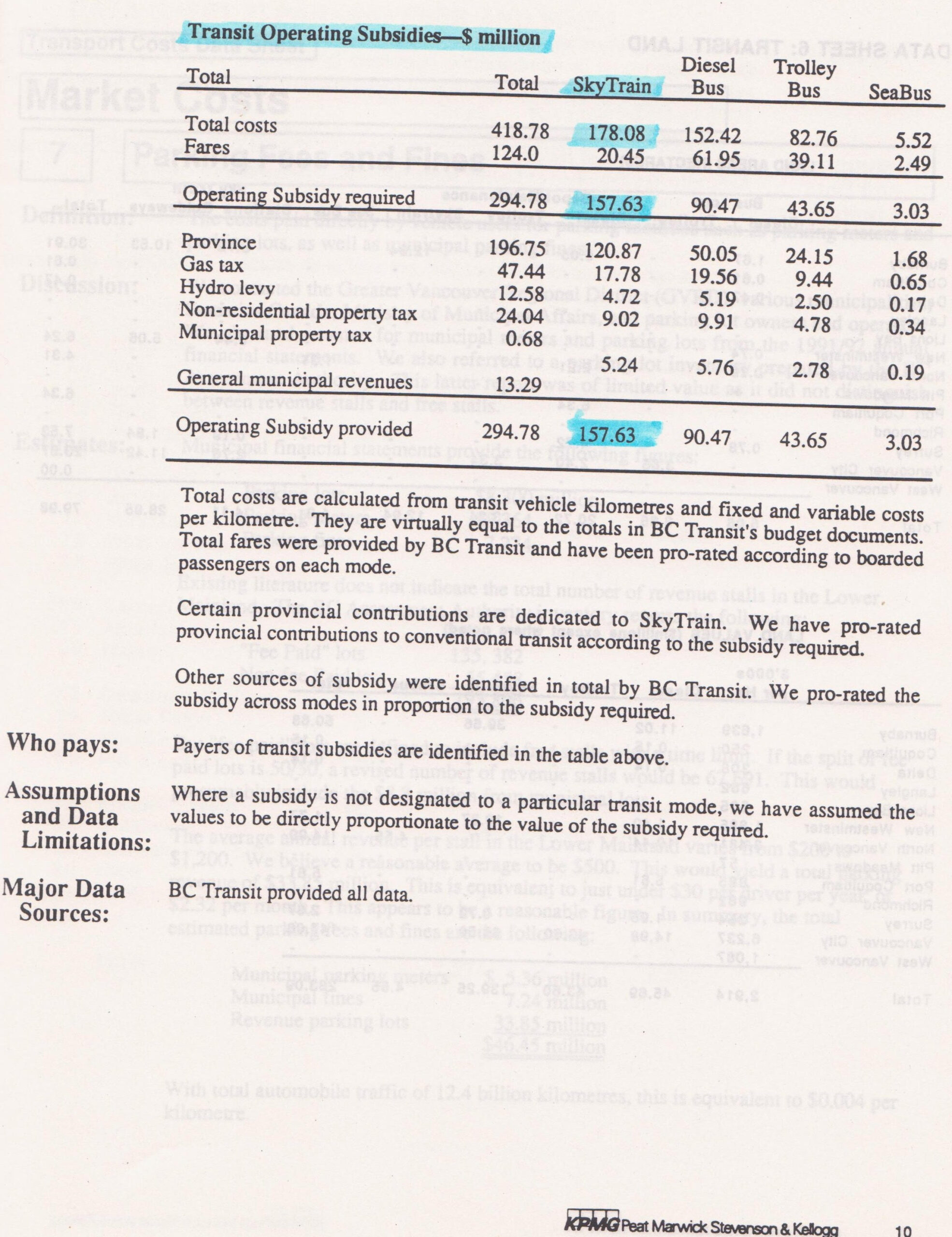
The GVRD did not want SkyTrain and instead wanted light rail for the then Broadway Lougheed Rapid Transit Plan as their “Cost of Transporting People in the Lower Mainland” Study found that SkyTrain, just to New Westminster, was subsidized at $157 million annually in 1992; more than the trolley and diesel bus operations combined!. Accounting for inflation, this is $300 million annually in 2024 dollars
The NDP have flip-flopped twice, Broadway Lougheed and Surrey, from originally planned for light rail to SkyTrain light metro.
Why?
It certainly wasn’t because it was a better system because the well studied ALRT/ART (ART is the name for Bombardier’s rebuild of ALRT) has been found wanting and remains today unsalable.
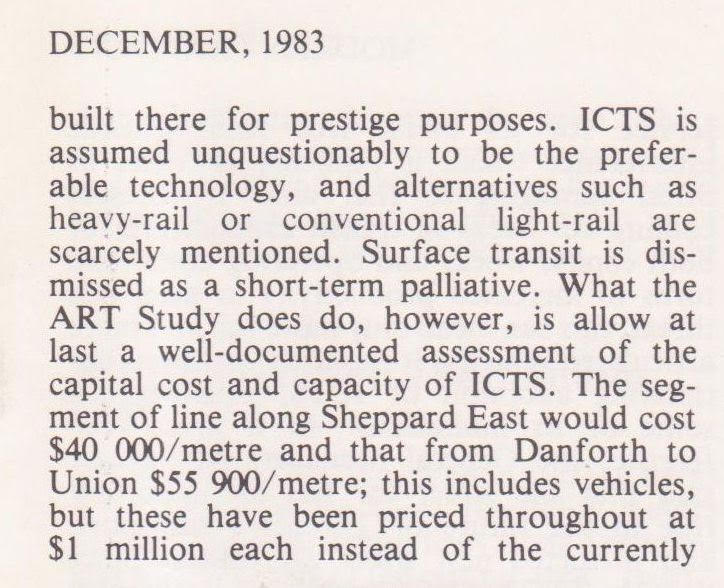
The following is from Modern Tramways in 1983 and clearly shows that ICTS/ALRT was inferior to LRT, yet the Toronto studies were never permitted to be made public in BC and the Vancouver media never bothered to investigate ALRT.
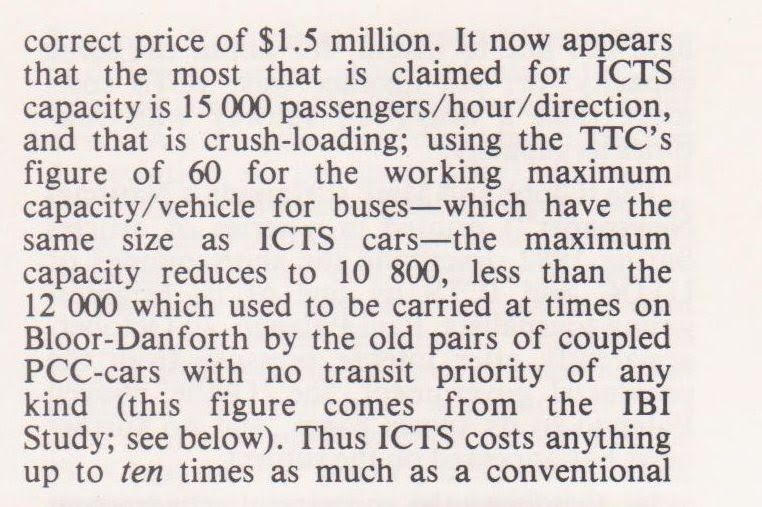

It was known by 1983 that what we call SkyTrain was unsalable and today only seven systems were built and only six remain in operation. It was well known in the 1990’s that Bombardier’s rebuild of ICTS/ALRT was unsalable and resorting to pay “success fees” to bureaucrats and politicians in Korea and Malaysia to build with ART.
Bombardier could only sell one ART system in the USA, if the Canadian government, through the Overseas Development Bank would fund it, yet Vancouver continues to plan for more and worse, pretends it is a “world class system“!
Whoever has heard of a “world class system” that is unsalable?
This is the legacy of the SkyTrain light-metro system, a world class white elephant.
Why does government continue planning and building with it?
A Comment from our Canadian expert who advised Rail for the Valley (You know someone who works in the industry and not posting YouTube videos)
1. When I was at Bombardier people treated the technology and system as a like a joke. The main problem could be expressed in a single statement, It wasn’t scalable and the design (especially the vehicle) was unadaptable even when that was desirable for the customer.
You couldn’t buy a basic version and work up to the “Full Monty” later. If you wanted one part or feature but not another, as a customer, you were out of luck, you had to take everything. This is what primarily killed it. Want an extra feature like a drivers cab, ala the Scarborough RT, the design back flips that had to be done were stuff of legend. The design was set and that’s it, too bad if the customer wants or needs a change.
1 (a) The extreme corporate and institutional resistance against it, when it was forced on Bombardier buy a corporate purchase. it wasn’t a Bombardier product. It also directly compeated against other Bombardier products, making all of them including the Skytrain, harder to sell.
As an employee of Bombardier, god help you if you were given a position in that department and its various sub sections which promoted and sold it. ALRT, Skytrain, Scarborough RT, whatever you called it, you had just been demoted, almost as bad as being banished to the Monorail and People Mover Department. The most commonly heard phrase was, “a duck making a lateral career move to, a l’Orange!” It wasn’t liked and it wasn’t easy to promote due to it being very complicated and considering its capacity, really expensive.
2. Half the capacity of a full Metro (because it’s a Light Metro) but 80%+ the cost to build.
3. It’s automation wasn’t scalable either. One single line, one isolated line could save money for an operator however multiple lines in a network actually increased its operating costs.
4. Contrary to what your Translink people said, you could only buy the technology from Bombardier because we made it legally difficult and expensive to use anything but Bombardier technology. Plus you the operator, signed legal agreements banning any vehicle or principle operating technology outside of Bombardier’s products. These included NDA’s banning a list of topics for outside public information consumption. Don’t blame Bombardier this is actually very common in most of today’s industry agreements.
4 (a) The more you invested in the system the more you became more dependent on Bombardier. You might get cheaper off the shelf or easy to design and build replacement vehicles using the Mk 1 Skytrain, Mk 2 Skytrain levels of technology. However, finding a builder with the technological capacity to replace or build another version of the Mk 5 Skytrain with the same specs and capabilities designed from scratch to fill this niche market vehicle mandate, all for a comparable price, forget it. We designed it that way. All modern railway vehicle manufacturing companies do this to some extent. The odd mixtures of technology with the Skytrain vehicles made it easy to do that.
5. The odd nature and location of its propulsion equipment makes using nearly all of the easily available (cheap) 3rd party auxiliary track devices, virtually impossible. Thus forcing you to use either a far less common (more expensive) 3rd party alternative equipment or Bombardier’s (and its corporate partners) design specific equipment. This was common in maintenance equipment as well.