The Real Question: What are You Willing To Pay For A Subway?
Here is the question taxpayers inAi??Metro Vancouver have not been asked; “What are you willing to pay for SkyTrain/RAV/Canada line?”Ai?? The regional taxpayer has never been asked:
- Do you wish light rail at a cost of $20 million/km. (streetcar) up to $35 mil/km. (LRT)?
- SkyTrain at a cost of $90 mil/km to $100 mil/km.
- Subway, at a cost of $150/km (cut and cover) to up to $450 mil/km. for a bored tunnel?
The SkyTrain lobby, the provincial government,Ai??TransLink and the Vancouver Engineering dept.Ai??are utterly scared to death with the preceding choices. The question thus becomes…”why?”
Would you personally pay $1,210 to build the Sheppard subway?
Here’s one way to visualize the cost difference between subways and LRT.BY: Edward Keenan
Just a quick thought experiment on the ongoing subway-vs.-LRT debate, since one of the major factors that should weigh in the decision is cost. Those advocating for LRTs can seem like skinflints, and those saying we should splurge on subways often say this in the manner of someone suggesting you should go for air conditioning in your new car: it costs a little extra, but youai??i??re worth it. Except it costs a lot extra. So is it worth it? To you, as the person actually expected to pay the difference? Letai??i??s think about it.
We hear big numbersai??i??a subway extension along Sheppard would cost about $3 billion, or tunnelling the entire length of Eglinton would add about $1.9 billion to the cost of that project. But itai??i??s hard to figure out what such large numbers mean. So letai??i??s visualize it from the perspective of the individual citizen.
For the purposes of this discussion, letai??i??s imagine for a moment that the $8.4 billion committed to transit building by the province is money already spent. That money comes from provincial taxpayers, of course, and city residents are provincial taxpayers, too, but since the money has already been committed by the province, our share of that has already been sent to the province, and now this lump sum has been returned to us to spend on transit building. Now, we need to figure out how much, if any, we need or want to spend on top of that.
Option A is to spend the money on what it was originally committed for: the Transit City plan that would build LRT lines on Sheppard East, Finch West and Eglinton Avenue, with the Eglinton line running underground through the central city and everything else running above ground. Under this option, no additional contribution is required.
Letai??i??s call the Rob Ford plan that council scorned Option Bai??i??itai??i??s the option the mayor is still trying to revive: The Finch line is cancelled altogether, while the entirety of the Eglinton line goes underground. That eats up all the existing money. In addition to that, we build a $3 billion subway extension on Sheppard. This requires each citizen of Torontoai??i??all 2.48 million of usai??i??to write a cheque for an additional $1,209.68. There are five people in my household, so our bill comes to $6,048.35.
Letai??i??s say Option C is the James Pasternak Deluxe edition, which would see Option B plus an additional extension to the Sheppard line running west to Downsview subway. Thatai??i??s estimated to cost $1.48 billion, or $596.77 per person. Thatai??i??s another $2,983.85 for my family.
And finally, letai??i??s say Option D is the ai???Mammoliti Propositionai???: that in addition to Option B (and, letai??i??s say, C), we also build, at some time in the future, a subway line along Finch West. That kind of comes out of the blue, but since Giorgio Mammoliti and the mayor say the reason not to build an LRT on Finch is that the people out there deserve a subway, letai??i??s imagine it being formally, actually proposed. Since no one that I know of has recently studied the cost of that in any depth, Iai??i??ll estimate that, like the Sheppard subway extension estimate, the cost will be about $375 million per kilometre. If the subway travelled the same distance as the proposed LRT line, it would be 23.4 kilometres long, bringing the total cost of construction to a ballpark of $8.8 billion on the back of the most drink-ringed and crumpled of napkins. So thatai??i??s an additional $3,548.39 per resident of Toronto. Additional bill in Chez Keenan sees another $17,741.95.
So, as a citizen weighing the discussions about relative speed, capacity and the likelihood that subways in Scarborough will run two-thirds or half-empty for generationsai??i??and as someone unlikely to make much use of any of the proposed lines, but hopeful my fellow citizens will see good, rapid transit builtai??i??my options are:
Option A (ai???Transit Cityai???): $0 per person, $0 total for the Keenan family.
Option B (ai???Ford Planai???): $1,209.68 per person, $6,048.35 for the Keenan family.
Option C (ai???Ford Plan, Pasternak Deluxeai???): $1,806.45 per person, $9,032.25 for the Keenan family.
Option D (ai???Mammo Propositionai???): $5,354.84 per person, $26,774.20 for the Keenan family.
There is no question that, as the mayor says, people prefer subways to LRTs. And even if the number of people expected to ride the things could be easily carried by an LRT, and an LRT would go maybe 80 per cent as fast, we still probably on some level prefer subways. The $26,774.20 question for my household is whether we prefer them enough to take out a second mortgage on our house to pay for them. And thatai??i??s before we start to talk about operating costs.



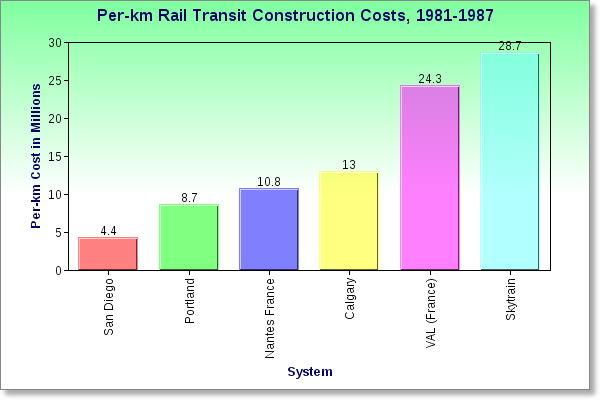
Interesting chart, of course it is not really relative what would be important is the cost per rider…or the cost per new rider. Voony’s blog has a great post about that. On acost per new rider basis the San Diego system is one of the most expensive. Sometimes a bigger cost is a better deal. Do you want to pay $10 per new rider or $3 per new rider…or maybe more or less, people better check their numbers before deciding on their system (corridor and technology).
On the same vane without actually crunching the numbers (and ignoring the examples from France thatI don’t know) I would expect that Calgary would have had the lowest cost per new rider followed closely by Vancouver both well above Portland and San Diego.
In a Toronto context I understand the ridership difference between the full subway option and partial underground Eglington LRT does not justify a subway. That does not mean a subway is never justfied, projects should be reviewed based on how they achieve their goals (and I would argue cost per new rider and mode share would be some of the most important metrics).
Cost per rider, based on what? Based on TransLink’s deliberately low-balling SkyTrain costs? To date the taxpayer has spent over $8 billion on three metro lines, while the Calgary taxpayer has spent just over $1 billion on the Calgary C-Train. The cost per rider should be much, much less in Calgary than Vancouver. Also, for the cost of one SkyTrain line, we could have built three LRT lines, generating much more ridership than one SkyTrain Line. Like TransLink, Voony tends to ‘cook’ the books in favour of SkyTrain. Ever notice, no one is building with SkyTrain these days?
Unlike some authors/posters I have found Voony’s posts to consistently insiteful (even if I don’t always agree) and I can not think of a post where he ‘twisted’ facts to suit his purposes. Infact his posts endorse a large range of technologies and urban ideas with well researched blogs….he is also excellent at posting sources and showing assumptions so it is easy to check the facts. Feel free to give me an example of his ‘cooking’ the books….don’t forget to reference and provide clear methodology like he does.
Even if the sources are non-sources or in Chinese/Korean. Sources are easy to come by, but facts tend to be in short order. Our European friends find Voony rather silly, but hey, this is Vancouver and everyone wears rose coloured glasses and the taxpayer has endless money to give the government.
This blog is about transit and rail transportation and the support for the Rail for the Valley’s proposal for reinstating the interurban (TramTrain) on the existing route from Vancouver to Chilliwack. In that end, the RftV group engaged Leewood projects to do a study on the interurban/TramTrain proposal. This blog is vetted by transit experts and to that end, probably has the best information on the subject in this local. We talk transit here, not hoccus poccus theories and much of what is talked about here causes much heartburn yo the SkyTrain Lobby, who certainly has stretched the truth to the breaking point.
The beauty of well referenced posts is it lets the reader decide on the credibility of the source. For example a recent post on rail for the valley referenced a comment by an annonamous reader of the Tyee magazine. Enough said about that….
The trouble is, most what is printed here is fact, but it is unrecognized in Vancouver, because the SkyTrain Lobby prefers well sourced fiction, than general knowledge.
Good referencing is important, that way a reader can decide for themselves if they trust the APTA or Joe from Canmore as their source. Or more importantly look at source document themselves to make their own interpretation of the data.
Go to the RftV/Leewood Study, all the sources you need are there, if you care to look.
Actually I dont’t recall a referencing issue with the study it is the blog posts I would like better references for. For the record I doubt capital costs on the Interurban would be the issue. The issue is past Langley it wanders all over Hells half acre and does not serve many people. Between Chilliwack and Langley a good cyclist would probably be time competative with it. A bus would be so much faster for most destinations only people with no time constraints would use it. So while it maybe cheap per km it would be very expensive per rider. It would probably be cheaper per rider to build an entire new line on a new alignment past Langley (certainly worth exploring).
Absolutely wrong, in fact the interurban services the city centres of Chilliwack, Abbotsford, and Langley, at a cost pf a fraction of that of other modes. Read up on TramTrain and modern LRT and learn something.
As for costs: Greenfield construction would be horribly expensive considering land expropriation and engineering, using the established interurban route would be a lot cheaper.
By the way, what source did you quote for, “Between Chilliwack and Langley a good cyclist would probably be time competative with it.”
I am lazy and of course I am not writing a blog just commenting…I would be a good reason not to quote people from the comment sections of blogs or magazines. That said all you need to do is look at the map to see how the Interurban line wanders between Langley and Chilliwack even if the line was travelling at 100km an hour it would not be remotely competative with a bus for travel time. It would not matter if it is cheap if few people use it.