Finacial Reality Surfaces With Regional Transit Plans – Vancouver Mayor Robertson In a Subway Induced Stupor
Well now, financial reality has now appeared with regional transit planning and a good thing it has.
TransLink is broke and with the Evergreen Line’s construction starting, TransLink will descend further into a financial morass and unless the province forks over billions more for regional ‘ rail’ transit, nothing will happen.
The subway lobby in Vancouver remain oblivious to the high cost of subway construction and try to gloss over it with quaint phrases of TOD, densification, or innovation. In ‘Lotus Land”s Vancouver and university, reality is a concept best ignored, lest unpleasantness consequences makes one look foolish in front ones contemporaries.
Ai??Ai??Ai??Ai??Ai??Ai??Ai??Ai??Ai??Ai??Ai??Ai??Ai??Ai??Ai??Ai??Ai??Ai??Ai??Ai??Ai??Ai??Ai??Ai??Ai??Ai??Ai??Ai??Ai??Ai??Ai??Ai??Ai??Ai??Ai??Ai??Ai??Ai??Ai??Ai??Ai??Ai??Ai??Ai??Ai??Ai??Ai??Ai??Ai??Ai??Ai??Ai??Ai??Ai??Ai??Ai??Ai??Ai??Ai??Ai??Ai??Ai??Ai??Ai??Ai??Ai??Ai??Ai??Ai??Ai??Ai??Ai??Ai??Ai??Ai??Ai??Ai??Ai??Ai??Ai??Ai??Ai??Ai??Ai??Ai??Ai??Ai??Ai??Ai??Ai??Ai??Ai??Ai??Ai??Ai??Ai??Ai??Ai??Ai??Ai??Ai??Ai??Ai??Ai??Ai??Ai??Ai??Ai??Ai??Ai??Ai??Ai??Ai??Ai??Ai??Ai??Ai??Ai??Ai??Ai??Ai??Ai??Ai??Ai??Ai??Ai??Ai??Ai??Ai??Ai??Ai??Ai??Ai??Ai??Ai??Ai?? You canai??i??t have it all: Polak on transit expansion
Projects wonai??i??t happen in Vancouver and Surrey simultaneously
Jason Howe March 1, 2013
Ai??SURREY (NEWS1130) ai??i?? The back and forth continues between the regionai??i??s mayors and the province over transit funding.
BCai??i??s transportation minister is rejecting claims major expansion can be done in Vancouver and Surrey at the same time.
The mayors in both cities argue it shouldnai??i??t be one or the other; both citiesai??i?? needs should move ahead.
But Transportation Minister Mary Polak doesnai??i??t see it that way.
ai???Itai??i??s not possible to have both of them go forward at the same time. Youai??i??re talking about multi-billion dollar projects. Youai??i??re talking about huge project tasks in terms of just the size and logistics of the projects,ai??? explains Polak.
She plans to meet with Mayorsai??i?? Council reps soon to discuss the next steps on a funding solution.
But Polak says donai??i??t expect a final answer before the May election.
ai???I think thereai??i??s too much work that needs to be done. Unfortunately, thatai??i??s just not the place where the public are right now. I hear reaction and I know the mayors that Iai??i??ve spoken to hear it, the public says ai???Hey, weai??i??re not confident that TransLinkai???s operating efficiently. Weai??i??re not confident that our money is already being used well,ai??i??ai??? Polak adds.
The regionai??i??s mayors have made a number of funding proposals, including a sales tax hike, a vehicle levy, and road pricing.



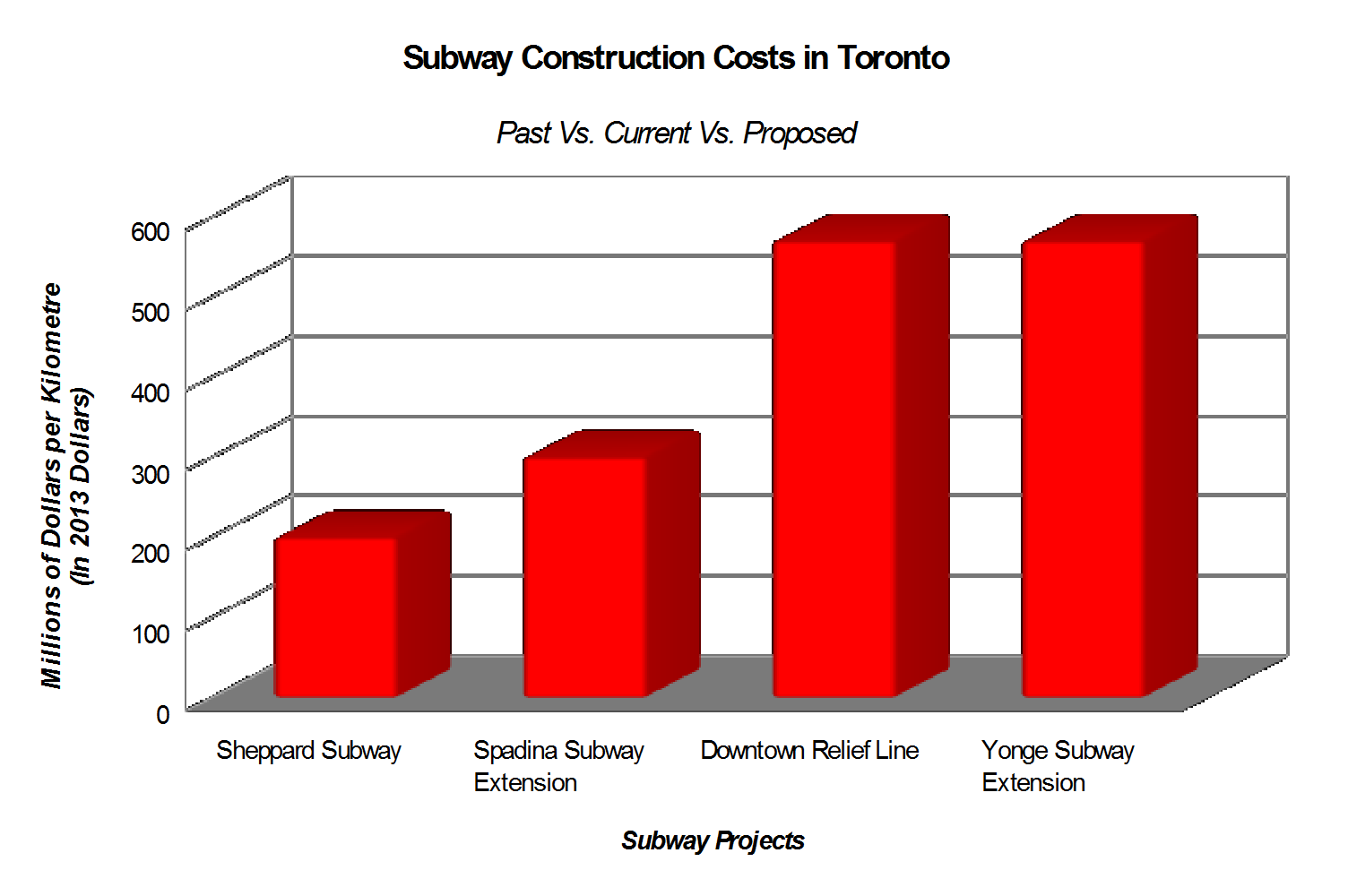
Interesting graphic, what is it with Toronto costs? Toronto LRT cost can get over 200million/km as well. What makes rapid transit in Toronto so expensive?
As to Mary Polak I doubt she cares, by June she will be out of office. It would be nice if she showed some vision and worked towards resolving the funding crunch instead of marking time to the election.
Zweisystem Replies: The high costs for LRT in Toronto is for subway construction and LRT ceases to be LRT when it operates in a subway and becomes a metro. This is something the subway lobby choose to ignore.
Granted Eglinton has a lot of tunnel in its 269million/km price but the cheapest being proposed is 71million per km and prices go upto 157million per km for mainly at grade LRT. Something must be driving the costs up. Have a Crow mentioned how expensive the operations yard was for the subway proposals, this is the only thing I can think of.
Zweisystem replies: Rico, the troll listen. The base cost for LRT/streetcar construction is about $6 million/km. This includes the track and OHLE. This does not include vehicles, shops or substations or land acquisitions. Add it the previous items and the cost of a LRT/streetcar ranges from $15 mil./km to $25 mil./km depending on the number of vehicles needed and engineering required. Costs higher than this means there is one hell of a lot padded costs, such as over engineering or over design.
With apologies to Haveacow, I feel that Toronto’s planned LRT are grossly over engineered and much of the planned lines are in a subway, which makes the so called LRT a metro. Ottawa’s LRT also suffers from deliberate over-engineering with a several km. long subway. Still by opting to build with LRT, either as a streetcar, light rail, or a hybrid light-metro, still leaves the door open to plan the LRT to operate on a lesser quality of rights-of-ways. With SkyTrain and the Canada line, this is impossible.
Subway mania, as being practiced in North America is a holdover from 1950’s and 60’s transit planning being taught in universities as the light rail Renaissance has not yet reached those ivy covered walls of learning. Basically, current subway based transit planning in North America is akin to teaching the world is flat.
We seem to have this conversation every so often with you feeling just calling something streetcar (and no doubt thinking Eurean tram) and me thinking of streetcar – LRT as a spectrum with ‘tram’ in the middle. A lot of the improvements that make ‘streetcars’ useful are the ones that increase the cost per km…upto the extreme with Ottawa (which will be great system precisely because it is a tunnel downtown). Without those improvements you end up with Portland’s Eastside loop. Projected ridership of 4000 per day and it is faster to walk with a more realistic cost (inflation happens, especially to transportation) of 39 million per km (includes vehicles but I do not think it needs an ops yard). Toronto’s Sheppard LRT could do better but improves speed from 16km/hr on the current bus to 22km/hr for 71 million per km although it more of what I would call a tram level of service.
Zweisystem replies: I am going to limit you to one comment a day. You spew the trolls drivel of internet links.
I am not a fan of the dated concept that a streetcar is something different than light rail, Both are one and the same, except that the quality of rights-of-way are different; a streetcar operates on-street with little reservation or signal priority and LRT operates on a reserved rights-of-way with full signal priority at intersections. Both LRT and/or a streetcar can operate as a streetcar or LRT. What limits the speed of LRT is stops as modern LRT has about 3 stops to 1 when compared to a metro. More stops means a somewhat slower commercial speed, but more stops attracts more customers. One thing that is never mentioned my the metro/SkyTrain lobby is that subways and somewhat to a lesser extent, elevated metros are poor in attracting ridership. The Expo Lines higher ridership can be attributed to a mass of bus passengers forced onto the metro and cheap fares for seniors and students.
The Canada line is more of the same, giving existing bus passengers a forced transfer and the vast majority of metro users using cheap fare senior and U-Pass rates. No wonder TransLink is in the financial morass it finds itself. I am gob-smacked by the number of politicians who just do not understand the finances of operating a metro system.