Karlsruhe – More fuel on the fire
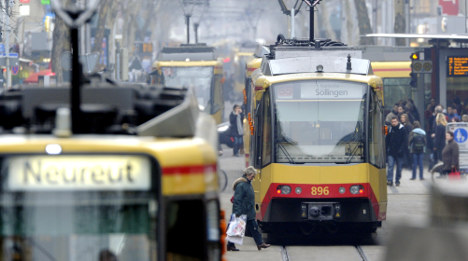
A few weeks back, Zwei created a firestorm of denial by the anti-tram crowd, when I reported that the main tram route in the city was being replaced by a subway; “because of the success of Karlsruhe’sAi??regional tramtrain service, the main tram route through the city was seeing 45 second headways“. All Zwei did was calculate the capacity offered by Karlsruhe’s trams and tramtrain and came up with a figure of over 40,000 persons per hour per direction, with 45 second (90 trips per hour) headways, using coupled stes.
Impossible screamed the SkyTrain crowd; Karlsruhe can’t operate couples sets of trams, claimed a planner from TransLink.
Yet, 45 second headways, with a mix of single cars and coupled sets could give peak hour capacities in Karlsruhe well in excess of 40,000 persons per hour per direction.
Well the following quote from the Light Rail Transit Associations Topic Sheet No 5 – A Question of Capacity tells a different story.
THE CAPACITIES of different modes of
transport are generally quoted as
0-10 000 passengers per hour for bus,
2000-20 000 for light rail, and 15 000
upwards for heavy rail.
It is city centres where several routes combine
that the most capacity is required. A typical
situation could be a pedestrian street with six
routes operating at 10-minute headway giving 36
double coupled trams per hour each with a
capacity of 225. This gives a nominal capacity of
16 200 passengers per hour which can be
increased to 25 200 pph in extremis without extra
vehicles. Light rail is unique in this ability to
operate on the surface with its capacity without
detracting from the amenities which it serves
Note Statistics are based on Karlsruhe, using GT8-l00c/2 cars.



Thank you for the link Zei, glad to know that by myself I consitute a firestorm. By the way I had previously found that link, hence my comments I was unable to find a link showing greater than 26,000…(quite a difference 26,000 to 40,000) that said there is often a significant difference between the theoretical capacity and actual capacity, for instance for Ctrain Calgary Transit currently calculates a theoretical practical capacity for 4 car trains somewhere around 20,000 but the current am peak capacity is around 7 or 8000 (too lazy to go refresh my memory exactly but Calgary Transits website is easy to use and the info jumps out).
Zwei replies: The maximum theoretical capacity for the Calgary C-Train, using 4 car coupled sets, was given as 33,000 pphpd. Current peak hour capacity is over 12,500 pphpd. The maximum theoretical capacity for SkyTrain Expo Line is 30,000 pphpd; for the Millennium Line, 26,000 pphpd.
From Calgary Transit. Maximum practical capacity with 4 car train 19440pphpf. Actual maximum peak hour passanger load 7255pphpd. http://www.calgarytransit.com/html/technical_information.html
Zweisystem replies: You are so full of bullshit Rico. The time and effort you take to discredit light rail has now made you a troll. Your subtle anti-LRT rhetoric is woven into a web of deliberate misinformation. What you use is from around 2006. The transit mall has been now signaled to 90 second headways, thus increasing capacity, thus actual and theoretical headways have been increased by 15 more trains per hour per direction.
Maximum THEORETICAL single direction capacity (pass./hr/dir) at 256 pass./car and 2 min. headway (2006):
3-car train 23,040
4-car train 30,720
Adiós chum.
For starters I am not interested in discrediting LRT, I like it, not to mention 20,000pphpd is pretty impressive, what I wanted to show was the vast difference between practical capacity and actual capacity (the difference would be even more compared to theoretical capacity). You will note the difference between practical and theoretical as well…theoretically I can line buses up in single file, run them at 3km an hour with the doors open and get a theoretical capacity of 1000000000pphpd but it is not PRACTICAL. I am almost certain that Calgary retained 2min headways dispite having track signalling allowing 90second headways do to the inability to give traffic signal priorization at shorter headways which is why Calgary Transit still today lists PRACTICAL capacity as 19440, theoretically they could have greater capacity but they will screw up downtown to do it and that is not PRACTICAL.
All that digression for the key point. With a practical capacity of 19,440 current AM peak load is still less than 8,000 so when you keep talking about Karlsruhe as if it has an actual capacity of 40,000 it annoys me when you can’t back it up. You are giving LRT a bad name with unsupported claims and an inability to accept other points of view. And that annoys me…..because I actually do like LRT but I don’t like bullshit.
Obviously you do not like light rail and you do offer lots of (as colonel Potters said) “horse pucky”. Your sly anti-light rail rhetoric is more than troublesome and if you had actually read something about transit and transit mode, in real books or manuals, you may learn something. Any tram/streetcar/LRT line (provided it is double tracked) can obtain capacities greater than 20,000 pphpd and this has been true since the mid 80’s. Get over it.
Well as a master of ‘horse pucky’ you have made me go to the Karlesruhe website again and try to find actual pphpd (by the way I do believe 20,000 or even 26,000 is possible in a grade seperated (or in Karlseruhe pedestrian) route). I did not find actual pphpd but I did look up the AM peak schedule 8-9am. And what do you know you are full of ‘horse pucky’ again. The S-5 has 3 trains per hour, the S2 has 3 trains per hour, the tram 1 has 6 trains per hour, tram 4 has 6 trains an hour, tram 5 has 6 trains an hour, tram 2 has 6 trains per hour and the S4 has 2 trains per hour. All are for single direction on the common segment, for a total of 32 trains per hour in the am peak. I believe the lightrail analysis of 36trains/hr would also be reasonable (as opposed to your 90)….therefore THEORETICAL (or possibly PRACTICAL) capacity of 26,000pphpd as posted by light rail. Here is the link to the Karlseruhe operator http://www.kvv.de
The Karlseruhe system in Karlseruhe is a success don’t make it look bad by making ‘horse pucky,’ up. Stop spewing ‘horse pucky.’ People are more inclinded to listen to people they respect, people known for making things up are less likely to be respected.
Zweisystem replies: Actually the main tram route in Karlsruhe was seeing 45 second headways with a mix of single and coupled sets of GT-8 trams. The hourly capacity of such an operation exceeds 30,000 pphpd and may indeed surpassed 40,000 pphpd.
Zei, I forgot the link is in German (not sure if you read German) but since you mentioned your brother in law drives tram in Basil he could translate and count the trains/trams per hour on the common segment for you to verify.
Too bad the Karlsruhe operator is so unorganized they left off 58 tram trips an hour off their schedule. Don’t you hate it when you think you are only running 32 trams/hr and some unknown person goes running all these extra trams you don’t know about on your system? Bottom line is unless I looked up the info incorrectly (always possible my German is rusty) they are running 32 trams an hour TODAY (very similar to the Light rail number of 36 trams/hr theoretical capacity number so I doubt it) that means they are running at headways of approximately 90seconds, I am sure they are able to do 45second headways, but I bet there are lots of practical reasons why they don’t. That means you are full of ‘horse pucky’
Probably a good time for you to apologize for being ordinate. Or show me the error of my ways.
Unfortunately Rico no one reading this blog is at all interested in your obsession to prove that LRT will not work in Vancouver
Give it up Rico please, I’ve read your comments over the past month and I am worried by the compulsive trait of your personality, which drives you to scrutinise every word written on LRT, Light Rail, Trams, Streetcars so that you might attack the threat.
Too often I read your questions which are false, disputed, or question-begging presuppositions, you will not gain anything with perusing an argument, with logical fallacy loaded questions
It is just as much of a (fallacious) argument as all the other categories in your taxonomy. This isn’t merely splitting hairs; a debate can be won (in the view of the audience) by someone who does nothing at all but pose loaded questions; each serves to presume things for which no logical argument is offered.
Stewarts Lane, blah blah blah. Here is the thing I am more than capable of liking RRT, LRT and buses as well. In fact I am a bit of a transit fan. RfV has some neat articles when Zei does not write any commentary. Now something about my personality, I don’t like beligerent bullies and to me unfounded or clearly flawed attacks on (in no particular order) Canada, Translink, Skytrain or Vancouver by Zei get me annoyed. So if Zei posts things that are demonstratively false (no transit mode share shift in Vancouver/Canada line ridership is 20% YVR employees riding for free) I call bullshit and so should you. I also find bragarts to be untrustworthy so I tend to defend the truth against Zei’s damaging exagerations. Even after posting a link to the Karlseruhe schedule Zei just repeats “they were seeing 45second headways and the capacity may well exceed 40,000pphpd…..” The 20,000 or 25,000 theoretical capacity is a very large number and impressive number that can be supported by recognizable sources, why does he feel the need to post numbers that can be shown to be completely fictional? Or do you subscribe to the fact the kvv just forgot about the schedule for more than half their trams?
Zweisystem replies: You are a joke Rico. I use the Light Rail Transit Association http://www.lrta.org and Light Rail Now group http://www.lightrailnow.org as an authorities on the subject and both groups are rather conservative. I ALSO HAVE A RATHER LARGE LIBRARY ON URBAN TRANSIT, MOSTLY TECHNICAL STUFF. I have all four Volumes of prof. of Urban Transport, University of Wuppertal, Carmen Hass-Klau’s series, starting with Bus or Light Rail making the right Choice. I also consult with real transit experts in the UK and Europe on transit issues. In short Rico, I use real resources, from real people and not random links that support my opinions. My opinions are based on light rail operating in revenue service around the world. Added to all this, the RftV blog is vetted by transit experts and I would imagine that some of those posting are the very same experts, who wish to remain anonymous. Sorry Rico, the rantings of one persons, using random links just can’t compare.
Zei, define Vancouver. I have stated LRT is a poor choice for the Broadway corridor. I have also said I think it could work in Surrey on King George, it should also work on Fraser Hwy. If those corridors get built as RRT I imagine that would work as well but it seems overkill.
Zwei replies: Actually LRT on Broadway would be much better than a SkyTrain subway, as LRT would attract far more new customers than a subway and operate at a far cheaper cost. Another savings with light rail, is that a shadow bus service would not be needed. A Broadway subway would be the final straw in the financial collapse of TransLink and even metro Vancouver.
Rico, you are accusing me of lying, this will be the last post you will be allowed. I know you are a shill for the SkyTrain lobby, but my patience has worn rather thin, with your dated rhetoric. This nonsense that light rail is OK for Surrey, but SkyTrain and subways are OK for Vancouver shows your politics. Rico, did you count both TramTrains and tram services for Karlsruhe? I bet you didn’t. Have you consulted with anyone in Germany about Karlsruhe? I bet you didn’t. Have you even talked to a real expert about rail transit, including subways, LRT and passenger rail, I mean someone who actually works in the field? I severely doubt it.
If you call me a liar, they you are calling the LRTA and Karlsruhe’s operating authority liars as well. But I guess TransLink types call anyone who supports light rail liars.
Adiós chum, your last post, enjoy it, you are spam now.
.
Interesting to see that Karlsruhe is being talked about here, but I’m sorry to say that both of you have got your figures wrong.
If you take a look at the network map http://www.kvv.de/fileadmin/user_upload/kvv/dokumente/netz/liniennetz/2012/L0SCHI_DEZ11_Internet.pdf
you’ll see that the busiest stretch is Marktplatz – Kronenplatz. Actually, at the moment, Europaplatz – Marktplatz is even busier, but that’s only because of the construction works for the new tunnel, necessitating the deviation of a few lines.
Now, back to Marktplatz – Kronenplatz, you’ll see eight lines running there, three of them being regional lines. All lines are running every 10 minutes Mo to Sa during daytime, except for the S4/41, whose timetable is a little more complex, resulting in 5 trams per hour. That gives a total of 47 trams per hour, or alternatively, a headway of 76 seconds.
During the peak hour between (which in Karlsruhe is rather between 7 and 8 AM by the way) you’ll get a maximum of 52 trams, respectively a headway of 69 seconds, and that is about the maximum you can operate before reliability starts decreasing considerably, as even today, especially during peak hours trams will often start queuing up at the signalised intersections each side of the central pedestrian area.
Please take note that I am talking about *scheduled* headway there. If you were to go out in the street, you could of course observe trams following each other as closely as 45 seconds, but the difference between those two values is necessary to give the timetable some kind of resilience. Actually *scheduling* trams at 45 seconds intervals would definitively be madness.
Thank you for your local input. All I did was quote a news item from Tramways and Urban Transit, which said that the route was seeing 45 second headways in the peak hour and did a simple calculation for capacity and never suggested that this was scheduled service.
Your figure of 69 second headways, still provides a capacity far greater that what is said as possible by planners in Vancouver.
Now you can help me, how many of the peak hour services are there with coupled sets? Certainly the TramTrain services tend to use coupled sets during peak hours but what would the ratio be?
Thanks again!
First of all, I have to correct myself, peak hours actually does extend to 9 AM, though that doesn’t change the figures I’ve posted.
As for the composition of services, all tram lines are operated using single 28 or 38 metre units, except for tram line 1, which has half of its diagrams operated by single 38 m units, and the other half by two 28 m units coupled together.
Moving to the regional lines, the S1 only runs through the western half of the central section, but for completeness here it is: In the morning peak, about half of the trams are coupled sets (38 + 28 m, or 38 + 38 m), but there are also a lot of extra services running. In the evening peak, it’s mostly the normal frequency, but most sets are doubled up.
On the S2, about a quarter is using two 29 m units coupled together, the rest is operated with single 38 m units.
Finally moving to the actual tram-train lines (only 38 m units), outside of peak hours, at a rough guess about 50 – 60 % of the service on the S4/41 is running with coupled sets, and a quite lower proportion of services on the S5.
In the peak hour, counting at Kronenplatz citybound between 7 and 9 AM, 7 out of 9 services on the S4 use coupled sets, and 5 out of 14 services do so on the S5.
A final thought: Don’t forget that if you were to run all the service using only coupled units, headways would have to increase slightly because the trams will need more time to clear stations, junctions and intersections.
Thank you for your prompt reply. I asked this question because a TransLink planner emailed me (a graduate planner from UBC) claiming that no couples sets were operated at all on this route. Your email confirms my opinion that several services are operated by coupled sets during peak hour.
This, of course, is part of the silly debate in Vancouver where the SkyTrain lobby claims that light rail can’t carry much over 10,000 pphpd and that SkyTrain has a much higher capacity. The truth of the matter is, the Karlsruhe example demonstrates that LRT can obtain similar or even higher capacities than our SkyTrain mini-metro.
I have been a fan of the Karlsruhe tram/tramtrain system since the 1990’s as it has been success after success and a good model for Vancouver and outlying cities.