The Broadway Follies – Vancouver Tries Terror Tactics.
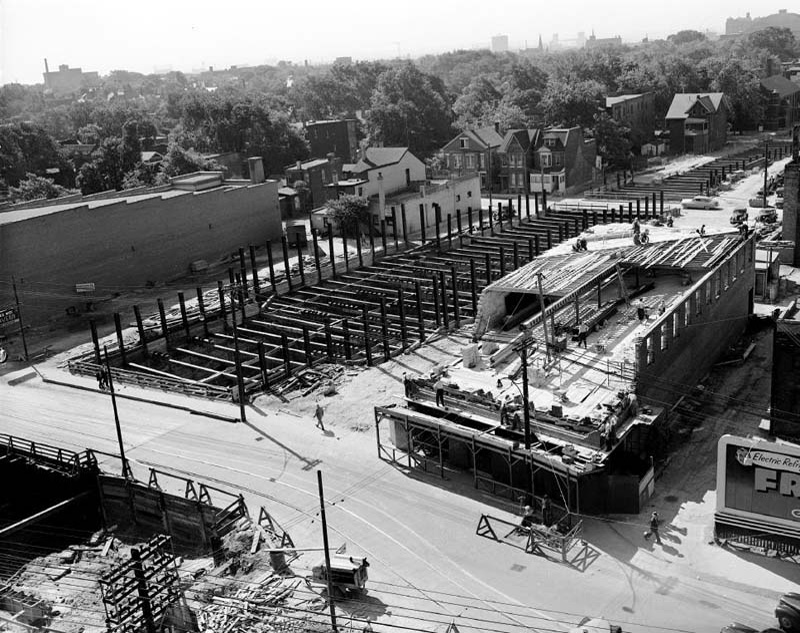
Cut and Cover subway construction
Last week, the City of Vancouver started a long and odious campaign for a multi-billion dollar SkyTrain Subway under Broadway, as far as Arbutus and maybe as far as UBC. In order to secure a favourable public opinion, the city claimed doom and gloom to any and all who would dare advocate for a much cheaper and possibly more effective light rail option.
What should concern the great unwashed who live South of the Fraser, if the spoiled brat that the City of Vancouver has become, gets funding for a subway, kiss goodbye to any transit improvements south of the Fraser river, except for token bus improvements. Also watch for for South Fraser taxpayers more than their fair share of taxes to pay for Vancouver’s extravagance.
The following letter sent to Zwei says it all.
Mayor and council, City of Vancouver;
There are many transit developments that the mayor and council maybe completely unaware or deliberately made unaware by the city Engineering Department and TransLink.
SkyTrain is obsolete and made obsolete by modern light rail over three decades ago. That TransLink keeps wanting to build with with the proprietary SkyTrain system, demonstrates that they are wilfully blind to modern light rail transit.
The huge annual subsidies required by our three mini-metro lines have pauperedTransLink, yet we plan and build more, even though SkyTrain has been rejected by knowledgeable transit planners around the world for almost 30 years. To date, only seven SkyTrain systems have been built and only 3 are used seriously for public transit, the rest being one experimental line and three airport style people movers.
SkyTrain’s decline into obsolescence started in 1982, four years before the opening of the Expo Line. The 1982 IBI Study, done for the Toronto Transit Commission found’“that ICTS/ALRT (SkyTrain) costs anything up to ten times as much as a conventional light rail line to install for about the same capacity; or put another way, ICTS/ALRT cost more than a heavy-rail subway with for times its capacity.” The report killed several major ICTS/ALRT projects in Ontario, the birthplace of SkyTrain, yet the then Social Credit provincial party, like country rubes, bought into the SkyTrain‘kool-ade’, much to the Ontario government owned UTDC’s delight.
Arguments comparing SkyTrain with light rail are moot and the arguments put forward by the province, TransLink, and the City of Vancouver’s Engineering Department today are based on hearsay and false premises.
Subways by nature are very expensive, both to construct and to maintain and unless a transit line has traffic flows in excess of 15,000 persons per hour per direction, a subway line soon becomes a financial millstone around the operating authorities neck. In 1992, just the Expo Line saw an annual subsidy of $157 million, more than the the combined subsidy for diesel and trolleybuses in Metro Vancouver. With two more metro lines built since, this annual subsidy is now well over $300 million annually and goes a long way to explain why TransLink is in the financial mess it finds itself today.
The Evergreen Line and the proposed Broadway subway will all but bankrupt TransLink with their huge burden of costs.
Subways suffer from high maintenance costs and have proven not to be very successful in attracting new ridership and our mini-metro system is a good example. In 1999 when BC Transit ran our regional transit system, 57% of the trips in the were by car drivers yet in 2011 after 12 years of TransLink rule and over $8 billion invested in‘rapid transit’ 57% of the trips in the region were by car drivers; there is no evidence of modal shift from car to transit.
Just a week ago, in what was tantamount to a terror preemptive strike by the City of Vancouver, a vast anti-LRT diatribe, including that “Broadway would be completely ripped up and the trees chopped down………..” was unleashed to soften up any opposition to Broadway subway. The problem with using the old hackneyed anti-LRT rhetoric as used by the City of Vancouver for the past several decades, is that in the 21st century, modern light rail has evolved, unlike SkyTrain, and can happily operate as a streetcar, LRT operating on a reserved rights-of-way, a light-metro, and TramTrain or a commuter train –all on the same route!
Unlike metro or light-metro, which is built to cater to already established large passenger loads on a transit route, modern LRT and even a streetcar can economically handle traffic flows from 2,000 pphpd to over 20,000 pphpd, thus effectively bridging the gap of what buses can carry and that of a metro. Light-metro, such as SkyTrain and the Canada Line, are constrained by their expensive automatic (driverless) method of operation, have comparable capacities.
Modern light rail transit, despite the SkyTrain spin, is very economic to build and operate. One tram (one tram driver) is as efficient in operation as 6 buses (6 bus drivers) and unlike light-metro, which being driverless has a small and expensive army of attendants and maintenance people to ensure smooth operation.
Modern LRT, operating on Broadway, with stops every 500 metres to 600 metres, would replace all bus service on Broadway and give a clear economic benefit to TransLink with reduced operating costs, unlike a subway which is expensive and needs ‘shadow‘ bus service, which again increases operating costs. There is no economy to be had in building a Broadway subway, Skytrain or no.
In 2008, noted American transit expert Gerald Fox, in a letter to a Victoria transportation group, shredded TransLink’s Evergreen Line business case, stating; “I found several instances where the analysis had made assumptions that were inaccurate, or had been manipulated to make the case for SkyTrain. If the underlying assumptions are inaccurate, the conclusions may be so too.”Fox later said; “It is interesting how TransLink has used this cunning method of manipulating analysisto justify SkyTrain in corridor after corridor, and has thus succeeded in keeping it proprietary rail system expanding. In the US, all new transit projects that seek federal support are now subjected to scrutiny by a panel of transit peers, selected and monitored by the
federal government, to ensure that projects are analyzed honestly, and the taxpayersai??i?? interests are protected. No SkyTrain project has ever passed this scrutiny in the US.”It seems that the City of Vancouver is following TransLink’s lead in providing “assumptions that are inaccurate and manipulated” and are “manipulating analysis”to make the case for a hugely expensive Broadway SkyTrain subway, in deference to the overwhelming need for affordable transit South of the Fraser River.
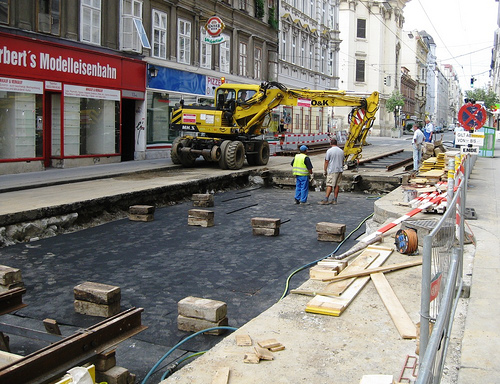
Pre-fab tram/streetcar/LRT track construction



Transit here has been taken over by individuals who are using it to make money. For TransLink to spend $1.4 billion for SkyTrain along the 11 kilometre Evergreen Line route only to lower the SkyTrain down to grade for a significant distance “to cut costs” is insane:
http://www.evergreenline.gov.bc.ca/route_and_stations.htm
TransLink will be fencing off large areas of land at grade to keep people from being harmed or vehicles from damaging the tracks at grade. SkyTrain is a foolish mistake by corrupt individuals who are using it as their meal ticket.
TransLink has conned much of the media and most of the public to support transit under the guise that it is taking cars off the roads to reduce gridlock and pollution. Really, transit by TransLink merely increases transit trips of “existing transit users” to create the illusion that more people use transit. Since the formation of TransLink, TransLink has reported increases in transit use which can’t possibly be real.
TransLink is moving the same number of transit users on more buses and trains to create riders out of people who don’t exist. Every time that a SkyTrain line goes into operation, there is a huge increase in reported transit ridership. Yet, at the same time, the number of cars on the roads does not drop and increases, instead. TransLink is simply lying about taking drivers off the roads.
It is also at grade because the Port Moody council wanted it at grade there. The at grade portion is along the railway. Since people are restricted from crossing the railway anyway (even now) pedestrian access will remain the same.
@ Rico, after the developers move in to make money from the densification in Port Moody with condos for drivers to inhabit, the railway line will be too noisy for the condo inhabitants and be gone in no time. The SkyTrain will blight the community and interfere with movement in the area. It will be despised as the other SkyTrain lines are by many people in Metro Vancouver.
First: cancel the SkyTrain-abomination for the Evergreen Line route.
Second: build a tram line for one-tenth the cost.
Third: fire everyone who is remotely connected with the planned SkyTrain disaster along the Evergreen Line route.
So you figure the skytrain will be noisier than the heavy rail line?
Zweisystem replies: SkyTrain is a heavy rail line and is noisier than light rail. In fact modern LRT is very quiet.
But quieter than the CPR
Skytrain is the most successful rapid transit system in North America. That’s why Skytrain has 3 times the ridership of Portland’s largely street level light rail system. Metro Vancouver would be making a huge mistake if it failed to complete the Skytrain network. This includes completing the Evergreen Line, the UBC Millenium Line extension, and extending the Expo line to Langley.
Zweisystem replies: On a cost per passenger basis, the Calgary LRT system far outshines SkyTrain. If SkyTrain so fantastic as you say, why has it been rejected by transit planners in North America and Europe.SkyTrain’s high ridership comes from dumping vast amounts of passengers onto one core line, in fact there is absolutely no evidence of a modal shift as SkyTrain perceived increases in ridership come from population growth. As well, take away the U-pass and ridership on the metro will fall!
You mean they use Skytrain as a trunk route and have people tranfer from buses? Like Calgary? Or Portland? Or any other LRT skystem? I am shocked….lol. I wont bother going over mode shift links with you since those are facts you don’t like and won’t hear. You are correct about Calgary’s cost per passanger but that should be praise for Calgary not a critic of Skytrain since as far as I can find Skytrain has a lower cost per passanger than all other LRT systems in North America.
I think Calgary’s LRT extension is opening today.
Maintenance is another dark spot for the SKY TRAIN (SCARBOROUGH RT) system. The L.I.M. Units are two to three times the cost of a standard modern electric truck/wheel mounted motor and harder to get affordable spares. Just look at the chaous caused by Bombardier’s main door manufacturer going bankrupt. Several Light Rail and Subway vehicle contracts were late and now the replacement is causing problems on Toronto’s new Toronto Rocket subway trains and that is somthing that is normally not considered crtical. If bombardier’s LIM manufacturer went bankrupt how long do you think it will take to get a new manufacturing firm in production? That is the final nail is the Skytrain’s coffin the proprietary nature of the whole system.
@John, try to sell your SkyTrain idea to Ottawa and Edmonton engineers who looked at it and laughed. They went with trams, instead. You don’t have to be a chemical engineer or a graduate of MIT to realize that tram lines cost one-tenth as much as SkyTrain lines. Tram lines move more people at a faster rate than SkyTrain lines (UBC 2009). SkyTrain from day one was intended to create a manufacturing base here to export SkyTrain technology and to create jobs. It failed.
Certain individuals are all to eager to tax drivers to expand SkyTrain so that they can save their jobs and reputations. I and many others don‘t share their enthusiasm. It means that TransLink will continue to operate diesel buses on trolley bus routes to harass residents on the 99 B-Line route for at least another decade, for instance, and that Surrey will not get any light rail transit, any time soon. Here are some facts:
At over $127 million per kilometre to construct the Evergreen Line (EGL) and then an additional $100 million per kilometre in upgrades to the SkyTrain network to integrate the EGL into the existing SkyTrain network – the EGL is going to cost $227 million per kilometre or $2.5 billion for the 11 kilometres. To safely do the necessary upgrades for the EGL, TransLink is most certainly going to shut down the SkyTrain station at Metrotown for 15 months and is going to do major upgrades at the SkyTrain station at Commercial Drive (these upgrades are really neglected maintenance which is being charged to the EGL) – sneaky TransLink:
http://metronews.ca/news/vancouver/467100/upgrades-could-close-metrotown-skytrain-station-for-15-months/
http://metronews.ca/news/vancouver/441964/translink-rolls-out-plan-for-third-commercial-broadway-platform/
Then, of course don’t forget the added 7% in service hours to shuttle riders on buses to the EGL without undue delays (SkyTrain stations will be about two kilometres apart and too far to reach by foot). In 2011, the No. 97, which the EGL is replacing, logged 54,990 service hours and after the EGL, the service hours with the shuttle buses for the EGL will increase to 58,839. At about $115 per service hour for busing, this will add about $7 million in operating costs annually to the EGL.
If TransLink built a tram line, it would cost $300 million. Moreover, the tram line would save $7 million in busing costs because the full sized bus-shuttles for the EGL would not be required with the tram stops located 500 metres apart in distance. So, notwithstanding inflation, after 30 years the tram would cost about $90 million ($300 million – 30 * $7 million). In contrast, the EGL will cost over $2,700 million in 30 years (SkyTrain has other incidental operating costs such as police and control room operators, too). That is, the undiscounted cost of the SkyTrain line will be at least 30 times more expensive than a tram line. Still, TransLink wants to tax drivers to pay for it rather than build the tram line which could be designed to carry more passengers, more efficiently, than the SkyTrain line.
If you live “at a SkyTrain station” and work “at a SkyTrain Station“ (who does?), the SkyTrain will shave 16 minutes off your commute and if you don‘t, there is a 75% probability that it will slow your commute. In other words, the SkyTrain line is guaranteed to be slower than a tram line.
There are 1.5 million registered drivers in Metro Vancouver, and with transit, there are about 1.3 million potential drivers (based on 300,000 transit users with 1.6 occupants per car). Since drivers make two trips over 24 hours, the reduction in cars on the roads on average is around 17,000 cars each hour. Wow! This number of cars is almost inconsequential in doing anything to reduce vehicle gridlock for the zillions of metres of roads in the Lower Mainland.
TransLink touts its frequent transit network (FTN) as being necessary to create transit-oriented communities. In truth, FTN is a band-aid solution to make SkyTrain function. Without FTN, the trip to the SkyTrain station would be over 30 minutes for many transit users and would sink SkyTrain. Really, FTN is expensive and results in many buses running around empty to create noise and pollution.
If you are someone without a car, taking transit increases pollution by 100% – all the time (you‘d be walking or car pooling without transit). If you are a driver and use transit, transit only reduces your driving by about 35% on average. To achieve this, TransLink operates empty or nearly empty buses much of the time. Transit based on SkyTrain is a hoax and either increases carbon emissions or does very little to reduce carbon emissions.
Anyhow, that’s enough for 2012. Happy New Year!
Skytrain is improving the noise level in the new cars. The first generation of Expo cars are by far the oldest and noisiest in the System. They are 1986 models and if they were your cars they would have outstood those by millions of miles alone. Perhaps the real value is the private vehicle is saving milage and the gas and mechanical expense goes into the fairbox. Most 1986 passenger cars are wrecked or recycled in some way by now.
The seat-per-mile equation dates back into the R.D.C. before VIA RAIL came along. It was used between Toronto and Montreal to compare Rapido and the Expo 67 high speed rail project. It was based on how many empty seats between two cities against the full ones. At the time highway vehicle traffic made better time, gas prices far cheaper, maintence prices far more competitive, and insurance rates were low. So many compared their personal expenses against passenger rail fare. For most personal expenses were more, but the trade off between time and convience to leave anytime and go many places the train could not was called freedom.
Today because of the shift of long drives from rual communities of the past is gone. Since 1970 over 90% of the population is in major cities for many reasons the small towns could not provide for. Via has cut many stations and runs because of that reason. The seat-per mile ratio does not work between Skytrain stops as stops are not cities and are too close together to know the outcome. However one can apply it to The West Coast Express as it covers many miles and stops in 8 or 9 different cities. However there is no other comparison to know if its doing well or not, and Skytrain has the same problem. In the Lower Mainland this may not last for long as the new proposal called Twinning of Commuter Rail on the south side of the Fraser is gaining in popularity.
The outcome of tolls on the new Port Mann bridge and the funnel effect from different entrances may tell a huge mistake in the malfunction of future projected population and vehicle use as was found in California. There the freeways have no room and there are no Commuter Train seats available in the Los Angles rush hour. By building the freway wider we have made the same mistake, because the Fraser Valley is growing at 40% every year and will double Vancouver’s 600,000 people every 6 months. Over population has made transport supply and demand very expensive and the more the sponge is saturated the tougher it is to wring it out. It gets sloppy. The Lower mainland needs a period of Transition of Transportation needs and a diversity in fuels to balance the bang for a buck concept. If we don’t, neither car nor train will be the future solution to satisfy the density democracy can least afford.
Eric Chris, I think both Ottawa and Edmonton would be quite upset to hear their expensive mainly grade seperated LRT systems called tram lines….especially since Ottawa’s will cost way more than the Evergreen line or Canada line. Not sure were you get the rest of your garbage from.
Zweisystem replies: Rico, Mr. Chris get his “garbage” from reputable sources, unlike you, who contorts every bit of info to support Skytrain – oh by the way, no one is buying Skytrain are they? They must read the same “garbage” as Mr. Chris. As for calling LRT tramways, in Europe, what we consider LRT is a tramway and LRV’s are trams. A light railway is something again different.
I was talking with the head of the Rail Implementation Office during the official revealing of the winning consortium last Wednesday and again on Thursday at the Rideeau Centre presentation. The winning bidder The Rideau Transit Group,is getting 49 metre, 4 section vehicles, operating in 2 car trains. The heavily modified Alstom Citadis. He refered to it as a tram too. I do not think he cares what you want to call it.
Thank you! I look forward seeing the Citadis in operation!
The total cost of phase 1 of Ottawa’s “Confederation Line” will be exactly $2.12 Billion. Any cost overruns will be paid by the operating consortium ,The Rideau Transit Group. There are to be 34 vehicles, again in 2 car trains at peak and will run at a minimum headway of 3 minutes and 16 seconds. Tunnel platforms are 150 metres long and all other platforms will be 120 metres in length (expandible to 150 metres in the future). This is possible because the Transitway was designed to be converted to rail when it was first designed back in the early 80’s and with the exception of 2 curves all are designed to rail standards. The first section of the Transitway opened in 1983, many of the concrete structures were up as early as 1981. The high cost is due to the downtown tunnel and need to replace a lot of concrete infrastructure that was nearing the end of it’s life and was going to need replacement or major enhancement. The trains are expected to easily handle the current peak load of 10700 people per hour per direction. The line operates from Blair Transitway Station in the East through downtown Ottawa to Tunney’s Pasture Transitway Station in the west, a total of 12.5 km. Phase 2 from Tunney’s to Baseline Transitway Station is currently going through the E.A. process.
Zwei, Eric was saying that the station upgrades to Broadway/Commercial and Metrotown are required for the Evergreen line. In what universe does a station upgrade for Metrotown apply to the Evergreen line? When the Evergreen is built it will likely be quicker to go to Brentwood station and take the bus to Metrotown rather than go the long way around the Expo line. Assuming the Evergreen line is wildly successful way beyond Translinks expectations and tens of thousands of extra (new) transfers happen at Broadway each day there could be some justification for considering this as part of the Evergreen line but that is really stretching it. I won’t bother with the rest of his ‘facts’ because it is clear nothing gets in the way of ‘his’ views….For his reference from the request for proposals on the Metrotown upgrade it envisions building a temporary station at the Metrotown pocket track for the duration of the upgrade so there will still be a station at Metro town during construction.
Trams.
I think most people around here know that trams and LRT often use the same type of vehicle and that there is no firm boundary between them. Most also understand trams to be local services operating in mixed traffic while LRT is mainly seperated from traffic and often grade seperated (even if it runs at grade), LRT is generally considered more of a regional service….Just like the systems being built in Edmonton, Ottawa and even the Evergreen line. I am pretty sure I could speak for Edmonton and Ottawa when I say they would be pretty pissed if their more expensive than Evergreen Line systems ran in mixed traffic, had stops every 400m and travelled at 15km/hr. Just like Vancouver they decided that speed and reliability of the system are important, that is why they are largely grade seperated…and expensive….I think both Edmonton and Ottawa will be great systems while a tram line from Coquitlam to Vancouver or a tram line on Broadway would not because all of these corridors are REGIONAL corridors where speed is an important component of total travel time. PS I don’t Broadway would work as LRT but a good LRT system aka Ottawa, Edmonton or Calgary would have been fine for the Evergreen if we did not already have Skytrain.
Lastly, I’m personally not thrilled with the vehicle length choice because it really screws up the original plan for the station platforms. The vehicles were supposed to be 30 metres in length operating in 3 or 4 car trains. 4 car trains (120 metres in length) are the current max that most LRT manufactures are comfortable with. The Tram-Train version of the Citadis will do 3 car, 52 metres x 3 =156 metres but that is expected to be operating with Heavy Mainline Railway Voltages. Eventual expansion to 3 car trains in Ottawa is expected once the need is there. In the vehicle’s defense, it has a higher operating top speed than most LRV’s, 100 km/h and the 49 metre length is continous, so it won’t loose passenger space due to the space between cars. The vehicles hold 300+ passengers each which is an advantage. The vehicle choice is the unfortunate product of using a group of Companies as a basis for your choice. You choose one consortium and you get the vehicle company they chose. By the way, the new DMU’s that were chosen for the O Train 2 years ago, are also Alstom products, the Cordina Lint DMU.
Zweisystem replies: Longer trams are both cheaper to build and operate than operating 3 or 4 car coupled sets. Welcome to the world of modular trams.
I was wrong about the Metrotown pocket track being part of the Metrotown station upgrade. It was an option presented not a requirement.
Zweisystem replies: A reversible track at Metrotown has been mooted on several occasions, as it would be able to provide higher capacities to town. On another note, the Expo Line originally had plans for future stations at (if my memory serves me correctly) @ Glenn and Terminal, near Gilley & Rumble, and Sterwartson and 3rd Ave in New West.