A Broadway LRT or streetcar could look like this
LRT operating on Broadway could look like this.
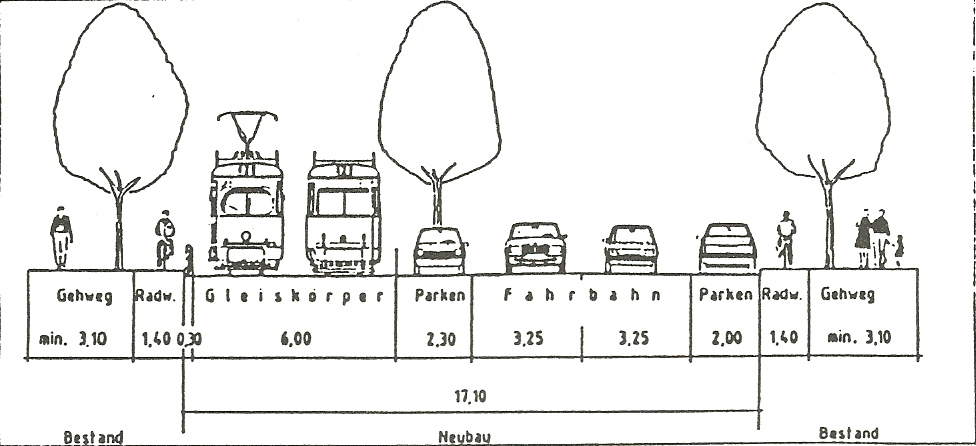
The preceding picture shows a German concept of LRT operating on a city street. Pedestrians, cyclists and motorists have good access to the city street, with the trams providing the “capacity” for high traffic flows.
If the city of Vancouver ever wished to actually reduce auto traffic, while at the same time, provide an ambient and affordable public transit, a complete rethink must be done on about major city streets and the concept of “arterial” roads. In the future, an “arterial” road, may mean a road that has a tram or streetcar!
From the Globe and Mail.
“Direct light-rail line to campus the way to go, UBC says
FRANCES BULA
VANCOUVER ai??i?? The Globe and Mail
Published Tuesday, Nov. 27 2012, 8:00 AM EST
Last updated Tuesday, Nov. 27 2012, 8:00 AM ESTUBC is urging the city to advocate for a rapid-transit line all the way out to the university right away.
Officials say the two-phase system for the Broadway line, which Mayor Gregor Robertson has been pitching, is not workable for them.
UBC has 140,000 people a day coming and going from the campus by transit, with nothing but increases on the horizon. The Broadway B-Line bus service, which currently connects the campus on the western tip of the city peninsula with a Commercial Drive station in east Vancouver, frequently has to pass up people waiting at bus stops during peak hours.
A two-phase rapid-transit line “is just not a solution,” said Pascal Spothelfer, the university’s vice-president of community partnerships. “Over 50 per cent of our passenger volume coming to UBC is by transit. That’s despite the fact that a large number of people are being passed up.”
Having a line all the way out to the university will spark even more of a transformation at UBC in how people get there and how the university develops, he said.
“It is a real game-changer, a generational shift.”
Mr. Robertson said recently the city is advocating to regional transportation authority TransLink for a first phase along Broadway with a tunnelled SkyTrain to Arbutus ai??i?? an option everyone knows is going to be expensive.
From there, he said, rapid buses could take people the rest of the way to UBC, and a SkyTrain could be extended to the campus at some undefined point in the future.
The extension was supposed to have come quickly after the Millennium Line was built from Coquitlam to Vancouver in 2001.
But it was moved down the queue after the province pushed for the Canada Line to be built in time for the Olympics.
TransLink is currently reviewing plans for the Broadway extension, along with plans for a light-rail extension for Surrey.
But UBC is saying that it might be better to build one cheaper light-rail line in order to get the whole route covered within TransLink’s budget, instead of one expensive SkyTrain for half and then buses for the other half.
“I’d rather see whatever the solution is to be a complete solution,” said Mr. Spothelfer.
Mr. Spothelfer said the two-phase solution just moves the problem down the line for the passengers trying to get across town.
“So if a train is full, do we have 20 buses waiting to take them?”
A two-phase approach also guarantees that UBC wouldn’t get rapid transit until some long-distant new round of funding, because TransLink typically only takes on a big transit expansion once a decade.
“If we miss this opportunity, it’s not like this will come back in the next two years. If a line gets built to Arbutus with no continuation to UBC now, only my grandchildren will get it.”
University officials are hoping that they hear a new message from the city as soon as Tuesday, with Vancouver’s two top engineers scheduled to give an update on the Broadway-line plans.
The university and city have been in a “very active dialogue” since the mayor made his remarks about a two-phase approach 10 days ago, said Mr. Spothelfer.
UBC has seen its students, staff and faculty shift their commuting patterns dramatically in the past 14 years, going from 77 per cent private-vehicle use to 43 per cent.
About 138,900 transit trips are now made to and from the university on an average weekday.
Mr. Spothelfer pointed out that the university is the province’s third-largest employer, with a huge number of commuters. It also has a large number of its medical students and faculty travelling regularly to the growing hospital-and-research precinct near Broadway and Oak, which is about 10 kilometres east of the university.
The mayor’s reference to a two-phase solution with buses came as news to the university.
“I was a bit surprised by him bringing up the buses again,” said Mr. Spothelfer.
He said he understands the city’s priority is serving the density it has along Broadway.
“They’re pretty set in what serves their immediate purpose.”
But he and others at the university are anxious to prove that serving UBC with good transit sooner rather than later is also in the city’s interest.



About 300,000 people use transit in all of Vancouver on a weekday and about 150,000 to 200,000 on a weekend. As usual for dramatic effect, the ridership to UBC in the Globe and Mail article is exaggerated (double) and is being confused with the number of times that people board transit or make trips:
http://www.railforthevalley.com/latest-news/zweisystem/a-broadway-lrt-or-streetcar-could-look-like-this/#comment-31910
In any case, densification is not dependent on transit and the COV is merely using transit as a convenient excuse to build little villages along the SkyTrain route. It is for the COV to stuff more people into condos in order to tax (property) the large number of “drivers” who will be moving into the match boxes along Broadway.
For every transit user who moves into a condo, four are drivers. Densification will do what it did to Toronto – create longer commutes because the roads will become stuffed from all the added cars. When you take a one block area with 100 people and increase the density to 1000 people living in condos, you increase the cars on roads from 57 to 570 in the immediate area, gridlock worsens.
Jerry Dobrovolny who is the director of Transportation at the COV is a psychopath who has built his career licking boots to support SkyTrain. He cares nothing of residents who don’t want SkyTrain in Point Grey. Jerry wants SkyTrain because TransLink wants SkyTrain. If TransLink wanted LRT, so would Jerry. Like Hitler in his bunker, Jerry has no plan-B – it is SkyTrain or nothing. Hasta la vista Jerry, good-bye, your days are numbered.
Although LRT with a dedicated ROW as the Globe and Mail article proposes would be great, merchants will fight it and don’t want to lose their parking. Fine, do away with the ROW and go with trams. As the Citadis video shows, a tram line would be almost as fast and won’t delay the commute by more than a few minutes over the short 14 kilometre trek from Commercial Drive to UBC:
http://www.alstom.com/transport/products-and-services/rolling-stock/citadis-tramways/
Eric about densification you are making a classic error. You assume that if densification does not happen that growth won’t happen. The growth will still happen’ just in Surrey…hows that for travel time increases…Since short of putting up a fence around Vancouver growth will happen the best place for the growth is near major destinations or transportation options so travel times are minimzed (yes some of those destinations/transportation options are in Surrey).
@Rico, don’t put words in my mouth. If the COV does not relax the zoning restrictions which prevent 42 story buildings in Point Grey, you will not have more densification in Vancouver.
Jerry is incompetent as a design engineer and a disgrace to his profession. He is on the way out, soon. Transit by TransLink based on rapid bus, subways and SkyTrains is flawed by design. It creates major trunk lines based on the mistaken premise that transit by TransLink is fast.
SkyTrain is really slower than conventional transit. It results in buses clogging up the roads because you have to get people to the SkyTrain and “getting people to the SkyTrain is slow” – a bus transfer, park and ride or walk.
Jerry and TransLink have made the blunder of incorrectly assuming that just because the ride on the SkyTrain is fast for a “small segment of transit users” who travel 30 kilometres to work that it is fast for the majority of transit users whose median trip distance is seven kilometres.
Door to door travel on a “tram is much faster for the majority of transit users” whose median travel distance is seven kilometres and suited to tram travel – not SkyTrain which is the misapplication of technology for what is needed to move people efficiently and economically here. This comment is not intended for you, it is intended for someone who might be able to understand it.