13.9% Grade in Lisbon – Impossible Claims the City of Vancouver!
Ever see a tram climbing a 13.9% grade?
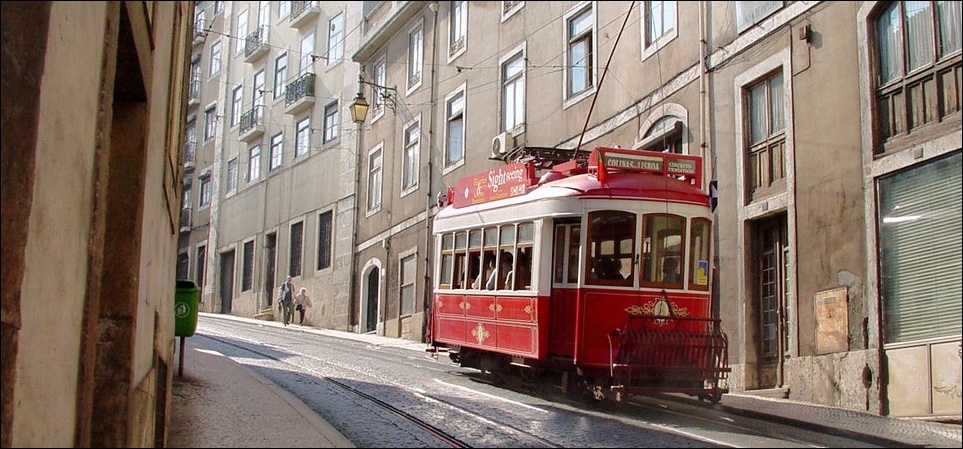
Well now you have! A Lisbon tram climbing the famous 13.9% grade in the city.
Please don’t tell the City of Vancouver or its Engineering Department, because they will just just believe you.



Translink and most local politicians come up with any excuse for the SkyTrain lobby. They are either unaware of the facts from poor research, buying everything the Skytrain lobby says or outright lying.
It is just crazy how they won’t consider LRT other than Diane Watts…
LRT should of been out to Chilliwack years ago, same with out to Mission. (Yea their is West Coast Express but only runs in rush hour for 5 trips and hence an extremely limited service)
Well, the City of Lisbon obviously knew. However, they still chose to build a grade-separated metro system instead of surface LRT for their rapid transit system. Mentioning Lisbon really does not help your case.
Obviously, these trams are used mainly by tourists. It even says “Sightseeing” in the photo. I’ve been to Lisbon and these trams are not much faster than walking going up and down hills. They hold less passengers than most buses.
Zweisystem replies: Actually, the post was to show that LRT/trams can climb steep grades contrary to what TransLink and the COV say.
The Lisbon metro was opened in 1958 and only has 4 line, with a route mileage of 45 km, serving 55 stations. The tramway has a 900 mm gauge and today has has 5 routes with a mileage of 45 km.
Zweisystem & the Cardinal do not have prove their cases Richard, it is you that has to prove yours.
You may start by confirming that the City of Vancouver’s obsession for tunnelling beneath Broadway has all to do with maintaining full road width for cars and nothing to do with transit journey time.
And the Lisbon Metro has a ridership of 500,000 passengers per day. Way more than ride the tram. Medium and large cities that are serious about transit typically have their main lines separated from traffic. Streetcars on Broadway as a rapid transit option is really a ridiculous idea. Surface LRT is not much better. Most cities would either partially or totally grade separate transit on such a busy route.
Zweisystem replies: Richard, you are a pip. You are comparing standard gauge metro to a 900 mm gauge heritage streetcar or tram system. By the way you fail to mention the ridership on the wee trams, why is that? Are you afraid of the numbers. Comparing metro to a 900 mm gauge tramway is a real apples and oranges comparison.
@Richard (Campbell?) – City of Vancouver engineers are doing residents in Vancouver a disservice by proposing a tunnel to accommodate SkyTrain to UBC. City of Vancouver has too many low caliber engineers who aren’t mechanical, electrical, process or environmental engineers going through very rigorous and theoretical curriculums to get an engineering degree.
It is no secret in the engineering profession that City of Vancouver engineers are grossly over paid for what they know and do. They are mocked in the profession and did not do their due diligence to justify the tunnel for SkyTrain based on the transit demand to UBC. Low level City of Vancouver engineers have risen to the top because they are sycophants agreeing to whatever TransLink wants and have simply proposed a tunnel to appease TransLink which requires the tunnel to extend SkyTrain to UBC.
To employ SkyTrain – you have to isolate the guide way used for the linear induction propulsion of SkyTrain – go above grade or below grade or physically fence off the guide way. The guide ways for SkyTrain must be protected from traffic and pedestrians at a huge capital cost and this is the main reason for the unpopularity of SkyTrain in most cases for general public transit use – except for in BC where TransLink executives keep proposing SkyTrain to avoid admitting that it is a mistake and to avoid ending their lucrative careers and bloated salaries.
In all of Metro Vancouver, transit demand peaks at about 78,000 pphpd early in the morning and averages about 27,000 pphpd. Peak transit demand to UBC along Broadway is about 4,000 pphpd and averages about 1,400 pphpd on a busy weekday. On weekends and holidays as well as for four months during the UBC recess, the transit demand to UBC along Broadway averages about 1,000 pphpd (for 55% of the year).
To build a SkyTrain line to UBC with a capacity of 40,000 pphpd or whatever TransLink says to operate almost empty most of the day at a cost of $3 billion is extremely silly. You can build a tram line (operating like a trolley bus in traffic) with a capacity of up to 21,000 pphpd at a two minute headway (same headway as current 99 B-Line) for $300 million and pay for it with savings from the reduction in busing service hours (elimination of the 99 B-Line and other buses on Broadway). It would be just as fast as or faster than the current 99 B-Line. Overcrowding on transit is the purported issue to justify rail transit to UBC and not speed.
If you build the tunnel for SkyTrain to UBC based on “top” speed, you increase busing service hours to get people to the SkyTrain and slow down the commute for the average transit user busing it to the SkyTrain. You also never pay for SkyTrain from operational savings because you are increasing operational costs with the added buses for SkyTrain. SkyTrain from an environment, a technological, a financial or a social perspective is dumb.
Hope this clarifies things for you. If not, too bad.
@ Richard, I find your obsession with grasping the smallest scrap of justification for building a metro in Vancouver dismal; a little like an immature adolescent repeating over & over again to his mother, so & so’s got one so I want one – wretched individual.
Hello everybody,
One of the main issues with any rail system is the ability to climb hills. Wether it is LRT or Sky Train the ability to climb hills becomes paramount in construction and planning/design costs. I can tell you most modern rail systems dealing with transit in cities rarely considers going beyond 4-5% grades. The reason is that, most rail systems can loose anywhere between 15-40% of their systems hill climbing ability (depending on a large variety of inputs) when you add just a second vehicle. This is the reason all those pictures of steep climbing streetcars are single vehicles or have a second very light weight un powered trailer (a picture I have on a 8% grade). Most LRT catalogs say that 7% is the maximum grade the vehicles will handle. What they do not tell you is that to do 7% grades you can only have single cars and you better have sanded the rails in a major way. I can also tell you no one wants to loose the ability to attach a second, third or forth car on most modern rail transit vehicles because it wipes out the productivity/operational advantage of rail based transit. The Skytrain’s propulsion system does give it a slight and I do mean slight advantage over standard LRT but does so at the loss of acceleration ability compared to LRT (up to 30%) in general operation. In modern terms any vehicle going above 5% is considered specialized equipment and has extra operating and purchasing costs attached to it which make it politically unpalatable for most cost obsessed tax payers and politicians. Reality with rail based systems in my personal and professional experience is often very complicated.
Zweisystem replies: What you have said maybe was true 20 years ago, but not today. Modern articulated trams, with auto-sanding and anti-slip control mean that they can climb steeper grades faster, with less problems than before. As stated before, the industry standard for LRT to climb grades is 8%, which means modern LRT can avoid expensive engineering solutions, which otherwise would be required for metro. Lighter cars, more powerful motors, anti-slip/auto-sanding which are associated with the light rail Renaissance, has not been realized by transit planners and engineers on this side of the pond, with the result of dated and expensive planning. Notice that the vehicle manufacturer’s never demand less steep grades, because they know their product will operate on steeply graded routes without problems.
Most subways or metro, operate long trains and not all axles are powered, in fact, some cars are not powered at all, which would see adverse operations on steeper grades. As a general rule, subways or metros do not operate on grades steeper than 5% and LRT on grades steeper than 10%.
LIM’s are a different beast altogether as they do not require adhesion, they are magnetic. A 6 car SkyTrain can operate with one LIM, but it will do so very slowly, less than 1 kph, but the train will still move forward. In theory, LIM’s would work well on steeply graded lines, the catch is, modern LRT works just as well.
In Sheffield UK, their “Supertram” has a section of 10% grades and there never has been a problem. The vehicles are a standard 3-section articulated cars which have all axles powered. Sheffield, at this point in time, does not operate cars in coupled sets, but I have been assured that if coupled sets were to be run in Sheffield, there would be no performance problems.
@ Richard Campbell,
1] Medium and large cities that are serious about transit typically have their main lines separated from traffic..
2] Most cities would either partially or totally grade separate transit on such a busy route.
Richard please justify the above two statements with searchable references, otherwise I shall assume that this is your opinion only.
Since you’ve searched Wiki for figures for ridership on the Metro, please substantiate the corresponding figures for the trams run by Carris
So I’d like to chime in actually, this might be my first time on this site but I have more than a few interesting things to say.
First of all is that the “tram” in this picture is a small single-car and single-bogey unit. It appears to be very light. In the same way that a heavier aircraft can only ascend from an airfield more slowly and a lighter aircraft can ascend more quickly, this kind of tram may be more suitable for these much steeper grades because it is much lighter.
When you consider LRT in the sense of either full-speed operation rapid transit (as in, a 60-80km/h multi-car service with much longer and much heavier LRVs) or even tram service (50-60km/h service with vehicles again much heavier and longer than these mini-trams), these grades are not actually feasibly possible.
I don’t really care what grades LRT can do nor have ever tried to claim that there is a certain percentage of grade that LRT just cannot do, I just want to point out that this comparison is absolutely ridiculous. Mr. Johnston, I highly recommend that you simply take this article off of your site because you are only curbing unnecessary commotion and ruining the reputation of you and Rail for the valley, because there is nothing of value to get from the fact that tiny trams can take on 14% grades in Lisbon that will help regional transit planning here in Metro Vancouver.
At Eric Chris, you need to consider how much of the 99 B-Line’s demand is overflowing onto other parallel routes not just on Broadway but on other corridors. We need to be looking at the 9, the the 14, the 4, the 7, the 25, the 33, the 41, the 43, the 44, the 84 and the 480 as well. A full SkyTrain corridor to UBC has the potential to take on the ridership from all of these routes, plus new riders attracted to faster and more reliable transit. I would also like to dispute your claim that more SkyTrain to UBC means more bus hours – the addition of SkyTrain, relieving UBC rider pressure on all of these parallel routes, will likely allow for a relaxation in bus service hours.
You also need to be considering how the extra capacity of SkyTrain will help Vancouver 25-50 years down the road, not just in the next 5-10.
Zweisystem replies: The smaller 4 axle “heritage cars” have been retained because of the sharp vertical curvature on the lines, as the tram lines were designed 100 years ago for the 4 axle cars. There are plenty of U-Tube videos on Lisbon’s trams, watch some, as your aircraft analogy is not correct.
Light Rail is not rapid transit, as the two modes are built for two different reasons. Light rail is built because it becomes much cheaper to operate than buses on transit routes, what we call rapid transit or metro is built when ridership on a route (20,000 pphpd+) makes at-grade operation undesirable. Light rail can be built as a simple streetcar, operating on-street, or LRT, operating on a reserved R-o-W. When LRT is built on a R-o-W, it has the same characteristics of rapid transit, only at a far cheaper cost.
I see, you have fallen into the Translink/SkyTrain kool-aide rhetoric and follow the dated concept of having one trunk transit line to serve ALL transit routes, leaving whats left to fend for themselves with inferior bus services. Doesn’t work and even TransLink’s own studies show it doesn’t work. Consider this, for the cost of a full Broadway SkyTrain subway, we could build modern LRT on Hastings, 4th Ave., Broadway and 41st (with a combine capacity of 60,000 pphpd!), the the RftV Vancouver to Chilliwack TramTrain, a TramTrain Evergreen line and at least 2 LRT routes in Surrey.
If you have read anything about transit, you would find what attracts people to transit is convenience and if one doesn’t live near a SkyTrain station, out transit system is very inconvenient and is the reason why transit growth has remained largely static, despite over $9 billion spent on 3 mini-metro lines.
The problem on Broadway is not capacity, for if one looks at the schedule, the offered capacity by the trolley buses and 99-B Express buses, is less than 5,000 pphpd in the peak hour. The problem on Broadway is that Translink is deliberately not providing the buses service to cater to the volume of demand. A tram/LRT line on Broadway would be able to provide the capacity, at a far cheaper operational cost than buses.
Friends of TransLink are very good at making people focus on red herrings such as the “supposed superiority” of SkyTrain to go uphill or fast – to draw attention away from TransLink essentially stealing from taxpayers to pay off SkyTrain losses.
When you prove that TransLink is lying or making misleading statements, TransLink simply says nothing to avoid bringing attention to it and uses our tax money to exploit another half-truth in the media which ignore the old lie to print the new lie.
It is just a matter of time before we read of TransLink executives being arrested and charged with fraud.
TransLink is attempting to force another vehicle tax under the pretence of needing it to fund future transit (Evergreen Line as a SkyTrain project).
In fact, most of the money from the proposed vehicle tax is really going to be used to pay off the Canada Line and other crushing SkyTrain debts.
Of course, if TransLink is awarded a ridiculous amount of tax money to fund a transit system which is already costing twice as much as elsewhere in Canada, some money will be used to buy a few more buses, too.
I’m sick of the dishonesty of the scammers at TransLink and would prefer to just see all the executives at TransLink, gone, to save taxpayers all the millions of dollars spent on their unnecessary salaries.
How fast can these trams go up a 10% grade? That would save a lot of money in regards to the Evergreen Line!
Zweisystem replies: The Sheffield cars have all axle’s powered so acceleration is quite snappy. The steepest tram stop is on a 9% grade and the tram acceleration is the same as with any less graded tram stop.
Pray explain Mr Daryl of the friends of TransLink, why Zweisystem should take down the article?
To please you or to please TransLink? Because the posting is causing commotion amongst the so called transit planners & engineers in TransLink, the City of Vancouver & the narrow minded amongst the advocates in BC.
Your problem Mr Dela Cruz, apart from your arrogance is that the narrow view you have elected to take precludes you from seeing any other solution.
TransLink have adopted a similar stance and have become totally obsessed with SkyTrain, to the extent that they cannot & will not allow themselves to consider alternative modes.