Bi or double articulated buses have created a demand for such buses to operate in Vancouver.
I believe this would be a big mistake because from what I know about bi articulated buses, they are a niche transport system, designed to solve niche transit problems.
What I do know is that they are maintenance intensive and maintenance, especially preventative maintenance is something that TransLink is very poor good at doing.
Bi articulated buses are illegal to operate in Canada, unless they operate in a fully dedicated rights-of-way.
This means the cost difference between a bi articulated bus and a tram (LRT) would be almost the same, without the benefits of the tram with cheaper operating costs; much higher passenger capacities; and lack of flexibility in operation.
From my stays in Germany, the German CDU political party is akin to Canada’s Conservative party and the likes of Doug Ford, who is a Conservative and hates trams.
I do not know why, but the more Conservative a politcal party, the more they dislike affordable public transit and spend huge sums of money on largely unaffordable subways and light-metros. In BC the same is true of the NDP, who ignore affordable transit solutions in favour of hugely expensive “SkyTrain light-metro” solutions.
Back to the bus. I think it would be another grand mistake operating these buses in Metro Vancouver, as for what little increase in capacity on transit routes, would mean a large increase in maintenance and operational costs.
In the end what should be done is not done in favour of gimmicks for election time and to hell with the taxpayer and transit user.
Berlin: Mega buses instead of trams? Between pragmatic solution and political deadlock
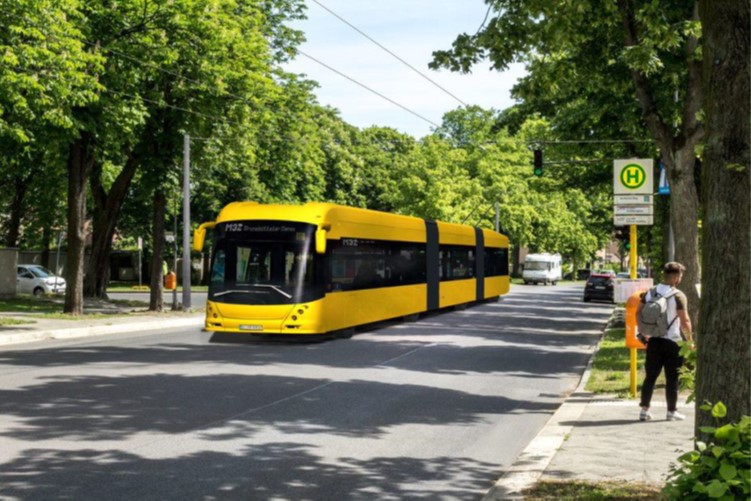
The Berlin Transport Authority (BVG) is planning to deploy extra-long electric articulated buses measuring up to 25 metres in length. Supported by Berlin’s CDU party, these ‘mega buses’ are being presented as a flexible, short-term alternative to trams – especially in areas where tram expansion has stalled. Critics, however, speak of a ‘political distraction debate’ and accuse the current Senate of stopping or delaying key tram projects for ideological reasons. Urban Transport Magazine takes a detailed look at the current situation, technical options – and the strategic significance for the transport transition in the German capital.
The idea: XXL buses with a length of 25 metres
As part of its ‘E-Bus 2025’ electric mobility programme, BVG is preparing to purchase a new generation of buses: double-articulated buses with a length of around 25 metres and a theoretical capacity of up to 200 passengers. In reality, the capacity is around 130–150 people – nevertheless, they represent a significant increase over the 18-metre articulated buses currently in use.
In 2020, BVG considered using double-articulated trolleybuses, but this did not happen. Source: BVG/VDV Elekbu Conference 2020
These vehicles are intended for use primarily on heavily used MetroBus lines such as the M32 in Spandau, but also on other lines with high passenger numbers, such as in Marzahn-Hellersdorf or along Heerstraße. The vehicles will be fully electric and charged at terminal stops. Procurement could begin in 2026, subject to political approval and structural adjustments.
Technology meets tactics: the political significance of the bus strategy
While the BVG presents the planned deployment as a logical step towards expanding capacity and electrification, the project has a strategic component, particularly for Berlin’s CDU party, which is aggressively promoting XXL buses as a cost-effective and quickly implementable alternative to trams. In interviews, large buses have even been referred to as ‘tram killers’ – a phrase that has met with opposition not only from transport experts.
In this context, the website Umweltzone Berlin refers to the CDU’s ‘ideology-driven hatred of trams’. Large buses are stylised there in the same way as the magnetic levitation train once was – as a supposedly forward-looking technology, but one that in fact only distracts from the expansion of the tram network. The comparison published there is pointed: ‘Large buses are the new magnetic levitation train – lots of PR, little substance.’
Transport policy reality: tram projects on hold
While the mega buses are being discussed publicly, tram expansion in Berlin is slowing down dramatically. The new black-red Senate has stopped key tram projects or postponed their planning indefinitely:
Alexanderplatz – Potsdamer Platz: The planned closure of the gap via Leipziger Strasse has been halted, even though 530 metres of track had already been laid and €6 million invested. The search for alternative routes is setting the project back by years.
Johannisthal – Gropiusstadt (M11): The expansion was also completed, although initial planning costs had already been incurred.
Blankenburg South, Mahlsdorf, Heerstraße North: Projects in the northeast and west have been postponed or delayed, often citing details such as fire brigade access routes or insufficient prioritisation.
No reliable time frame: The Berlin Senate is currently not giving any completion dates for 12 originally planned tram projects covering a total length of around 60 km.
Transport initiatives such as the Berlin Passenger Association (IGEB) are already warning of a ‘loss of five to ten years for the tram’ in Berlin.
Pro: The Advantages of the Large-Capacity Bus Solution
Despite all criticism, there are valid arguments in favor of XXL buses – at least as a complementary measure:
Fast deployment: Compared to rail infrastructure, buses can be procured and put into service within just a few years.
Capacity increase without tracks: The 25-metre-long buses offer significantly more space than conventional buses and could temporarily relieve capacity bottlenecks.
Easy integration into existing routes: No planning approval process, no construction pits, no years-long permitting.
Environmentally friendly: The new vehicles are fully electric, locally emission-free, and therefore part of Berlin’s climate strategy.
Con: No Substitute for a High-Capacity Rail Network
At the same time, XXL buses are no full replacement for tram systems – neither technically nor from a transport policy perspective:
Lower capacity: Even at 25 metres, buses do not match the capacity of modern trams (up to 250 passengers).
More prone to disruption: Buses still share the road with general traffic – congestion, illegal parking, and accidents impair reliability.
Shorter infrastructure lifecycle: Rubber tires, shorter vehicle lifespans, and charging infrastructure challenges make buses more expensive in the long run.
Problematic policy signal: Promoting XXL buses as “tram replacements” could ultimately undermine commitment to expanding rail services – contrary to the recommendations of mobility research and climate policy.
Conclusion: Megabuses as a Bridge – Not as an Excuse
The proposed bi-articulated buses can provide short-term relief – especially on routes with growing passenger demand and no foreseeable tram expansion. But they must not be used as an alibi to indefinitely delay tram development.
Experience from other European cities shows that a high-performance, electrified public transport system needs both: modern buses and an expanding light rail network. Rather than an ideologically charged “either-or debate”, Berlin needs a pragmatic “both-and” approach: large-capacity buses as a flexible interim measure where necessary – but trams as the structural backbone of the mobility transition. Currently, however, political obstruction seems to outweigh the need for a balanced and forward-looking transport strategy.
Hamburg: Van Hool Bi-Articulated Buses – An Ambitious Experiment with Limited Success
In the early 2000s, Hamburg’s public transport operator Hochbahn AG began searching for ways to cope with rapidly growing passenger volumes on its main MetroBus corridors—particularly on Line 5, one of the busiest bus routes in Europe. Rather than reviving the city’s long-abandoned tram system, Hamburg opted for a high-capacity rubber-tired alternative: the introduction of ultra-long bi-articulated buses measuring 24 metres in length. The city chose the Belgian manufacturer Van Hool and its AGG300 model.
The vehicles could carry up to 180 passengers, featured five axles—three of them steerable—and had four wide double doors on the right-hand side. A conventional rear-mounted diesel engine powered the middle axle. The buses entered service in 2005 on MetroBus Line 5, operating between Burgwedel, Niendorf, Eppendorf, and Hamburg Central Station. The route was specially adapted to accommodate the new buses, including dedicated bus lanes, traffic signal priority, and extended platforms.
In theory, the Van Hool bi-articulated buses were intended to bridge the gap between conventional buses and rail-based systems. In practice, however, the vehicles proved impressive but prone to operational issues. Technical breakdowns—particularly involving the articulations or the complex steering system—occurred repeatedly. The buses struggled especially during winter operations: with only one driven axle, they often lost traction on snow or ice, leading to delays and occasional service suspensions. Their sheer length also made navigation through narrow city streets difficult, particularly when turning. Maintenance posed another challenge, as these non-standard vehicles required special parts that sometimes had to be sourced directly from Belgium.
Despite these issues, the buses remained in regular service for several years and briefly stood as a symbol of Hamburg’s innovative approach to public transport. Ultimately, however, the operational and infrastructural disadvantages outweighed the benefits. As electric articulated buses became more widespread and service frequencies increased, the Van Hool fleet was gradually withdrawn from service. A follow-up order, once considered, was never pursued.
Today, the Van Hool project is viewed as a cautionary case study in the challenges of boosting bus capacity to levels comparable with rail systems—especially without fully segregated infrastructure. While the effort was pioneering, the trade-offs between flexibility, capacity, and reliability proved too great. Since then, Hamburg has not only invested in modern electric buses but has also shown renewed interest in tram systems, particularly in long-term planning for a sustainable mobility transition.
Sources: Berliner Morgenpost, Neues Deutschland, Umweltzone Berlin, Berliner Zeitung, Berliner Senatsverwaltung. 25.07.2025
This is a repost from the Light Rail Transit Association (LRTA), because again politcans in metro Vancouver do not have a clue about “capacity” as evidenced in the local media.
Please copy or Email this to your local civic, provincial and federal politcans.
A QUESTION OF CAPACITY
THE CAPACITIES of different modes of transport are generally quoted as 0-10 000 passengers per hour for bus, 2000-20 000 for light rail, and 15 000 upwards for heavy rail/subway.
* Maximum capacity is only likely to be required for a few hours during peak hours, and even here there are likely to be variations both day by day and within each hour. The capacity required originates from the route’s social characteristics.
* As for the vehicles, buses have a comfort capacity equal to the number of seats, and a maximum capacity equal to seats plus standing load.
* In the case of trams, it is more complicated. The nominal maximum capacity is calculated at four passengers per square metre of available floor space (a reasonably comfortable level), plus the number of seats.
* As trams are designed to carry a large standing load, the ratio of standees to seats is quite high. The standing area is also important for the carrying of wheelchairs, pushchairs, shopping and sometimes bicycles. Some manufacturers quote maximum capacity using 6p/m2 while a figure of 8p/m 2 is used as a measure of crush capacity. This last figure is also employed to determine the motor rating of the vehicle.
* A further complication is that even when there are seats available, some passengers prefer to stand. This may be because they are only traveling for a few stops, that they want to stretch their legs, or may just prefer to stand.
* A tram’s comfort capacity can therefore be considered as the number of seats, plus the voluntary standees who may amount to up to 10-15% of the nominal maximum number of standing passengers.
ELASTICITY
* It is the difference between the average passenger load for any particular time and the crush load which gives light rail its Elasticity Factor, allowing it to cope with variations in conditions such as sudden surges or emergency conditions.
* Standing is made more acceptable by the design of track and vehicle, reducing the forces acting on the passenger to a minimum. This makes for a smooth ride, as well as ensuring ease of access, good support and the ability to see out without having to stoop.
* Where a route is mainly urban with short journey times, the number of vehicles required should be calculated on the nominal maximum. On longer journeys outside the central area, a lower level may be more appropriate, dependent on the route’s characteristics. Even on rural sections, there are likely to be a a number of short distance riders, and the loading factor will increase nearer to the urban area.
COMPRESSIBILITY
* While it might be thought desirable to offer every passenger a seat, it is in fact the ability to carry high loadings in a confined area (the Compressibility Factor) which enables light rail to achieve many environmental benefits, allowing large numbers of people to be carried without harming, and often improving, the features of a city.
* It is city centres where several routes combine that the most capacity is required. A typical situation could be a pedestrian street with six routes operating at 10-minute headway giving 36 double coupled trams per hour each with a capacity of 225. This gives a nominal capacity of16 200 passengers per hour which can be increased to 25 200 pph in extremis without extra vehicles.
Light rail is unique in this ability to operate on the surface with its capacity without detracting from the amenities which it serves. A further factor in setting the resources required is the need to lure motorists out of cars. The more difficult the traffic conditions, the higher the loading’s will be acceptable. It is however important that crush loads are not allowed for more than the shortest of periods on an infrequent basis, both to maintain customer satisfaction and prevent elasticity of the system being compromised.
* It is vital that public transport can cope with sudden changes in demand, such as extreme inclement weather or air quality violations which can cause private traffic to be halted. This is where the elasticity inherent in light rail is so beneficial in enabling an instant response in an economical fashion. A tram may be crowded, but its infinitely better than having to wait in the snow of smog until extra vehicles are brought into service.
* It is this unique combination of Capacity, Compressibility and Elasticity rather than capacity alone which makes light rail so successful as an urban transport mode.
* Note Statistics are based on Karlsruhe, using GT/8 cars
Several recent posts in local transit oriented blogs have denounced the modern tram as some sort of throwback in planning.
Really?
Public Transport is about a user friendly service that provides a quality product for the customer. In over 450 cities around the world (not including strictly Light Rail Operations), the modern tram is the workhorse transit mode, that provides both a user-friendly and non-user friendly transit service that can operate 24 hours a day, 7 days a week.
User friendly means easy for the transit customer to use and a service that satisfies ones travel demands.
Non-user friendly means that the service is affordable to the taxpayer and integrates well in urban, suburban and even in rural areas. In urban and suburban operation the modern tram operates on grassed or lawned track, making the tram route a linear park, environmental friendly in congested neighborhoods.
It is well worth remembering, that since Vancouver’s proprietary “SkyTrain” light-metro has been on the market since the late 1970’s, only seven such systems have been sold, with only six remaining in operation. No new SkyTrain system has been sold, in the past 20 years.
During the same period over 150 new tramways have been built around the world and many of the existing tramways have been rebuilt to modern standards, with many more extensions either under construction or being planned.
The 3.9 tramway expansion in Bratislava, replacing costs much, much less than SkyTrain’s elevated guideway, yet provides the same quality of service.
The value of the Petržalka contract is €83.043.464 (CAD $133 million(no VAT). This works out to $34.1 million/km; based on the current cost of the Expo Line extension to Langley, 3.9 km of elevated guideway costs $1.365 billion or put another way, for the same cost of 3.9 km of elevated guideway for SkyTrain light-metro, we could build 40km of modern Tramway!
That is what TransLink and the Mayors Council on Transit do not want the taxpayer or transit customer to know!
Bratislava: The new tramway extension to Petržalka starts service
The metre-gauge tram network in the Slovak capital Bratislava has been completely renovated in many places in recent years, and various new low-floor railcars from Skoda now form the basis of the fleet.
Since the 1960s, extensive new housing developments have been built on the south bank of the Danube using standardised prefabricated construction methods. These areas were (and still are) served by various bus lines, which attempt to cope with the rush of passengers, especially during rush hour, by running at short intervals. For a long time, there was talk of building a metro to the districts south of the Danube, but these plans ultimately could not be implemented in Bratislava, which is a fairly compact city. An attempt to connect the area to the tram network was finally made in 2016 with the commissioning of a new 2 km long line with three stops between Safárikovo nám. and Jungmannova, which now also crosses the Danube on a large bridge. However, this only connected a small part of the residential areas.
The extension from the previously temporary Jungmannova terminus with six new stops over 3.9 km to the Južné mesto terminus had been planned for a long time in order to provide better and more direct access to the Petržalka residential area and to significantly reduce bus traffic. Construction began in 2021/22 on the route, which is largely laid on grass tracks on its own right-of-way, partly away from the roads, and was largely completed in autumn 2024. But not quite: on 19 December 2024, an initial test run took place, but various defects in the construction were discovered. Discussions about responsibilities and accountability ensued – and delayed the opening several times.
But today, 27 July 2025, the time has come: trams on line 3 run through to the new terminus at Južné mesto – every 5 minutes on weekdays during the day, with even more frequent service in the morning rush hour, running every 2.5 minutes. Tram line 7 and bus lines 59 and 95 have been discontinued, line 192 has changed its route – and the residents of Petržalka finally have an attractive, fast public transport connection to the city centre!
First posted by zweisystem on Thursday, April 8, 2021
Updated.
Reinstating passenger services on regional railways, it is what government should be doing, to deal with traffic congestion and pollution, but they are not, as government would rather spend money on prestigious “rapid transit” monuments to cut for photo-ops at election time.
The E&N, the RftV TramTain from Vancouver to Chilliwack; and the Okanagan corridor from Salmon Arm to Kelowna are all candidates for regional passenger rail.
The former BC Rail line to Prince George and beyond should also have passenger rail service reinstated.
Government refuses and instead, invests billions of dollars on a glitzy, propreitary light-metro transit system, which has proven not very good in attracting the motorist from the car, nor will it be, at a cost of over $350 million/km to build! Too expensive to extend to where transit is needed, means potential customers must first take the bus, which translates to, “taking the care is just easier and faster“.
With the now over $16 billion investment to extend the Expo and Millennium Lines a mere 21.7 km, means there is little money for anything else. Yet, is investing in a now obsolete, proprietary light metro a good investment?
Mode share for transit in Metro Vancouver in 2017. Despite over $15 billion in investment on the SkyTrain light-metro system, mode share for transit is slowly decreasing.
The rails to trails lobby, abetted by the various cycle lobbies, who have attached themselves to both major provincial parties, have become selfish, self-absorbed anti-rail cynics and, have done everything they can to thwart any sort of modern use on rail corridors.
The refusal of government to deal with 21st century transit and transportation issues, with 21st century transit solutions and instead rely on obsolete transit solutions born in the 60’s and 70’s only demonstrates how ossified government and the bureaucracy have become.
With no tangible improvement in the future, except greatly increased congestion on highways, more pollution and ever higher taxes to pay for governments grand mistakes, doing the same thing over again and expecting different results is the government’s mantra.
Using existing railways or former rail routes to provide a cost effective rail transport only makes sense, but common sense is in short supply in government, where the “grand spectacle” such as the World Cup Games become the great government event.
Global warming is only a theme, which the current government has paid lip service too as they pander to environmental groups but in the end are not serious.
Government at all levels, do not care!
As stated before in a previous post:
The NDP are paving paradise and turning it into a parking lot.
A French regional rail service has boosted tourism in areas it serves.
By Patrick Carnahan, Co-Executive Director, All Aboard Washington and Tim Gould, Transportation & Land Use Committee Chair, Sierra Club Washington
Rail is the only form of mechanized ground transportation that does not contribute to tire-related massive salmon die-off. Yet, news of University of Washington research on tire dust toxicity to coho salmon coincides with the state virtually freezing intercity passenger train service. The toxic effects to salmon, caused by a compound in rubber tire dust that runs off roadways into streams, do not occur with steel-wheeled trains. How frustrating that the energy efficiency advantage of steel wheels on rail, and the mobility access provided by the rail network are ignored as solutions to pressing environmental and transportation challenges.
Amtrak Cascades has connected the Vancouver-Seattle-Portland corridor since 1995, offering a green travel alternative to I-5. Cascades handled over 800,000 annual riders in 2018 and 2019. However, in response to the pandemic, service has been curtailed to only one train per day. Worse yet, due to an equipment shortage, the Washington State Department of Transportation (WSDOT) does not envision a full return of service for up to five years. Our best hope for a sustainable, equitable transportation network is being terribly neglected at this critical moment in the fight against climate change.
Passenger trains can make a difference in reducing greenhouse gas (GHG) emissions during the next decade, the critical time to avoid climate change tipping points. WSDOT has had plans since 2006 to improve and expand service. Hourly train trips between Portland and Seattle would divert three million people annually from aircraft and highways to curtail GHG emissions. However, this plan has been neglected and is not even available on WSDOT’s website (find it on All Aboard Washington’s [AAWA’s] website).
Time is of the essence. Within a decade, we need to leverage the sustainable transportation alternative we already have: Amtrak Cascades. AAWA and Sierra Club recognize the pandemic-induced budget limitations that the Legislature faces. Yet, the state’s economic recovery and environmental goals can be advanced using existing rail infrastructure to restart and enhance Amtrak Cascades service.
To fight for our salmon and climate today, five Cascades projects are needed:
Restore North Sound Service
Cascades train service north of Seattle has been discontinued during the pandemic due to the Canadian border closure, eliminating twice-daily round-trips that serve Edmonds, Everett, Stanwood, Mount Vernon, and Bellingham. WSDOT should restore North Sound service, and extend it to Vancouver when the border re-opens.
Complete the Cascades Long Range Plan (LRP)
Realizing the vision presented by the 2006 Cascades LRP will be critical in our efforts to combat climate change. An update this year to the LRP will position the Cascades to seek federal grant money, implement shovel-ready projects, and acquire new train equipment with sufficient funding.
Secure Stable Funding
Rail needs consistent, robust funding in order to become our accessible, equitable, and climate-friendly transportation backbone. Let’s support creative revenue sources such as land value recapture and county rail districts.
Strengthen Local, Regional, and Federal Partnerships
Cascades service, supported by Oregon and Washington, can be more successful with closer cooperation between the states, the province of British Columbia, and stakeholders. Streamlined governance relationships, regional rail commissions, and rail advisory committees can facilitate better cooperation.
Expand Service Statewide
Washington’s commitment to equitable, sustainable mobility for rural and urban communities across the state requires more intercity rail service to complement other transportation modes. The Legislature needs to embrace a bold vision of mobility justice with passenger trains serving more of Washington.
First posted by zweisystem on Wednesday, March 2, 2022
One of the RftV’s many friends, Haveacow is a Canadian transportation specialist. He uses the Avatar Haveacow because in the arcane world of Canadian and American public transportation, speaking the truth may find you out of a job.
An American transportation Engineer who has helped Zwei in the past, found this out when the long arms of SNC Lavalin and Bombardier caused him much worry due to a not to pleasant factoid about our locally venerated SkyTrain light-metro system.
TransLink is seldom honest with the public, but with the TransLink’s new CEO taking to the stump, drumming up support for new taxes for TransLink one can believe that TransLink is in dangerous economic peril.
This, of course , is not new and has been long predicted by experts outside the metro Vancouver/TransLink bubble.
Gerald fox had a terse comment about financial ills in his 2008 critique of the Evergreen Line and stated:
“But, eventually, Vancouver will need to adopt lower-cost LRT in its lesser corridors, or else limit the extent of its rail system. And that seems to make some TransLink people very nervous.“
TransLink is nervous and Mr. Cow gives detailed insight at TransLink’s financial ills in a comment in the previous post. Insight that the Hive or the mainstream media do not give, nor care to give.
A subsidy of $157.6 million in 1992, translates to $275 million in today’s money.
Over to you Mr. Cow!
When you have a regional transit agency like Translink it’s very difficult to not use taxation as a form of operating funding. When I refer to taxation, I mean taxes the transit agency itself can levy against taxpayers. I knew a long time ago that agencies that use this revenue or somewhat dubious private investment funds filled with taxpayer funding to fund not just operating budgets but a portion of future capital budgets as well, are headed for great troubles unless, they are very, very careful. North America is full of regional transit agencies that have done this since the 1960’s and been burned financially, some are still paying for it (SEPTA, MBTA, TriMet, MPAT and PATCO come to mind).
When I saw that a not to small amount of funding from Translink itself was required to fund Stage 1, 2 and 3 of their 10 year capital works funding plan (2018-2028), I started to worry for Translink. This is the current 10 year plan that has several high order projects like, the phase 1 of the Millennium Line extension to Arbutus, the original SNG LRT Line, which were all part of stage 2 of the plan. Projects like phase 2 of the Millennium Line extension to UBC and the LRT extension from Surrey to Langley (which was actually affordable), which were funded in stage 3 of the 10 year plan.
However the most important parts were the hundreds of smaller, state of good repair and operational improvements in all 3 stages of the plan. Many of those were highly dependant on Translink’s funding. Many of these desperately needed items can’t happen without the portion of funding from Translink’s coffers. As early as the implementation of stage 1 of the 10 year plan, Translink’s own financial documents questioned if the planned funding from Translink for stages 1-3 would be enough (about $725 million). These comments were usually in the “financial risk portions” of the documents, at the end of the financial documents. The parts after they would show how great their financing ability was and how “on track” they were going towards their financing goals. These comments are essentially, under the category of “look guys and gals we’re just covering our buts here”. The public and many politicians have been conditioned over the years to ignore these sections but they all said the same thing essentially, “we really need a lot more funding in the future than we currently have but we are ok for now. However, one catastrophe and everything changes, forever”. Without a lot of these little projects being completed many of the big ones become impossible.
The Catastrophe Begins
First, a fool (the current Mayor of Surrey), believed he could fund a 16km long Skytrain line with the same amount of funding for 11 km of surface LRT, a yard and its LRV’s. He didn’t understand that just the concete alone for a 16km long, above grade Skytrain line was going to cost almost as much as the entire LRT Line over the original 11 km distance in phase 1 of the LRT plan. The new Skytrain extension price didn’t include new trains where as the LRT price did. This cost was added into a Skytrain vehicle order which was now costing around $727 million. The final cost of that contract has gone up, believed to be now around $800 million simply due to the length of the contract being extended multiple times let alone inflationary costs and not immediately nailing the cost down at the time of it’s announcement. This is a common error made by agencies. Other cost increases have and will occur because Bombardier was bought out by Alstom
This mayor didn’t realize that, if this line became a Skytrain line a massive new operations and maintenance yard (OMC#5) would be needed, this alone will add $350 – $600 million in cost to the line, depending on the yard’s capacity and capabilities.
He also didn’t know that surface LRT along the highway median through certain portions of the Surrey to Langley LRT line (phase 2) was cheaper because an above grade Skytrain line running at the north side of the highway alignment would mean, building a concrete viaduct through 3 to 4 km’s of wet unstable soil as well as bog and swamp.
There’s a few more cost surprises coming and it all depends on the choices made by Translink in the extension’s final design. So 2 LRT lines costing a combined $3.4-$3.5 Billion covered by 2 different stages of the 10 year plan as well as everything 27 km’s of LRT operations would need is replaced with, 16 km of Skytrain, costing $3.95 Billion and rising, not including the trains or financial risk costs, with the final price rising because none of these costs have been finalised yet.
This forced the Province to take over the project because Translink could no longer afford its portion of the costs. The original LRT money now doesn’t even cover the 7 km long first stage, in the originally 2 stage funding plan. Then the plan became a single stage plan, all 16 km to be built at once, all having to be covered by the provincial government. This maneuver alone will raise the cost of the line not to mention, the extra time costs Translink is now forcing on the project to modify its entire 10 year funding plan. Remember Covid 19 hadn’t hit yet and a reworking of the 10 year funding plan was already needed by late 2019. This means costs for materials that were to be ordered, based in 2021-2023 costs now have to be all budgeted at costs based in 2024 and later, adding at the least, 2 years of increasing inflationary cost to this project, let alone any other inflationary costs. That’s why I know the line cost will continue to go up. The entire $3.95 Billion cost for the Surrey to Langley extension is based in ordering construction materials based on prices for 2021, 2022 and 2023 levels. The line’s new cost benefit analysis being done by the provincial government won’t be complete until late 2022 at the earliest. Then they have to finalize cost estimates. Which aren’t truly, actually known until the tendering process is complete.
Then Covid 19 hit!
Yes the Fed’s bailed out Translink on its operating funding from 2020 through part of 2022 but that doesn’t cover capital costs. Funding that was supposed to go into the existing 10 year plan from their own taxation was extremely degraded because of Covid 19 costing not only the total missing amount of funding for capital project costs versus pre Covid levels but the future potential interest, that holding some of that cash would have provided towards Translink’s portion for stage 3, 10 year plan funding. The federal government is spending $750 Million this year in operating funding relief (operating funding only) to bail out transit agencies but that’s for all Canada not just Vancouver. This continues to put a bigger and bigger hole in capital funding until Translink’s tax levies return to pre Covid levels, sometime between 2024-2028. This may never happen if electric vehicles take hold in a big way because they (Translink) rely on a lot of gas taxes for their funding. Hence the call for new funding sources from Translink’s CEO.
A repost. First posted by zweisystem on Friday, March 27, 2020
With all the hype and hoopla about the new SkyTrain 5-car train-sets being delivered and the media oo-ing and aw-ing about the system, I thought retelling a little history was in order.
One just has to shake ones head!
Except for brief mentions of our local SkyTrain Lobby, we do not hear about the now called Movia Automatic Light metro system in Youngin and for very good reason, as it has mired Bombardier into a massive local scandal.
The local prosecution office is more blunt: EverLine, a lead prosecutor says, was built after Bombardier engaged in corrupt practices to win the 2004 contract for its construction.
The evidence his office gathered showed that Bombardier supplied its South Korean representative, Henry Kim, with lobbying fees totalling $1.8-million over a five-year period. Bombardier sent gifts to the homes of local politicians, as well as to researchers tasked with creating the ridership forecasts that would underpin construction of the new light-rail line, the prosecutors found. Mr. Kim received a further $4.7-million in advanced payment incentives that were deposited into a Swiss bank, under the name of Mr. Kim’s wife, Mr. Cha said.
One wonders what gifts and lobbying fees were given or paid locally to in Metro Vancouver to continue planning for the now obsolete MALM system?
Why do local politicians still strongly support building with it, when expert opinion, in Canada and abroad, has deemed our SkyTrain light-metro system obsolete?
Why do local politicians never explain that only seven such systems have been built in the previous 40 years and only three are seriously used for urban transport?
why do local politicians sidestep any question about the light metro system with inaccurate or misleading statements?
In Canada, politicians and police don’t care to know!
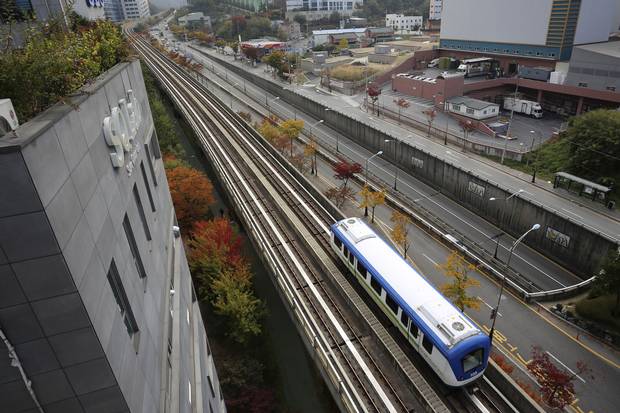
The Bombardier-built EverLine, which runs along an 18-kilometre track in Yongin, South Korea, was sold to local leaders as a vision of the future, but is now derided by locals as a bus on rails.NATHAN VANDERKLIPPE/THE GLOBE AND MAIL Dec. 30 2017
Yongin, South Korea
Every few minutes, a single car passes by Chodang station, one of the stops on 18 kilometres of elevated track that wind through Yongin, a small city 40 kilometres south of Seoul. When the EverLine was sold to local leaders, it was a vision of the future – driverless cars that would swiftly transport tens of thousands of passengers a day.
Today, locals mockingly call it a bus on rails, slower on some routes than taking an actual bus, and, for the city that built it, far more expensive. The local prosecution office is more blunt: EverLine, a lead prosecutor says, was built after Bombardier engaged in corrupt practices to win the 2004 contract for its construction.
The project’s one-trillion-Korean-won price tag, equivalent to $940-million in today’s dollars, was based on initial expectations that some 160,000 people would ride the EverLine every day. But even three years after operations began in 2013 – a start date delayed by legal wrangling between Yongin and the Bombardier-led consortium that built the line – actual ridership was less than a fifth of that figure. The resulting financial shortfalls have saddled Yongin with so much debt that the municipal government was forced into austerity measures around the time the line entered service.
The problems have brought intense scrutiny to how a consortium led by Bombardier won the right to build the project. A special investigation by Yongin prosecutors concluded that the company operated a slush fund and bribed researchers and decision-makers with gifts and trips. For half a year, a team of six South Korean prosecutors, 14 investigators and two certified public accountants worked together. They examined the records of 52 fixed phones, analyzed 115 cellphones and computers, scoured 725 bank accounts and accumulated 285 boxes of documents. “We were aiming to hold people responsible for this wrongful private-sector investment project,” prosecutor Cha Maeng-ki told The Globe.
In Yongin, lawyer Hyun Geun-taek is surrounded by more than10,000 pages of paper, the accumulated record of legal challenges to the Bombardier-backed Everline.NATHAN VANDERKLIPPE/THE GLOBE AND MAIL
The evidence his office gathered showed that Bombardier supplied its South Korean representative, Henry Kim, with lobbying fees totalling $1.8-million over a five-year period. Bombardier sent gifts to the homes of local politicians, as well as to researchers tasked with creating the ridership forecasts that would underpin construction of the new light-rail line, the prosecutors found. Mr. Kim received a further $4.7-million in advanced payment incentives that were deposited into a Swiss bank, under the name of Mr. Kim’s wife, Mr. Cha said. Some of that money, Mr. Cha said, was used to buy real estate in South Korea.
The company also flew 37 people, including 18 city councillors, to Canada, where it “paid their full expenses, put them up in luxury hotels, and provided them with golfing trips, a trip to Niagara Falls and other luxuries,” he said. “These trips took place at the time during which Yongin city and Bombardier were going through negotiations for their business conditions.”
Mr. Cha said, “Providing gifts or funding trips to civil servants in the line of duty constitutes bribery.”
The results of Mr. Cha’s investigation were made public in 2012 and, in the years that followed, local courts found Lee Jeong-moon, the former mayor of Yongin, guilty of corruption on charges related to the EverLine construction. He was sentenced to prison for bribery related to the selection of subcontractors, including his younger brother and friends, for the rail-construction project.
Mr. Kim was found guilty of embezzling funds from the Bombardier-led consortium, where he had served as CEO. But the Bombardier representative did not face trial on charges of corrupting officials nor was the company itself charged with wrongdoing. By the time prosecutors began digging into the company’s South Korean project, it was too late for charges. “The statute of limitations at the time was five years,” Mr. Cha explained.
Canada’s toughened anti-corruption law contains no such statute of limitations.
(Mr. Kim’s phone number in South Korea has been disconnected, and The Globe was unable to reach him for comment.)
Bombardier’s Mr. Marcil, however, contested Mr. Cha’s interpretation of events. “We reject the insinuation that we, in any way, acted wrongfully in the Yongin project, or that we unduly influenced either the choice of technology or the decision to build the transit system,” Mr. Marcil said. “After our full cooperation in their investigation, South Korean investigators determined that there was no cause for charges against Bombardier.”
Mr. Lee, the former mayor sentenced to jail on corruption charges, also defends the EverLine – and the company that built it. He is “completely in favour of them,” he said in an interview. “Bombardier didn’t hurt Yongin City the tiniest bit. Not one bit.”
Bombardier had been given preferential status in bidding for the Yongin project, and was the sole company to submit a bid, according to a local lawmaker.
But the company has since gained many detractors in a city where the EverLine has grown into a symbol of extravagance and waste. The lower-than-forecast number of riders has meant less revenue than initially expected and has sparked a dizzying number of efforts to assign blame. Prosecutors charged 10 people, accusing them of bribery and violating construction safety laws. A citizens group has sued Yongin for damage compensation.
The city and the Bombardier-backed consortium faced off twice before the International Court of Arbitration, or ICA, after Yongin accused the consortium of safety flaws and noise issues. The consortium then sued over delays in opening the line, and won. In two judgments, the ICA awarded the consortium a total of 778.6 billion Korean won, an amount roughly 22-per-cent greater than the consortium’s share of construction costs. Because the city could not afford to pay the entire sum at once, it agreed to continue payments until 2043. After a contractual change, Bombardier no longer operates the rail project that it helped bring to Yongin, where the project continues to raise local passions.
Lee Sang-cheol, one of the 18 councillors who travelled to Canada with Bombardier, acknowledged that the company gave him gifts, although he down-played them as “nothing out of the ordinary.” He also defended the trip he took to Canada on Bombardier’s dime. “If they want to sell us machines, they have to show us those things,” he said. And he added that “stopping by some tourist attractions shouldn’t be such a big deal. How can we just see light rail and nothing else?”
Still, he has come to regret the company’s involvement. “Bombardier made zero losses in this transaction. Bombardier lost absolutely nothing. It took everything it wanted to take,” he said. And he resents the financial duress that the EverLine project inflicted on his city. “Honestly, what Bombardier did, it caused massive harm to Yongin city.”
This post was released on Wednesday, February 11, 2009, sixteen years ago under the title, “Five reasons Why Gordon Campbell and his ‘Falcon’ don’t want the “Return of the Interurban”. It is still relevant today, only the names have been changed, to expose the guilty.
Under the NDP, nothing has changed and in fact has gotten worse!
So, with a little tweaking here and updating there, we have the following……..
Five reasons Why the NDP don’t want the “Return of the Interurban”.
It is all too simple, the tracks are there from Vancouver to Chilliwack, the diesel light-rail vehicles are available from many manufacturers and have been proven in revenue operation, and the precedent of the Karlsruhe two-system or zweisystem LRT, with over 33 years of safe operation, track-sharing with mainline railways, makes the return of the interurban an almost shovel-ready project. Why then does Premier David Eby and his Minister of Transportation and now demoted Mike Farnsworth , do not want the “return of the interurban” for the Fraser Valley.
Here are five main reasons.
1) The interurban is not seen to be a Metro Vancouver rapid transit project. The monied ‘West-side types’ (locally known as the creme de la creme) who run and finance the provincial and federal NDP, see the interurban as a non-vote getter, thus not essential – not needed. It was the same Liberal ‘West-side types’ that forced the now $2.5 billion (actually with 16 years of operation the cost, due to the payments to the consseionaires of the P-3 Canada Line, the cost is approaching $4 billion!) Canada Line subway on TransLink because they did not want LRT operating on the former interurban rapid transit route, the Arbutus Corridor.
2) Because LRT is much cheaper to build, there is less chance of ‘friends of the government’ or ‘ ‘friends of the bureaucracy’ getting contracts to work on the project. Simply put, light rail is too cheap to build for political or bureaucratic benefit. The NDP would be very embarrassed if a 130 km, under $2 billion rail route from Marpole to Chilliwack would attract more new customers than a now almost $7 billion, 16 km SkyTrain extension from Surrey to Langley.
3) Over 40 years of the SkyTrain myth has ingrained itself on planning in the region; transit is no longer built to move people affordably, rather it is built to facilitate land development. For developers, the bigger and more expensive a transit project is, the better it is. Building SkyTrain in the region has been like forcing round pegs into square holes.
4) The NDP have all but written off‘ valley‘ seats in Parliament as most are safe seats, in a largely Conservative farming region, the same time ignoring the explosive population growth along the former interurban line. The NDP don’t care about any transit improvements because they think Fraser Valley voters, like sheep, will always return non NDP MLA’s to the legislature.
5) The unions representing trucking industry and the Road Builders Association are big supporters of the the NDP and the NDP’s ‘rubber on asphalt’ transportation policies favour theses two groups. Rail, unless there is political benefit, is not even on the radar screen. ‘Rubber on Asphalt’ , especially the now almost $10 billion upgrade to Highway 1, is the credo of the Transportation Ministry.
There are many more reasons why Eby’s NDP, like Gordon Campbell’s Liberals do not want the ‘return of the interurban’ to the valley. It is up to ‘rail’ advocates to make ‘Rail for the Valley’ an election issue, to force both the BC Liberals and the NDP, to come out of the closet with real (not empty promises) plans for the return of passenger rail service from Vancouver to Chilliwack. The clock for the next election election is ticking down……………………………..
Forget the hype and hoopla from politcans about transit; forget the well timed media releases; forget the staged photo-ops for the local papers, if any local papers have survived. The big question facing the region is; has TransLink given up?
The big news is that fares are going up, yet the service provided seems unattractive to potential customers. Actual ridership numbers are increasing somewhat, but the overall percentage of mode share for transit is dropping. it seems increasing ridership numbers are coming from population increase and not modal shift from car to transit.
In my wee part of the world in South Delta, the express buses are operating with a large number of empty seats and even the local buses are bereft of customers except for students and those working at Tsawwassen Mills.
Of course the 620 bus to the Tsawwassen Ferry terminal is full, but the rest of the services are grossly underused.
Venturing to SFU last week, where the traffic was almost in perpetual gridlock, what few buses I saw were half full at best. Even passing by SkyTrain at 22nd Ave Station, there was no indication of over crowding ( lots of space between the standees) and this was at 5PM on a Friday!
This not to say all the buses were operating half empty but it wasn’t the transit chaos espoused by many in the many public forums on social media blogs.
At present, TransLink provides an adequate service for the region, with a few select bus routes purposely under-served by buses to give the impression that the system is full to the brim with customers.
The “TransLink Listen’s program is a failure simply because the first question asked is “do you use transit” and if you answer “No”, end of survey. Should not TransLink investigate the reasons why people do not use transit, rather than “should bicycles use transit” sort of question.
It seems the mandarins in their ivory towers do not want to know why people do not take the transit provided.
TransLink is out in full force, with spin-doctors galore for all SkyTrain or BRT announcement, but that’s about it. It seems TransLink has given up and just does what its told to do by the premier’s office and that is to give transit a “happy face” at election time.
One of the problems with commenting on “other people’s” transit stories from “other cities” is that one does not get the full story and what may seem to be a problem caused by “A”, was really caused by “B”, compounded by “C”.
Mr. Cow is a Canadian Transit Professional, who lives not far from Toronto and offers his expertise on my previous post.
The problem that I see is that the politcal machines and news outlets in Metro Vancouver, point to the cost issues with light rail and compare them to our SkyTrain system. It has been brought to my attention that a local CBC Radio program said that light rail system in Ottawa was a disaster and an another failure of light rail, which is far from the truth, where politcal interference largely caused many of the problems with the Confederation Line. My fear is the $13 billion price tag for the Eglinton LRT will be used against any future light rail planning on this side of the Rockies.
Subway construction is horribly expensive, but with a planned maximum daily ridership of 300,000 customers, a subway maybe justified. In Vancouver, we are building a now almost $4 billion, 4.5 km subway to move a mere 50,000 to 60,000 customers a day.
Let us not forget in Metro Vancouver, the government took a $1.63 billion light rail plan and turned it into a $6 to $7 billion SkyTrain line, which has been ignored by the legacy mainstream media including the CBC!
From Mr. Cow.
It’s LRT Zwei. It had to have a tunnel because many parts of that corridor of Eglinton is far too narrow for surface LRT. People sometimes forget how old certain areas of cities are in eastern North America. The Yonge/Eglinton area for example, was a long busy crossroads community even in the 1820’s. In1837, the area was the site of the Battle of Montgomery’s Tavern in the Rebellion of 1837-38 here in Upper and Lower Canada (Ontario and Quebec). Major portions of Eglinton Ave never had streetcars, the sections that did have them were literally widened by moving or destroying the existing buildings during the late period of the Toronto Railway Company and the early TTC period (1910-1925). Most Toronto roads are based on a right of way width of 66 feet or an imperial “chain length”, where as many parts of the Crosstown’s tunnel corridor were laid out with a 52-56 foot width.
The tunnel section exists because that section of Eglinton Avenue East & West, although a major east west concession road under the original British land survey of Upper Canada, like most of Ontario’s main roads, was unfortunately, laid out as a “residential avenue” when that section of farmers road was being developed in the 1870’s-1890’s. When it started becoming a major commercial street as well during the 1890’s through to the early 1910’s, many commercial businesses at the time, complained of its narrow nature. Even when I was a student planner in Toronto in the early 1990’s, certain sections of Eglinton Ave. West were so narrow, although there appeared to be 4 lanes with a centre turning lane, you couldn’t open your car door in an emergency to get out of your car in those lanes without the door being stopped by a very close vehicle or utility pole. There was just no room.
The 5,500 p/h/d is there because it’s based on the bus numbers before construction began. Much of the eastbound Eglinton West bus routes prematurely ended at Eglinton West Subway Station and didn’t continue through to Yonge and Eglinton. Eglinton Ave East had most of its bus traffic siphoned off to the Davisville Subway Station because by 2010 the bus bays at Eglinton Station which dated from 1954 (the opening of the Yonge Subway), were too small due to the narrow streetcars and buses that the Eglinton Division used before 1954. Those bus bays had become too difficult to access (due to traffic and location), with modern buses by the time construction was actually started.
The line is expected to have 110,000-120,000 riders per day on its opening day, its designed for 300,000 per day because Mayor Rob Ford who had the original design changed, hated Transit City, LRT or anything to do with streetcars and wanted,”subways, subways, subways and only subways!”. Unfortunately, outside of the tunnel portion, most of Eglinton’s bus passenger counts don’t warrant anything close to a full scale subway line. Not to mention, those areas of Eglinton East and West are more than wide enough for surface LRT. The Eglinton West LRT extension currently is mostly tunneled because Premier Doug Ford (Mayor Rob Ford’s older brother) also dislikes anything that interferes with road traffic.
The high cost of the Crosstown was primarily due to Rob Ford changing the original tunnel and station designs after 2010. Originally, the tunnel stations were to be much simpler, with limited access points to reduce costs, that changed under Ford. Rob Ford stated he wanted the entire length 19 km, in a tunnel.
The second problem was the portion of LRT tunnel that went directly under the original Yonge Subway tunnel box (built between 1947-1952, opening in 1954), revealed that, by 2015, the then 63 to 68 year old tunnel box floor was going to fail if you dug underneath it. The construction lateness was due to having to spend 6 years redesigning the LRT Tunnel box and reinforcing/rebuilding 450 metres of the Yonge St. Subway tunnel box floor. All this construction occurred while the Yonge Street subway was still operating and therefore had to be done slowly and carefully. The resulting court case was because the builders of the Eglinton Crosstown didn’t want to pay for that. The TTC, the City of Toronto, Metrolinx and the Government of Ontario disagreed with that assessment.
The fact that the famous TTC Guage wasn’t used and standard gauge was used was simply done to decrease cost and the fact that originally, none of the Eglinton Crosstown or any Transit City LRT line were to be TTC run or operated. The LRT network and the streetcar network were separate entities.
The standard gauge LRV’s also can’t navigate Toronto’s incredibly tight streetcar track turning radius of 8-11 metres without significant modification (modern LRV’s are limited to 25 M radius turns), these modifications lead to not being able to operate in multiple car trains. The new streetcars Toronto uses had this issue, the standard answer is to use smaller streetcar or tram bogies instead of the common standard full sized railway bogies preferred by all builders.
Many European cities including Karlsruhe, have this same issue by the way. Many of the “zwei” powered LRV fleet can’t operate on certain streets due to turning radius issues. Some of the track rights of way in Karlsruhe, like Toronto as well, date back to a time of tiny 6 to 10 metre long streetcars pulled by horses. The usual answer to this problem, using smaller tram or streetcar bogies instead of the larger standard railway bogies becomes problematic in Karlsruhe, the smaller streetcar bogies have difficulty on long sections of mainline railways that they travel on, due to their being “too light” for lack of a better term, for use on main line railway tracks.
The soon to open 19-kilometre Eglinton Crosstown LRT, (Line 5) includes a 10 km subway, which in my book, makes this project a light metro and not LRT.
The Crosstown route between Mount Dennis Station (Weston Road) and Kennedy Station will include a 10-kilometre underground portion in its central section between Keele Street and Laird Drive. The rest of the line will run at street level in a dedicated right-of-way transit lane, separate from regular traffic.
With subway construction, the real financial benefits of light rail are lost as the cost of the project passes the $13 billion mark! Yet, on the more light rail part of the line, there will still be light controlled intersections. This is surprising with the $13 billion price tag – maybe they ran out of money.
With stops more than 800 metres apart, about 200 metres more apart than recommended for light rail (this is based from the Hass-Klau study, where the vast majority of customers using transit come from a 300 metre radius from each stop), may not deemed as user friendly by customers as planners would hope and ridership may not meet projections.
Less than half of Line 5 operates as classic LRT, with the 10 km subway operating as a light-metro, complete with automatic train control.
The projected ridership of the Crosstown is 5,500 passengers per hour in the peak direction by 2031.
What? That MetroLinx is spending $13 billion to move a mere 5,500 pphpd demonstrates, zero oversight and out of control planning, which is all too common in Canada.
The capacity of Line 5 is 15,000passengers per hour per direction, which is double the maximum of the Broadway subway, after resignalling, but again, for $13 billion, would it not been wiser just to build a proper subway and stop pretending that you are building with light rail. Or, build real light rail, without subways and use the savings to extend the network.
Due to Toronto’s streetcar system being “broad gauge” and Eglinton being standard gauge, both systems will be incompatible in operation!
The Eglinton light rail is just another hybrid light metro/rail system, overbuilt and over priced for what it will do and displays Canada’s utter backwardness in modern public transit philosophy. In Canada politcal glitz and of course subways trumps common sense and affordability.
Over built, over cost and under used seems to be a theme that is repeated over and over again and until that is rectified, public transit will continue to lag and the car will remain the primary mode of transportation.
Maybe, despite the hand wringing over global warming and climate change, this is what Canada’s politcans want!









Recent Comments