How America Killed Transit – How the Americans (and we) Are Getting it Wrong
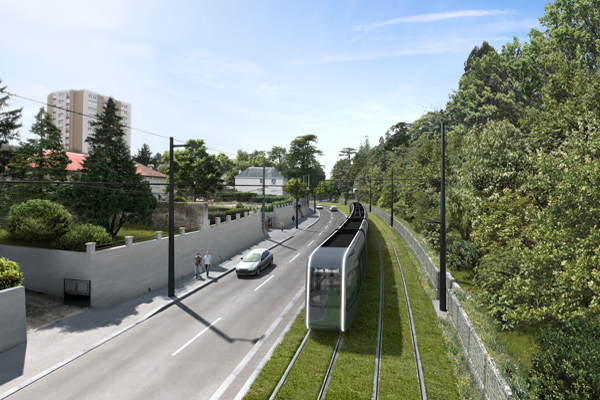
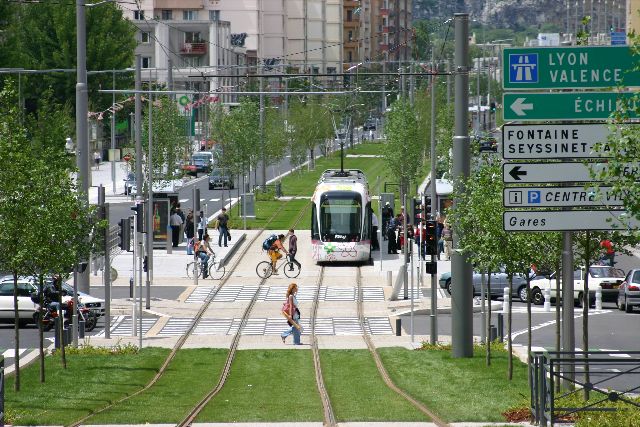
The Tours tram, built on a former motorway.
I think the author, a PHD candidate, seems unread on what modern light rail is. He still defines light rail vehicles, different than a streetcar
Memo to PHD candidate: it is not the vehicle, but the quality of rights-of-way, that defines LRT.
His comment; “And though cheaper to build, light rail lines are often too slow and have too low capacity to make a truly meaningful dent in a city’s auto orientation.”show’s he is utterly out of touch with the concept of modern light rail, which when well designed and built, has comparable commercial speeds, but with somewhat less capacity than a modern metro.
Sadly, in North America, so called exports get lost in the theory of transit and ignore the practicalities of urban transport.
No wonder public transit is failing in the USA, where bigger and more expensive is deemed better.
So here is what made the French Renaissance of light rail so successful in France.
- Ensure that at least 60% of a transit route is in a dedicated formation or reserved rights-of-way.
- Grass or lawn the dedicated R-o-W’s to make them appealing to the non-transit user.
- Modular low-floor articulated cars to allow an almost universal use by all customers, including the mobility impaired.
- Stops every 500m to 600m apart to provide good customer access.
- Make ticketing and fare collection easy and simple.
- Build transit to the Push-Pull theory of public transit, by building new tram lines on road lanes, which constricts road capacity, pushing people onto transit, while at the same time, offering a quality transit servcie on the route, that customers like to use.
- Real consultation with both residents of areas served and transit consumers and not politically inspired dog an pony shows, so favoured by politicians and bureaucrats.
- Provide inventive and affordable transit solutions to transportation issues, such as TramTrain.
- Always remember that public transit is a product and if the product is good, people will use it, but if the product is bad, people will not.
Modern LRT in an urban setting, lawned rights-of-ways, simple yet effective stations, and both user-friendly and non-user friendly.
Jonathan English is a PhD candidate in urban planning at Columbia University.
Streetcar, bus, and metro systems have been ignoring one lesson for 100 years: Service drives demand.
One hundred years ago, the United States had a public transportation system that was the envy of the world. Today, outside a few major urban centers, it is barely on life support. Even in New York City, subway ridership is well below its 1946 peak. Annual per capita transit trips in the U.S. plummeted from 115.8 in 1950 to 36.1 in 1970, where they have roughly remained since, even as population has grown.This has not happened in much of the rest of the world.
While a decline in transit use in the face of fierce competition from the private automobile throughout the 20th century was inevitable, near-total collapse was not. At the turn of the 20th century, when transit companies’ only competition were the legs of a person or a horse, they worked reasonably well, even if they faced challenges. Once cars arrived, nearly every U.S. transit agency slashed service to cut costs, instead of improving service to stay competitive. This drove even more riders away, producing a vicious cycle that led to the point where today, few Americans with a viable alternative ride buses or trains.
Now, when the federal government steps in to provide funding, it is limited to big capital projects. (Under the Trump administration, even those funds are in question.) Operations—the actual running of buses and trains frequently enough to appeal to people with an alternative—are perpetually starved for cash. Even transit advocates have internalized the idea that transit cannot be successful outside the highest-density urban centers.