UBC and Vancouver Embarrass Themselves, Demanding a Subway
Universities used to be a place of learning and education, but today, UBC makes a mockery of education with their support of a Broadway subway. The sheer ignorance of UBC demanding a subway is appalling and one questions the “intelligence” of those making such an expensive demand!
In the real world, subways are only considered for transit routes with traffic flows greater than 2o,ooo pphpd, yet traffic flows along Broadway are much less, more than 15,000 pphpd less. That’s right, peak hour traffic flows along Broadway are less than 5,000 pphpd!
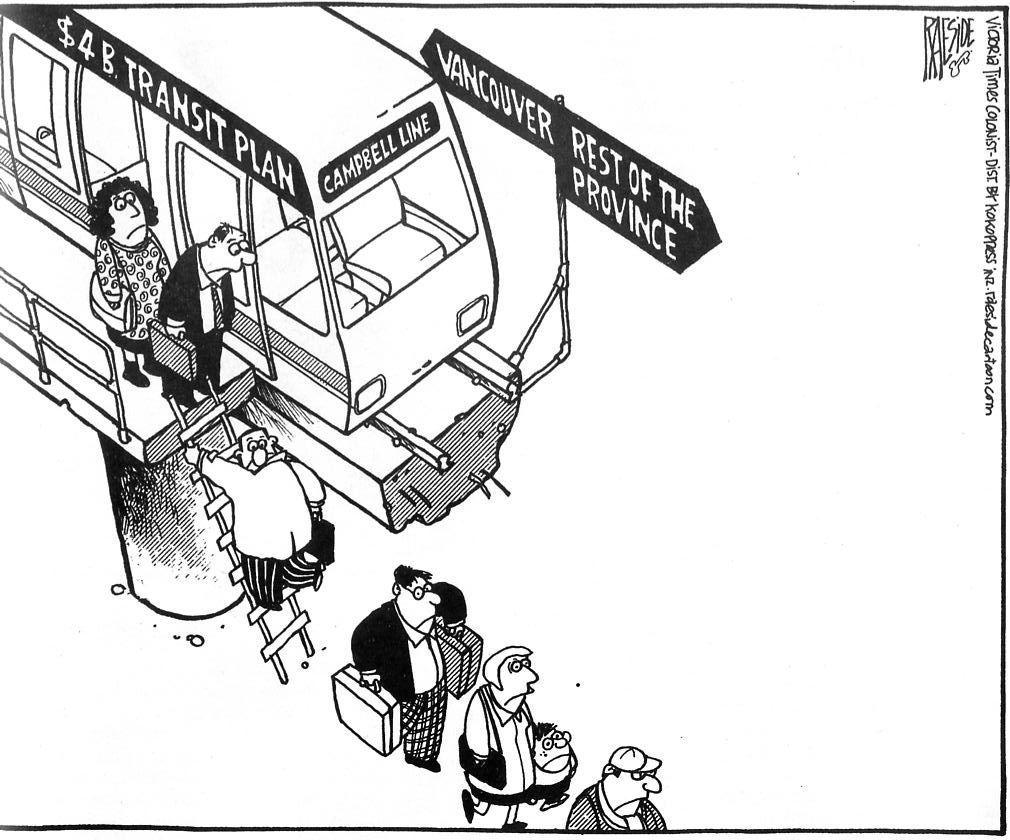
Building a subway will greatly add to TransLink’s financial burden, but then, the well heeled UBC and City of Vancouver types are depending on massive subsidies from taxpayer’s elsewhere (read South of the Fraser), to fund subways in Vancouver.
The ignorance about modern light rail is appalling and it seems professional misconduct with transit planning in Vancouver reigns supreme.
The question that the subway lobby ignore; “will the Broadway subway be designed to cater to high traffic flows?“
The continuing farce, is that the Canada Line subway was so designed to have its capacity constrained by cheaper, smaller stations and has a potential capacity much less than at-grade/on-street streetcars! It would cost about $1 billion more to increase the Canada Line’s capacity.
This kind of “crap” that passes for transit planning in the City of Vancouver, UBC and TransLink is indicative of the large anti-LRT regimes entrenched within their bureaucrats. The hubris, combined with the ignorance about modern LRT, is appalling!
This announcement is a warning for the South Fraser municipalities of massive tax increases to come and South Fraser cities and municipalities must discuss secession from TransLink, lest the insatiable financial demands for SkyTrain and subways bankrupt their taxpayers!
Vancouver, UBC make case for Broadway subway, saying area could become “innovation hub”
By Kelly Sinoski, Vancouver Sun February 28, 2013
VANCOUVER — The City of Vancouver has renewed its push for a $2.8-billion subway along the Broadway corridor, this time highlighting the crucial need for transit to turn the corridor into an ai???innovation hub.ai???
The push, made jointly with the University of B.C., is based on a new KPMG report that suggests Vancouver is growing faster than was anticipated three years ago, and ai???a rail-based line is needed to meet the corridorai??i??s population growth and significant economic potential.ai???
The corridor, stretching from Commercial Drive to UBC and 16th Avenue to False Creek, has been touted as ai???one of North Americaai??i??s fastest-growing life science and technology clustersai??? with commercial and industrial floor space almost equal to that found in Vancouverai??i??s downtown.
But the area is also North Americaai??i??s busiest bus route, and with another 150,000 people expected for the corridor in the next 30 years, Vancouver Mayor Gregor Robertson warned the area is at risk of losing high-tech jobs to other cities such as Toronto, New York or San Diego because of ai???gridlock and over-stretched transit.ai???
ai???What is currently a powerhouse for jobs will suffer and be choked off from the opportunities,ai??? Robertson said. ai???We need to take the transit system to the next level. Without it, the Vancouver and B.C. economy risks falling behind.ai???
The KPMG report, which cost $110,000, suggests that while the Broadway corridor has many strengths, such as a supply of locally trained graduates and proximity and access to hospitals and clinical trial opportunities, it is being constrained by several factors, including lack of access to affordable office/lab space and of superior transit infrastructure.
In order for the corridor to retain its competitive edge as a world-class life sciences and technology hub, the report states, rapid transit, along with more affordable commercial and residential space and a city/university strategy to attract investment, is critical.
The Broadway corridor is one of TransLinkai??i??s top priorities for a rapid-transit line, along with light rail for Surrey, but no decision has been made about which project will go ahead first, or where the funding will come from to pay for it. TransLinkai??i??s mayorsai??i?? council on transportation is in the midst of working with the province to develop new funding sources to generate revenue for transit.
Robertson, who is pushing for a $2.8-billion subway line for the corridor, maintains the latest announcement, made two-and-a-half months ahead of the May 14 provincial election, isnai??i??t an attempt to give Vancouver an edge on Surrey, noting both projects are desperately needed in the region and should go ahead together.
Both projects would take at least five years to design and another five to build, meaning the earliest they could be built would be 2020 to 2022.
Robertson noted that the projects are different ai??i?? with Vancouver needing transit to meet rising demands whereas Surrey wants it to shape growth. ai???These are no either-or choices; they both need to happen,ai??? he said.
But he added Vancouver, with its high ridership base, would be more profitable than the Expo line.
UBC president Stephen Toope said itai??i??s crucial to start the planning now. But he noted itai??i??s premature to say whether UBC would contribute to the cost of the project.



Remember when you said the Canada line will never come close to achieving its ridership goals? Now you complain that it does not have enough capacity? For the record it is still at less than half the design capacity. And instead of increasing the Canada line capacity a parallel route such as Arbutus could be built to share the load and create a new route.
For the Broadway corridor we are hearing the same song from you…..except the Broadway corridor already has more than double the ridership of the buses that rode the Canada line corridor before it was built. It is obvious a Broadway line has more than enough ridership to justify a ‘subway.’
For the record the Canada line has more boardings than the entire Portland Max system. The MAX line Portland is currently (orange line) building will cost 1.5billion dollars and is expected to get 25,000 boardings per day. So what is a better deal 3billion dollars for at least 150,000 boardings or 1.5billion for 25,000 (yes I realize a Broadway LRT would get more than 25,000 trips but if you crunch the numbers the cost per rider for a Broadway ‘skytrain’ is less than for a Broadway LRT even before factoring externalities).
Zweisystem replies: Rico, you play the game well, but not well enough.
TransLink laid a foundation of misleading propaganda several years before the Canada line opened. Several years before the Canada Line opened, TransLink stopped doing individual ridership counts on bus lines, then understated bus ridership on routes that would feed the Canada Line. Added to this, TransLink over estimated Canada line car capacity, by about 35 persons. The result of this deception is that the Canada line appears to be carrying more riders than previously estimated.
But the facts don’t quite measure with TransLink’s spiel. South Delta is a good example, twice since the Canada line opened, rush hour bus service has been reduced due to lack of ridership, as the thousands of new customers did not materialize. In fact the Canada line is hated by a good many former transit users because it is user unfriendly. The Canada Line more and more is looking like the white elephant it was predicted to be.
Excuse me Rico, DO NOT pander to me the TransLink bull shit that LRT will carry fewer customers than a subway, the opposite would be true, an at-grade/on-street LRT would attract far more new customers than a subway. In fact subways are notorious for not attracting ridership. LRT on Broadway would carry more customers, cheaper than SkyTrain. Mind you, the BS you peddle would make you a good candidate for the CEO position at TransLink
Do you really read what I write? My comments was YOU said the Canada Line would never come close to achieving its ridership goals (and now it is way over them and you are basically saying the same thing this time about Broadway…with even less reason).
Note the last time I checked (before the last round of route cuts) South Delta had significantly more ridership on its buses (almost double) than pre Canada line. For some people it will be less convient than the previous service but for others it will be more convient, since ridership increased in South Delta so dramatically after the Canada line we can infer more people found it more convient than less convient.
If subways (or skytrains for that matter) are so poor in attracting ridership why is the Canada line carrying more riders than the whole MAX network (you would think at least one route would go where someone wants to ride)? The answer is in Portland the downtown section has poor grade seperation is slow and gets delayed all the time. Compare that to Calgary where although still surface the LRT is not as greatly delayed downtown and they get way better ridership. LRT on Broadway will end up looking like MAX, not C-train (because of all the major road crossings resulting in limited opportunities for signal premption) and as a result it will be expensive (not as expensive as a subway but still expensive) and have less ridership than a subway. The CAPITAL costs per rider for a subway on Broadway will be LESS than the capital cost per rider for LRT because of this.
Zweisystem replies: Rico, my estimates were based on TransLink’s bus ridership numbers or estimated bus ridership numbers. As TransLink deliberately under estimated bus ridership feeding onto the Canada line, to give an impression of high ridership. Thus TransLink may have underestimated bus ridership by 20%, giving the impression of of people flocking to the metro, while in reality, ridership has stagnated with those on the outer reaches of the transit system reverting to their cars. It is a bit of a shell game.
Then Rico, let us not forget the U-pass and its gross over use that is flooding the transit system with students taking advantage of cheap fares. Cheap ticket U-Pass users are forcing full fare passengers from the system, while this gives the impression of high ridership, it is paupering TransLink of much needed full fare revenue. A TransLink official has told me that many students who use the Canada line, may use it 6 or 8 times a day, which certainly improves the ridership picture, but greatly decreases revenue.
What is needed is a full and independent audit of TransLink and the mini-metro system, but TransLink and politicians are scared to death of this. You just can’t contravene the general laws of transit operation, TransLink has tried and now are in a finical pickle.
As for Portland, the public want their light rail at street level, because of ease of access. In fact modern LRT operates at grade because transit customers want their transit, on the pavement ready to use.
We’ve misssed you Rico, have you been laying low for the past month or so, whilst all at Translink breaksdown under the threat of the forthcoming class action?
No matter old buddy, your postings hardly make sense anyway
This is from TransLink’s web site.
The 09 – Broadway Granville Alma:
Maximum peak hour frequency 4 to 5 minutes – average 13.5 trips per hour, bus capacity 75 persons. Peak hour capacity offered 1012 persons.
The 99 B Line – Commercial/Granville station to UBC Loop:
Peak hour frequency 2 to 4 minutes – average 20 trips per hour, bus capacity (artic.) 110 persons. Peak hour capacity offered 2200 persons.
Combined peak hour capacity offered on Broadway 3,212 persons. Margin of error @15% 482 persons
Total peak hour capacity offered by the #9 and 99 buses 3,694
So, cutting through the TransLink speak and the crocodile tears of of the subway lobby, the current capacity being offered on Broadway is barely enough to support a light rail solution and nowhere near the ridership needed to justify a metro!
How does TransLink increase the numbers for Broadway, easy, it include the several bus routes, such as the 08 Fraser/downtown; 17 Oak/downtown; 14 Hastings/UBC; and the 16 Arbutus 29th STN. operate partially along Broadway. Though they increase ridership numbers for Broadway, they should not be confused with the demand for a subway.
The exception is the 14 Hastings UBC bus, which travels along Broadway from Granville to UBC. Peak hour operation is only every 9 to 10 minutes or 7 additional buses an hour which increases capacity supplied along Broadway from 3,694 to 4219 persons per hour per direction, still far off the mark that would demand a subway, but with LRT in operation, we could reduce operating costs considerably, simply because one modern tram (1 driver) is as efficient as 6 buses (and 6 drivers). Automatic metros are very expensive and again, if traffic flows are below 20,000 pphpd, will see an increase in operating costs.
This cursory look at Broadway shows that there is no need for a Broadway subway.
Over to you Cardinal Fang.
What a load of old spherical objects from TransLink & their high school advocates & analysts
In many cases tunnels are just a cowardly solution where planners are unwilling or unable to tackle motor traffic.
In implementing them, they also miss out on many of the secondary benfits of trams such as making cities more walkable and more livable.
Comparing Portland’s MAX with Skytrain is rather an apples to oranges comparison. First off, far more Canadians are willing to take public transit than their American counterparts. The area covered by MAX is extensive and has a much lower population density than the mini-metro lines. For the Canada Line, there is another important factor, Richmond is largely becoming a Chinese Island, where many new immigrants have never driven a car and were brought up using public transit, but their children are certainly driving and have taken up with the American point of view that public transit is second class.
10 years from now, with over densification in South Delta and constant traffic gridlock, the Canada Line will look more and more like a “beached whale” as it is far too expensive to extend.
Apparently there is no shortage of people who just don’t get it. A look at the ridership on metro lines shows most of them don’t get 20,000pphpd (almost none in North America). Someone forgot to tell them that they should not have been built. And apparently the Expo line should not have either because it is only currently achieving 16,000pphpd (although it is forcast to go over 20,000). But wait, doesn’t it more than breaks even on its operating and maintainance costs (not so with Portland)? But the capital costs….oh wait those are less than Portlands on a per rider basis too….You are letting Portland off too lightly, in areas with good transit (NY) Americans use it. Portland does have some defense in that a lot of it is less dense than a lot of Vancouver and has more freeways but they went cheap with their right of ways (used available right of ways instead of the best alignments) and don’t have much grade seperation where it matters so it is slower and less reliable. Those decisions were within Portlands power to fix. Better grade seperation at least like Calgary would have had higher ridership.
I used to live in Ladner and would love to have good transit access from it to Vancouver but it is clear that even at your wet dream price of 20 or 30 million per km plus a bridge even LRT won’t be coming to Ladner for a 100years (or hopefully longer because I like farmland and want to see the farmland stay as farmland and Landner and Tswassen don’t have enough potential riders to justify LRT).
For those that missed me blame Zei as he mainly just tosses my comments as spam.
Zweisystem replies: Obviously Rico you want to ignore the fiscal hardships of transit systems that are operating subways. In Germany in the 1970’s and 80’s, scores of German cities put their trams in subways and today they suffer severe financial problems, the cities that didn’t put their tramways into subways do not have the same financial problem. Rico, your ignorance about transit financing and alike is truly dismal.
By the way, only 10% of Calgary’s LRT is grade separated.
The Ragnore brothers, take a look at the rendering of a proposed Broadway LRT for Patrick Cordon’s article in the Tyee. It does not show a center platform station. Now visualize a center platform….now visualize reducing the sidewalk to accomodate it. Now visualize limited crossings of Broadways by pedestrians to improve LRT movements….On Broadway LRT will not increase walkability, it will decrease it. A ‘subway’ will be neutral to walkability and if street improvements are implemented at the same time positive to walkability.
Only 10% of Calgary’s system is not at grade. With the exception of the downtown transit mall most of the rest is grade seperated for all practical purposes with complete signal priority and exclusive right of way. Unlike Portland the Calgary system basically only slows down and stops at the stations (although this does not always work out in the transit mall) unless there is some kind of problem. Also unlike Portland stop spacing is similar to Vancouver.
Zweisystem replies: Grade separated means the transit line is elevated or underground, most of the Calgary LRT operates at-grade on reserved rights-of-ways.
Rico, just answer me:
Why is the proletariat being directed in to the bowels of the earth, to complete their journey?
To free up the roads for more buses & private cars journeys or my slippery fuck-witted little friend, is this part of the grand scheme to manipulate population density to the advantage of the real estate speculators?
Not sure if Zei will let me answer (last comment was not posted) brothers but space in a city is limited, who says that space freed up by a subway would have to go to cars, someone with vision could use that space to increase the pedestrian realm. ‘Proletariat directed to the bowels of the earth,’ good god did you right speaches for Karl Marx in 1890? In general underground subways I have ridden have a good cross section of people including upper income people and lower income folks…this includes Vancouver.
As to my previous post less than 10% of Calgary’s system is not at grade (not the same as grade seperated). With the exception of the downtown transit mall most of it has grade seperation as it mainly has full signal preemption and exclusive right of way. This means that unlike in Portland in Calgary the train is basically just slowing down for the stations (although it does not always work, particularily in the transit mall) and since station spacing is similar to Vancouver it means the trains are fast and pretty reliable.
The NDP is now backing the broadway expansion plan. I encourage all readers to register for the event as it will be a political show for the local candidates.
Reserve tickets here
http://votevision.ca/transit
Zweisystem replies: I guess Dix has forgotten the two seat rump that the NDP had after the Millennium Line fiasco.
@zwei
More and more people are realizing that LRT is not performing as promised by advocates. Fast frequent reliable grade separated transit is what people want and is effective at getting them out of their cars.
Even LRT expert Donald Malcolm Johnson is coming around. In the comments on http://www.vancouversun.com/touch/news/metro/Vancouver+subway+along+Broadway+corridor+could+turn+area+into/8030379/comments.html?rel=
He states “The Evergreen Line’s business case was badly skewed to favour LRT.”
Zwei replies: I believe it is a typo, if you read the article, which was posted on the the RftV blog, the Evergreen Line’s business case was badly skewed against light rail. Johnston probably knows more about SkyTrain and LRT than the planners at TransLink or the COV.
By the way, Johnston hates the term expert as he feels there are no transit experts, including himself, in the Vancouver Metro region.
@rico, good to see you back posting.
In Metro Vancouver 14% of the 2.3 million population or 324,000 people used transit daily on a weekday in 2011 (TransLink):
http://habilisblog.com/cycling-and-transit-use-see-big-gains-in-metro-vancouver/
There can’t be zillions of people using transit on the Canada Line, Expo Line… here. Transit use follows a binomial distribution and the 324,000 weekday transit users show up twice daily over 24 hours (weekend transit use is 25% to 50% of weekday transit use). That is, the average number of transit users is 27,000 on a weekday and the peak number of transit users is less than 80,000 on a weekday in all of Metro Vancouver. Broadway in Vancouver is only a small percentage of the 80,000 people taking transit in Metro Vancouver on a weekday.
Broadway buses are 75% empty on average – every full bus to UBC is an empty bus to Commercial Drive in the morning. There is no dire need for a subway to UBC. The whole overcrowding on Broadway has been contrived by TransLink dumping all its major routes onto Broadway and even so there is only limited crowding for a few hours daily. On a weekday, 86% of the population does not take transit. On a weekend or holiday, up to 97% of the population does not take transit. TransLink is broke and every person taking transit costs taxpayers almost $3,000 annually – thanks to sky train.
Want the truth? TransLink is in receivership after being stupid and spending too much money on sky train – and to hide its massive losses it is going after massive expansion plans to bury its losses. Mayor Gregor Robertson who is on team TransLink is a fool or a tool, take your pick.
Eric Chris, I am glad my comments are showing up again. Note, you can use percent of population or you can use trips/boardings but you can’t take the % using transit on a given day and divide by two trips or whatever random numbers you divided by. We will let that one slide as a brain fart (happens to me sometimes to) but I am pretty sure I posted a link giving bus ridership info by route before. The 99 is extremely busy with more boardings than most MAX lines…better cost recovery too (even excludng capital costs)….you will also see they clearly have lots of people in them mosts of the time. If you would actually read translink stuff you would see they are actively trying to encourage use on alterate corridors to relieve the pressure on the 99.
Ever taken transit on a weekend? Unlike cities dependant on a strong downtown for ridership Vancouver has good weekend ridership.
Zweisystem replies: @ rico “Ever taken transit on a weekend? Unlike cities dependant on a strong downtown for ridership Vancouver has good weekend ridership.”
Really you jest, transit on weekends is dismal except for a few routes such as Broadway or the ferry bound buses. Long waits and poor patronage, except of course for next to free U-pass or concession passes. You can not run a transit operation affordably on cheap fares.
I can’t believe that the SkyTrain Lobby a.k.a. would go so far as to libel me, but they have. They have done so in th past in the Georgia Straight, so much so that the Straight had to delete all transit comments for one article due libelous comments.
A simple typo, that’s all, as Zweisystem suspected.
By the way, I have been in communication with several transit experts overseas and they think that anyone proposing a subway under Broadway is smoking way to much BC Bud.
Rico, thanks for correcting my lack of knowledge. I guess that those 12 calculus courses in chemical engineering and honours math classes in high school were a waste of time.
Let me clarify, there are 324,000 people who make two trips daily on average (APTA). So, over 24 hours you have 648,000 real transit trips (one there and one back) and the average rate of transit ridership is 27,000 pphpd (the number of transit boardings is irrelevant – car drivers make up to 10 or more car boardings daily – there are not 15 million car drivers, just 1.5 million). If you correlate the 324,000 transit users to the trip starts published by TransLink, you’ll find that the peak number of transit ridership occurs before 9 am and is about 78,000 pphpd in all of Metro Vancouver.
Broadway only carries about 5% to 7% of the transit users (about 5,000 pphpd at most). Boardings on the 99 B-Line result in 35 people making trips on the 99 B-Lines to UBC on average and the articulated 99 B-Line diesel buses hold up to 120 people, crush load – they are about 70% empty on average. This isn’t too bad but it comes at the cost of having almost nobody on the trolley buses shuttling passengers to the 99 B-Lines.
From my vantage point near UBC, all you see are empty and nearly empty 99 B-Lines and trolley buses most of the day. Serious and intentional overcrowding only occurs from 8 am to 9 am for about 5% of the day on the 99 B-Line route. If UBC started some classes at 7:30 am, all the empty buses from 6 am to 7:30 am would have riders and the bad overcrowding on the 99 B-Line would disappear.
There is no reason for transit to UBC along Broadway. I had to take my car in for AirCare today (smoking diesel buses don’t go through AirCare and are exempt, they would fail) and took West 24th Avenue with a big grass median for LRT or trams. TransLink could build a tram line on West 6th Avenue or West 16th Avenue, too.
However, Mayor Robertson has big plans for the drug laundering developers who are counting on condo permits on Broadway. Geoff Meggs and Gregor Robertson are pushing for a sky train line so that developers can have an excuse to bulldoze homes for the cocaine dealers to build condos along Broadway. This is already happening on Cambie Street along the Canada Line. It is called economic development by our mayor in Vancouver. It won’t reduce road congestion and will worsen it when there are more people crammed into high density condos.
Transit here isn’t about moving people, mitigating carbon emissions or reducing road congestion – it is about the apparent extortion of corrupt politicians and about developers backed by drug gangs making money. If it weren’t, we’d be building tram lines to preserve communities rather than building sky train lines to transform communities. We’d be building tram and LRT lines like the rest of Canada. Hope this clarifies things for you.
Zweisystem replies: Quote:”roadway only carries about 5% to 7% of the transit users (about 5,000 pphpd at most)”. This number corresponds to the bus capacity provided by TransLink on Broadway. Overcrowding is caused when 1 or 2 buses do not run.
I could provide links to quite a few respected transportation bloggers (and for brevity I will exclude any that are Vancouver centric) who are on record as favouring a Broadway ‘subway’ option if you like. Since I have not heard any credible voices against it care to provide some names for your ‘experts’? I can imagine a conversation where you in your (unbiased of course) way describe the Broadway situation and some ‘expert’ goes that sounds crazy. If they put their name to it I would assume they will have looked at info from other sources than you (maybe the options study). If they have looked at all the info I doubt they would go on the record as calling the Broadway subway option crazy.
Zweisystem replies: I do not see any credible comment on the Broadway subway from any real transit expert. Most are rolling on the floor laughing and the silliness that passes for transit planning in Vancouver. One has to remember Rico, most who favour a subway remain quite ignorant of modern LRT and base their decisions on extremely dated precedent. Subway(ism) is the mantra of most engineer based transit planners and many refuse to accept anything other than 1950’s definitions of LRT. Mind you, engineers find the most work with subways because of the huge amount of money spent. Subways themselves do not improve transit, nor attract ridership and building a subway for the sake of building a subway under Broadway will lead to massive tax increases for generations to come.
Rico, sure, give me their contact details and I’ll talk to them.
Hi Eric, not much time for the next week so no links but I will provide names and with the magic of Google….Jarett Walker, Yonaha Freemark of The Transport Politic, Steve Munro in the comments of one of his old threads,Alon Levy of Pedestrian Observations, Zach Shaner and various authors at Aukland Transit blog. I eagerly await names of the ‘experts’ who think a Broadway skytrain subway is crazy.
I managed to free up some time. Eric your numbers are still confusing to me, according to the APTA translink has more than 1.2 million boardings per day in 2012 (about double the numbers you are using). Also I am unaware of any info that would let you calculate a system wide pphpd from the number of boardings, care to enlighten me on your methodology?
Re: 99 Bline, according to the performance review the average load for the 99 is 68…not 35, pretty impressive, definetely not empty…that includes buses at 5:00am starting east from UBC….of course it also includes buses at 8:00 going west on central Broadway. There are 500,000 pass ups on the 99 each year, more than the yearly ridership on Porlands Streetcar.
@rico, your comments are irrational. Do you work for TransLink?
Quantitatively, trams are the optimum transit mode. City of Edmonton engineers who are legitimate experts and who follow their code of ethics to put the public before political interests take into account the environmental, social and financial costs of transit and will not build another subway in Edmonton. All future transit is going to be urban-LRT (trams) at grade in Edmonton.
Subways and sky trains merely free up road space and have the same effect as building roads to lead to more road traffic – quashing the basis for any more sky train funding. They also require buses on the roads to get transit users to the subways and sky trains. This hampers vehicle traffic, increases transit costs and degrades the air quality.
More later… when there is more time to respond to the rest of your craziness. In the meantime, APTA says that the number of people using transit is 45% of transit trips and transit trips are 65% of boardings here so 1.2 million boardings implies 351,000 people on transit daily (1.2 million boardings * 45% * 65% = 351,000 people which is almost right on and very close to the actual number of 324,000 people on transit based on the population and TransLink mode share of 14% in 2011 unless the mode share by TransLink dropped which is the rumour and the reason for no public statements bragging about record ridership in 2012 ):
http://apps.bts.gov/programs/economics_and_finance/transportation_services_index/html/public_transit_ridership.html