Vancouver Comes in fourth, With the Decades Most Expensive Transit Projects
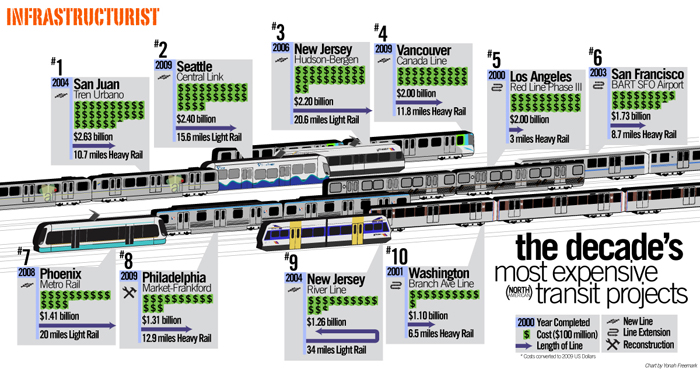
This graphic should sound alarm bells to transit planners and politicians about the ever escalating cost of transit projects. What ever happened to the 80’s light rail philosophy of “build it cheap and build lots”?
The the real cost of the Canada Line has now been pegged at $2.4 billion (depending on who one listens to in Translink or the Provincial government), which would mean that the Canada line would be tied in second place with Seattle’s hybrid light metro/rail. Yes indeed, Vancouver has a world class heavy rail metro that as designed, has less capacity than a streetcar.
“How would the RftV/Leewood interurban fair in comparison“, you say.
The cheapest interurban option would be $500 million for 98 km or 61 miles of route.
Not a bad investment for the taxpayer.



Just my periodic attempt to see if you post my comments. Wow, a graphic from an article in 2010….but without the important information contained in the article. The Canada line had the 2nd lowest cost/passanger mile (behind the Philly Metro). Kind of puts it in perspective huh?
Zweisystem replies: I see your usual BS continues.
Rico, this is the same blogger who attributed the success and high ridership of Canada Line to the Chinese people going to Riverrock Casino! I can understand his support for rail for the valley, but can’t see why he hates skytrain/Canada Line so deeply. I am still thinking if lightrail would have taken you from downtown to Richmond in 23 minutes! no chance in hell with all the intersections, trafiic, accidents etc.
Zweisystem replies: I see the trolls have been let loose again.
The vast majority of the Canada Line’s ridership comes from recycled bus riders forced to transfer onto the metro and I doubt Translink factors in the cost of all the buses needed to feed the metro. As well, TransLink counts boardings, not ridership (in fact, Translink has no clue as to actual ridership numbers) and now with the advent of the U-pass (with over 110,000 issued), the numbers of transit customers using the deep discounted tickets for multiple boardings (3 or more) has not been factored in – nor will it if TransLink has it way.
SkyTrain and the Canada line are the root of Translink financial malaise and building more will only exacerbate the situation. Ever wonder why no one else builds with SkyTrain? I know you will not like the answer.
Zweisystem, Daniel asked you a question you avoided to answer. Is lightrail able to go from downtown to airport or richmond in about 25 minutes? I think you know the answer. I used to drive to work in richmond. Sometimes when wife would need the car, I had to take the b-line which I hated it. It would take me 45 minutes on a good day. I can just imaging lightrail would get stuck in the same traffic as it’s not graded. Ever since Canada Line started opeating, I stopped driving and I am enjoying the fast and clean commute. Try it once and your hatred will turn to love! cheers
Zweisystem replies: The answer is yes, if the light rail line is designed to, it could reach the airport in 25 minutes, but that 25 minute trip cost the taxpayer over $2.5 billion and the bankrupcy of scores of merchants on Cambie street. Add two more stations on the Canada Line and your 25 minute trip is no more. The real question is not the 25 minute Canada Line trip, rather the time for the total commute. Light rail does not get stuck in traffic because light rail does not operate in traffic, it operates on a reserved rights-of-way or route used exclusively by the tram. It is a myth that LRT gets stuck in traffic and it is the trolls that perpetuate the myth.
My usual BS continues. Here is a link to the article (actually it is a slightly different article by the same author because ‘the Infrasturist’ no longer exists but he did basically the same article in the TransportPolitic) http://www.thetransportpolitic.com/2010/03/11/the-decades-top-hits-2/
Note the table showing the usual BS about things like capital costs, miles of route, ridership, route mile and cost per route mile…..I know you don’t think anything except capital costs and route miles are important, but for those that actually want a good system they are….
Zweisystem replies: The problem Rico (lies, damned lies and statistics) is TransLink and the provincial government have never been honest with the costs of the Canada line. Today, the cost of the Canada line can be put anywhere from $2.3 billion to $2.5 billion. Documents in the Susan Heyes court case alluded to a cost of $2.7 billion. Then there is the “ridership game” where boardings are misrepresented as number of persons and does not take into account (because the system can’t) multiple boarding by one passenger holding a “ride at will pass” such as a day-pass or a U-pass. As there is no independent audit of TransLink, they can claim anything they like. Fact is no one other than the locals here believe anything that comes TransLink ways.
Ever wonder why no one builds with SkyTrain? No one in the SkyTrain lobby has answered that question and for good reason, SkyTrain and the Canada Line has been built on a shaky foundation of lies and deceit.
Dude, could you tell me where you get what you’re on? cause I love to start hallucinating just like you. Open your eyes to the facts and don’t call people trolls for just not agreeing with you. This is not a kindergarten. Signed, an avid transit user that loves the comfort and speed of skytrain and canada line
Zweisystem replies: SkyTrain and the Canada Line comfortable? Ha, ha, ha – you must be a troll. The speed of a transit system is by design not mode.
@Alex, statistically, trams are the fastest and most economical transit choice for most people in Vancouver. For someone in Richmond, it might be faster to take sky train occasionally, maybe but you only know what you know and don’t know anything about trams so you can’t compare.
Then again, if Vancouver had better roads like in Seattle where I worked for five years and if Vancouver didn‘t have sky high parking fees killing the downtown core (I live in Vancouver by UBC but am taking the kids to Metrotown in Burnaby to avoid the parking hassles, druggies and vandalism in Vancouver for a movie tomorrow) – it would be twice as fast for you to get to Vancouver by car.
PS, I’ll be driving like everyone else I know in Point Grey.
Gentlemen, as an independent planning consultant let me put forward a few points about Bombardier’s (UTDC’s really) Advanced Rapid Transit system. A few years ago (2010) Ottawa had a 3 day technical briefing and conference about rail technology and it’s merit. It was only open to the public on the last day. The first two days were for the city’s transit panning group and people like me who got to chat and pitch ideas to industry people with none of the pesky public and rail transit fanboys allowed. I say pesky because you have to stop and explain every sentence if it contains too much technical inforamation to most members of the general public. The fanboy comment is there because we are not trying to prove how much we know and sound important like most fanboys do and that if another expert has a different opinion than I do, it is ok and I want to hear what they have to say. What is nice is you get fresh unguarded, unedited info about new ideas and not constantly rehashing tired technology arguments like, LRT vs. BRT, LRT vs. Light Metro/Subway et al. Also, in about 1 out of every 4 conversations you get information that shakes you to your core about the realities of this indusrty, professional horror stories and other important info. Then when the show is over for the day, the really smart guys go to a near by pub/bar and then, the real talking starts. Again the comments are not ment to be mean but, as someone who actually has to deal in this arena of hell as way of life, it’s nice to bitch to someone who understands.
However, to the point of this story. During one of these pub info sessions I was sharing a very tiny table with a rep from Alstom, another from Siemens one from Bombardier, another from Colorado Railcar (now he is at United Transit USA new american streetcar builder part of Skoda) and two other indepdent people like me both based in Toronto (my hometown). There had been a strong management led push by several Bombardier and Siemens sub groups to push for Light Metro in Ottawa because most of the R.O.W. is totally segregated physically and by grade by design. The Light Metro people had the lead which really burned the LRT guys I was talking to. That their own company would send those groups to try and push for these useless crap, as the LRT guys put it “nearly dead pieces of old tech useless crap”. The LIM centred Bombardier system and the Val centred Siemens aquired system. Both technology had been aquired by the parent companies because the original companies both government owned were sold off and or privatised. Both companies got stuck with these monsters. Both have had very few transit versions built and both have moved into the amusement park and airport people mover markets. It was clear though that both companies knew by the end of the second day of this conference that, Ottawa was going the LRT route. The Bombardier guy was telling us that Bombardier was getting tired of the LIM driverless system because no one in North America or Europe wants it (other than Vanccouver and maybe Honalulu) as a transit system. The worry was that, Bombardier could be in the same place that Siemens was in a few years ago. They (Siemens) made too many products, in too many diffirent industries and too many of them were not making money. Siemens had to cut many divisions and either sell them or kill them off all together. Bombardier’s Transit Vehicle Division was making too many products and many of them were competing with each other in the same markets. The (Sky Train) LIM tech is on that list. In as early as 2014-15 there will be a massive cut of non competitive transit vehicle designs to free up production in company facilities world wide. I made the comment that Vancouver had heavily invested in this tech and he (Bombardier Guy) nodded “Yup, my bosses don’t give a s*** about Vancouver. By 2014 we will have the flexity LRV design in as few as 5 cities or as many as 14 and that is not counting N. America. Real orders, real money is what they want. Not chances to pitch to people about something they might buy, maybe in a five years. Cold hard cash!” He continued, “after the crap that Ottawa pulled (cancelling a signed LRT contract with Siemens) and all these tight fisted sanctimonious Conservative politicians who could care less if people ride a bus or subway as long as their driver gets them the right type of latte in the morning, my bosses will only offer products we can for sure get multiple cities and multiple future orders for. The days of designer systems for each city are over. If the political winds change and that visonary Conservative turns back to the fiscal f***ing a****** maybe a bus is better than a full rail system kind of guy, we will either sue them or never talk to this city again till gets it’s better leadership”. The Siemens guy smiled and said “make a choice and stay with it”. Someone else (I don’t remember who anymore) commented that, “the lefties are the worst for that! They will champion anything unless someone with more backbone says no, which is everyone”.
Now alcohol was very apparent here in this conversation but the point is clear. Vehicle producers want serious people and are not going to keep endless production lines open hoping someone will buy it. Bombardier for example has, totally abandonded the Guided Electric Trolley Bus BRT products (Buses that look lime LRV’s) they use to pitch. This is another example of a company’s technology that they got stuck with when they purchased it.
It is not enough anymore for a single city to buy a product and have the builder keep the production line ready just in case they get around to order a next generation of vehicles or more of the same class for an existing line extension. The development costs are just too large to keep going on products that no one buys. Keeping in mind they warn cities and their government agencies now directly up front about this, so there are no misunderstandings. If no one else buys this we may shut down the product line, make your choice wisely. They both the Siemens and Bombardier guys pointed out to me that, most of the features available with Sky Train, including, down to the second computerized sheduling and remote fleet vehicle activation (the ability to turn on an immediately needed train from the yard put it into service and remove one or several trains at the same time from service without the need for any human intervention or knowledge of), can already be put into LRT vehicles as long as they have a private R.O.W.’s. Driverless system technology has been available commercially for rail transit vehicles since 1969 when PATCO started the sucessful Lindenwood N.J. to Downtown Philly subway line. Even now, San Francisco’s streetcars and LRV’s operate on a driverless system when they operate in the central subway tunnel portion of the Muni’s LRT system. The need for having Sky Train’s expensive LIM tech is dropping away fast and they (Bombardier) know it. Some are saying that, in as little as 10 years we will reach the point of a totally driverless system regardless if the vehicle (Bus or Train) is on a private R.O.W. and when that happens, say goodbye to the bus driver forever. The choice of vehicle technology in rapid transit is a political decsision it always has been, even in privately run systems. The choice is expensive and needs people who are willing to take big chances even if the choice seems easy to lay people. Today’s newest gadetbahn system becomes tommorrow’s Seatle Monorail. LRT has survived because it is adaptable where system like Sky Train are fixed into a pre existing design category that it can never get out of. That predesigned market category, Light Metro technology (which needs fully segregated R.O.W.’s) has been surpassed by cheap add on technology to existing LRV’s already operating.
Lastly, street running LRT’s maybe slightly slower because of the need to control traffic signals when they go through intersections (they will always have private R.O.W.’s that cars can not access) but, Zwei is correct when he says they almost totally eliminate the need for buses in their corridor because with stops between 500-800 metres you do not need most local buses. For example, Toronto’s LRT surface lines are important because they will be faster than a bus almost as fast as a the subway and will immediately remove the need for 150 buses as well as ultimately remove the need for up to 400 buses from the TTC’s surface fleet. They have roughly a fleet of 1650-1800 depending on the year and have admitted that they cannot afford a larger fleet of them due to their high operating costs (a minimum of 2.5 drivers per bus) LRT will massively reduce the need for buses on these streets and increase the operating speed of the service. There will be a total 182 LRV’s in the fleet for the 3 new lines. At peak all three lines will be in either two or three car trains at most 61 trains operating total for all 3 lines, instead of 150 buses. The trains will also have extra capacity that the buses don’t currently have so again the TTC comes out way ahead. It’s the operating costs that the transit agency is trying to reduce. The problem with Sky Train is the high maintenance costs as well the need to hire attendents to get people out for trains when stuff breaksdown. The lack of need for drivers is lost when you have to hire almost as many attendants as if you had a vehicle technology that required drivers and so is cost savings. Plus, the latest LRV’s are significantly larger than the Sky Train vehicles and thus by design have a big advantage when thinking about available capacity. Sky Train has to make up for this by running more frequency but that comes at a greater maintenance cost (less time to do maintenacne because a greater percentage of your fleet needs to be active).
Zweisystem replies: Thank you for this!
Just to add to your excellent post, when the Vancouver Heritage Streetcar opened to the public, Zwei was invited to the ceremony. Bombardier donated much finical support for the project and bombardier reps were everywhere. In due course I struck up a conversation with a European Bombardier rep who said something very curious to me. The rep said; “I would never say this publicly, but senior management at Bombardier felt that the Vancouver SkyTrain greatly hurt Bombardier’s efforts in supplying light rail vehicles in the North American Market.” He went on and alluded to the fact that Bombardier could not refute the claims of other companies products about LRT, as it would hurt the chances for SkyTrain in Vancouver! I definitely got the impression the chap that he would not shed a tear for SkyTrain if Vancouver opted for light rail!
I do know that during the Canada line farce, Alstom and Siemens thought the bidding process was a sham and that Siemens reps were forbidden to mention light rail at all.
I also like to add, I do not many people who nay-say modern light rail understand that there is a great deal of automation involved with today’s generation of trams, including anti collision (radar?) devices etc.
Oh wow, a great honour and today is my birthday (July 14th). Just one technical correction I did not work with the LRT office here in Ottawa. I worked with several side groups who had final imput, also with a group of downtown business people early in the planning process for the Confederation Line. However, never with the official project, (just not connected enough I guess) I would have made a lot more money. The life of a indepdent consultant, fiest or famine. I again thank you for the honour. I also would have actually better edited the comments if I had known it was going to be imortalised like this. The truth is I whipped that one off while I was trying to control my overly excited 2 and half year old old son (youngest of 3) in a coffee shop. If you want to talk more openly you have my e-mail address. Many thanks!
Haveacow
Zweisystem replies: Your post is in essence what transit professionals have been telling me for the past 20 years. The SkyTrain Lobby has made the grand mistake of promoting light-metro (SkyTrain, VAL, monorail, etc.), when he mode has been deemed obsolete a decade or so ago by real transit professionals. I am looking for one, just one international transit professional to recommend SkyTrain and to date no one has!
An excellent explanation & posting Haveacow, you’ve answered many of the irksome questions I had about the state of transit planning & design in Ottawa & Toronto and more importantly the procurement & contract placing process for transit schemes.
Now I just need to get some more clarity on the corruption in Translink and the COV
Wow, and there’s me thinking that Rico, Alex & Daniel are all one and the same person, LOL
Easy mistake guys, your style was identical, of course it could just have been machine spam.
Seriously though guys you need to get a grip on your fixation with speed, all speed will do is spread the sprawl of downtown further & further out; now is that what you really want?
I do hope that modern light rail can operate on street level without drivers. Also, how can Translink stop fare evaders from boarding the LRT?(because there are no turnstiles) Finally, who can take action and stop Translink from building more Skytrain lines?
Zweisystem replies: LRT, operating at-grade/on-street will have drivers and what is wrong with having drivers? Automatic transit systems don’t have drivers, but they have transit police, train captains and attendants to run the show, in fact automatic transit systems needs more workers than non auto systems. The fare evasion fiasco has been largely overblown and turnstiles do not deter fare evaders, especially the ones being installed on SkyTrain. Having conductors on trains, constantly checking tickets is the only way to deter fare evasion. As for SkyTrain itself, honest transit planners and honest politicians will stop further SkyTrain expansion.
Subway systems with drivers will add to the cost (NOT LRT!). Subway systems already need transit police, train captains, and attendants, so it is necessary to avoid the cost of drivers. LRT systems only need drivers, so there is no need for the other three mentioned above. Also, it is time for humanoid robots to do fare checks, not conductors and certainly fare evaders could leap through turnstiles in some way. Right now, though, the BC Liberals and Translink are corrupt. No voters are convinced by this fact though. What other way can we taxpayers halt the Liberal’s and Translink’s corrupt acts? I also have another question: How can we convince everyone in Metro Vancouver, including the super rich people driving Bentley cars, to take public transit in order to reduce fuel emissions and traffic congestion?
Zweisystem, why would a LRT Canada Line travel within 25 minutes cost over $2.5 billion? Second, when talking about new riders, does that mean that the former bus routes (e.g. 98 B-Line) still operates but then the commuters choose to take the new Canada Line, or are new riders ones that had never taken Vancouver’s public transit?
Zweisystem replies: The Canada Line is not LRT, rather a heavy rail metro built as a light metro. Zwei was told by a representative from Siemens that if LRT was built instead of light metro, for the same cost we could have had LRT on both the Arbutus corridor and Cambie St.; LRT to YVR and two LRT lines in Richmond going to Steveston and Ironwood Mall.
I meant that if Canada Line was an LRT, why would travel within 25 minutes would cost over $2.5 billion? Also, you avoided my second question about the definition of new riders. Also, is heavy metro better than light metro, because I heard that cities such as Tokyo has developed successful heavy metro (not light metro) lines?
Zweisystem replies: I do not know where you have come up with “travel within 25 minutes would cost over $2.5 billion”, as the now revised cost of the Canada Line is just under $2.5 billion. The 25 minute travel time was YVR’s demand that airport passengers have only a 25 minute travel time on the metro.
Light-metro is a term mostly used to describe a series of proprietary, driverless transit systems, requiring complete grade separation. They were supposed to bridge the gap, from what old streetcars could carry and that of a metro. When modern LRT evolved, it bridged this streetcar-metro gap itself, with articulated cars and transit priority, thus modern LRT, without the need of expensive grade separation. In short, modern LRT can carry more people than a light-metro at a far cheaper cost. Adios light-metro.
Your reply to Alex’s question “Zweisystem, Daniel asked you a question you avoided to answer. Is light rail able to go from downtown to airport or Richmond in about 25 minutes?” is “The answer is yes, if the light rail line is designed to, it could reach the airport in 25 minutes, but that 25 minute trip cost the taxpayer over $2.5 billion and the bankruptcy of scores of merchants on Cambie street.” Now why would the light rail line cost more than $2.5 billion if it is designed to travel within 25 minutes? Second, if Vancouver just built conventional subways instead of light metro (Skytrain and Canada Line), would that be acceptable?
Zweisystem replies: The answer is yes, if the line is designed to and it would not cost $2.5 billion nor would it bankrupt Cambie St. merchants.
The 25 minute claim is nothing more than a canard – means absolutely nothing in real terms. It was a mere invention y the folks at YVR, who wanted a taxpayer paid “prestigious” light metro from YVR to downtown Vancouver. To keep the 25 minute timings, no more stations can be added to the Canada Line.
Conventional subways have costs starting a $300 million/km or put another way, one can build a 12 km of LRT for about 1 KM of subway.
So that means light rail is the best, followed by light metro, and finally conventional metros are the worst right?
Zweisystem replies: sorry you don’t get it and I think some study on your part is required.