Extracts from The Regional Transport Strategy role of Tramways & Light Rail (UK)
The following give some insight how real transit planning is done and shows that health benefits should be calculated into new light rail cost analysis. Alas, for the SkyTrain lobby, with 80% of its ridership first taking buses to the metro, creates more pollution that new LRT replacing buses! 1 1. Health Impact of Airborne […]
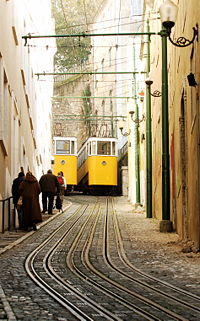
Trams in tight places
Under the department, a picture is worth a thousand words, trams, streetcars and their kin can operate in very tight places, this funicular in Portugal should dispel any notion that ‘rail’ transit can’t operate in tight locations! Ai??Ai??
From the Tyee – Passenger rail rights at risk: Langley Mayor
By Amy Juschka May 7, 2009 An agreement that protects passenger rail rights in the Fraser Valley is set to expire this summer and Langley Township Mayor, Rick Green is calling for its urgent renewal. The Master Agreement is between BC Hydro, who owns the right of way, and Canadian Pacific Railway (CPR), whom bought […]
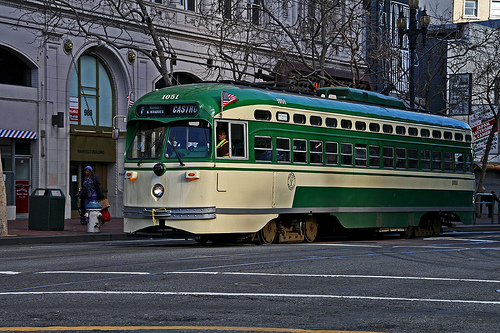
From the Light Rail Transit Association – CAN LOCAL FUNDING SUPPORT A HERITAGE TYPE TRAMWAY
The following is a discussion document (#72 January 2009)Ai??Ai??from the Light Rail Transit Association www.lrta.org which may be interesting for those who are interested in building a ‘start-up’ heritage interurban/streetcar service. The Federation of Small Businesses (Yorkshire and Humber) have shown concern about the need to reduce traffic congestion in Leeds. Their suggestion was that […]
PROVINCIAL ELECTION QUESTIONNAIRE RESULTS
Rail For The Valley asked South of Fraser candidates where they stand on light rail. Click here for their responses Of particular interest is the BC Liberal party’s support in principle for a demonstration project to be launched by 2010. (See last page of Questionnaire, BC Liberal party response to Q3: Will you support a […]
The German disease – What is it? Do we suffer from it?
In the early 1960’s, when the German economy was beginning to recover from the war, Germany invested heavily in new subways (U-Bahn) and fast commuter style metropolitan railways (S-Bahn). The tram or strassebahn, which bore the brunt of providing public transitAi??Ai??from theAi??Ai??late 40’s, to theAi??Ai??60’s, was largely regardedAi??Ai??by manyAi??Ai??as a dated or evenAi??Ai??obsolete.Ai??Ai??At the time, […]



Recent Comments