Letters to the Editor: Daryl versus Malcolm
Tit for tat department.
Last Thursday SkyTrain lobbyist Daryl Dela Cruz had the following letter printed in the Surrey Leader.
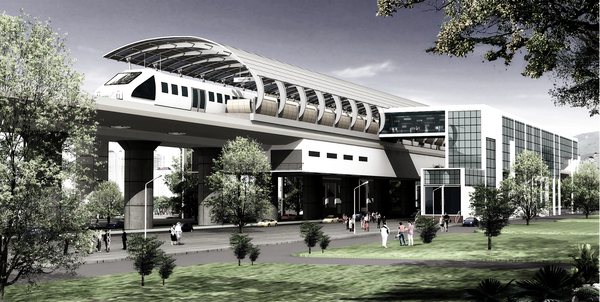 An elevated metro station, as envisioned by Mr. Dela Cruz. Expensive to build and to maintain
which translates into higher operating costs.
Light railai??i??s downsides
Published: May 15, 2013Re: ai???Letai??i??s not get soaked by poorly planned transit,ai??? Letters, The Leader, May 14.
I think that many advocates like the Light Rail Links coalition are misleading people into supporting them, because they are hiding the downsides to at-grade, on-street light rail transit.
Some of those downsides are:
ai??? Light rail is slower transit; it is limited to at-grade speed limits of 50-60 km/h.
ai??? Light rail can be closed off completely by accidents. Disruptions at high-accident intersections in Surrey like King George Boulevard and 88 Avenue will mean that an LRT line will close down several times a week.
ai??? Less speed and reliability means less ridership. Less ridership means less fare revenue.
ai??? Even with both a light rail system across Surrey and transportation demand management to raise the cost of driving, 65 per cent of commutes will still be by car.
ai??? No Surrey light rail options will meet 2041 transportation modal shift goals from the car set by TransLink.
In my view, light rail is simply not an investment that will be worth the cost. Surrey residents should consider supporting SkyTrain expansion instead. SkyTrain has some downsides like its visual profile, but I support SkyTrain because:
ai??? SkyTrain actually generates more monetary transportation benefits than cost, unlike light rail.
ai??? SkyTrain has worked in Vancouver to increase transit mode-share and reduce motor vehicle use.
ai???Ai??SkyTrainai??i??s lower operating costs per hour can mean more frequent off-peak and weekend transit service compared to light rail.
ai??? SkyTrainai??i??s grade-separated right-of-way means consistent 96 per cent on-time reliability.
ai??? SkyTrain is the best catalyst for transit-oriented urban growth and slum revitalization when compared to other cities around the world.
Daryl Dela Cruz
Campaign Director
Better Surrey Rapid Transit
This, prompted a reply from long time light rail advocate Malcolm Johnston.
We now see that Mr. Dela Cruz, a high school student, is the campaign director for Better Surrey Rapid Transit, which makes Zwei wonder if BS Rapid Transit (just gotta love it) has any professional input at all? Rail for the Valley has the Leewood Report, a professional transit study done by a real consultant, you know, someone who makes a living by planning real transit projects for real customers.
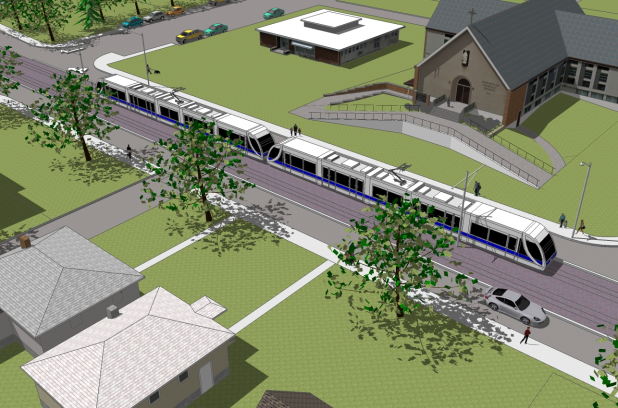 At-grade/on-street LRT has very inexpensive stations, which translates to much cheaper maintenance costs
and being at street level, are far more convenient for the transit customer.
Light rail makes SkyTrain obsolete
Published: May 21, 2013
A letter by a Mr. Daryl Dela Cruz grossly misinforms the public about modern light rail (LRT).
The difference between modern LRT and a streetcar is the concept of the ai???reserved rights-of-wayai??? or a R-o-W for the exclusive use of a streetcar ai??i?? in laymanai??i??s terms, a HOV lane with rails. The reserved R-o-W enables the modern streetcar to operate as fast as and carry as many or more transit customers than an elevated light-metro like SkyTrain, The fact is, modern LRT made SkyTrain obsolete almost two decades ago.
Modern LRT can operate at speed of 80 km/h to 90 km/h at grade on a reserved R-o-W in complete safety and does in hundreds of cities around the world.
Accidents do happen on LRT lines when car drivers disobey signals, but when a rare accident does occur, only a portion of the line affected is closed and in most cases the streetcars can be easily switched to the unaffected line to continue their journey.
At-grade LRT actually is better in attracting new ridership than grade-separated mini-metros like SkyTrain, simply because stations or stops are handier and easier to use. LRT is far more convenient than SkyTrain and convenience attracts customers.
Since TransLink has no experience in planning and building with LRT, I would question any transit plan presented by TransLink, but since modern LRT can handle higher capacities than SkyTrain, future customer demands would be of little problem.
Today, in Karlsruhe Germany, the main tram (streetcar) line on Kaiserstrasse is dealing with peak -hour capacities in excess of 40,000 persons per hour per direction. This is 10,000 persons per hour per direction more than the maximum theoretical capacity of the SkyTrain mini-metro.
SkyTrain does not have lower operating costs than LRT; instead the opposite is true. SkyTrain costs about 40 per cent more to operate when compared to modern LRT.
Since SkyTrain was first marketed in the 1970s, only seven systems have been built and not one was allowed to compete against LRT. During the same period, over 160 new LRT systems have been built, with a further 30 under construction.
It seems knowledgeable transit planners around the world do not support the Dela Cruzai??i??s SkyTrain hype and hoopla.
D. Malcolm Johnston
Rail for the Valley
Delta



It seems like common sense… Building any part of your transportation infrastructure, be it roadway or rail, in either a tunnel or on a bridge is the most expensive part. Skytrain is built completely on a bridge or in a tunnel. Many places where it is completely unnecessary.
Aside from the specific car manufacturing specifics (and that skytrain is driverless), LRT on it’s own elevated guide way would just become skytrain right? I mean Canada line and Sky train aren’t the same train systems, but they are both built the most expensive way possible… That flexity tram that was on the olympic line, if that same tram was used, but put completely on an elevated platform or in a tunnel, then would it satisfy the skytrain lobbies desires?
So what their really complaining about is that it’s stops aren’t placed as far apart (meaning you are less likely to have to switch to a bus after), or that it might have to wait at an intersection (though they could have signal priority?). Or do they just want to keep trains off the roads so they can drive their car unimpeded?
The way I look at it is, lrt could be built much more affordably, and therefore could attract more riders than the skytrain that isn’t built because we can’t afford it.
Am I way out to lunch here?
Onto the RftV Leewood train…. The tracks in question, those are the same tracks that this whole roberts banks rail corridor project is developing to push more freight trains through isn’t it? If so, I can’t imagine any chance of ever seeing trains on there, once those overpasses are done, there is likely to be a huge increase in freight trains through langley? I think lrt sounds great but I don’t know that they will allow it there?
Of course, the NDP destroyed themselves in that election so the BC “liberals” are back, and I don’t see any chance of anything other then business as usual anyways.
sad. 🙁
Zweisystem replies: The Canada Line is an automatic railway, using standard EMU’s. It would have been cheaper and more effective to us light rail vehicles instead of the Hyundai ROTEM EMU’s.
With the Rail for the Valley, the shared track with the Roberts Bank Railway could have pathways allocated for the interurban. It is a matter of signalling and maybe in the future, double tracking.
I am just going to answer Mr. De La Cruz’s claims:
1) ” Light rail is slower transit; it is limited to at-grade speed limits of 50-60 km/h.” – Vehicle speed is determined by station spacing. LRT and Skytrain with equal station spacing will have very similar speeds. Here in Toronto it was determined the surface portion of the Eglinton Crosstown LRT will only be 5km slower than a grade separated option.
2)’Light rail can be closed off completely by accidents. Disruptions at high-accident intersections in Surrey like King George Boulevard and 88 Avenue will mean that an LRT line will close down several times a week’. – What a nonsense statement. Mr. De La Cruz should know the city would take the accident rate into account and will implement measures to protect the LRT. This is fear mongering at it’s worst, and discredits Mr. De La Cruz.
3)’Less speed and reliability means less ridership. Less ridership means less fare revenue.’ – Another nonsense statement. Reliability is not dependent on the technology, and just from reading this blog, Translink has not been running Skytrain reliably. LRT can easily achieve high ridership with station spacing that is appropriate for the corridor. But it’s shown that 1km or more station spacing does not produce ridership without expensive bus feeders!
4″Even with both a light rail system across Surrey and transportation demand management to raise the cost of driving, 65 per cent of commutes will still be by car.” – And this is where Mr. De La Cruz’ gets desperate. By his faulty logic, if a LRT network can’t get people out of their car, how is 1 skytrain extension going to attract riders? What a joke.
5)’ No Surrey light rail options will meet 2041 transportation modal shift goals from the car set by TransLink.”
And one Skytrain extension will?
Reading the nonsense from Skytrain for Surrey, I can undertstand why Surrey opted for LRT!
Light rail can only gain more credibility with the likes of DDC on TransLink’s side. TransLink must be thrilled to have an expert such as DDC on its side; DDC complements Mike Harcourt, Geoff Meggs and Gordon Price – very nicely.
Don’t forget about the possibility of a seismic event in the future. After Kobe Japan earthquake many rail lines were still functional. I suspect anything raised would be shut down for quite some time.