Study Supports LRT
Someone should tell the SkyTrain Lobby that no one builds with SkyTrain anymore; even the Canada Line isn’t SkyTrain!
Modern light rail made SkyTrain and light metro obsolete decades ago, yet no seems to read the news in this part of the world, with many people still championing SkyTrain, a transit system that costs more to build; more to operate and more to maintain, than LRT.
So who are you going to believe, Shirocca Consulting, a professional transportation consulting group or Daryl Dela Cruz a teenage college student, with no formal back ground in transit? I’ll place my money on Shirocca Consulting.
Surrey defends LRT plan with economic study
 Light rail transit in Surrey might look something like this street-level train in Dublin.ai??i??Ai??image credit: Surrey.ca
- byAi?? Jeff Nagel – Surrey North Delta Leader
- posted May 15, 2015
The City of Surrey is trumpeting its case for two light rail transit (LRT) lines with a study that claims the system will generate big economic benefits.
The report’s release is officially aimed at forming part of the business case to secure federal funding for the $2.1-billion project.
But it also comes as city officials seek to quell continued opposition to the choice of ground-level light rail technology over elevated SkyTrain from some critics in Surrey and Langley, and to help ensure the project proceeds even if the Metro Vancouver transit funding referendum is defeated.
TheAi??Shirocca Consulting study claims 24,600 direct and indirect jobs would be created in B.C. during construction and $1.4 billion would be paid in wages and salaries.
The provincial government would collect $132 million in taxes and $354 million in tax would flow to the federal government, and still more would accrue over the next 30 years of operations.
Mayor Linda Hepner argues the taxes generated will help offset the capital grants she wants senior governments to make to finance Surrey LRT.
She said it’s the most cost-effective rapid transit option to connect the city’s town centres.
“We can get one and a half to two times as much light rail compared to SkyTrain,” Hepner said. “And it also animates and develops and shapes the community instead of acting as just a simple mode of transportation.”
A Langley Township transportation manager recently cautioned that LRT seems designed to move Surrey residents within the city at the expense of a no-transfer, more reliable and likely faster ride for passengers from Langley through Surrey if the Fraser Highway line is built with SkyTrain instead.
Although the province overruled the original local choice of LRT for the Evergreen Line in favour of SkyTrain, Hepner said she’s confident the province understands the need for LRT in Surrey and noted it has the agreement of the Metro mayors’ council.
“It was chosen under the mayors’ plan as a priority project and agreed regionally that light rail was the way to go in terms of connectability and what we could get.”
The Surrey LRT project proposes a 10.9-kilometre “L-line” linking Guildford, Surrey City Centre and Newton that would open by 2023, and a 17.1-kilometre line from City Centre to Langley City opening by 2028.
Service is assumed to be every five minutes, falling to every three minutes with an expected service upgrade in 2041.
Light rail would have more stations than SkyTrain and be more pedestrian-friendly, offering “both eyes on the street and from the street visibility,” the report said.
“Unlike Rapid Bus or SkyTrain alternatives, the LRT will have a permanent physical presence in their exclusive rights-of-way and yet be at a human scale and have a gentle footprint in keeping with the lower density portions of the line.”
The study argues the light rail lines will be a magnet for other high-tech and health sciences employers, resulting in more jobs springing up along the network.
It notes access to Surrey Memorial Hospital would improve, accelerating the development of that area as a growing health technology centre.
And it predicts increased investment in high-quality residential, commercial and civic development that would increase the tax base and add jobs in both Surrey City Centre and Langley’s town centre.
More households may be able to afford homes in the area, it says, because the line will allow more residents to forego a car.
SkyTrain for Surrey advocate Daryl Dela Cruz said the Shirocca report appears to emphasize economics and development because the actual transit improvement case from LRT is weak.
“Commuters don’t want to know about these vague details ai??i?? they want to know if they’ll be able to get around easier,” Dela Cruz said.
His group proposes SkyTrain to Langley on Fraser Highway ai??i??Ai??which would get riders boarding in Langley to Waterfront Station in under an hour ai??i??Ai??and bus rapid transit instead of light rail on other corridors.
Light rail on King George would be only one minute faster than the existing 96 B-Line express bus to Newton, he said, while 104 Avenue would end up more congested with the loss of a lane of traffic to LRT.
“It would seem that the results have more to do with appeasing developers, business prospects, pro-light rail advocates and other such entities as opposed to transit riders and the actual stakeholders on the proposed lines,” Dela Cruz said.
Tram problems in Toronto
Next time, forget Bombardier and buy from Siemens or Alstom!
TTCai??i??s new streetcars plagued with manufacturing problems
CEO Andy Byford wants customers to know initial cars were slow to hit the street because they were badly built.

Marcus Oleniuk / Toronto Star Order this photo
A TTC worker changes the track for a new model streetcar at the TTC Hillcrest Complex, where the cars are tested before hitting the street.
By: Tess Kalinowski Transportation reporter, Published on Tue May 12 2015
Laminate that wouldnai??i??t adhere to the parts, and under-frames so badly out of alignment with the walls Bombardier tried to rivet them together: The first vehicles in Torontoai??i??s new $1.2-billion streetcar fleet were so poorly manufactured, the TTC wouldnai??i??t accept them for fear they would break down on bumpy city streets, transit CEO Andy Byford has revealed.
The European design for the streetcar parts simply wasnai??i??t translating to the Mexican manufacturing facility that is supplying parts to the Thunder Bay assembly plant.
ai???Thunder Bay was finding when they went to attach the under-frame to the sidewalls they werenai??i??t square. You either accept that or try riveting it to create that square alignment. We rejected that. We donai??i??t want it riveted. We want it built properly, because rivets pop,ai??? Byford said.
There should have been about 50 of the new streetcars running on Toronto streets by now, according to the original schedule. But there are only five, with two more expected to come online shortly.
Bombardier spokesperson Marc-AndrAi?? Lefebvre said the company was aware of the manufacturing problems and has been working to fix them.
Video cameras instead of mirrors, air conditioning and touch-screen technology are some of the highlights in the cab of the new streetcars.
ai???I think Mr. Byfordai??i??s comments were obviously on items that we have already discussed with the TTC,ai??? he said. ai???Those are items in the past that we have already acknowledged.
ai???We took action to make sure that the vehicles we delivered to Toronto were at the highest quality possible.ai???
Conscious that customers are eager to see the new fully accessible, air-conditioned cars in service, Byford said he is now pushing to have the manufacturing schedule ramped up, first to two cars a month, then by fall to delivery of one every five days.
There should be 30 cars in Toronto by the end of the year, with the Harbourfront, Spadina and Bathurst lines fully furnished. He is adamant that Bombardier meet its 2019 end-date commitment for delivery of the entire 204-car order.
Lefebvre said the company was on track to meet its delivery targets.
Itai??i??s been a tricky balancing act between the desire to get the cars and the need to get them right.
ai???Iai??i??m not striving for absolute perfection, because equally customers want the new vehicles,ai??? said Byford, who plans to visit Thunder Bay with TTC chair Josh Colle in June.
There are still issues with loose screws, wiring and electrical connectors; the latter can only be tested once the streetcars are running on the track.
Bombardier is retooling its Mexican operation and the production line in Thunder Bay is getting new quality-assurance processes that catch problems before they get to Toronto. But Byford said heai??i??s made it plain the TTC is not a happy customer.

Marcus Oleniuk/Toronto Star
A new model streetcar is seen here at the TTC Hillcrest Complex.
ai???Where a defect is not critical and can be rectified later, we do accept the vehicles. Thereai??i??s been some panels where the aesthetic appearance isnai??i??t perfect. Thatai??i??s not going to make the vehicle break down. Weai??i??ll allow that, on the written assurance that when thereai??i??s enough of them that vehicle will go back and get rectified,ai??? he said.
Byford said he was sharing the extent of the quality assurance issues so that TTC riders would understand why theyai??i??ve been waiting so long for new vehicles that were ordered in 2010.
ai???I wouldnai??i??t want them to think weai??i??re passive here. On the contrary, we are hammering Bombardier,ai??? he said, adding that he speaks to his counterpart there regularly and there are daily meetings between the manufacturer and the TTC.
TTC engineers are already helping Bombardier with the commissioning of the new vehicles. To leave Thunder Bay, the vehicles need a partial acceptance certificate (PAC). It is then shipped by train to the TTCai??i??s Hillcrest complex. TTC engineers then issue a final acceptance certificate (FAC). Until that happens, the TTC doesnai??i??t own the vehicle and no money changes hands.
ai???We will not FAC and therefore pay for, with Torontoniansai??i?? tax dollars ai??i?? we will not accept a sub-optimum vehicle,ai??? said Byford.
The cars now in service ai???have proved superbly reliable,ai??? he said. One of the two-stage wheelchair ramps has failed once and a Presto device was out of service for about two hours, but otherwise the vehicles have been problem-free.
The TTC has set a target of 35,000 kilometres between failures for the new cars, compared with about 7,000 kilometres on average between failures on the old fleet.

With files from Eric Andrew-Gee
TransLink dumps planning veterans Tamim Raad and Brian Mills – Adios Surrey’s LRT?
It seems anyone who even breathes light rail in Metro Vancouver is quietly terminated from TransLink.
UBC educated Tamin Raad, was a supporter of light rail and understood the issues surrounding light metro.
TransLink CEO Tom Prenderghast was forced out of TransLink because he dared to challenge the SkyTrain Lobby, by supporting light rail and now, more are being eased out, which means only one thing, whether the plebiscite passes or fails, a Broadway SkyTrain subway will be built and LRT in surrey will probably will not.

***************************
From the Georgia Straight
TransLink pushes out senior transportation planning veterans Tamim Raad and Brian Mills
- Transit riders have lost two of their supporters at TransLink with the ouster of Brian Mills and Tamim Raad. Stephen Hui
In the midst of a Lower Mainland transportation plebiscite, TransLink has given walking papers to two transit experts.
This comes less than three months after the board of directors replaced CEO Ian Jarvis with interim CEO Doug Allen.
The Straight has asked TransLink media relations for a comment. Nobody has responded as of this writing.
Raad and Mills are both UBC graduates and each reported to recently appointed vice president of transportation strategy, Tim Savoie.
Savoie, former director of planning and development services in Port Moody, has extensive experience as a municipal planner. However, he does not have nearly as much experience in dealing with transit Mills or Raad.
Mills has been involved in this work for 27 years and led TransLink’s long-term vision and strategy document, Transport 2040.
Raad has been with TransLink for 16 years. In February, he told the Georgia Straight that the regional transportation authority’s goal was to create a “frequent-wide transit network” serving 70 percent of the population.
‘You head out your door in Surrey, say and walk a few blocks,” he explained. “You dont need a schedule. A bus comes every 15 minutes. Average wait: seven-and-a-half minutes. Thats the plan?
Last year, Raad told the Vancouver Sun that TransLink “thinks a light rail line from Commercial to UBC is workable”.
The Vision Vancouver controlled council has adamantly demanded a more expensive subway. This was included in the suite of projects supported by the Mayor’s Council and put before voters in the plebiscite.
Even if the plebiscite passes, the provincial and federal governments will each have to kick in nearly $700 million to build the subway. If it’s constructed, trains would travel underground from VCC-Clark Station to Arbutus Street.
Understanding the benefits of modern light rail

What is good for New South Wales in Australia, is certainly good for BC.
The benefits of building with light rail and I so wish local politicians take the time and read the following.
ITLS_presentation_5_May_2015_-_McKibbin_-_Light_Rail[1]
The key building with light rail is building it right, serving major transit destinations as well as areas of housing, giving the transit customer a seamless (no transfer) journey. A lesson TransLink has yet to learn.
Metro Madness

Seoul, South Korea – op-ed: Asia builds subways; lesson for Canada ??
VANCOUVER, Toronto and Montreal still haven’tAi?? settled their subway dreams but an op-ed commentary in The Globe and Mail says Asia, instead of voting on subways, actually builds them:
<http://tinyurl.com/ljlh6tt>
“Asia doesnai??i??t vote for subways, it builds themJEFFREY SIMPSON\SEOULAi??ai??i??Ai??The Globe and MailPublished Saturday, May. 02 2015
Citizens of British Columbiaai??i??s Lower Mainland, unite! You have nothing to lose but your gridlock! Hemmed between the ocean and the mountains, the Lower Mainland is choking now. The traffic contributes to Greater Vancouverites being Canadaai??i??s least happy people, according to a recent survey by Statistics Canada.
Imagine what the region will be like in two decades if voters reject the small sales tax increase proposed in a plebiscite to bring new public transit improvements to the region.
We live in a changed country now where doing things collectively is out-of-favour, replaced by a mixture of contempt for government and ai???Iai??i??m all right, Jack.ai??? So the plebiscite might lose, and transit will fall further behind.
In Greater Toronto, Montreal and a few other Canadian cities, urban transit has to catch up to local needs and international realities. Canadians are now largely an urban people, but we have not adequately financed public transit. The result: urban areas that do not function as they should, and not as they need to against world competition.
We stop, we go. Governments do this project, then wait, then do another some years later. There is little systematic, ongoing, year-over-year capital investment.
In the recent federal budget, for example, the Conservatives pledged $750-million (USD $616.7 million) spread over two years beginning in 2017-2018, with $1-billion-a-year (USD $822.3 milliion) thereafter. This sounds like an eye-popping number, until you think about it, which the Conservatives obviously hope people will not.
A billion-a-year divided among, say, the countryai??i??s top six or seven cities ai??i?? and they will all be hungering and lobbying for their share of the pittance ai??i?? might build another station or two in this city or that. But compared to the need, and to what competing nations are doing, itai??i??s close to a joke.
The Lower Mainland, even more than the rest of Canada, competes with Asia, especially North Asia. There, subway lines are ubiquitous and cheap, as are urban surface rail lines.
In Seoul, for example, with a population a little more than twice Greater Torontoai??i??s, there are nine subway lines. Nine. The GTA will launch on June 6 an airport link to Pearson; in Seoul, there have been for a long time subway links to the two international airports, Gimpo and Incheon. The same goes for Tokyo: direct train links from the two international airports, Narita and Haneda.
Beijing and Shanghai have magnetic levitation trains whisking people from airports at speeds of up to 420 kilometres an hour (260.9 MPH). Toronto, in other words, is playing catch up. Vancouver, happily, has the Canada Line from the airport to downtown. Montreal has nothing.
The cost in Toronto from Pearson to downtown will be $27.50 (USD $22.62). The cost in Seoul from Gimpo, the airport closest to downtown is $6 (USD $4.93), and from Incheon, further away, $17 (USD $13.98). The cost of subway tickets in central Seoul and Tokyo: $1.20-$2.40 (USD $0.99 to $1.97) for systems that offer far more timely, modern and efficient service than anything in Toronto, or Montreal for that matter.
The key in North Asia is the assumption that urban transit is a public good that must be given priority in funding and planning. These countries donai??i??t engage in the fits and starts of Canadian cities; they plan to improve every year. It happens in authoritarian China, but also in democratic Japan and South Korea.
To wit: there are four extensions under way of existing subways in Seoul. Here, they donai??i??t do it like Ontario Premier Kathleen Wynne: Making grandiose promises to improve transit in a surge; or the kind of financially fake promise of Prime Minister Stephen Harper, with numbers that sound more muscular than they will be in fact.
You might reply: Yes, but these North Asian cities are gigantic. And indeed they are. Tokyoai??i??s population is about 34 million, Seoulai??i??s about 10 million. But Nagoya, Japan, with a population about the size of Vancouver, has 93 kilometres (57.7 miles) of subway; Nagasaki (population 1.3 million) has five subway lines; Osaka (population 2.6 million) has eight lines across 130 km (80.7 miles). The large cities all have buses everywhere and, in some cases, commuter rail.
Governments here donai??i??t put matters to a plebiscite. They do what governments are supposed to do: they decide. The Chinese donai??i??t care much about Not in My Backyard. Democratic countries have to pay more attention to public opinion. Judging by the public transit in North Asia, people understand that without large and efficient systems, their cities will be less manageable and competitive.
We can only hope the people of Greater Vancouver get the message from North Asia.
Finch Ave. West LRT is a go!
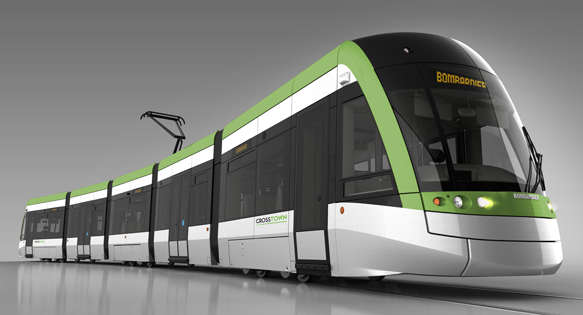
Finch Ave. West LRT is a go!
With thanks from Mr. Haveacow!
In the latest of a flurry of transit infrastructure announcements before and since last weekai??i??s launch of Ontarioai??i??s 2015 budget, the government of Ontario says itai??i??s finally going to start building a light rail transit line along Finch Avenue West.
The Finch West LRT is an 11-kilometre light rail transit line that will run along the surface of Finch Avenue from the new Finch West Subway Station on the Toronto-York Spadina Subway Extension at Keele Street to Humber College.
It will provide rapid transit to neighbourhoods that need it the most; it will travel through two of the City of Torontoai??i??s 13 identified priority neighbourhoods ai??i?? Jamestown and Jane/Finch.
The Finch West LRT is a $1 billion (2010$) investment from the Ontario government to expand transit in Toronto.
Construction is currently estimated to begin in 2017.

High Capacity
The projected ridership of the Finch West LRT corridor is 2,800 passengers per hour in the peak direction by 2031. The capacity of an LRT is 15,000 passengers per hour per direction. LRT cars can be removed or added easily, thus providing the flexibility to accommodate ridership demands.
Reliable
The Finch West LRT will carry passengers in dedicated right-of-way transit lanes separate from regular traffic, as well as priority signaling at intersections. These two components ensure that the Finch West LRT is reliable and that travel times are more certain.
Convenient
The Finch West LRT will have up to 18 surface stops along Finch Avenue and will have rapid transit connections: Finch West Station to the new Toronto-York subway extension.
Accessible
The Finch West LRT will have multiple entrances and low floors to ensure fast and accessible boarding. In addition, each vehicle will use the PRESTO proof-of-payment system.
Proven Technology
LRT is a proven technology that is used around the world, including cities with variable temperatures such as Edmonton, Calgary and Minneapolis.
More TramTrains For Karlsruhe
Karlsruhe, Germany, the birthplace of the TramTrain concept, goes from success to success.
For twenty-two years, TramTrain have been operating in the Karlsruhe region with no major accidents, track sharing with both the city tram systems and mainline railways, providing affordable tram services to regions which otherwise would not been able to afford a quality transit service.

Karlsruhe orders more Vossloh tram-trains
KARLSRUHE Transport (VBK) and Albtal Transport Company (AVG) have exercised an option with Vossloh Kiepe and its Spanish sister company Vossloh Rail Vehicles for 25 additional CityLink NET 2012 tram-trains, taking its total fleet of these vehicles to 50.
VBK and AVG placed an initial ai??i??75m order for 25 vehicles in October 2011 and deliveries started in May 2014 with the first vehicles entering service in October. So far AVG has received around half of the vehicles from the first order.
Vossloh Rail Vehicles is assembling the tram-trains at its Albuixech plant near Valencia, Spain, while Vossloh Kiepe is supplying electrical equipment traction vehicle control systems, heating, ventilation, air-conditioning, train control systems, passenger information systems, and CCTV.
The 80km/h, 37.2m-long vehicles are 2.65m wide and accommodate up to 224 passengers, 104 of them seated.
The NET 2012 is equipped with IGBT inverters and to meet the high redundancy requirements specified by VBK and AVG, each of the four 125kW four-phase asynchronous traction motors is supplied by its own inverter.
The NET 2012s will operate over the main line network on tram-train lines S1 (Hochstetten ai??i?? Bad Herrenalb) and S11 (Hochstetten ai??i?? Ittersbach).
The Perils of Proprietary Railways
 The Sydney Australia monorail was another expensive and short lived line.
Now torn down, Sydney is now investing in light rail.
The pitfalls of buying into a proprietary railway are many; for what was once “high tech” and “state of the art”, soon becomes yesterday’s tech and obsolete.
Owners of proprietary railways, like to sell them because those who purchase and build with a proprietary railway are tied to one supplier (the owner), which is known in the business as the “gotcha factor”.
The ‘Airtrain’, probably looked like a good deal at the time, but 19 years later, it now looks like a $354 million museum piece that will soon be scrapped.
There are many lessons to be learned about buying and operating a proprietary railway, unfortunately politicians who love to cut ribbons at election time and bureaucrats who go on junket ‘fact finding tours’, remain deaf to any lesson at all.
Newark airport monorail targeted for scrap heap, cost $354M to build
The Port Authority is planning to replace the AirTrain monorail at Newark Liberty International Airport, which links EWR to an NJ Transit station on the Northeast Corridor Line. (Jerry McCrea | The Star-Ledger)
By Steve Strunsky | NJ Advance Media for NJ.com
Email the author | Follow on Twitter
on April 27, 2015NEWARK ai??i?? The 19-year-old AirTrain monorail system at Newark Liberty International Airport is being targeted for replacement.
The Port Authority of New York and New Jersey has not publicly estimated the cost of a new system, or said when it expected the project to begin or end. But Port Authority commissioners are scheduled to vote Thursday to authorize spending $40 million on planning consultants for the project, plus another $30 million on technical experts.
“Although substantial investment has been made to maintain current operations, such investment has not extended the 25-year design life of the system, nor has it expanded capacity,” states the planning resolution proposed for adoption Thursday.
The agency plans to ask the Federal Aviation Administration for permission to use $40 million in airline ticket surcharges to offset the planning cost.
The 3-mile system carries about 30,000 passengers a day between terminals A, B and C, the airport’s parking and rental car lots, and a station linking the airport to NJ Transit trains along the Northeast Corridor line.
A 2011 report by the Regional Plan Association, a transportation research organization, recommended replacing the monorail system as part of a broader plan to expand the region’s airport capacity. The RPA report criticized the AirTrain as slow and unable to accommodate growth.
“The AirTrain has been a problem for a while,” Richard Barone, the RPA’s director of transportation programs, said in an interview Monday. “It’s unreliable.”Beyond reliability, Barone said increasing capacity of the airport’s circulator system — whether it turns out to be another monorail, a steel-wheel train, or some other mode — has become even more critical with the Port Authority’s plans to extend the PATH system to the airport train station. That project, still several years away, would pour even more riders onto the airport circulator, apart from increases relates strictly to growing demand for air travel.
The AirTrain, which is free within the airport, has been characterized by service interruptions due to power failures, accidents and maintenance. Last summer, the AirTrain was closed for two months to fill what were essentially 60 potholes in the steel and epoxy running surface. The weight of the cars is born by rubber tires that roll on the running surface.
The AirTrain system first opened in 1996 at a cost of $354 million, built by a company that is now a subsidiary of the Canadian aircraft and rail car maker Bombardier, which operates the monorail under a contract with the Port Authority through 2022.
In 2001, the system was linked to a heavy rail station just north of Newark Liberty, where fliers and airport workers can transfer between the monorail and NJ Transit trains heading in an out of Newark Penn Station. The monorail was also expanded from 12 cars to 18.
Thursday’s authorization votes come four months after the Port Authority issued its first contract for preliminary work to extend the PATH commuter rail system from Newark Penn Station to the airport rail station, a project estimated to cost $1.5 billion.
The PATH extension is among 11 major projects, along with hundreds of less costly ones, included in a 10-year, $27.6 billion Port Authority capital plan adopted by the agency’s board in February 2014, under then-Chairman David Samson, who resigned the following month amid investigations growing out of the George Washington Bridge lane closure scandal.
However, like a new Port Authority Bus Terminal projected to cost $8-10 billion, a new AirTrain is not included in the capital plan, suggesting agency officials will have to come up with additional revenues or spending cuts, to pay for it.
“Not to disparage anybody who was involved in it,” Barone said of the capital plan. “But I do think that capital plan was the product of a tumultuous period for Port Authority leadership.”
The one Port Authority official who agreed to talk about the monorail replacement, Commissioner Ken Lipper, a June 2013 appointee of Gov Andrew Cuomo of New York, said the project was a necessity and that room would be made for it during a review of the capital plan that officials are just beginning to undertake.
“It is a priority,” said Lipper, who said he did not play a role in the current capital plan’s formation.
A report issued in December by the Special Panel on the Future of the Port Authority, convened last year by Gov. Chris Christie and Gov. Andrew Cuomo of New York, stresses the need to modernize and expand capacity at Newark Liberty, John F. Kennedy International and LaGuardia Airports, gateways to the region that have been criticized as outdated.
“While some improvements have been made at these airports over the past decade, many of these facilities are outdated and ill-equipped to meet the increased passenger demands of the future,” the report stated.

Brampton, Mississauga to get new 23-km light-rail line

Another new LRT for Canada!
Using both reserved rights-of-ways and mixed traffic, the Hurontario LRT is a classic 21st century light rail operation.
Brampton, Mississauga to get new 23-km light-rail line
At 26 stops, 23-kilometre line will run from GO stations in Brampton and Mississauga
CBC News Posted: Apr 21, 2015
The Ontario government is putting up $1.6 billion to build a 23-kilometre light-rail line that will connect GO stations in Mississauga and Brampton and “transform Peel region.”
Led by Metrolinx, the Hurontario-Main Light Rail Transit line will have 26 stops, including three in downtown Mississauga and two in Brampton. The line will run from the Port Credit GO station northAi??to the BramptonAi??GO station.
The lineAi??will also connectAi??to many of the region’s existing transit lines including GO Transit’s Kitchener, Milton and Lakeshore West rail lines, Brampton ZA?m, and the Mississauga Transitway.
BramptonAi??Mayor Linda Jeffrey said the new line will “transform Peel Region” while Mississauga Mayor Bonnie Crombie called the new line a “game changer.”
Construction on the line is expected to begin in 2018 and completed by 2022.
The executive summary.
hurontario_MP_Executive_Summary (2)
With thanks to Mr. Haveacow!
How to build light rail in our cities without emptying the public purse
An interesting read and quite pertinent to our transit situation in the lower mainland.
Both the BRT and SkyTrain Lobby’s have so perverted the concept of modern light rail, to support their own projects, that the concept of affordable LRT has all but disappeared from the TransLink lexicon.
The following quote; “……….while cities with rubber-wheeled public transport continue to be dominated by cars and urban sprawl“, is so true of Metro Vancouver, where congestion is on the rise, yet politicians and planners opt for remedies that will further exacerbate the situation.

How to build light rail in our cities without emptying the publicAi??purse
Light rail is good for cities, but it’s also expensive, which is why many Australian cities have opted for buses instead. But there is a way to get top-drawer public transport using private dollars.

In cities all around Australia, light rail is being considered as a solution to a range of urban problems. Perth, Newcastle, Parramatta, Bendigo, Canberra, Cairns and Hobart have all considered trying to do what many European and American cities have done ai??i?? create new development around light rail.
Often, though, the high costs of these projects mean that the debate can soon become a question of whether buses might do the job just as well. But what if private financing could allow the preferred option of light rail to stay on the table?
Advocates of the cheaper bus mass transit option might ask whether there is truly any fundamental difference between steel wheels and rubber ones. My answer is that itai??i??s not just a question of trams versus buses ai??i?? itai??i??s really an issue of rail-based versus road-based urban development. The former can attract private financing, while the latter does not.
Driving development
Most of the worldai??i??s urban development over the past 50 years has been road-based. The assumption has been that most people will drive, with the odd bus laid on to pick up those who donai??i??t.
Yet in recent years there has been a revival of rail-based urban development, which brings reduced traffic, creates more walkable and lively places to live and work, and most of all attracts developers and financiers to enable denser, mixed-use development.
Perthai??i??s beleaguered MAX light rail project ai??i?? now mothballed in favour of a bus rapid transit service ai??i?? was designed to deliver precisely these benefits. But when the bus lobby sidles in and whispers ai???we can do exactly the same for half the priceai???, they get a sympathetic ear from transport planners who are trained to get people efficiently from A to B, without thinking about whether they are also delivering good urban development.
Rubber-wheeled public transport does not create dense, mixed-use urban centres. Having examined examples around the world, I have found none that can be claimed to have resulted in more focused urbanity apart from already dense third world cities where BRTai??i??s have been successful in attracting patronage as they get people out of traffic. In the United States, the past 20 years of dramatic growth in public transport has seen light rail grow by 190% and heavy rail by 52%, while bus transport has contracted by 3%.
It is no surprise that developers, banks and governments in developed cities have returned to light and heavy rail to help regenerate urban centres, while cities with rubber-wheeled public transport continue to be dominated by cars and urban sprawl. On current trends, Perth itself could conceivably turn into a 240 km sprawl stretching from Myalup to Lancelin, most of it made of nothing but car-dependent housing ai??i?? more Mad Max than MAX.
Perthai??i??s planners know that they must redevelop and create activity centres, but they do not control the decisions on transport. Transport planners, meanwhile, do not seem to see that their choices have impacts that go beyond simple modes of transport.
Enter the private sector
Here is my possible solution, which Infrastructure Australia has previously tried to get state governments to adopt: get the private sector involved in the planning stage, as well as the delivery and operations, of any light rail project. Light rail lends itself to private-sector involvement, but only if the development outcomes being sought are built into the whole project, rather than being an afterthought.
The model for Infrastructure Australiaai??i??s approach was the A$1 billion Gold Coast Light Rail, which runs through areas that had lots of potential for redevelopment. Thus the funding was provided by a public-private partnership, with expressions of interest sought from private bidders to design, finance, build, own, operate and develop land as a basis for funding.
Government base funds and a general set of guidelines were delivered and bids were sought. Five consortia from around the world competed on this basis and included most of the worldai??i??s main consulting groups with expertise in light rail.
However, the group of transport experts (mostly main roads engineers) set up by the Queensland Government to deliver the light rail argued that they did not have the expertise to manage the land-development part of the exercise, and successfully appealed to avoid this approach. Instead, funding was delivered through an annual transport levy across the whole Gold Coast local government area.
The private sector consortia were well prepared for the land-development option but of course went ahead without it. Keolis won the tender and delivered a first-class light rail. As soon as the route was announced, developers from around the world bought up all the best sites and are now delivering them, albeit for their own interests rather than channelling back to the project.
This is the way to do it if you have tax funds to provide the capital and the operational expenses, and if you can find the initial public funding. But most politicians today say they do not have sufficient government funds for a light rail so they need to consider the cheaper bus option. Do we have to take second best?
The rubber-wheel option is never going to deliver the regeneration that many of Australiaai??i??s cities need. We need to be brave enough to go for the better option, the rail system, and that means embracing the public-private partnership financing model.
Bringing the private sector on board
To go for a full private-sector approach you must integrate redevelopment into every stage of the project. This is how you do it. Call for expressions of interest for private companies to design, build, finance, own and operate the light rail link and, crucially, make sure this includes land-development options (rather than letting in outside developers). This would help to create funds that can be used to finance and to operate the system.
Government needs to contribute a base grant and an operational fund that could be more specifically focused along the areas where the biggest benefits are felt in the corridor itself, where land values will go up most. Private expertise will ensure that the best sites are chosen for the light rail route. These land-value increases will flow through taxes into treasury and can be set aside in a dedicated light rail fund for ongoing operations and/or for raising finance (rather than instituting a city-wide levy as the Gold Coast did).
The approach, called tax increment financing, allows infrastructure to be built where it can be shown that the taxes would not have been generated without it. A bus instead of a light rail would not generate such land-value increases, and hence the extra tax dollars would not flow. For instance, Perthai??i??s southern rail line raised land values around stations by 42% over 5 years and could have raised 60-80% of the capital cost if tax increment financing had been used.
Across Australia we should accept that there is a real choice over steel or rubber wheeled development. We can choose MAX over Mad Max. But are we brave enough to go one step further than the Gold Coast and involve private financing?
Some might object to our public transport being in private hands, but if we manage it well, this kind of partnership with private expertise can deliver beautiful cities as well as beautiful trains.



Recent Comments