I will repeat this once again to prevent any misunderstanding; Congestion charges and/or road pricing will not work in our region until we have a viable public transit system to provide an attractive alternative to the car. Buses are not and I repeat, are not a viable and attractive alternative to the car and only light rail, in its various forms can provide the affordable transit alternative that would make congestion charges and or road pricing politically sellable to the public.
There are no such plans and TransLink really does not have a clue about light rail and plans it as a poor man’s SkyTrain.
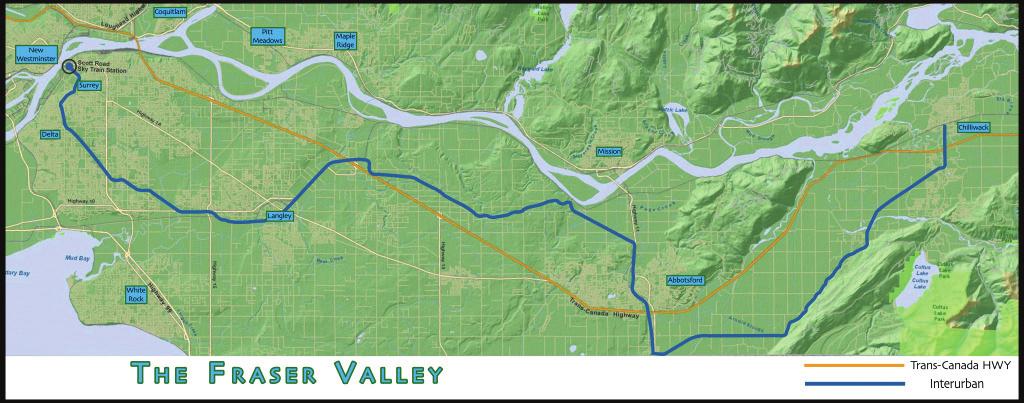
Those who champion congestion charges or road pricing are accomplishing nothing until you put a regional light rial network (over 300 km) on the table. It can be done and at a cost the taxpayer can afford. Let’s start with the Leewood/Rail for the Valley TramTrain interurban; 130 km of rail transit for around one billion dollars. Compare that with a 7 km subway under Broadway, costing now $3 billion!
Traffic congestion: is there a miracle cure? (Hint: itai??i??s notAi??roads)
Once a new road opens, people switch back to cars and congestion increases back to a steady-state point of gridlock. For lasting effectiveness, policy needs to include congestion charges and better rail services.
If the choice is between waiting in their cars and long waits on inefficient public transport, many people prefer to drive. AAP/Julian Smith
With our ai???infrastructure prime ministerai??? and both sides of politics trumpeting the building of new roads to reduce congestion, you could forgive everyday Australians for believing that they might have a point. Letai??i??s simply build more roads, then there will be less traffic. Unfortunately, this story reads more like a childrenai??i??s fairytale than a visionary plan.
Many politicians have stood up with the ambition of ai???solvingai??? road congestion by building a tunnel, highway or bridge. While they may be able to promote the initial time savings as proof of their success, the additional capacity created by this new infrastructure is filled relatively soon.
Given constant demand for driving, new infrastructure does initially lead to reduced congestion. In turn, driving travel times are reduced. However, this reduced travel time lures individuals who would normally take other means of transport into driving their vehicles ai??i?? a phenomenon transport economists refer to as ai???latent demandai???.
As more individuals make the switch to cars, road congestion increases again, back to a steady-state point of gridlock ai??i?? only now with even more vehicles stuck in the queue. This is the harsh reality that our politicians never speak of.
A report recently published by Infrastructure Australia forecast that road congestion will cost A$53 billion a year by 2031. Accounting for not only the financial but also the social and environmental impacts of road congestion, we know as a nation we must do something to manage this issue.
The benefit of increasing road capacity rarely lasts as an uncongested route attracts more drivers until it is congested again. AAP/Dave Hunt
Click to enlarge
What we must realise, though, is that road congestion cannot and never will be completely eliminated. Some level of road congestion is actually economically efficient ai??i?? that is, road space should be efficiently utilised.
The only way under our current socioeconomic framework in which we can optimise this level of congestion, and avoid complete gridlock, is through the use of dynamic road pricing. This is otherwise known as congestion charging.
Global move to congestion charges
Congestion charges have been successfully implemented in cities around the world, including London, Singapore, Milan and Stockholm. Congestion charges have been applied in many different forms, but the principal means is to charge a toll on those who choose to enter and/or exit a congested area during congested periods.
In each of the implemented examples, the schemes have been shown to reduce levels of congestion (and, in turn, harmful local pollutants). The charges also raise significant revenue, which governments can then direct back into alternative means of transport and alternative routes.
This approach to managing a transport network is in stark contrast to that of most jurisdictions in Australia. Here, we prefer to toll the very infrastructure we want drivers to use to avoid congested city areas ai??i?? for example, the Clem7 tunnel in Brisbane. None of the revenue raised is used to improve other elements of the transport network, with congested routes allowed to remain toll-free.
This discussion becomes even more important in contemporary Australia where we see an unfolding debate between the merits of constructing roads versus rail (public transport).
The harsh reality is that every time we drive our vehicles on the road, we use some of its capacity, which has a cost to other drivers and, more broadly, to our society. Yet as individual drivers we do not pay directly to use this space, nor do we receive a price signal to remind us of just what value this space has to society.
With the introduction of a road toll, one that varies depending on the time of day driven (as is the case in Stockholm), drivers receive this price signal. In response, they are able to make a more efficient choice about which transport mode to take and/or which route to drive. With variable charging, we are also able to spread the peak traffic periods to provide economic incentives to work earlier or later.
Part two of the answer is public transport
But, you say, public transport is already full and it takes a long time. I would rather sit in traffic in the comfort of my car than sit in traffic on a bus.
I could not agree with you more. Unfortunately, many cities in Australia are far too reliant on buses, using the same roads as cars and trucks, as a mode of public transport in and out. If Australia is serious about increasing the productivity of our cities to an internationally competitive standard, it must improve the lacklustre quality of public transport.
To do this, we need adequate funding. Congestion charges provide an economically efficient manner in which governments can subsidise public transport infrastructure and may even make it possible to construct mass rapid underground rail across our capital regions.
Now I am not suggesting we implement congestion taxes across the country tomorrow, but we must have a serious discussion about the future of our transport systems and how we want them to function. With the rise of vehicle-sharing programs and autonomous vehicles, over the next decade we are likely to start to see a fall in vehicle ownership rates. This means governments will no longer be able to rely purely on vehicle registration fees to cover the costs of road infrastructure and maintenance.
We must take a serious look at what other options are available. One path forward could be to trial a series of congestion taxes across the country, with a six-month ramp-up period in which public transport services are significantly increased before any tolls are set. We could then gain some insight into just how efficient Australiaai??i??s transport networks could be.
The decision to make tolls permanent could be taken to voters through a plebiscite. If upheld, governments could then allocate the revenue raised to the construction of mass rapid transit systems across the nation.
Despite what our politicians say, simply building another road, tunnel or bridge, while sometimes locally significant, will not solve the nationai??i??s road congestion problems.
One of the perils of expensive proprietary transit systems, is that they do not age well.
The SkyTrain ALRT/ART mini metro Expo Line is now 30 years old and it is beginning to show its age, it stops; it goes kaput from time to time.
With no drivers or attendants on board, the public start taking their safety into their own hands and this again happened yesterday when SkyTrain passengers abandoned 35C degree car temperatures and made to the nearest stations on foot. What are they supposed to do, wait and expire due to heat because a voice in a distant air conditioned control room says stay put?
TransLink had better bite the bullet and ensure that there is an attendant on board each train, as all European driverless transit systems must by law, to ensure public safety as breakdowns become more and more common.
Only seven SkyTrain type systems (ICTS, ALRT, ALM, ART) systems have been sold in 38 years, which one surmises, other transit authorities well understand that proprietary Gadgetbahnen do not age well.
SkyTrain service restored after glitch strands commuters
Vancouver SunJune 9, 2015
A photo from Twitter of SkyTrain cars stopped on the tracks Tuesday, June 9, 2015.
Photograph by: Julian Gan, Tweet
Hundreds of SkyTrain passengers were stranded for more than an hour in hot trains during Tuesday’s evening rush hour due to a technical glitch that caused 19 trains to lose contact with the control room.
The glitch, which is still being investigated, forced the closure of the tracks between Waterfront and Royal Oak stations just after 4:10 p.m. System-wide service was not fully restored until 6:45 p.m.
Transit Police spokeswoman Anne Drennan said the packed trains had to be manually driven to the stations to let passengers off.
However, some passengers tore open the doors of three trains near the Nanaimo station and started walking along the tracks. That caused about an hour of further delays, she said.
“We do understand people were getting frightened and upset because of the heat,” Drennan said.
She noted one of the passengers included a pregnant woman, who was taken off the train and treated by ambulance attendants. She said she was not aware of anyone else with health concerns.
Twenty-five shuttle buses were dispatched during the closure to operate between stations for the duration of the shutdown and after the system is back up to clear any backlog. Their service will now be winding down. Extra trains were also running on the Millennium Line.
About 100 staff members were sent to the closed stations to answer questions from customers and manage crowds.
Drennan said Transit Police advised Rogers Arena about the shutdown and it agreed to delay the Shania Twain concert to give SkyTrain passengers a chance to get there.
The shutdown is the latest in a series of problems plaguing the transportation authority, such as switch problems and bird’s nest that sparked a fire on the tracks. Last summer, hundreds of passengers broke open the doors and walked the tracks after a series of shutdowns on the Expo Line. “It seems were running into a series of different issues,” Drennan said. “These things happen on major transit systems.”
Drennan apologized to the public. “We are trying as hard as possible to get better at whatever eventualities may come up.”
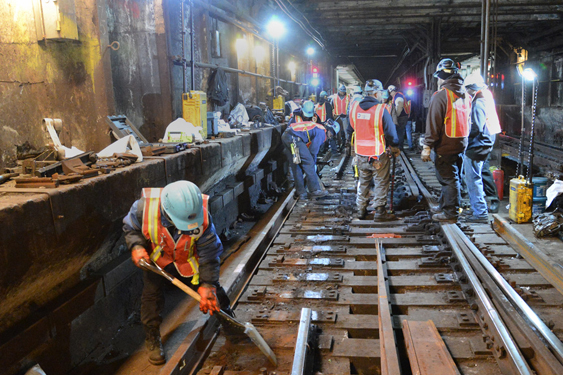
Old Zwei has been warning about the costs associated with subways and now New York’s MTA says it needs $32 billion over the next five years to repair decaying subway infrastructure! We also have a familiar name, Tom Prendergast, warning that the subway system needs expensive upgrading done.
Prendergast also warned TransLink about the high cost SkyTrain and light metro planning and operation and for his efforts he was shunned and was eased out ofAi?? TransLink. “Sent to Coventry” in layman’s parlance.
Is it not strange that those wanting a SkyTrain subway under Broadway never talk about massive future maintenance costs needed or how funding for such maintenance will erode service on the rest of the public transit system.
NEW YORK Daily News in a Sunday editorial says the city’s rapid transit system operated by New York Metropolitan Transportation Authority [MTA] is crumbling and something must be done: <http://tinyurl.com/q3bltx4> “New York’s leaders dawdle as the subways crumble
NEW YORK DAILY NEWS
Sunday, June 7, 2015
With subway delays creeping ever upward and packed trains creeping ever slower, New Yorkers are getting a grim preview of where things are headed if Albany keeps starving the Metropolitan Transportation Authority for cash:
Destination, commuter hell.
The MTA says it needs to invest $32 billion over the next five years to shore up decaying infrastructure, modernize aging equipment and accommodate record-high ridership. It has just $18 billion in capital funding available ai??i?? leaving a whopping $14 billion gap.
And what are Gov. Cuomo and the Legislature doing to address this crisis for the mass transit system thatai??i??s critical to the regionai??i??s economy?
Nothing ai??i?? apart from punting the hard but unavoidable choices to an indefinite future.
Even by the standards of New York State government, the dereliction is appalling.
MTA chief Tom Prendergast made the consequences of inaction painfully clear in testimony to the City Council.
Without more money, the MTA canai??i??t afford basic things like replacing signal systems that date back to the 1930s ai??i?? let alone major expansions and upgrades. Without more money, trains will get even more crowded and steamy stations will get even more dingy and nightmare breakdowns will get even more commonplace.
ai???In short, without a healthy capital program, the MTA is in deep trouble,ai??? Prendergast warned. ai???And that means deep trouble for New York City, too, and the millions who depend on the system to get to work, to school, to the doctor ai??i?? everywhere they need to go.ai???
The MTA takes money wherever it can find it ai??i?? including Washington and City Hall ai??i?? but responsibility for properly financing it ultimately goes to Albany, and to Cuomoai??i??s desk.
But his main contribution so far was to pronounce the MTAai??i??s five-year capital plan, first presented in October, as ai???bloatedai??? ai??i?? without specifying where it should be trimmed.
Although he started the year with a $5 billion surplus from legal settlements ai??i?? which ought to have gone exclusively to infrastructure ai??i?? he designated almost none of it for the MTA even as he blew big bucks on pet projects, such as universal broadband.
Last week, with the legislative session ticking down to its June 17 end, the only sign of urgency from the Legislature was a letter circulated by Brooklyn Assemblyman James Brennan that declares: ai???Viable funding options exist to support (mass transit), and the time is now to take action.ai???
He did not mention the single most viable funding option ai??i?? the Move NY plan from transit expert Sam Schwartz. It calls for equitably tolling drivers crossing the East River bridges and heading south of 60th St. in Manhattan, while actually lowering tolls on other major crossings.
That would generate $1.5 billion a year, which Schwartz would split between transit and much-needed repair of decaying road and bridges.
City pols who lack the vision and courage to back that sensible plan ai??i?? from Cuomo and Mayor de Blasio on down ai??i?? have a duty to offer a viable alternative, and now.
The MTA and the millions of New Yorkers who depend on it each day cannot afford to wait.
Xoupir: Charles Bombardierai??i??s ai???magic busai??i??
David K Gibson
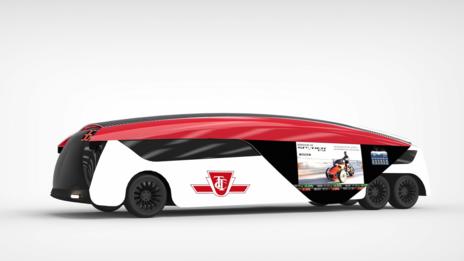
Charles Bombardier designs things. Fantastical things, like a robotic hockey referee, a tugboat that creates waves for surfing competitions, and magnet-propelled rollercoaster in which riders hurtle above the track in a metal sphere. He calls that one the ai???Pinballai???, for obvious, frightening reasons. Clearly, then, hereai??i??s the man to rethink mass transportation.
It is worth noting that Bombardier is no crank. His last name and early career belong to the Canadian maker of trains, planes and snowmobiles, and he is an influential design thinker and angel investor. Torontoai??i??s Globe & Mail publishes many of his ideas in its ai???Prototypesai??? section, and it was that publication that asked him to reinvent the buses of the Toronto Transit Commission.
(Credit: Charles Bombardier)
The result is the Xoupir (pronounced ai???superai???), a slippery electric fantasy that might make riding the bus sexy. Electric motors would power the four drive wheels in its Batmobile-like back end, and the bus would charge wirelessly though induction coils, hidden under the street, which would only power up when the bus passed over them. Roof-mounted, flexible solar panels would power the on-board WiMax station, providing ultra-fast wifi to bus riders and any commuters or residents within a mile radius.
Meanwhile, windows would change opacity as conditions warrant, while the body ai??i?? skinned with organic light-emitting diodes, or OLEDs ai??i?? would rotate through different adverts to passersby, in the manner of the memorable Toyota Fun Vii Concept of 2012. It goes without saying that there would be a smartphone app or biometric reader to pay ride fares.
(Credit: Charles Bombardier)
Perhaps the most outrageous aspect of the Xoupir is this: it is based entirely on existing technology. True, induction is not the most efficient charging method, and there are no public roads of any substantial length with embedded charging coils at the moment. But if a charging roadway were ever commissioned at the municipal level, it will occur on a dedicated line ai??i?? one, perhaps, reserved for municipal buses. Private buses already use high-powered wifi, so delivering more of it, to more people, seems wholly feasible. And that Minority Report-style personalised ad-delivery system, via OLED screens? The transport authority might as well reap the financial benefit from such highly targeted tech.
The public transportation of the future may not look like the Xoupir, but it surely will have an awful lot of its parts. Might as well get on board.
The monorail lobby is like the the SkyTrain lobby and their motto seems to be;Ai?? don’t confuse me with facts.”
There are many similarities between monorail and SkyTrain ALRT/ART and in fact our SkyTrain is sometimes mistakenly called a monorail overseas.
The big drawback, of course, is that they are proprietary railways and the operating authority is tied to one suppler.
With modern light rail, you can built it as a light-metro but you have the option of operating on lesser (cheaper) rights-of-ways if needed. With LRT, larger, yet cheaper “rail” networks can be built, thus providing a better transit experience for the transit customer.
The transit customer, the all important ingredient in our public transit mix, too often forgotten about in Vancouver and many cities abroad.
A monorail to nowhere in Jakarta
JAKARTA, the capital and largest city in Indonesia with an urban population of 11.3 million and a metro population of 30.3 million, wants a monorail firm to develop light rail transit instead, The Jakarta Post reported Saturday. “Governor Basuki ai???Ahokai??? Tjahaja Purnama said that the city preferred the LRT system over a monorail as it was physically easier to expand and add routes. ‘There are seven planned corridors but we may add more corridors in the future for better connections, and the LRT system would be easier to expand,’ Ahok told reporters at City Hall on Friday.”
Dewanti A. Wardhani The Jakarta Post, Jakarta Sat, May 30 2015, 7:39 AM
The Jakarta administration has sent a letter to monorail project operator PT Jakarta Monorail (JM) to find a new depot location in order to continue cooperation with the city administration and develop a light rail transit (LRT) system instead of monorail.
Jakarta Legal Bureau head Sri ai???Yayukai??? Rahayu said the letter was sent to JM earlier this year. She said the letter included two requirements that JM must fulfill in order to continue cooperation with the city administration.
ai???The first requirement is that JM must find a new location for the depot,ai??? Yayuk told reporters at City Hall on Thursday evening.
The problematic monorail project began in 2004 under then governor Sutiyoso.
The construction resumed in October 2013, with JM as contractor. However, construction has not progressed following disagreements between the city and the company.
Moreover, the city administration is doubtful of the companyai??i??s ability to fund the project.
Further, the Jakarta administration saw that JMai??i??s planned routes and stations were not feasible.
JM had planned to construct the first route, the green line, which will consist of 16 stations, extending 14.3 kilometers (8.8 miles) from the city police headquarters (Komdak) to Satria Mandala Museum, both in South Jakarta.
The stations and depot were to be built in Tanah Abang in Central Jakarta and Setiabudi in South Jakarta, among other places. Ahok said that the station in Tanah Abang would increase traffic congestion in the area as it would be built on existing roads.
Further, the planned station in Setiabudi would be built on a reservoir.
ai???The Public Works and [Public] Housing [Ministry] also sent a letter to the Jakarta administration saying that the Setiabudi reservoir was off limits. Therefore, JM must find a new location for the depot,ai??? Yayuk said.
The second requirement, she went on, was that JM must participate in a new tender in order to continue cooperation with the city administration.
ai???However, the bidding is not for a monorail system but for an LRT system. There will no longer be a monorail,ai??? Yayuk said, adding that the city was still waiting for an update from JM.
The city administration and the central government agreed earlier this year to develop an LRT system, which would not only travel within Jakarta but also to and from satellite cities, such as Bekasi, West Java, and Tangerang, Banten.
Governor Basuki ai???Ahokai??? Tjahaja Purnama said that the city preferred the LRT system over a monorail as it was physically easier to expand and add routes.
ai???There are seven planned corridors but we may add more corridors in the future for better connections, and the LRT system would be easier to expand,ai??? Ahok told reporters at City Hall on Friday.
Separately, JM director Sukmawati Syukur confirmed that the company received the letter from the city administration.
ai???Weai??i??ve received and replied to the cityai??i??s letter. We stated that we need time for internal discussions and coordination,ai??? Sukmawati said on Friday, adding that JM was preparing a route to adhere to the cityai??i??s requirements.
Interesting article from Toronto, which spells out some fiscal subway realities to TransLink and the City of Vancouver.
Please note Zwei’s two comments in the article and should give one pause to think that in Vancouver, the cost of subway construction has been vastly understated.
Mayor John Tory eyes alternative, more expensive routes for Scarborough subway
With concerns over building SmartTrack and a council-approved subway side-by-side, Tory and the city are looking at more eastern alternatives.
Marcus Oleniuk / Toronto Star Order
The replacement for the Scarborough RT, pictured above, might be getting more expensive
if Mayor John Tory’s team pushes for changes to the proposed subway extension.
By:Jennifer Pagliaro City Hall reporter, Published on Tue May 26 2015
Mayor John Tory appears willing to change the council-approved route for the controversial Scarborough subway in order to make it work with his SmartTrack ambitions.
But changes to the current plan could dramatically increase costs ai??i?? in one scenario by at least $1 billion.
Though he remains committed to building a subway instead of an LRT, Tory is keeping an open mind on where that subway would go, how it would get there and how many stops it might include.
Toryai??i??s main problem stems from concerns that his heavy-rail SmartTrack and the planned three-stop subway ai??i?? running north on McCowan Rd. ai??i?? would cannibalize each otherai??i??s ridership.
SmartTrack, which Tory largely staked his election campaign on and which hinges on the use of existing GO rail in the east, canai??i??t be moved. The subway, which he also promised to build, can. At what cost, however?
Because of how close together the two proposed lines are, city staff expanded their subway study area east to include other possible routes, something later encouraged behind-the-scenes by Toryai??i??s staff. Those routes, following public consultation, will likely be the subject of debate later this year with final approval up to council.
Officially, Toryai??i??s office says it would be premature for him to weigh in on any of the routes ahead of a staff report expected as early as July.
ai???The mayorai??i??s support for building the Scarborough subway is unwavering. Once a route is selected and the necessary preparatory work has been done, the mayor wants to get on with building it as soon as possible,ai??? Toryai??i??s spokesperson Amanda Galbraith said in an email.
But earlier this year, the mayorai??i??s staff seemed fixated on pushing the subway east.
On Jan. 28, Toryai??i??s director of policy Stephen Johnson, chief of staff Chris Eby and the cityai??i??s chief planner Jennifer Keesmaat discussed a public presentation on the subway study to be posted the next day.
That back-and-forth, which played out in emails obtained by the Star through a freedom of information request, focused on one particular map showing nine possible alignments for the subway.
ai???The route option that hits Kingston Road needs to show a station there. That is essential,ai??? Johnson told Keesmaat.
Galbraith said a Kingston Rd. stop was ai???raised in the context of the expanded study area and the view that it should extend as far east as Kingston Rd.ai??? She pointed out that staff ultimately decided against that suggestion, though itai??i??s not clear why.
When the map was published in January, it showed a Markham Rd. corridor that would see a subway travel east on Eglinton Ave. and north on Markham to Ellesmere Rd. before doubling back to connect with the Scarborough Town Centre.
One crucial point, transit experts argue ai??i?? and Tory himself acknowledged during an interview with Steve Paikin on TVOai??i??s The Agenda last week ai??i?? is the need for any line to travel through Scarborough Town Centre as a major hub for riders. It is one of the biggest draws for the ridership used to justify the switch to a subway.
But in order to build a station there, any subway east of McCowan Rd. would have to double back.
Though it has yet to be spelled out by staff, a Markham Rd. alignment appears to cover, at minimum, close to 11 kilometres.
Typically, the price tag for building subways has been said to be at least $300 million per kilometre ai??i?? which doesnai??i??t take into account additional costs of building multiple stations and other expenses.
The three-stop McCowan option, which was presented and approved by council in October 2013 at a cost of $3.56 billion, runs 7.6 kilometres.
The cost of tunneling some three additional kilometres for the Markham Rd. option could be close to $1 billion.
A note from Zwei: Has the cost estimates of the proposed Broadway SkyTrain subway been purposely understated to confuse Metro Vancouver residents?Is the cost of the proposed Broadway subway over $1 billion more than the $2 billion bandied about by TransLink, the City of Vancouver, and Metro Vancouver?
The province made clear in 2013 that they were unwilling to foot any additional costs for a subway when council switched plans from a fully funded, seven-stop light rail line. The federal government later pledged $660 million to build the subway extension planned for McCowan Rd.
Since then, the city has also been collecting a special tax levy for the subway to pay its share of the costs.
Ahead of the staff report, itai??i??s unclear what else could drive up costs of the alternative routes and whether the city could find the extra money in order to complete the subway for 2023 as planned.
Itai??i??s also not apparent whether the lengthier subway option could make do with just three station stops and whether that route would attract the same number of potential riders.
In 2013, the TTC first said the ridership was 9,500 per peak hour ai??i?? a standard calculation for planning transit. That number was later changed in a city staff report to 14,000 ai??i?? just outside the necessary ridership to justify a subway, widely accepted as 15,000.
A note from Zwei: Zwei has always maintained that the minimum threshold for a proper subway were passenger flows in excess of 15,000 pphpd, despite much criticisms by local transit pundits, especially the SkyTrain Lobby. The Canada Line was built on the cheap and with pygmy stations that can only accommodate two car trains, translates into future massive costs to increase capacity of the line. The present maximum crush capacity of the Canada Line is around 7,500 pphpd, half the number needed for a subway.
Some argue it would be redundant to build both SmartTrack and a subway line because they both serve the same number of riders going the same way in the same amount of time.
Comparing the calculations by Toryai??i??s campaign team and the TTC, it would be possible to get from Kennedy Station to Sheppard Ave. in 10 minutes on both lines. Agincourt GO station, used by Toryai??i??s SmartTrack and a hypothetical McCowan and Sheppard subway station, would be just two kilometres apart.
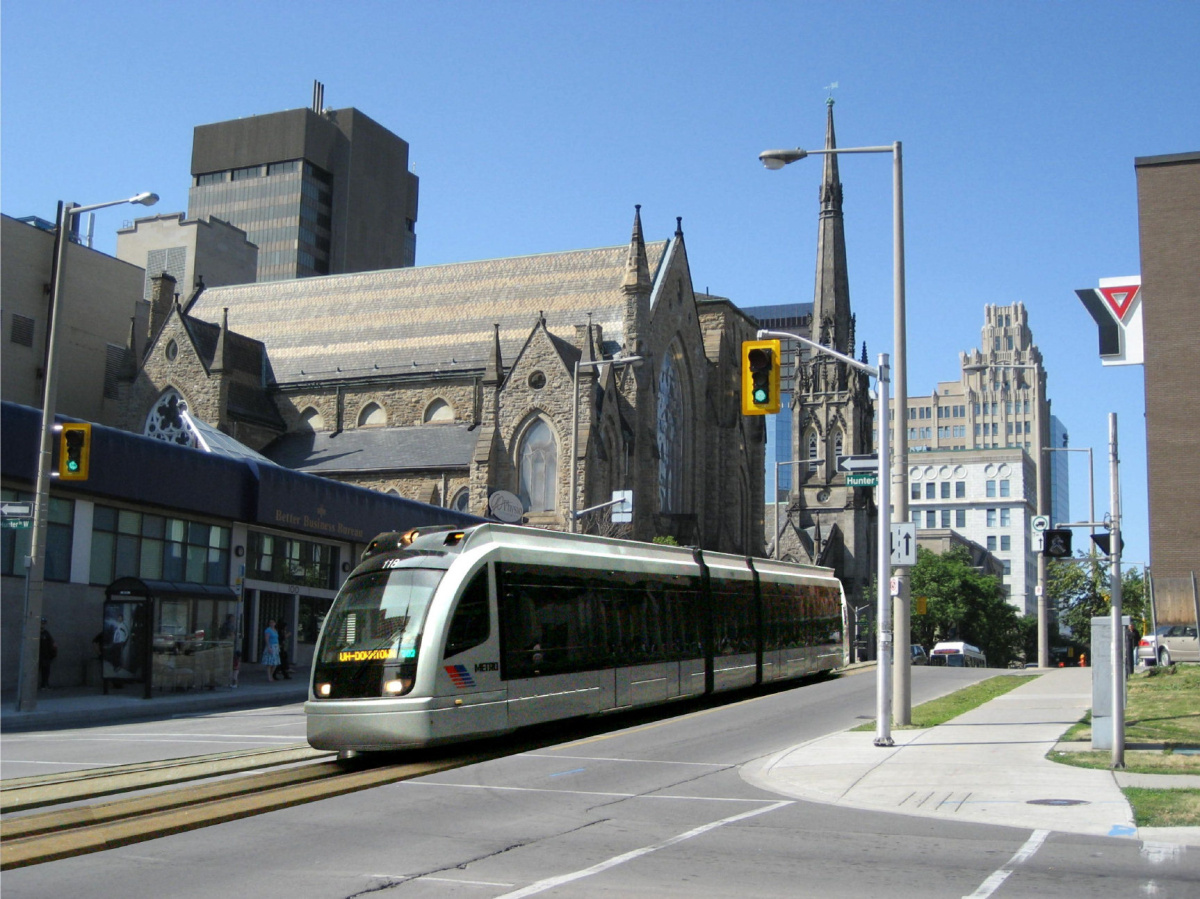
Well its official, at a press conference at McMaster University, Hamilton will get a roughly 11km 14 stop LRT line from McMaster University in west .Hamilton to the Queenston Traffic Circle in east Hamilton. There will also be a 1 km short spur line north up James Street to the new West Harbor GO Train Station, which opens in a few weeks. Allowance will also be made to build a high capacity pedestrian access route south 2.5 blocks to the existing Hamilton GO Centre Train and Bus Station (the stunningly gorgeous Art Deco former TH&B/CPR/NYC Hunter Street Railway Station). This is a shorter version of the LRT line known locally as the ai???B Lineai??? Originally the LRT line would have traveled a further 2.5-3km east, including 3 more stops to the Eastgate Square Mall. The project as approved allows for up to $1 Billion in funding for the LRT line and should start procurement in 2017 and construction in 2019. The original expected cost back in 2007 was $811 Million from McMaster University to Eastgate Square but due to all the time since and the needed connection to the new West Harbor GO Station the costs have obviously gone up. The Lakeshore West GO Train line that will end at the new West Harbor Go Train Station will also be extended to the long planned and much anticipated Centennial Parkway GO Station in Stoney Creek (now part of the new larger City of Hamilton). Construction is planned to start on the station in 2017. The GO train line should be open in 2019 and the LRT line around 2022? The line will be extended east to Eastgate Square Mall after 2022!
The line will be very much like Waterlooai??i??s LRT Line in that, it is an all at street level system and will start with single LRV consists and street level 60 metre station platforms. The system will purchase 17-20 LRVai??i??s probably Bombardier Flexityai??i??s to save on costs. It is expected to run at a peak frequency of 3-4 minutes. However, according to all the officials at the press conference there is still a little more detail work to do but, it seems itai??i??s a done deal!
Here is the map of the original project and some other graphics, mostly from the Hamilton LRT website. This site and its creator, Ryan McGreal has been the big overall organizer of Hamiltonai??i??s citizen LRT effort. He and many others have been banging away longer than you have at this Zwei but, they finally got the job done! You think Vancouverai??i??s PTBai??i??s were anti LRT wow, you should see the forces allied against Ryanai??i??s group however, little by little more and people got involved and little by little more people were convinced that LRT would work in Hamilton.
It should be noted that, Hamiltonai??i??s LRT is not just about better transit access but to increase the development in the core of downtown Hamilton. They have had a tough time switching from steel making (they still have 1 plant running) to a knowledge based economy, the LRT line is seen as a great anchor in attracting the young talent that Hamilton needs. To say that, Hamilton has had a seriously acrimonious debate about transit technology (LRT vs. BRT mostly) and or whether they need it at all, is well, understating the point! It has made your LRT vs. Skytrain debate seem gentle in comparison. Real threats, fist fights at public meetings, nasty city hall debates and vicious election campaigns that are right out of 1930ai??i??s Chicago, were the norm in Hamilton when transit topics came up in public. But that seems for now to be in the past, maybe.
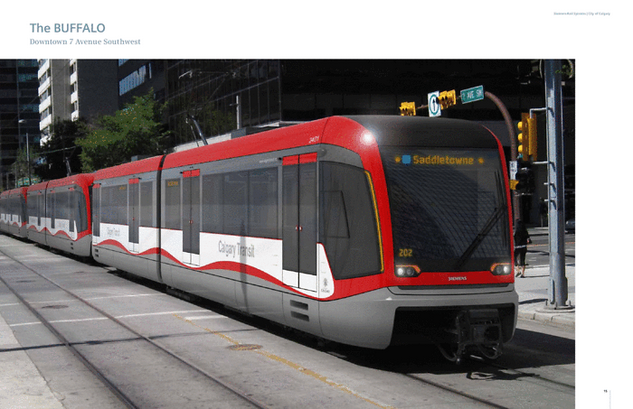
Calgary’s light rail can be best described as a 1970’s Belgium inspired ‘pre-metro’, using high floor light rail vehicles, using elaborate stations. 90% of the line was built at-grade on dedicated rights-of-ways, with the downtown section seeing operation mixed with buses.
The initial cost per kilometre of Calgary’s LRT was less than half of Vancouver’s SkyTrain, yet Calgary’s light rail had a higher capacity and attracted more ‘new’ customers to transit. Calgary’s LRT is North America’s most successful new build light rail system, with daily ridership now over 310,000 a day on a 58.7 – 45 station network.
Because of the large ‘pre-metro’ style, high platform stations, Calgary’s transit authorities have decided to stick with high-floor trams, as an economy measure. This has caused some problems with suppliers as the vast majority of trams built today are low-floor and many companies do not wish to invest in high-floor cars as there there is little scope for sales in a small and very tight market.
Siemens has taken up the challenge and now has provided an updated high-floor car for the limited market and the result is the S-200 high-floor LRV.
Siemens is currently building sixty such cars for Calgary, with future orders waiting for the replacing of the original U-2 fleet, which are now operating past their expected lifespan.
“The Worldai??i??s First Solar Road Is Producing More Energy Than Expected“
CREDIT: SolaRoad
In its first six months of existence, the worldai??i??s first solar road is performing even better than developers thought.
The road, which opened in the Netherlands in November of last year, has produced more than 3,000 kilowatt-hours of energy ai??i?? enough to power a single household for one year, according to Al-Jazeera America.
ai???If we translate this to an annual yield, we expect more than the 70kwh per square meter per year,ai??? Sten de Wit, a spokesman for the project ai??i?? dubbed SolaRoad ai??i?? told Al Jazeera America. ai???We predicted [this] as an upper limit in the laboratory stage. We can therefore conclude that it was a successful first half year.ai???
De Wit said in a statement that he didnai??i??t ai???expect a yield as high as this so quickly.ai???
The 230-foot stretch of road, which is embedded with solar cells that are protected by two layers of safety glass, is built for bike traffic, a use that reflects the roadai??i??s environmentally-friendly message and the cycling-heavy culture of the Netherlands. However, the road could withstand heavier traffic if needed, according to one of the projectai??i??s developers.
So far, about 150,000 cyclists have ridden over the road. Arian de Bondt, director of Ooms Civiel, one of the companies working on the project, said that the developers were working on developing solar panels that could withstand large buses and vehicles.
The SolaRoad, which connects the Amsterdam suburbs of Krommenie and Wormerveer, has been seen as a test by its creators ai??i?? a stretch of bike lane that, if successful, could be used as a model for more roads and bike lanes. The researchers plan to conduct tests of the road over the next approximately two and a half years, to determine how much energy the road produces and how it stands up to bikers. By 2016, the road could be extended to 328 feet.
Though the Netherlandsai??i?? solar road seems to be going as planned, solar roads overall typically arenai??i??t as effective at producing energy as solar arrays on a house or in a field. Thatai??i??s because the panels in solar roads canai??i??t be tilted to face the sun, so they donai??i??t get as much direct sunlight as panels that are able to be tilted. However, solar roads donai??i??t take up vast tracts of land, like some major solar arrays do, and they can be installed in heavily-populated areas.
One couple is set on making solar roads a reality in the U.S. Scott and Julie Brusaw created an Indiegogo campaign last year to help fund their Solar Roadways project, and the campaign raised more than $2.2 million. The U.S. might have to wait a while to see solar roads installed, however. As Vox pointed out last year, cost could be a major barrier for solar road construction in the U.S. And according to a Greentech Media article from last year, one of the biggest things that officials still arenai??i??t sure about with the roads is safety. They want to be sure the roads can stand up to heavy traffic, and that the glass protecting the solar panels wonai??i??t break.
ai???We canai??i??t say that it would be safe for roadway vehicular traffic,ai??? Eric Weaver, a research engineer at the Federal Highway Administrationai??i??s research and technology department, told Greentech Media. ai???Further field-traffic evaluation is needed to determine safety and durability performance.ai???
Melbourne’s entire tram network could be powered by solarAi??if the state government gaveAi??a bold renewable energy proposal the green light.
While the pitchAi??may conjure upAi??images of trams with rooftop panels on them like the family home, the power would instead beAi??generatedAi??atAi??two new solar farmsAi??the project proponentsAi??planAi??to build nearAi??Swan Hill andAi??Mildura.
The company behind the bid, the Australian Solar Group,Ai??haveAi??heldAi??quiet talks overAi??four years with different armsAi??of the government to try get theAi??project off the ground,Ai??butAi??has so far not gotAi??finalAi??backing.
The two solar farmsAi??wouldAi??generateAi??80 gigawatt-hours of electricityAi??a year, aboutAi??theAi??sameAi??amount used byAi??Melbourne’s tram network, which isAi??the world’s largest.
Under the proposal the government would back the projectAi??by signingAi??Public Transport Victoria (PTV) up to aAi??power purchaseAi??agreement withAi??the solarAi??farms, creatingAi??aAi??reliable revenue sourceAi??alongside theAi??renewable energy target.
The proponents sayAi??the project has been designed to ensure the cost ofAi??tram tickets would not rise, nor would it add to PTV’s power bill.Ai??It would cutAi??100,000Ai??tonnes of greenhouse gas emissions a year from running tramsAi??and give the city an obvious global selling pointAi??(see the mock-up tram design above), according to the pitch.
WHO BACKS IT?
The Australia Solar Group was founded by businessmenAi??Adrian Critchlowai??i??Ai??and Dave Holland.Ai??MrAi??CrtichlowAi??previously helpedAi??startAi??companiesAi??Booking.comAi??andAi??AlertMe,ai??i??beforeAi??successfulAi??sales of both. Mr Holland was formerly theAi??head ofAi??Solar Systems, a company that was buildingAi??a large solar project in MilduraAi??before financialAi??collapseAi??in 2009.
Mr Holland said Australia SolarAi??had triedAi??to getAi??almost all elements of the tram project ready to goAi??before it sought finalAi??financial backing.
“This project is virtually ready to go. We can’t see any barriers that would stop it from here,” he said.
The tram project has been supported behind the scenes by members of the Melbourne City Council, includingAi??Lord Mayor Robert Doyle.Ai??Councillor Arron Wood saidAi??it ticked many boxes,Ai??from contributing significantly towards the city’s renewable energy targetAi??to creating employment and training opportunities in rural Victoria.
“Ultimately, whether this project proceeds rests firmly with the Victorian Government.Ai??I just hope they take the action necessary to get itAi??done,” Cr Wood said.
A spokeswoman for the Andrews government said: “We are interested in how the project progresses and will continue discussions with the group.”
IS THE PROJECT VIABLE?
Australian Solar says the solar farms would span across 80 hectares and useAi??130,000 panelsAi??to trackAi??the sun throughout the day.Ai??It hasAi??planning andAi??grid connection approvals for itsAi??Swan Hill site, withAi??permitAi??processesAi??underwayAi??for the second site at Red Cliffs.









Posted on
CREDIT: SolaRoad





Recent Comments