Posted by zweisystem on June 30, 2015 · Leave a Comment
An interesting read from California.
I wish the Provincial Government would read this quote; ai???Realistically speaking, thereai??i??s no new highway building in the future.ai???, when planning for their bridge and highway vanity projects in Metro Vancouver.
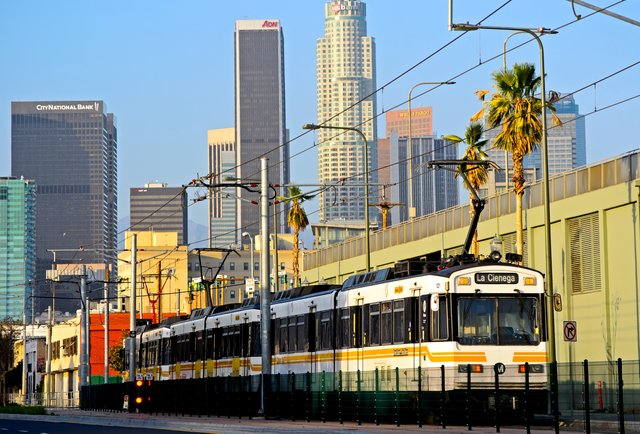
LOS ANGELES Daily News reports that Southern California planners are making strikes in a rail transit renaissance that owes much of its available right of way for track to the long vanished Pacific Electric “Red Car” lines that once spanned the region:
<http://tinyurl.com/nr565cg>
“Southern California transit planners are laying rail, squeezing more out of freeways
By Mike Reicher
Los Angeles Daily News
Posted: 06/28/15
Gridlock is nothing new for Southern California drivers. With some of the nationai??i??s longest commute times, weai??i??ve grown accustomed to idling in traffic.
But local transportation planners are working to give commuters more alternatives to driving and to make the regionai??i??s freeways more efficient.
The Los Angeles Metropolitan Transportation Authority, or Metro, is
spending $14 billion on expanding rail lines, widening freeways, buying new buses and other major capital investments. Officials call it the nationai??i??s largest public works project.
In San Bernardino County, officials have more than $3 billion of transit changes underway ai??i?? mostly for highway projects such as toll lanes and interchanges, along with some passenger rail construction.
ai???Over time, weai??i??ll be giving priority to transportation systems that carry people and goods more efficiently,ai??? said Genevieve Giuliano, director of the Metrans Transportation Center and professor at the USC Sol Price School of Public Policy.
ai???Realistically speaking, thereai??i??s no new highway building in the future.ai???
*
*
By charging more during rush hour, the system controls congestion. Also, tolls are reinvested into public transit ai??i?? namely buses along that same corridor ai??i?? that can move more passengers down the busy stretch at once.
*
L.A.ai??i??s current transit renaissance can be traced to the passage of
Measure R, the half-cent sales tax that took effect in 2009.
Itai??i??s expected to generate $40 billion over 30 years and has allowed the county to secure billions of matching federal funds.
*
Officials are expanding the current L.A. passenger rail system into the Westside, to LAX and east of Pasadena.
*
The first segment of Metroai??i??s Purple Line subway extension to Westwood, the most expensive single project underway, is expected to cost $2.8 billion.
Other rail projects, including the LAX/Crenshaw light rail segment, the Gold Line Foothill extension, and the Exposition Line to Santa Monica, have a $5.7ai??i??billion price tag.
*
Most of the money is coming from Metro.
*
The L.A. agency is also contributing more than half of the $4.3 billion needed to widen or improve segments of Interstates 5, 10, 710 and State Route 138.
Bus and other projects are expected to cost an additional $1.2ai??i??billion, drawing on various funding sources.
*
With the longest average driving commute times in the region, San Bernardino planners have focused much of their attention and funding on improving roadways.
Theyai??i??re studying possible toll, or ai???expressai??? lanes,
on the 15 Freeway between the Riverside County line and just north of State Route 210. That project could cost $1.3 billion.
*
A similar improvement
on the 10 Freeway, between the L.A. County line and Redlands, could cost from $600 million to $1.8 billion, depending on whether officials choose basic car-pool lanes or more expensive toll lanes.
*
Long commutes in the Riverside-San Bernardino-Ontario area are mostly due to the regionai??i??s distance from many employers, experts say, not solely from congestion.
On average, it took people 31 minutes to get to work, according to 2013 census data, compared with 26 minutes nationally. Car pools in the Inland Empire averaged 38 minutes ai??i?? the fourth worst among the nationai??i??s 195 metropolitan areas.
*
Besides the I-15 and I-10 corridors, San Bernardino County officials are planning to spend more than $750 million on other freeway improvements such as car-pool lanes, interchanges and lane additions.
*
*
Separating railways from roads is another way local planners are easing congestion, while also improving safety.
The
Alameda Corridor East project is building overpasses, underpasses or installing safety measures at 53 crossings in the San Gabriel Valley.
The total project budget is $1.7 billion.
Mike Reicher is an investigative reporter for the Los Angeles News Group with a focus on government accountability.
Posted by zweisystem on June 27, 2015 · 2 Comments

Zwei lived in Nottingham in the mid 70’s and is where I first gained interest in urban transit.
While waiting for my then girl friend, who was attending night school, I chanced a free public lecture by a Professor of Transportation (forgot his name) and was so entertaining that I still smile at some of his one-liners, such as “a stopped bus gathers no passengers”. I still remember well the ridicule I received about a dinner conversation at said girl friends parents house about trams retuning to Notts.
Well history has now proven otherwise.
What I find interesting is that the new tram line travels in low density areas, but provides a high standard of transit to those who live South of the Trent. I would wish that our own TransLink would do the same courtesy to those who live south of the Fraser, by providing a stand alone light rail system that did connect Langley and Surrey (the Leewood Report would have Chilliwack, Abbotsford, Langley, and Surrey connect to Vancouver) to Vancouver and not treat transit customers as sardines packed and repacked until they compete their journey.

Nottinghamai??i??s long-awaited Phase 2 tram extension will open this summer, insisted Alstom during a media tour of the new system.
Driver training is now complete and the delivery team in Nottingham is about to begin full timetable tests.
The 17.5-kilometre Y-shaped extension to Clifton and Beeston will more thanAi??double the size of the existing network. For the new lines, Nottingham ordered 22 Citadis trams, which have been delivered and can be found transporting passengers around the city on Line 1.
Drivers have had to complete a full day of training on parts of the new line ahead of their opening later this year.
The NET Phase 2 route was due to open in December 2014 but delays associated with utilities have delayed the projectai??i??s completion by several months.

Posted by zweisystem on June 26, 2015 · 11 Comments
Seattle’s light rail system is really a light-metro system, with over 70% of its route grade separated either on viaduct or in a tunnel (subway), yet ridership is dismal.
This not because the system uses light rail vehicles, but because Seattle’s politicians at all levels wanted a ‘world class’ transit system to ensure Seattle’s world class status.
Sound familiar?
You bet; as it is the same chant used in Vancouver to keep expanding the very expensive SkyTrain light-metro system.
There is an ongoing hubris with transit planners that subways will solve all transit ills, well they don’t and for added insult, they leave one hell of a financial hangover at the end of the day, as so well demonstrated by Metro Vancouver’s recent transit plebiscite.
The big difference between Seattle’s light-metro and Vancouver’s version is that Seattle’s transit authorities do not force all bus customers to transfer onto the metro, as Vancouver’s light-metro’s large ridership can be attributed to the fact that over 80% of SkyTrain’s ridership first take a bus to the metro.
In the USA, people forced to transfer, stop taking transit.

SEATTLE Times has posted an op-ed commentary which says the ridership on the Sound Transit light rail, commuter rail and bus system does not justify a costly expansion at taxpayers’ expense. The guests for this column examined statistics from the 2040 transportation plan for the Puget Sound region. “They show that in 25 years, fewer than 1 percent of all trips will be made on light rail while traffic congestion will only increase.”
There are better ways to spend transit dollars and get higher performance.
Special to The Times
Maggie Fimia is a former Metropolitan King County Council member, 1994-2001. John Niles, president of Global Telematics, is a Seattle-based independent researcher. Victor H. Bishop is a transportation planner and traffic engineer with 50 yearsai??i?? experience.
*
WE took a close look at data in the Puget Sound Regional Councilai??i??s (PSRC) adopted Transportation 2040 plan. They show that in 25 years, fewer than 1 percent of all trips will be made on light rail while traffic congestion will only increase.
*
We examined key performance measures we think the public really cares about: transit ridership, congestion, accessibility to jobs via transit, average speed and vehicle miles traveled ai??i?? and put them
into a user-friendly report, which can be seen at
seati.ms/2040-analysis*
For example, by 2040, PSRC estimates $87 billion would be spent for transit ai??i?? assuming 79 miles of light rail are built and bus service is doubled.That amount is nearly half total regional transportation spending. And the percentage of trips by all transit would rise to an estimated 4.3 percent from 3.1 percent ai??i?? almost 90 percent of those transit riders would be on buses, not trains.
*
These numbers are unacceptable, despite the justification that transit ridership improves during rush hour for downtown Seattle and a few other urban corridors ai??i?? ai???because thatai??i??s what really matters,ai??? we are told.
*
Our response: This is a regional plan paid for by everyone.
*
Even more disturbing, why are we led to believe that we are getting different outcomes? Weai??i??re told congestion would be solved at the same time we are warned the only predictable travel would be on rail. That was the argument 20 years ago when we voted to create Sound Transit. Today, light rail carries 0.23 percent of all trips in our region and congestion has increased 52 percent since 2010. Meanwhile, rush-hour buses are packed or not available at all.
*
Itai??i??s time to ditch the pretty photos and happy talk in the executive summaries and for elected officials to set realistic, measurable goals for our region.
*
This is not about roads versus transit. This is about honesty, accountability and the future. Investments in both should make sense.
*
The challenge is that land use and transportation go together. University of Washington Professor Emeritus Jerry Schneider once explained our growth patterns this way:
Picture a map of the region. Now drop a handful of pick-up sticks on the map. VoilAi??, you can see our actual travel and land-use patterns. No surprise that laying down half a pick-up stick every 10 years along a single corridor is not an effective way to deliver needed service. The modeling has shown for decades that fixed light-rail lines do not dictate where the great majority of people decide to live.
*
There are better ways to spend transit dollars and get higher performance. One is more bus rapid transit now going to more places in our region. More and better bus service do not take decades to implement and would be much more flexible. Weai??i??ve invested billions of dollars in 310 miles of HOV lanes. Letai??i??s expand incentives for commuters to use them.
*
We call for the Legislature to require the state Department of Transportation, PSRC, Sound Transit and local transit agencies to address the following points before the measure, Sound Transit 3, is put on the ballot:
*
ai??? Clearly and consistently state the regionai??i??s goals and key performance measures, and explain how they will be achieved.
ai??? Identify how the state will deliver on its commitment to keep HOV lanes at 45 mph, 90 percent of the time.
ai??? Explain how and when tolls will be in place and what the plan is to prevent soaring congestion on arterials.
*
Proper public transportation planning requires balancing performance numbers and cost numbers. Long-standing performance measures that helped our region move into the top 10 for transit ridership are now buried in documents or not measured at all. We believe they should be front and center, and we ignore them at our peril.
Maggie Fimia is a former Metropolitan King County Council member, 1994-2001. John Niles, president of Global Telematics, is a Seattle-based independent researcher. Victor H. Bishop is a transportation planner and traffic engineer with 50 yearsai??i?? experience.
Posted by zweisystem on June 24, 2015 · 4 Comments

Ai??A repost from 2012 and is as pertinent today as it was three years ago; even more so.
Transit Planning in the Vancouver Region ai??i?? The Years The Locusts Have Eaten
In the beginning, Vancouver was serviced by a sizable streetcar network and several interurban lines, but by 1960 the streetcars were long gone and the last interurban route saw its final service. There was a last ditch attempt to operate a New Westminster to Vancouver interurban service on the Central Park Line using coupled pairs of PCC cars but it failedAi??due  toAi??unionAi??demands forAi?? two man staffing (one driver per car) of the car trains.
In the 1960ai???s and 70ai???s many new regional highways and bridges were built to contend with the growing population and greatly increased car use.Ai??In the late 1960ai???s aAi??line is the sand was drawn in Vancouver preventing a US style freeway bisecting China Town in Vancouverai??i??s growing seedier East side, and the provincial penchant for new highway construction went elsewhere in the province to build new infrastructure.
Without a highway to cater to increased traffic flows, the Vancouver region started planning for ai???light railai??i?? and in the late 1970ai???s a three pronged light rail scheme was almost approved connecting Vancouver to Richmond, Surrey and Lougheed area on the Burnaby/Coquitlam boarder. The LRT plans were to utilize as much of the old interurban rights-of-ways as possible as the ridership potential was very high along these routes.
In a crass political deal the then Social Credit Government purchased a proprietary light metro or Advanced Light Rail TransitAi?? (ALRT) from the Ontario governmentai??i??s crown corporation, the Urban Transportation Development Corporation or UTDC. The automatic (driverless) ALRT light metro system was renamed from the UTDCai??i??s unsuccessfulAi??ICTS or Intermediate CapacityAi??Transportation System, which failed to find a market in North America. ICTS, being elevated, was to have a greater capacity than a Toronto PCC streetcar, built at a much cheaper cost than a Toronto subway, or in short, a transit system with the benefits of a heavy-rail subway at a fraction of the cost. It wasnai??i??t to be. The Toronto Transit Commission found that ICTS could cost as much as ten times more to built yet have the same capacity as modern LRT or cost about the same as a Toronto subway which had four times the capacity! ICTS was quickly renamed to ALRT and only one system was sold ai??i?? to Vancouver.
In total, only seven proprietary SkyTrain systems have been built, marketed under five different names.
Later Bombardier purchased the design rights to ICTS/ALRT and now sell the package as ART or Advanced Rapid Transit. SNC Lavalin retained the engineering rights to SkyTrain, guaranteeing them work whenever a SkyTrain ART system was built.
With ALRT, now renamed SkyTrain for the local market, came all the sales rhetoric for the light-metro and thus began the massive anti-LRT campaign the reverberates still today.
In the 90ai???s, againAi??saw light rail on the drawing board again for the region, but the then NDP flip-flopped on transit mode, again forcing the SkyTrain light metro system on what was to be the Broadway-Lougheed transit project, now renamed the Millennium Line.
Light Rail for the Canada Line was given the toss, by former City manager and close confident of then Premier Campbell, Ken Dobell, for strictly political prestige. The Liberal supporters along the former BC Electric Arbutus/Richmond Interurban Line, raised such a fuss that the public were conned by the BC Liberal government and TransLink that LRT was not viable and only a SkyTrain light metro could be built.
The Canada Line, planned for in the early 2000ai???s, saw its costs rise dramatically, from $1.3 billion to an estimated cost that now may exceed $2.5 billion. The result; a drastically  scaled back mini-metro that, as designed, has less than half the capacity than if LRT had been built on any route from Vancouver to Richmond. The result of this scaled down design was devastated businesses along Cambie Street, who suffered a design change from bored tunnel toAi??cut-and-cover construction. Even SkyTrain was too expensive for the Canada Line and a generic heavy-rail metro was built to a light-metro standard. SkyTrain and the Canada Line are incompatible.
Predicted 30 years ago by the experts of the day, the operating authority has run out of funds and needs new taxes to build the long waited Evergreen SkyTrain Line. TransLink wanted andAi??received aAi??gas surchargeAi??and still wants further extra taxesAi??to complete the funding for the locally called (N)Evergreen Line. The problem is the regional taxpayer is maxed out and is digging in its heels with ever increasing gas taxes.
In 2015, the Evergreen Line is nearing completion, but the deferral of maintenance to fund TransLink’s share of the line is telling on the rest of the transit system with many SkyTrain and bus breakdowns during revenue service.
Zwei predicted thisAi??over a decade ago in a presentation to the then new TransLink board, but predictions of a funding crunch for a metro system that costs three to four times more to build than a light rail alternative fell on deaf ears, as it still does today.Ai??The taxpayer will always have enough money to fund a new metro line, or does he or she?
Still the SkyTrain Lobby peddle their diatribes as they were fact, yet ignoring no one else wants the proprietary SkyTrain system. With this in mind, the slogan todayAi??is SkyTrain is for Vancouver and light rail is OK for Surrey, but of course all of Metro Vancouverai??i??s taxpayers pay for SkyTrain and if it was just Vancouver ratepayers fronting the bill for SkyTrain want to pay for expansion in their city, so be it, butAi??they do not and still want valley taxpayers to subsidize an obsolete metro system in their city.
It has been now 36 years since SkyTrain was forced upon the regional taxpayer and the bureaucratic, political, and academic prestige that has been invested in SkyTrain and the Canada Line light metros, will ensure that SkyTrain will be built for future transit expansion, but with SkyTrain expansion comes higher and higher taxes and user fees to pay for light metro. 36 years of extremely bad transit planning by both BC Transit and TransLink, to ensure the continuation of SkyTrain expansion has left TransLink on a financial precipice, yet no one will admit to it.
Rail for the Valley has offered TransLink a life-line with the Leewood Report, a major transit study done by a bona fide transit expert, but it has been rejected by TransLink with  any excuse they can think of. TransLink is planning, sort of, for light rail in Surrey, but it is the old story, design light rail as a poor manai??i??s SkyTrain and design it to fail. Simply, TransLink does not want a light rail solution for our transit woes and instead plan for pie in the sky SkyTrain expansion such as the $1.4 billion Evergreen Line; an up to $5 billion SkyTrain subway to UBC ($3 billion now to Arbutus) and up to $4 billion SkyTrain to Langley.
The Leewood/Rail for the Valley Study
The $1 billion, 130 km. RftV Vancouver/Richmond to Chilliwack TramTrain service certainly looks a better deal than TransLinkai??i??s proposed SkyTrain lines,Ai??as there would be nearly $9 billion left over to fund a BCIT to UBC LRT; a Marpole to downtown Vancouver streetcar; a White Rock to Surrey Centre LRT; a Hastings St. to Coquitlam LRT, LRT to SFU, a new Fraser River Rail Bridge; LRT for Langley on 200th; and several other LRT/streetcar lines in the region. Again, TransLink is so blinkered, the bureaucracy would rather bankrupt itself planning for prestigious mini-metro, rather than a consumer driven, user friendly regional light rail network.
When the time comes that TransLink is forced kicking and screaming to plan for modern LRT instead of light metro, future transit and transportation planners will call the SkyTrain years; ai???The Years The Locusts Have Eaten.ai???

Posted by zweisystem on June 23, 2015 · Leave a Comment
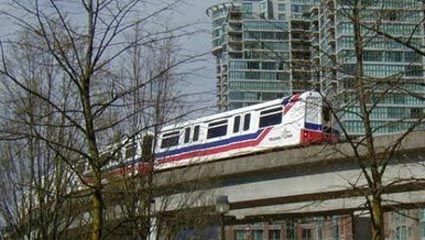
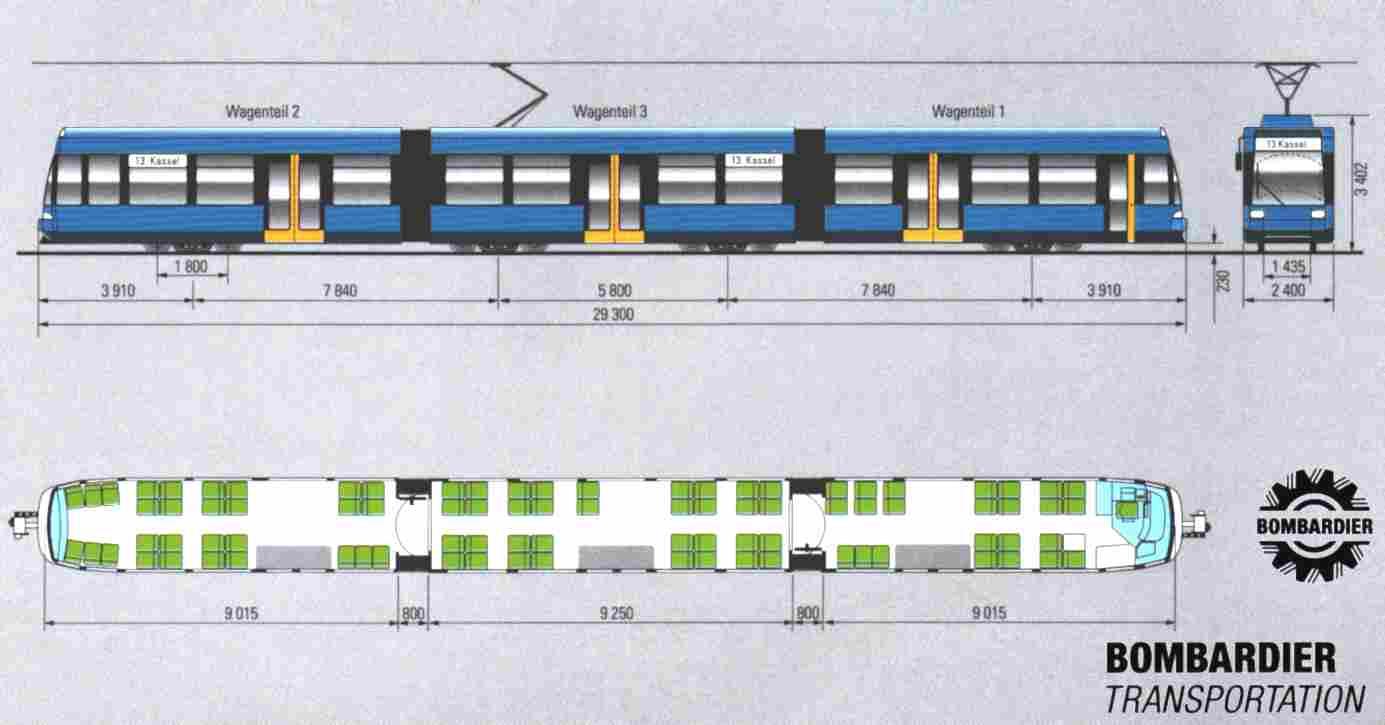
TransLink is mistakenly calling the new Mk.3 SkyTrain cars articulated, they are not. What Bombardier has designed is a saloon car, gangwayed at both ends; to fit between a married trainset, enabling to make the trainset longer; articulated they are not.
Sad to say, TransLink’s planning staff do not understand the basics, such as “what is an articulated rail car”, yet they are allowed to plan multi billion dollar transit lines, without question.
 A Bombardier articulated tram. Notice how the two end sections are supported by the centre section,
which does away with the need for two more bogies or trucks.
Articulated cars are rail vehicles which consist of a number of cars which are semi-permanently attached to each other and share common Jacobs bogies or axles and/or have car elements without axles suspended by the neighbouring car elements. They are much longer than single passenger cars. Because of the difficulty and cost of separating each car from the next, they are operated as a single unit, often called a trainset.
Passenger cars
Articulated passenger cars are becoming increasingly common in Europe and the US. The passageways between the car elements are permanently attached. There is a safety benefit claimed that if the train derails, it is less likely to jackknife and modern construction techniques prevent telescoping.
Articulated cars are not however a new idea. Many railways in Britain during the first half of the 20th century frequently rebuilt older, shorter cars into articulated sets, and the Great Northern Railway in Britain built suburban car sets new. In the 1930s, a number of streamlined trains built for the London and North Eastern Railway also made use of articulated technology.
Freight cars
Manufacturers such as Gunderson make articulated, low-floor “well” cars, articulated trailer carriers and articulated autoracks.
Advantages and disadvantages
Articulated cars have a number of advantages. They save on the total number of wheels and bogies, reducing initial cost, weight, noise, vibration and maintenance expenses. Further, movement between passenger cars is safer and easier than with traditional designs.
Disadvantages primarily relate to lesser operational flexibility. For example, additional cars cannot readily be added to an articulated trainset to accommodate peaks in traffic volume and a mechanical malfunction in one car or power unit can disable an entire trainset. Furthermore the axle load is higher compared to conventional train sets due to the reduced number of wheels and bogies
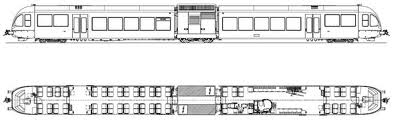 An articulated diesel railcar. Again notice how the two end sections are supported by the diesel motor unit,
negating the need fro two bogies or trucks.
Posted by zweisystem on June 22, 2015 · 2 Comments
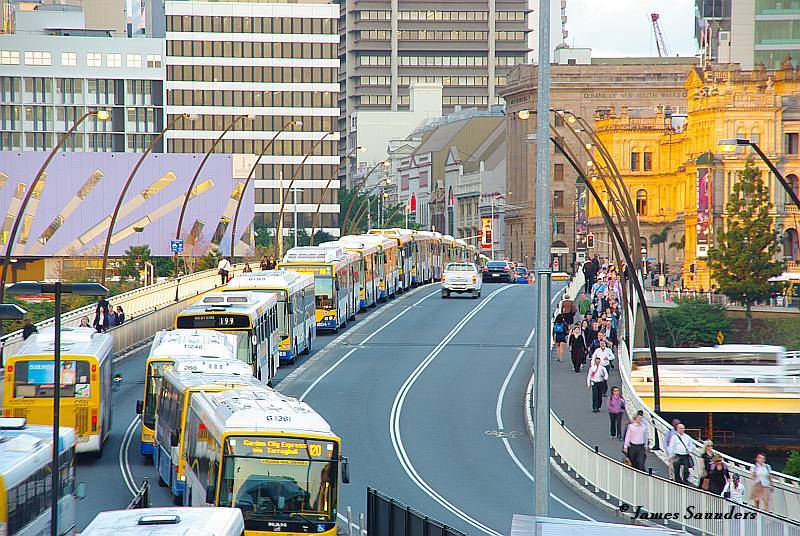
Brisbane Australia has a showcase BRT system, yet transit costs are extremely high.
Maybe it is time to get back to basics about modern light rail and forget the capacity and density debates and build LRT for the economic reason, one tram and one tram driver is as efficient as 4 to 8 buses and 4 to 8 bus drivers. Added to the previous numbers, for every tram or bus operated, one needs no fewer than 3 people to drive, manage and maintain them.
LRT was, and is still built for economy.

Many survey respondents said they would use public transport if it was cheaper. Photo: Harrison Saragossi
Cameron Atfield
Published: June 22, 2015 – 8:39AM
Research has found Queenslanders were more convinced than people in any other Australian state that driving was a cheaper way to get around than public transport, prompting fresh calls for fares to be cut.
A survey by consumer research firm Canstar Blue found 72 per cent of Queenslanders agreed with the statement “I find it’s cheaper to drive than use public transport”.
That was well ahead of Tasmania (60 per cent), Western Australia (57 per cent), New South Wales (54 per cent), Victoria (53 per cent) and South Australia (50 per cent).
Canstar Blue spokesman Simon Downes said 3000 motorists were surveyed across Australia.
“Respondents in Queensland were by far the most convinced that driving is cheaper than using public transport, but Queenslanders do show a strong willingness to use it more, should costs reduce,” he said.
Forty-three per cent of Queensland respondents said they would drive less if public transport were cheaper, compared with 41 per cent in NSW and Victoria, 34 per cent in SA, 33 per cent in WA and just 20 per cent in Tasmania.
Robert Dow, from public transport advocacy group Rail Back on Track, said the results were no surprise.
“That confirms what we know, that fares in south-east Queensland are certainly the most expensive in Australia for the majority of commutes and, in terms of world ranking, we’re up in the top three or four as well,” he said.
Mr Dow said there needed to be an urgent review of the fare structure in south-east Queensland and the Palaszczuk government had been too slow to act since it came into power earlier this year.
“If it’s got to the point where people think it’s much cheaper to drive, it’s a fairly worrying situation,” he said.
“Because what can happen, unless the government bites the bullet here and does something significant with the fare system to encourage people on it, we could start to see service cuts.
“Now that would be absolutely calamitous for south-east Queensland.”
A spokeswoman for Transport Minister Jackie Trad said: “We understand concerns regarding affordability of public transport, that’s why we promised an expert led review of the fare structure in SEQ to deliver a system that is fair, affordable and will boost patronage.”
The Canstar Blue survey also found Queenslanders spent an average of about $127 a month on fuel, less than Victoria ($140), SA ($134) and NSW ($133), but more than Tasmania ($118) and WA ($110).
“(Queenslanders) may not spend as much on fuel as others,” Mr Downes said, “but Queenslanders are the most likely to have days when they can’t afford to fill up.”
Thirty per cent of Queenslanders agreed with the statement “there have been days when I couldn’t afford to put fuel in my car”, compared with 28 per cent in NSW, 27 per cent in SA and WA, 25 per cent in Victoria and 22 per cent in Tasmania.
Posted by zweisystem on June 21, 2015 · Leave a Comment
Back in the 1980’s old Zwei was in constant contact (snail mail) with a Siemens representative in Europe. What was really interesting is that Siemens knew more about the proprietary SkyTrain system, than BC Transit.
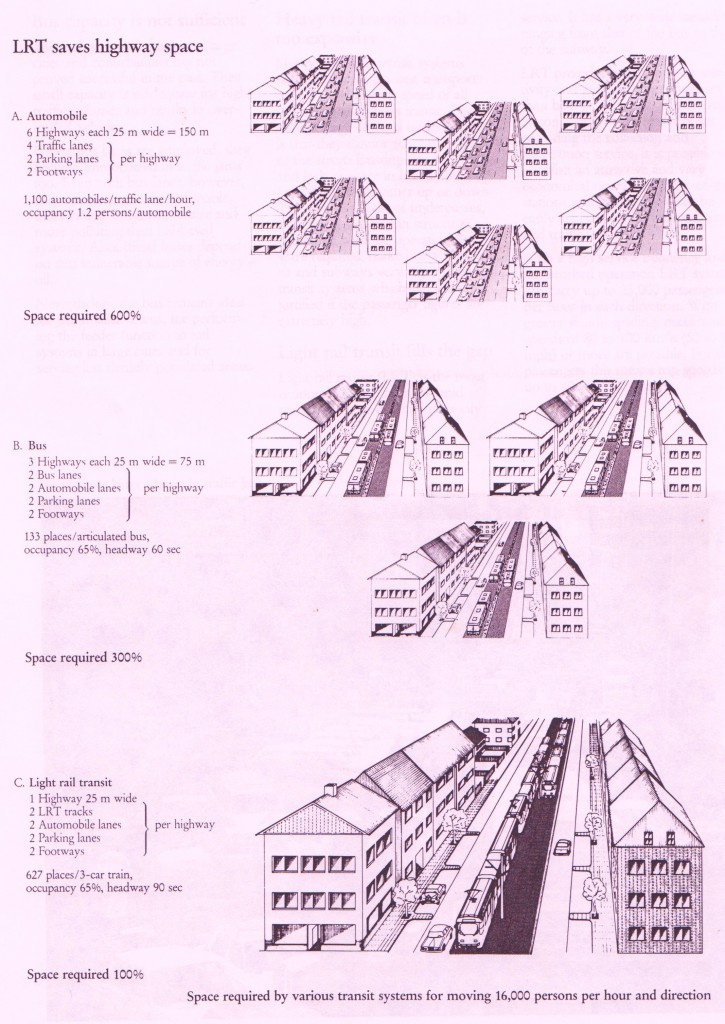
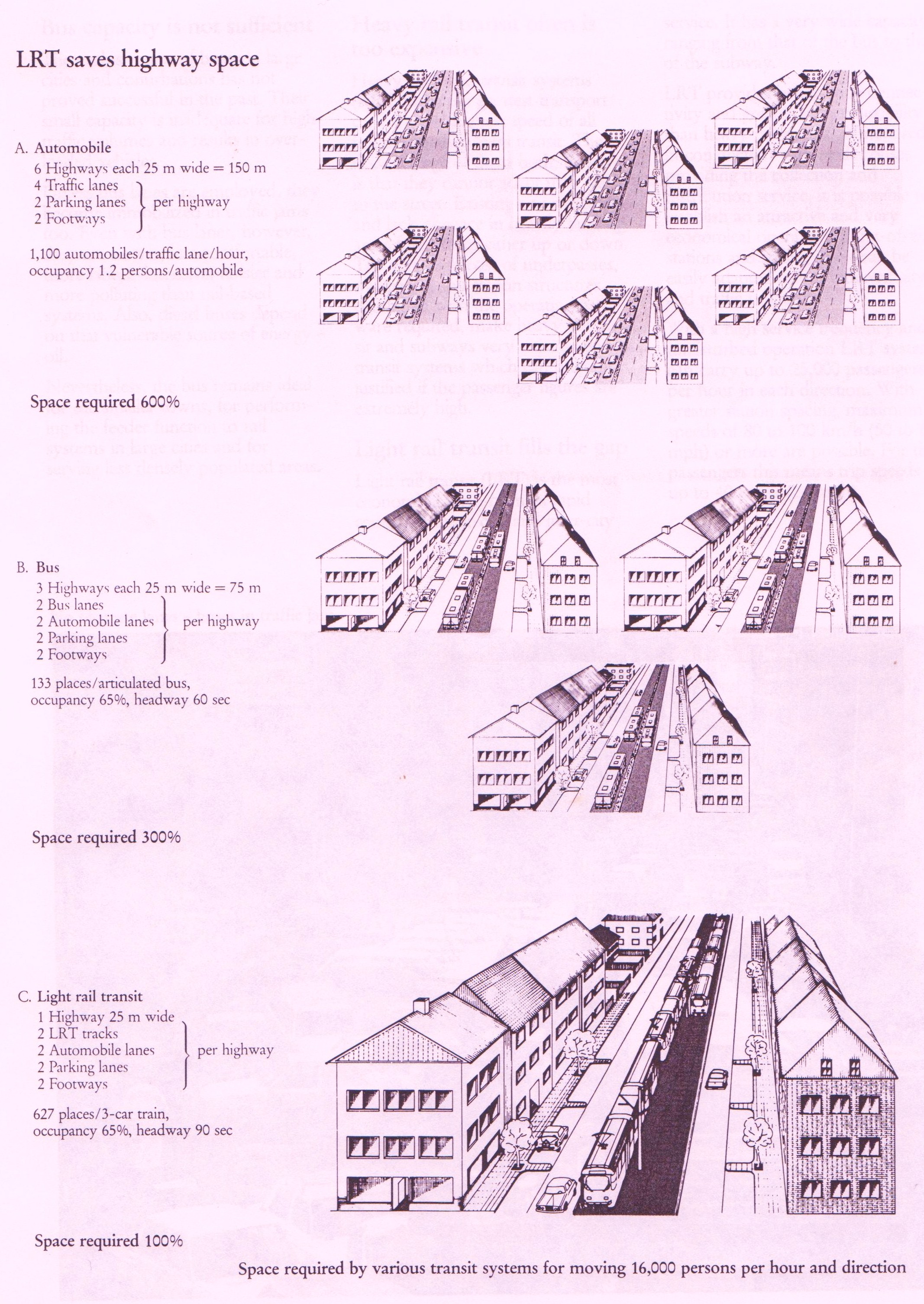
That was thirty years ago, but what is relevant to day is that modern LRT has always and still saves highway space.
The following graphic illustrates the space needed to carry 16,000 persons per hour per direction
Posted by zweisystem on June 19, 2015 · Leave a Comment
Another TramTrain is being installed and I thing it is time that both TransLink and BC Transit send a fact finding tour to Europe to investigate TramTrain!
As expensive vanity transit projects are seriously in trouble, the time has come to study 21st century transit philosophy and rethink expensive 20th century mini-metro.
The Leewood/Rail for the Valley TramTrain project is shovel ready and would make an excellent plan B.

Rotherham tram-train contract signed
UK: A firm contract for Vossloh EspaAi??a to supply seven vehicles for the Sheffield – Rotherham train-tram pilot scheme was signed on June 19.
The A?58m project will provide a tram-train service between Sheffield and Rotherham Parkgate using a new 400 m connection between the existing Supertram network and a Network Rail freight line which is to be electrified at 750 V DC.
The tram-trains are to be built at Vossloh’s Albuixech plant near Valencia in Spain and are scheduled to enter service in 2015. They will have Vossloh Kiepe equipment suitable for both 750 V DC and 25 kV 50 Hz power supplies, to allow for use under future main line electrification.
The tram-train pilot project is being led by South Yorkshire Passenger Transport Executive, which has placed the rolling stock order, in partnership with the Department for Transport, Network Rail, franchised train operator Northern Rail which was responsible for selecting Vossloh to supply the vehicles, and tram operator Stagecoach Supertram.
- Stagecoach Supertram was recently visited by 15 National Union of Road Transport Workers members from Lagos in Nigeria, who were in Sheffield to study how public transport operates in the UK. ‘We are only too happy to share our good practice with worldwide business leaders and continue to develop and strengthen these relationships’, said SYPTE Deputy Interim Director General David Young.
Posted by zweisystem on June 17, 2015 · 11 Comments
Are traffic flows along Broadway enough to justify a subway?
Simple answer is no, not anywhere close!
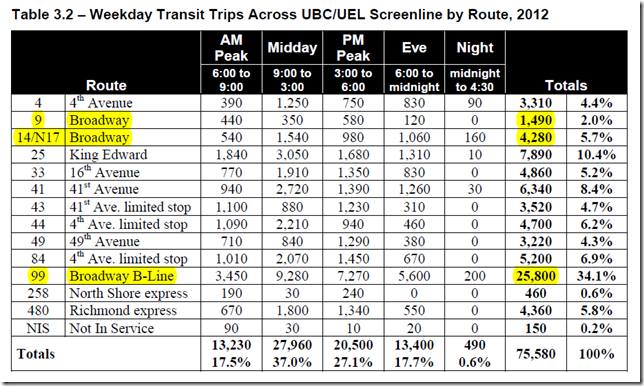
Traffic flows along Broadway are around 4,000 persons per hour per direction in the peak, but because it riders are mostly cheap fare U-Pass holders and operates buses at a far grater frequency than needed off the peak hours, Broadway is the most heavily used transit route in Metro Vancouver. That being said, the most frequent service is the 99-B Line express buses, which operate at 3 minute headway’s during peak hours and at 4 to 5 minute headway’s off peak. The maximum capacity of an articulated bus is about 110 persons and at 20 trip an hour (3 minute headway’s) or 2,200 pphpd in the peak hour!
The bare minimum traffic flow required for a subway, 15,000 pphpd!
Translation, if a Broadway subway is built, kiss goodbye to transit improvements South of the Fraser!
Until the mainstream media, like the Vancouver Sun and NW’98, grow up and start doing some real investigative reporting, the public will never know what a scam the SkyTrain subway is.

The mayor of Vancouver is following the example of his counterpart in Surrey in saying he too has a plan ai???Bai??i?? for the city plan to build a Broadway SkyTrain line.
Gregor Robertson says while he is hopeful the plebiscite result will be a ai???yesai???, he says the city needs and east-west line, regardless.
ai???This is just a matter of time, either we build it now, and I think we have great business case, so we spend a lot more money for it sometime in the future when the traffic congestion is even more horrendous.ai???
In Surrey, mayor Linda Hepner has also said her cityai??i??s plan for three light rail lines will also go ahead, regardless of the transit plebiscite outcome.
Posted by zweisystem on June 14, 2015 · 1 Comment
The mainstream media seldom give somewhat negative stories about TransLink and this item from Radio News 1130 may be the “shape of things to come”.
For too long TransLink has treated its passengers as cattle, acting like the “lord of the manor”, superior to all within its prevue. For too long, TransLink has not been frank with the taxpayer about costs to the system. For too long TransLink has squandered opportunity after opportunity to provide an affordable transit service, instead, plans and continues to plan for extremely expensive “vanity” projects that will do little in improving transit in the region.
Very few transit customers actually say positive things about Transit service and with each SkyTrain breakdown, the small pool of supporters of the present regime, decreases.
Too many mandarins are earning six figured salaries and do little, except protect their fat-cat salaries.
When the ever so friendly mainstream media start printing negative stories that give TransLink a “C” (which in reality means very little), it is like party faithful calling their favourite political party arrogant; the brand is getting stale and is due for a change.

Man behind independent review of TransLink gives system a ‘C,’ transit authority apologizes
TransLink will not issue refunds by those affected by system’s latest shut down
Audio consultant being brought in to upgrade TransLink’s PA system after passengers said they couldn’t hear instructions
Dozens of people to be hired by October in cause TransLink suffers more widespread delays
VANCOUVER (NEWS 1130) ai??i?? The man in charge of reviewing TransLinkai??i??s SkyTrain failures gives the transit authority a ai???Cai??i?? grade as it deals with the fallout from yet another shutdown.
Gary McNeil says improvements have been made since last year when the system was halted for about six hours.
Meantime, TransLink CEO Doug Allen has apologized, adding a part of the problem is the lack of staff on hand to deal with a transit failure.Ai?? As a result, TransLink is bringing in a total of 64 people by October to be at various stations to help get passengers from Point A to B.
Some passengers complained Tuesday that they werenai??i??t able to hear instructions over the PA system, adding there was a lot of confusion and to rectify that McNeil says an audio consultant will be brought in to fix that problem.
The issues on the system are being blamed on an induction motor problem which caused delays on 19 trains.

After this latest shutdown, a marketing expert believes it could be tough for TransLink to turn around its negative image.
ai???TransLink were right on there right away, making profuse apologies, saying they were going to try and get on it right away. Itai??i??s the right way to go about it but hereai??i??s the issue they, they have to deliver on this stuff.Ai?? They got to get to the point where youai??i??re not going to get these breakdowns,ai??? says Lindsey Meredith with SFUai??i??s marketing program.
He adds the shutdowns arenai??i??t the only issue ai??i?? he also believes the delayed Compass Card program and high executive salaries impact the public perception.
ai???Eventually all of this is collected in the publicai??i??s perception and its perception that is really the game of marketing and it eventually caught up to them.ai???
TransLink will not be issuing refunds for people affected by the delays.








Recent Comments