BRT- “just like light rail only cheaper” – NOT!
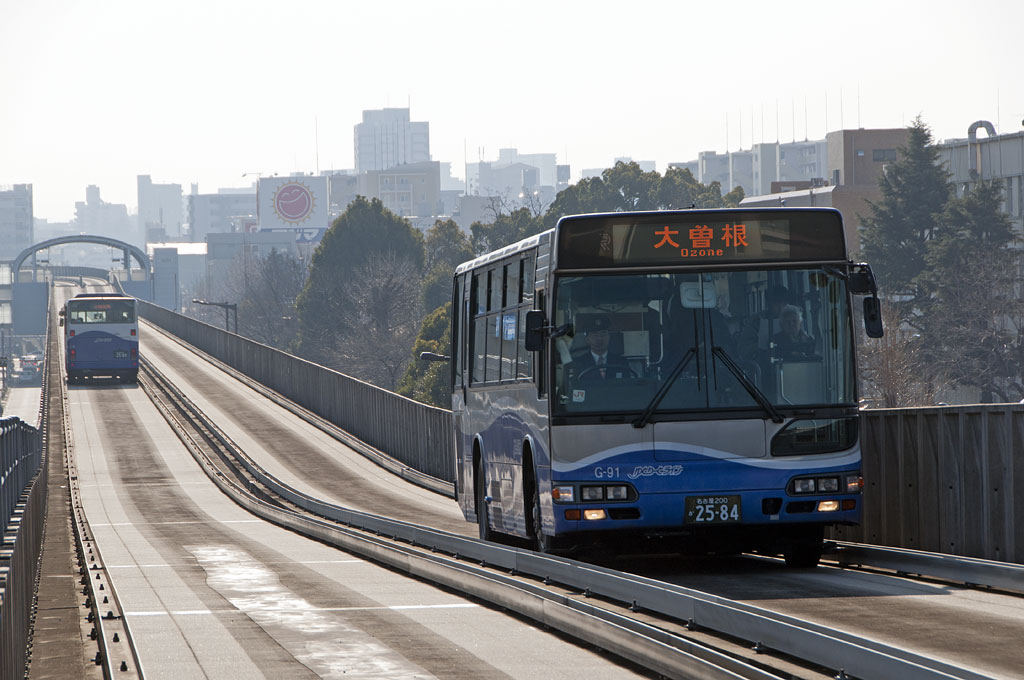
For Bus Rapid Transit, to be real BRT is must either have its own road or busway or it must be guided, using an exclusive guideway. Express buses, which operate in mixed traffic, with autos and commercial vehicles suffer the same issues as streetcars only slightly worse. Streetcars are cheaper to operate.
In the UK, transit officials in Cambridgeshire were persuaded by the BRT Lobby to build a BRT line instead of using rail on an abandoned railway formation.
First touted to be cheaper than rail, the Cambridgeshire busway is now looking like becoming a money pit, compared with rail.
What should be remembered is that when politicians and bureaucrats start touting BRT as a “rapid transit solution“, one should consider that what is being offered is a very expensive pig in a poke.
ai???Deterioratingai??i?? Cambridgeshire guided busway may need to be ripped up
10 April 2015

Guided bus,
The guided busway may need to be ripped up and re-done, a county council official has warned.
The busway, which runs between Cambridge and Huntingdon, has had 11 million passengers since it opened four years ago, but it has been plagued with defects.
A technical report six months ago said the busway, which was built by contractor BAM Nuttall, had A?31 million worth of defects – in some places the track has risen four inches – which need to be addressed to tackle the ai???deterioratingai??? ride quality.
Next weekend, the section from Addenbrookesai??i??s Hospital to Trumpington will be shut for maintenance.
Speaking to BBC Radio Cambridgeshire, Bob Menzies, service director for strategy and development at Cambridgeshire County Council, said they may be forced to put rubber pads under every beam of the track.
ai???The ride quality has deteriorated since it opened, and the joints are moving. The last thing we want to do is to have to do this work. But on the other hand we have to make sure itai??i??s maintained and kept safe,ai??? he said.
ai???Itai??i??s a real shame we have this problem, that weai??i??re having to close it over a weekend, having to divert the buses round, and we many have to do more of this in the future.
ai???Our expertsai??i?? view is that eventually weai??i??ll need to fix it all. And itai??i??s a real shame.
ai???If we (the county council) have to weai??i??ll lift every beam up and put these rubber pads back under each one of them as they should have been done properly in the first place.ai???
Replacing beams cost several thousand pounds at a time, so replacing 6 million joints could add up to a ai???very big figureai???, Mr Menzies admitted.
The council has already spent A?1 million on legal action against Bam Nuttall in a bid to get them to take responsibility over the repairs, Mr Menzies added.
He said: ai???What we believe should happen is Bam Nuttall should come back and fix it all, and get the ride quality back to where it should have been.
ai???Theyai??i??re quite clearly defects. It quite clearly doesnai??i??t comply with the terms of the contract. Iai??i??m absolutely clear about that, and so are our lawyers. Thereai??i??s six thousand joints along the busway – that could add up to a very big figure if you have to fix every one over the course of a number of years. Thatai??i??s why weai??i??re taking legal action against Bam Nuttall.
ai???Iai??i??d like Bam Nuttall to come clean and accept their responsibilities. But I suspect it wonai??i??t. In effect it will take a lot longer than that, knowing the previous history.ai???
FACTFILE
The initial contract between Cambridgeshire County Council and BAM Nuttall was for 130 weeks of work, with the completion date on February 27, 2009.
But the busway construction was not completed until April 2011 and not open for use until August of that year as the council raised concerns about defects along the guideway.
The council instigated the review into the contract after the project ran into problems and delays, resulting in BAM Nuttall, repaying A?33million of the A?147m costs to settle a long-running dispute about who should pay for the overspend for the concrete route.
The report found BAM Nuttall did not think the design was as complete as it expected it to be when the contract was awarded.
Involving a consultant to review the design was not value for money and removed responsibility from the contractorai??i??s designer, the report added.
Adios SkyTrain? Bombardier is selling off its rail division.
What would happen if the region continues to plan for SkyTrain, yet there is no SkyTrain?
If a potential buyer for Bombardier’s rail division already has on the market it’s own proprietary railway or railways, they would probably discontinue SkyTrain which has not had a sale in over a decade and with one SkyTrain line due to be decommissioned and replaced with either LRT or a heavy rail metro and another mired in legal problems, prospects for potential sales is minimal.
This could also be the reason for TransLink to repurchase the old MK.2 fabrication plant, in hopes of custom building SkyTrain for future light-metro lines.
All I can say is “I told you so” and let the SkyTrain lobby cry in their beer.
By:Ai??Bloomberg,Ai??Published on Fri Apr 10 2015Bombardier Inc. may fetch as much as $5.4 billion if it decides to sell the rail unit that supplies Torontoai??i??s new LRTs and long-delayed streetcars. Its rail unit has played a ai???stabilizing roleai??? amid the struggles at the companyai??i??s aerospace business, according to Alta Corp Capital Inc.

Bombardier is discussing options with bankers about its rail business that could include a full or partial sale of the business or an initial public offering, Reuters reported, citing people familiar with the matter whom it didnai??i??t identify. The shares rose 5.8 per cent at 10:01 a.m. to $2.76 (Cdn.). They have fallen 34 per cent in the past year through Thursday.
The transportation unit is worth as much as $3.50 a share, giving negative value to the aerospace businesses, said Chris Murray, an analyst with AltaCorp Capital, in a telephone interview.
ai???They are a global player in rail,ai??? Murray said. ai???It would attract a fair amount of interest.ai???
RBC Capital Markets analyst Walter Spracklin puts the potential value of Bombardierai??i??s Transportation much lower, at about $1.45 a share, or $3.47 billion.
He bases this on the estimate for 2016 earnings of 10 cents a share from the transportation side, as well as assuming 50 per cent of interest and taxes are applied equally to aerospace and transportation divisions.
ai???If a more significant portion of the debt is ladenai??? onto Bombardier Aerospace, then the value of Bombardier Transportation ai???could reach the quoted $5 billion, but we do not view that as prudent nor realistic,ai??? Spracklin wrote in a note to investors.
Isabelle Rondeau, a Bombardier spokeswoman, declined to comment to Bloomberg News on the report and said the company wouldnai??i??t speculate on rumours. She reiterated statements from Bombardier executives who said in February that the company would consider various options and that ai???everything is on the table.ai???
A breakup could be the best way for Montreal-based Bombardier to overcome the struggles facing its aerospace business, analysts and investors have said. The rail unit, which includes subway cars, signaling and control equipment, is the healthier part of the company, with 2014 earnings before interest and taxes of $429 million compared with a loss of $995 million at the aerospace unit.
ai???The transportation group plays a stabilizing role on the earnings profile of the company,ai??? Murray said.
Delays and cost overruns for Bombardierai??i??s new CSeries jetliner dragged the company last year to its first annual loss in almost a decade. The companyai??i??s debt is more than twice its market value.
Alain Bellemare, who became chief executive officer in February, is shaking up Bombardierai??i??s leadership team. He announced the replacement of two senior executives Thursday just after new doubts emerged about one of the largest orders for the CSeries.
Repeated delays have pushed the CSeriesai??i?? commercial debut to 2016, after an initial target of 2013, and ballooned the development cost of Bombardierai??i??s largest-ever plane to $5.4 billion, at least $2 billion over budget.
A sale of the rail unit would raise questions about how the aerospace businesses would fare on their own, Murray said.
ai???Short term, itai??i??s maybe a great thing for investors,ai??? he said. ai???The issue is longer term and what that says about their intention of future project development.ai???
Light Rail questioned by Langley Township planner – Yesterday’s planning at work!
The same old cliched arguments about modern light rail have surfaced in Langley Township.
What old Zwei finds so tiresome is that the some planners remains so uninformed about SkyTrain light-metro and modern light rail, think both are “rapid transit“.
Transit is only as ‘rapid’ as it is designed to be.
Sadly, the term “rapid transit” is now a catchall phrase that can describe about anything, which TransLink has used with great success in confusing politicians to OK building more SkyTrain.
Of course modern LRT crosses road traffic at intersections, but those intersections are protected by lights and major intersections will include a station or stop for the tram (transit is to pick up and transport customers) and it is the auto and truck drivers, who disobey traffic signals and cause collisions.
This can be rectified to a great extent by having CCTV and red-light cameras at major tram/road intersections, fining those drivers who disobey a traffic light and if one causes a collision with a tram, a one year ban from driving, would deter many people from disobeying a red light. A tram driver who disobeys a red light normally gets sanctioned or fired.
Today road/rail intersections are about ten times safer than road/road intersections.
The Leewood/Rail for the Valley study’s time matrix showed that the travel time from Langley to Scott Road Station, via TramTrain, would be 25 minutes and the time to travel to downtown Vancouver would be another 25 minutes, thus giving a Langley to Vancouver travel time of 50 minutes, unbeatable, even with TransLink’s planning.
It is time for our regional planners to step out of the ‘rubber and asphalt‘ world they live in and join the 21st century as modern light rail in its various forms, is very friendly indeed.
 A Alstom Citidis diesel TramTrain in action.
Rapid transit proposal questioned by Langley Township planner
- byAi?? Dan Ferguson – Langley Times
- posted Apr 8, 2015

A TransLink proposal that would use a ground-level light rapid transit (LRT) line to connect Langley and Surrey, rather than extend the elevated SkyTrain system, has been questioned by a senior Township planner, who says the line may not help Langley commuters get to Vancouver and could mean delays for riders and a higher risk of accidents.
In a letter to TransLink obtained by The Times, Langley manager of transportation engineering Paul Cordeiro expresses a number of concerns following a March 9 workshop to begin ai???Phase 3ai??? planning of proposed light rail lines to Langley and South Surrey.
Based on the discussion at the workshop, it appears commuters wonai??i??t be able to use the Langley line to take rapid transit to Vancouver, the Cordeiro letter states.
During the March 9 meeting, ai???comments were made about the LRT serving a local functionai??? that appear to indicate the line is ai???not to facilitate Langley to Vancouver regional trips, but instead to predominately serve local trips,ai??? the letter states.
ai???The framework guiding the design of this project does not appear to be consistent with a regional serving rapid transit lineai??? the letter adds.
It goes on to request that TransLink ai???clarify the role and function of this major capital project ai??i??ai???
The letter says that the line was originally described as a ai???rapid transit alternative with slightly longer trip times as compared to the SkyTrain model.ai???
The letter notes the line would run along Fraser Highway from Surrey into Langley at ground level, requiring the trains to cross several major road intersections, including Highway 15, described as a ai???high speedai??? major route and 200 Street, with an estimated 40,000 vehicles a day.
It describes the busy intersections as ai???major conflict pointsai??? and warnsAi?? ai???there is a potential for vehicle-train collisions.ai???
Cordeiro calls on TransLink to hire a road safety auditor ai???for assessment of risks at conflict points based on the traffic volume, traffic speed, probability of a collision and the consequences of a collision.ai???
Cordeiro also expresses doubt about the TransLink estimate that the Langley-to-Surrey trip would take 29 minutes on a ground-level LRT.
ai???Township staff would like to discuss what steps will be taken to ensure that this travel time is met on a consistent basis,ai??? Cordeiro says.
ai???Specifically, we would like to review what policies and procedures will be put in place when considering additional stops or other items that may impact the travel time of the system, which is of primary importance to the Township, due to our geographic location.ai???
A copy of the letter was distributed to members of Township council on March 19.
TramTrain for Hungary
From the International Railway Journal.
As TransLink and the regional mayors still champion hugely expensive vanity projects for the region, TramTrain makes very good economic sense.
A basic, bare-bones hourly service, using diesel light rail vehicles, from Vancouver to Chilliwack, would cost about $750 million. A more intense electric service, with a 20 minute service would today cost just over $1 billion, provide faster commute times from Langley and South Surrey to Vancouver and probably attract more new transit customers than the present Mayor’s council and TransLink’s plans.
A combined new road/rail bridge replacing the aging Patullo Bridge and the decrepit Fraser River Rail Bridge, plus with the full build Leewood/Rail for the Valley TramTrain plan, combined would cost no more than $2 billion; attract more new customers; and most likely would win public approval in a referendum.
The real problem is that it is a Rail for the Valley plan and not a TransLink plan and that makes a lot of people working at TransLink very nervous.

Planning begins for Hungary’s first tram-train line
Written byAi?? Ferenc Joo
PLANNING began on March 18 for Hungary’s first tram-train project, which will link the tram network in the city Szeged and a planned light rail line in HA?dmezAi??vA?sA?rhely via Hungarian State Railways’ (MA?V) Szeged ai??i?? BAi??kAi??scsaba line.
Utiber, Hungary, is responsible for planning the Forints 20bn ($US 72m) project and will complete detailed feasibility studies by the end of the year. Detailed planning and approval will take place next year and construction will begin in 2017 with the project due for completion in 2018.
The project involves linking Szeged tram Line 2 to the main line network at Szeged-RA?kus station. Tram-trains will run on the MA?V line as far HA?dmezAi??vA?sA?rhely-NAi??pkert, continuing on a new light rail alignment through the town centre before rejoining the heavy rail line at the city’s main station. The alignment of the light rail line in HA?dmezAi??vA?sA?rhely has yet to be finalised.
MA?V is planning to electrify the Szeged ai??i?? BAi??kAi??scsaba ai??i?? Gyula line by 2020 although there are doubts over when this project will be completed, which means the Szeged tram-train may initially operate with dual-mode vehicles.
It is also possible that a second track will need to be constructed between Szeged-RA?kus and HA?dmezAi??vA?sA?rhely to accommodate the increase in traffic.
Less expensive options?
Sounds familiar? One could ask the same for our regional transit planning.
HS2: Government has no ‘convincing case’ for A?50bn rail line
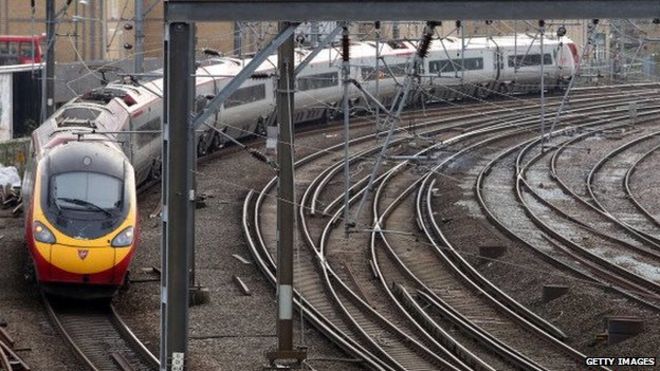
By Chris Johnston Business reporterThe government has no convincing case for spending A?50bn building the HS2 rail link between London and the North, a report by the House of Lords Economic Affairs Committee says.
The government’s main arguments in favour of HS2 – increasing railway capacity and rebalancing the economy – were still to be proven, Peers said.
There are less-expensive options than HS2, they said on Wednesday.
A government spokesman said HS2 would deliver big benefits.
Lord Hollick, chairman of the Lords’ committee, said overcrowding on the West Coast Main Line was largely a problem on commuter trains and on long-distance services on Friday nights and some weekends.
“The Government have not carried out a proper assessment of whether alternative ways of increasing capacity are more cost-effective than HS2,” he said.
“In terms of rebalancing, London is likely to be the main beneficiary from HS2. Investment in improving rail links in the North of England might deliver much greater economic benefit at a fraction of the cost.”
‘Satisfactory answers’
Lord Hollick called on the Department for Transport to provide detailed answers to the questions set out by the committee.
“Parliament should not approve the enabling legislation that will allow HS2 work to begin until we have satisfactory answers to these key questions,” he said.
The peer sets out arguments against the investment in a YouTube video.
A Department for Transport spokesman said the case for HS2 was “crystal clear” and claimed it would have a “transformational effect”.
“It is a vital part of the government’s long-term economic plan, strongly supported by Northern and Midland cities, alongside our plans for better east-west rail links confirmed in the Northern Transport Strategy last week.
“Demand for long distance rail travel has doubled in the past 15 years… it is crucial we press ahead with delivering HS2 on time and budget and we remain on track to start construction in 2017,” the spokesman said.
‘No blank cheque’
Shadow transport secretary Michael Dugher said that Labour supported HS2. However, he added: “It’s vital that ministers win public confidence for this important investment and ensure that the economic benefits are felt as widely as possible. We have said there will be no blank cheque for the project under Labour.”
Rhian Kelly, CBI director for business environment, said a modern railway was needed to deal with lack of capacity on the West Coast Mainline.
“HS2 will better connect eight of our 10 biggest cities, boosting local economies along and beyond the route together with complementary road and rail investment. It’s vital we avoid any further delays to the project,” she said.
The Lords report echoed a similar report published by the Commons Public Accounts Committee in January.
The MPs said that ministers lacked a “clear strategic plan for the rail network” and were “sceptical” about whether HS2 would deliver value for money.
The A?50bn price tag included a “generous contingency” that could be used to mask cost increases, they added.
The first phase of HS2 will be between London and Birmingham opening in 2026, followed by a V-shaped section to Manchester and Yorkshire.
It promises to reduce journey times to London from 81 minutes to 49 minutes, and slash the trip to Manchester by an hour to just 68 minutes.
The Compass Card – Another Gordon Campbell Fiasco!
The Compass Card fiasco is not really a TransLink problem, rather it is the epitome of why TransLink has problems; TransLink is a tool of the Premier’s Office and it must do the Premier’s bidding or face serious repercussions.
Premier Gordon Campbell’s best friend, Ken Dobell, was the lobbyist for Cubit Industries makers of fare card systems and fare-gates and what Ken Dobell wants, Ken Dobell gets! TransLink was compelled to purchase the compass fare-card and fare gate system, even though TransLink did not want it.
With help from the mainstream media, in particular the Vancouver Sun and CKNW radio, the propaganda campaign, using perceived rampant fare evasion as the ‘raison d’A?tre ‘ for fare-gates succeeded wonderfully. The Compass Card and fare gates were soon forced upon TransLink by popular public demand, even though fare evasion was well within industry norms!
The problems now associated with the Compass Card resides with concession fares, the U-Pass and the antiquated tap in – tap out method of using the fare card. In fact Zwei has been told by a whistle blower working at TransLink that the Compass Card and fare gates may be never put into revenue service!
The Compass Card debacle is just another, in a long list ofAi?? of Gordon Campbell’s ill conceived meddling forcing a rather complicated fare card/fare gate system on a very uncomplicated paid fare zone method with open access stations, which has cost the tax payer dearly, much more than was lost due to fare evasion.

TransLink stays mum as Compass Card problems point to further delay
By Dan Fumano, The Province March 26, 2015
Back in November 2007, B.C.ai??i??s then-transportation minister returned from a trip to Europe, and announced sweeping changes to Lower Mainland transit.
Minister Kevin Falcon was impressed by transit systems in London and Rotterdam, and he envisioned electronic fare gates and smart cards for Metro Vancouver.
The smart card, Falcon said, was ai???very easy to use,ai??? and a key part of the plan.
He said at the time: ai???It actually grows your ridership dramatically. Itai??i??s really convenient.ai???
A few months later, Falcon was asked about fare gates, or turnstiles, at SkyTrain stations, and he told The Province: ai???Itai??i??s going to happen.ai???
That was seven years ago this month, and passengers are still waiting for those fare gates and smart card system, now known as the Compass Card, to happen.
Many have wondered: Did the Compass lose its way?
With Metro Vancouver currently in the midst of a plebiscite about a 10-year transportation plan, TransLinkai??i??s reputation and efficiency has become a major issue in the campaign, and the delayed Compass rollout has been one of the most frequently cited examples of the regional transport authorityai??i??s supposed challenges.
Target dates have come and gone, budgets have ballooned.
Only a handful of transit passengers are using the cards now ai??i?? about 10 per cent of TransLinkai??i??s goal ai??i?? and itai??i??s unclear when the system will be fully operational.
The first fare gate was installed in August 2012. Now, gates are installed at most stations, but they remain unused.
TransLinkai??i??s media office was unable to make someone available for an interview for this story between Monday and Thursday this week.
In an emailed statement, a spokeswoman said that by the end of summer 2015, TransLink expects to have about 215,000 Compass Cards on the system ai??i?? about one quarter of their end goal of 800,000.
Questions about the expected timeline for the Compassai??i?? full implementation were referred to TransLinkai??i??s website.
On the Frequently Asked Questions section of TransLinkai??i??s website, the first entry asks: ai???When can I start using the Compass and fare gate system?ai???
The response does not answer that question, but begins with ai???Excitement is building for the launch of Compass!ai???
In December 2010, an American company called Cubic Transportation Systems was awarded the contract to design, build, and operate the Compass system. However, calls to Cubicai??i??s San Diego headquarters this week were not returned.
As debate over the transit plebiscite continues, a lack of trust in TransLink has become a huge issue for the Yes campaign, according to a poll carried out earlier this month by the Angus Reid Institute for The Province.
Even high-profile campaigners for the Yes campaign, such as Vancouver Mayor Gregor Robertson, have said they have ai???concerns about TransLink.ai???
Still, they have tried to remind voters, the vote is supposed to be about transportation, not about TransLink.
Jordan Bateman, the B.C. director of the Canadian Taxpayers Foundation and the de facto head of the No campaign, said he hears from ai???TransLink apologistsai??? who say the Compass problems are ai???not TransLinkai??i??s fault,ai??? because the program was thrust upon them by the provincial government.
Batemanai??i??s response to that is: ai???Look, anyone who has a boss has been forced at times to do something in their job that they didnai??i??t want to do … That doesnai??i??t excuse gross mismanagement. TransLink is over-budget, years late, theyai??i??re nowhere near getting these things up and running.ai???
HOW IT WORKS
TransLinkai??i??s website says: ai???the Compass system uses a simple tap-in/tap out process.ai???
But in reality, itai??i??s so far been less ai???simpleai??? than envisioned.
The system is supposed to work like this: Transit customers ai???loadai??? up a Compass Card with funds to pay for trips.
As passengers enter a bus, SkyTrain station, SeaBus terminal or West Coast Express platform, they swipe the Compass Card against a reader, ai???tapping in.ai??? They will then swipe the card again at the end of each trip, ai???tapping out.ai???
But, as the TransLink website notes: ai???Failure to tap out means the system will charge you for a three-zone fare, so itai??i??s crucial that you tap out!ai???
Indeed, the ai???tapping outai??? process has reportedly been one of the sticking points with the Compass technology.
Compass testers reported trouble getting the reader to recognize their card after repeated attempts to ai???tap out.ai???
This can result, testers say, in log jams at SkyTrain fare gates, agitated passengers on busy buses, and customers getting over-charged.
One tester said: ai???If they ever they get this thing up and running, I think itai??i??s going to be a bit of a gong show.ai???
Replacing the Fraser River Rail Bridge
Interesting item from the Netherlands.
Dutch Engineers have been at the forefront at lift bridge technology for over a century, due to the many canals that traverse the country.
The “tilting lock” would be especially beneficial to railways as there would no need for a lift span at all and trains could cross the bridge at faster speeds in complete safety.
The two bridges that are in dire need of replacing is the crumbling Patullo Bridge and its neighbour, the downright decrepit Fraser River Rail Bridge.
Instead of a complicated and expensive lift span for trains, boats and barges could pass using the “tilting lock” technology, which would both reduce the cost of a lift span, yet at the same time increase railway efficiency.
The only downside I can see is that there would be a size limit for water craft traveling Eat past the bridge.

Innovative Tilting Lock Concept ai??i?? Bridge Doesnai??i??t Open But Ships Submerge To Pass Under
A major road bridge with no need to open because ships ai???submergeai??i?? under it ai??i?? this is the new Tilting Lock invented by Dutch engineers at Royal HaskoningDHV.
Major bridges that move to allow sailing yachts to pass beneath them, like the Zeeland Bridge in the Netherlands, are causing daily traffic congestion when they open for the boats, peaking during the summer season. To resolve this problem, Royal HaskoningDHV has invented the Tilting Lock ai??i?? designed to allow boats to ai???submergeai??i?? under the bridge instead of it opening for them to pass under.
The Tilting Lock (Kantelsluis) is a floating structure which has two separate water filled channels with space for five yachts at a time. When the lock is level, the water surface in both channels is 4 metre lower than the water in the river. To start service the lock will tilt in order to raise the level of one of the channels to meet the water level outside the Tilting Lock
Sailing boats enter the Titling Lock. Ai?? Royal HaskoningDHV
Adding 8 metre vertical clearance
Mr Carolus Poldervaart, a Royal HaskoningDHV designer: ai???Once the yacht is in the channel, the lock will tilt and ai???submergeai??i?? the boat by 8 metre. After the boat has passed under the bridge the lock reverts to its original position to level the water inside and outside the channel again. This way almost all yachts will be able to pass under busy movable bridges without the bridge having to open. No more waiting traffic, no more waiting boats.ai???
The Tilting Lock does not pump water and no weight is being displaced. It remains in position, with tilting being the only movement. Mr Poldervaart explains: ai???The tilting motion is restricted, mainly to guarantee that the sides of the lock do not touch the mast of the boat.ai???
Ai?? Royal HaskoningDHV
Energy use: equivalent to four hours light from an ecolamp
The energy used by the Tilting Lock is extremely low. Mr Poldervaart continues: ai???The lock tilts 32 degrees in three minutes and it takes 30 seconds to set the tilting ai???in motionai??i??. In normal weather conditions this uses 0.04 kWh ai??i?? as little as an ecolamp needs to burn for four hours.ai??? Stopping the tilting produces energy, as do the solar panels on the lock. This energy will be used to tilt the lock and for lighting, as well as opening and closing the lock doors.
The lock will be made of steel and will be built at a wharf and then transported to its final location, enabling 15 to 30 ai???oversizedai??i?? yachts per hour to pass the bridge without it opening. Capacity may vary depending on width and length of the lock. Smaller sailing and motor yachts will still be able to pass the bridge as normal.
Ai?? Royal HaskoningDHV
Benefits higher than the costs
The investment for building such a lock is ai??i??60 million (CAD $81.60 million), depending on size, but the benefits will be enormous. A cost/benefit analysis predicts that the Titling Lock at another busy Dutch opening bridge, the Haringvlietbrug, will yield ai??i??100 million (CAD $136.44 million) over a period of 25 years, with a pay-back time of 12 years.
Applicable as ordinary lock
The Tilting Lock can also be used as an energy efficient ordinary lock with no water being lost when moving ships from higher to lower water levels ai??i?? a persistent problem in canal systems that are dependent on rainwater to maintain sufficient water depth.
https://www.youtube.com/watch?feature=player_embedded&v=S3R4Yd0-kdo
The $14 billion transit plan the B.C. Liberals conveniently forgot about
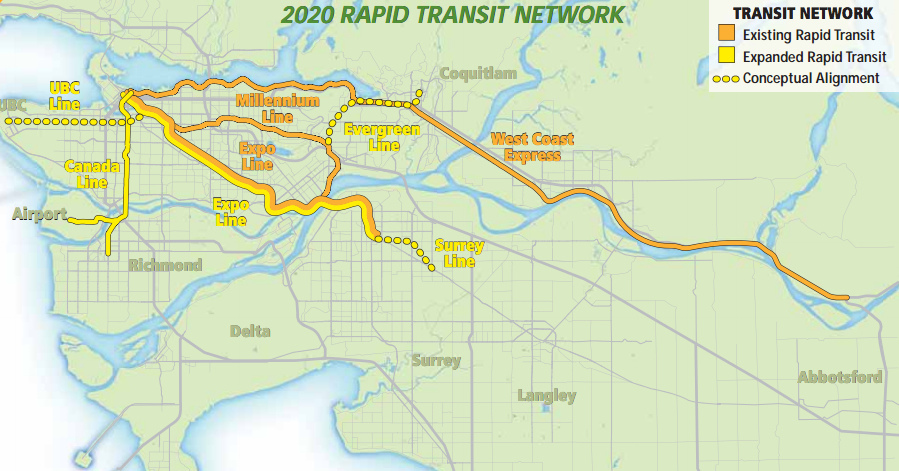
How soon we forget, the BC Liberals had a $14 billion transit plan for Metro Vancouver and what ever happened to that?
The following from Vancouver Buzz explains events from seven years go.
A discussion about TransLink
A new transit blog is in town and I think it is well worth a read.
Called Inside TransLink, it gives an insider’s view of the organization and the many problems the exist, culminating with this rather destructive transit plebiscite.
http://www.insidetranslink.ca/

The ways to improve TransLink, from a voice that saw the inside. Ai??There are a lot of critics of TransLink, and they are commenting on the obvious and visible symptoms of the issues Inside TransLink. Ai?? It takes an outsiders, inside view to know exactly what is happening at TransLink and where the root causes of the problems are!
Terence Corcoran: Hey, Vancouver: Just say ai???Noai??i?? to transit tax
Though I am trying to avoid unhappiness with the upcoming transit plebiscite, this item from the Financial Post is well worth a read.
What I find interesting, is the following comment; “Even London, a world leader in public transit and congestion charges, is still bogged down in traffic. ai???Traffic jams in London getting worse, ai??? said a BBC headline last year.”
So those who think a few km of LRT in Surrey and a paltry 5 km SkyTrain subway under Broadway or a few BRT lines, will alleviate congestion, think again.

Terence Corcoran: Hey, Vancouver: Just say ai???Noai??i?? to transitAi??tax
Terence Corcoran | March 16, 2015
ai???The cityai??i??s proposed sales tax plan is just a trigger for billions in new spending and higher taxes in future. Ai??And for what?ai???
Ah, congestion! What a windfall for policy wonks, sustainability dictators and others with a penchant for standing at the intersection of economic life and directing ideological traffic. Itai??i??s a global trend that this week officially sweeps into Vancouver with the distributionai??i??by mail!ai??i??of ballots for a city plebiscite on a proposed ai???transit tax.ai???
Or, as Happy City guy Charles Montgomery wrote in the National Post over the weekend, Metro Vancouver voters are being asked to participate ai???en masse in a fascinating behavioral experiment.ai??? Thatai??i??s not entirely inaccurate, since the plebiscite is indeed an experimentai??i??to determine whether the majority of voters in a big city can be bamboozled into voting for new taxes and big spending to support their local transit industrial complex.
The campaign for the transit taxai??i??a Vancouver-region increase of 0.5% in the provincial sales tax to raise $250-million a yearai??i??has the backing of a council of local mayors, a multi-million dollar marketing budget, plus the usual round-up of local business leaders, green activists and assorted economic theorists flaunting big dollar stats and grand claims that the tax will trigger major long-term economic and congestion benefits for all Vancouver. Be happy, vote for higher taxes.
The ballots have just been mailed out and it will apparently take Vancouver voters another 11 weeks to figure out whether they can believe claims that the new sales tax ai??i?? about $125 a year per householdai??i??will magically relieve congestion and generate $1.2-billion in long-term benefits.
Recent polls suggest that Vancouverites arenai??i??t enjoying the behavioral experiment, with the ai???Noai??? side holding the upper hand heading into this week.Ai??Ai?? Between now and May 29, the last voting day, FP Comment will present occasional commentaries on the transit tax battle. As of this week, however, the best advice to Vancouverites would be: Just say ai???No.ai???
A vote for the transit tax is a vote for massive expansion of public transit spending over the next 10 years. The official figure bandied about by the major pro-transit tax operative, the Mayorsai??i?? Council on Regional Transportation, is $7.5-billion in new capital spending over the next 10 years. More spending is needed for operating costs.
Only 6% of the $7.5-billion will go for road/bike lane improvements, with another 13% to replace the Patullo Bridge. The bulk of the money, more than 80%, will be sunk into assorted public transit schemes, the biggest item being $4-billion in new rapid Ai??rail transit investment, including a new line to the Vancouver suburb of Langley to give a fresh boost to urban sprawl.
The transit tax, if approved, would obviously only cover part of the $7.5-billion cost. As with all urban congestion relief policy expansions, the bulk of the costs will have to be borne by other levels of government and tricky manipulations of other taxes. The proposals suggest assorted additional tax grabs, including vehicle registration fees ($100-million a year) and taking back all or part of the revenue from British Columbiaai??i??s famous carbon tax (up to $380-million a year). Thereai??i??s talk of a land-value capture tax ($10-million) and a new ai???mobilityai??? tax that would tax drivers on the distance they travel rather than the fuel they use. Or maybe both. Itai??i??s not clear in the documents.
Then thereai??i??s a possible road tax, but thatai??i??s not on the ballot and in any case is shoved off into the far future by the Mayorsai??i?? Council, maybe eight years into the future. Even if one favoured road tolls as good economic policy, itai??i??s not really on the transit ballot agenda and, if implemented, would generate only $250-million a year to funding big transit capital projects. As with all urban transit tax plans, all these are seen as just starting point for bigger increases in the future.
The transit-tax ballot is in effect a marketing scam. Vote for this teeny little 0.5% increase in the sales taxai??i??only 35 cents a day per householdai??i??and collect an economic bonanza worth $950, according the Tides Foundation-funded Clean Energy Canada group and the C.D. Howe Institute.
In addition, any new regional Vancouver sales tax and the other local taxes on carbon etc. will still have to be supplemented by much larger contributions from Ottawa and the province. The ballot, in other words, is a little trigger for a big increase in tax-based spending over Ai??decades.
Nothing in any of the material on the Mayorsai??i?? Councilai??i??s glitzy get-out-and-vote Web site explains how any of this onslaught of taxes and spending will reduce actual congestion and/or improve the lives of Vancouverites. Itai??i??s a dream that has never really materialized anywhere, even in cities that have tried all the options: Spend billions on public transit, raise taxes on carbon and cars, and everybody will be happier, riding their bikes, hopping on trains and cruising over traffic-free roads.
Even London, a world leader in public transit and congestion charges, is still bogged down in traffic. ai???Traffic jams in London getting worse, ai??? said a BBC headline last year. A study showed that London was ai???second only to Brussels in terms of Europeai??i??s most congested cities, despite the congestion charge.ai??? Why? A growing economy is the main reason.
There may be good policies around to tackle congestion, including deregulation and allowing commuters to devise their own congestion-fighting behaviors. How about privatizing transit? But the idea that traffic can be controlled and reduced with massive new taxation schemes to fund zillion-dollar sprawl-inducing public transit created by central planning bureaucracies and politicians has become part of our modern urban mythology. Vote ai???No.ai???



Recent Comments