Toronto’s lonely ICTS (SkyTrain) Line is due to be dismantled within ten years because it is life expired, but with the ongoing seesaw debate to replace the ICTS Line with LRT or a subway rages on. To keep the line operable the existing cars need to be refurbished to keep the line operating for the next few years.
This is what the TTC’s revamped SRT cars look like
The TTC recently announced that a makeover was in store for its Scarborough RT trains. With the aging transit line forced to operate until the completion of a new subway line in Scarborough (at least a decade away), it wasn’t possible to put off upgrades any longer. Despite the notorious unreliability of the cars, the city is stuck with them for now, so the the TTC will invest $132 million to overhaul the fleet.
The first car has been re-wrapped as part of the makeover. It will travel the SRT to draw attention to the project and allow for the TTC to solicit feedback on the new design. At first glance, it’s a major improvement over the dated 1980s aesthetic of the original trains, though it does bear an odd resemblance to the Montreal Metro.
It’s also clear that the TTC is invested in rebranding the SRT to “Line 3,” with each car prominently marked with this still MTA-looking label (though, in fairness, New York isn’t the only city to number its subway lines). That’s not a bad idea given the bad reputation that line has accrued over the years, with loads of service delays each winter.
Almost five million rides are taken on the SRT each year, so if this renovation project helps to make the experience better for the next decade, it will likely have been worth it, even if the construction of an LRT instead of a subway would have made this upgrade unnecessary.
In addition to the new-look exterior, the TTC will replace the motors of these vehicles as well as other aging parts and upgrade the interior space in an effort to make the trains more accessible and bright.
Battery powered trains are evolving at a fast pace.
For the Chilliwack interurbanAi?? purposes, this sort of train could operate quite well on sections of non electrified track, including the 12.5 section of shared track with the Roberts Bank Railway and the 22 km section from the Fraser river Bridge to the downtown Vancouver Central Station.
As battery powered trains and trams improve, by the time the government comes out of its transit mega project stupor, the ability of battery powered trains to run further afield, will only increase.
Prototype battery-powered ai???IPEMUai??i?? carries passengers for first time
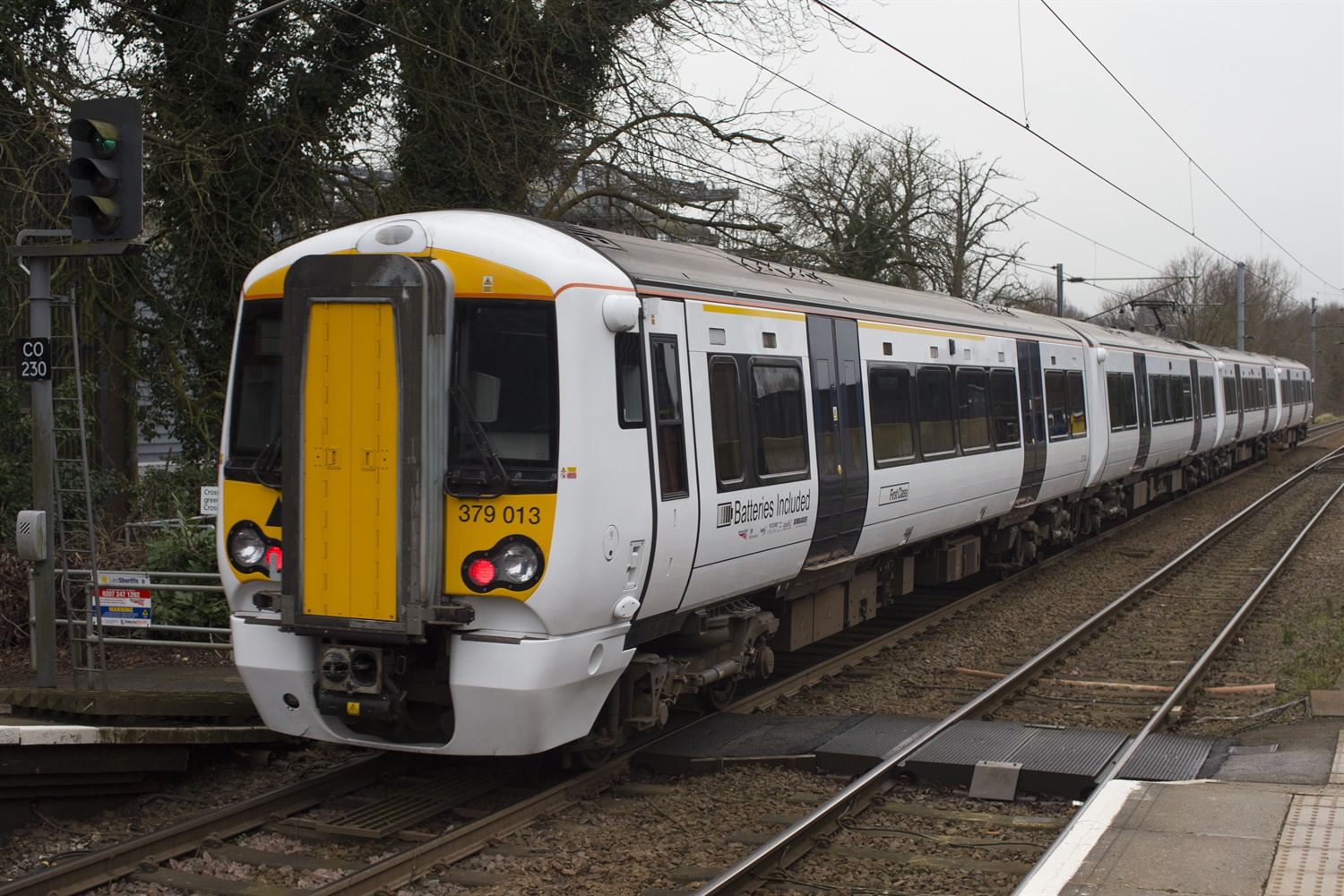
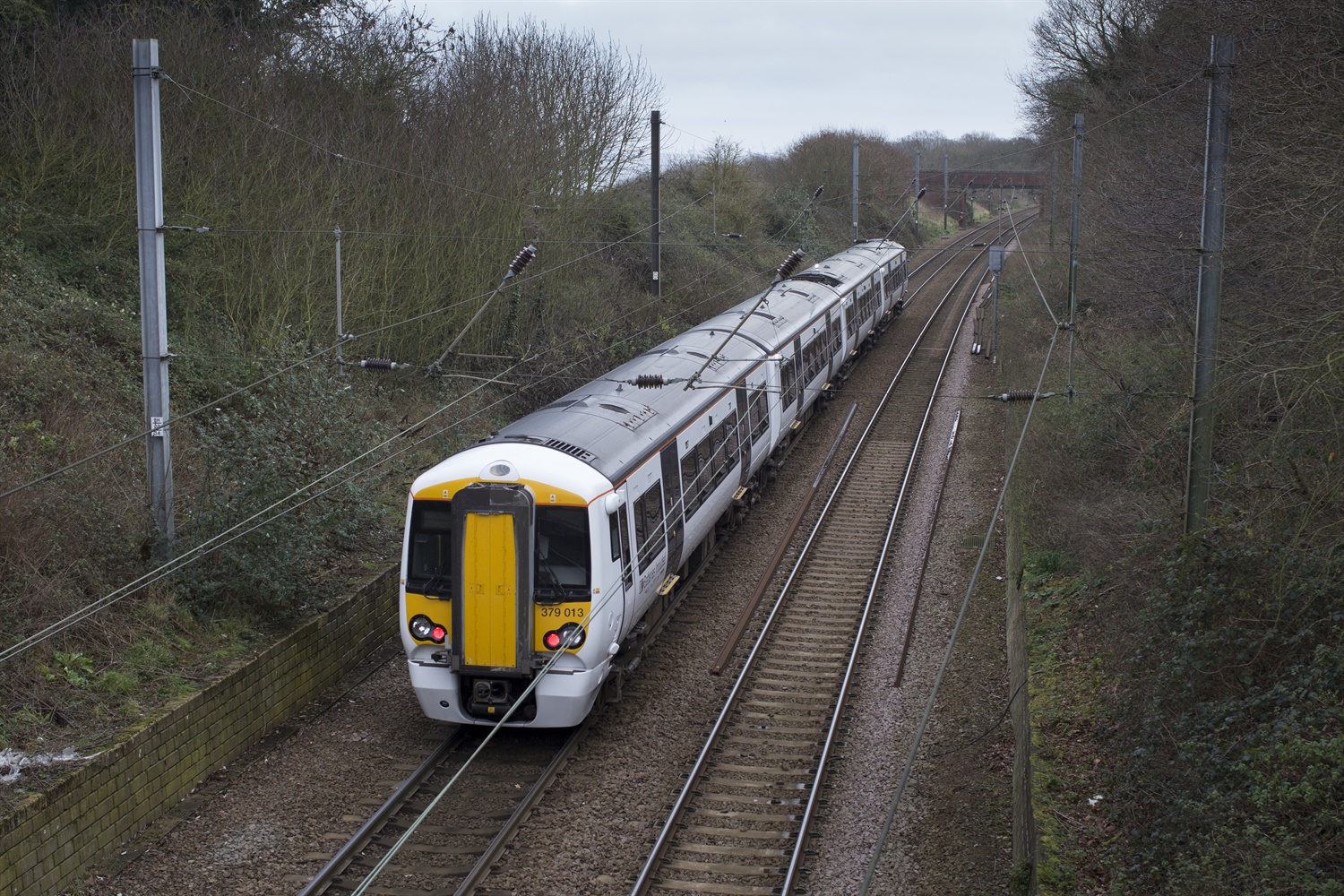
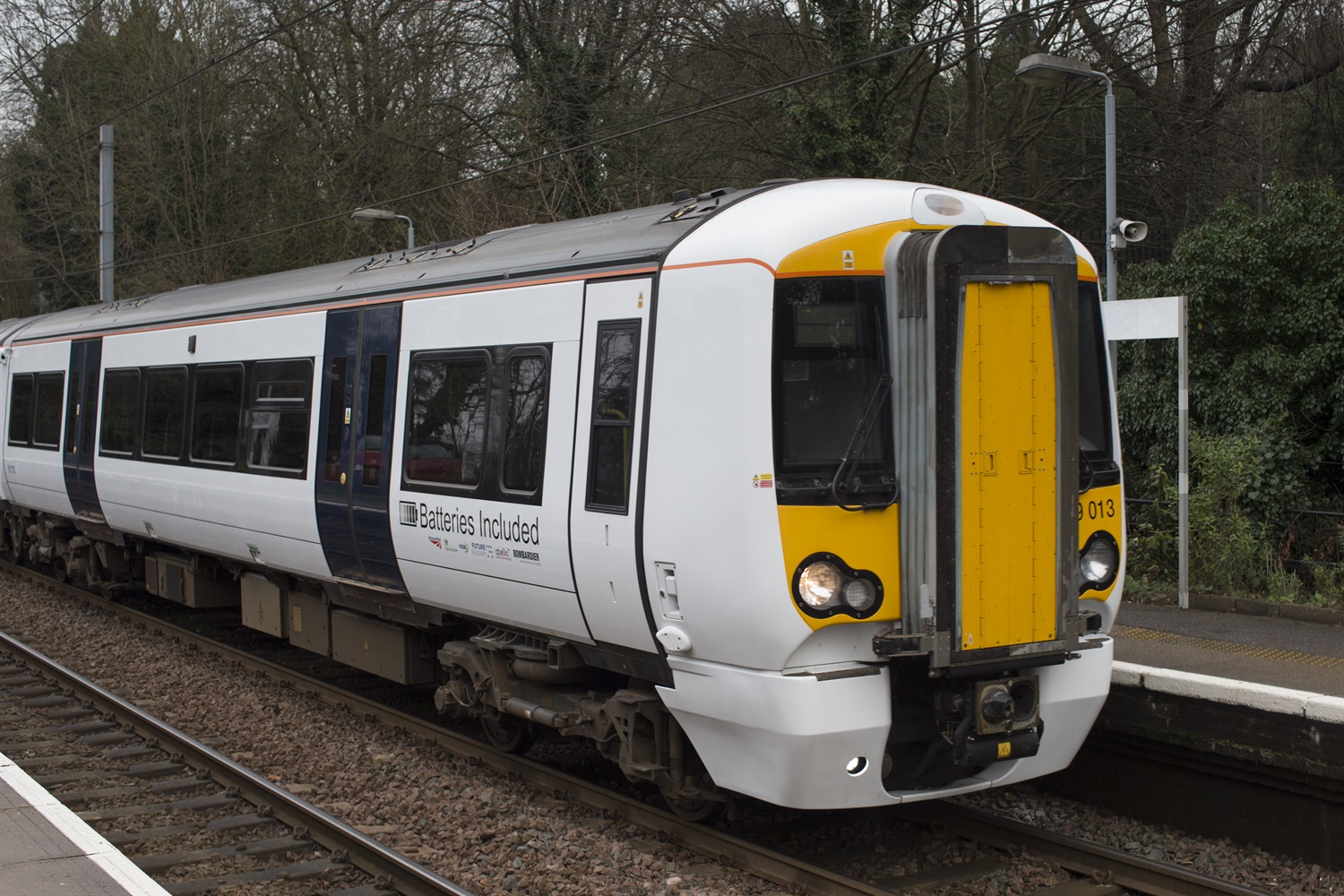
Ai??The first battery-powered train to run on Britainai??i??s rail network in more than half a century carries its first passengers this week.
The modified Class 379 Electrostar battery-powered train ai??i?? also known as an Independently Powered Electric Multiple Unit (IPEMU) ai??i?? will run in weekday timetable service for five weeks between Harwich International and Manningtree stations in Essex.
It was retrofitted and tested by Bombardier in Derby and Leicestershire. The IPEMU is a joint project between Network Rail, Bombardier, Abellio Greater Anglia, FutureRailway and the Rail Executive arm of the Department for Transport.
The partner companies involved in the project believe there is huge potential for battery-powered trains to bridge gaps between electrified parts of the network and to run on branch lines where it would be too expensive to install overhead electrification.
Data gathered during the experiment will be used to help the wider rail industry determine what form a future IPEMU will take, be it a straight battery unit or hybrid.
On the retrofitted Class 379, the DMOS, PTOSL(W) and DMOC cars are standard, but the MOSL car has been converted to a ai???Trailer Battery Car (BOS)ai??i??. The MCM (motor converter module), CET tank and power bogie have been removed, the pipework and cabling have been reconfigured because of equipment being relocated and the toilet is locked out. The auxiliary reservoir has been relocated to the DMOS, and six battery rafts have been installed, alongside new power cables, trailer bogie, a new button on the cab desk, an additional HMI screen, and data acquisition instrumentation.
The battery rafts fitted to the Class 379 unit contain a battery box, isolation switch, power distribution control panel, battery charging inverter, batteries and battery monitoring system, all mounted within a bespoke, purpose-built rig. Their creation follows the successful testing of several types of battery technologies, including lithium iron magnesium (which are being used for these tests) and hot sodium nickel salt.
A project update for the IMechE by Charles Twort of Bombardier and Sam Barrett of Network Rail said the trial performance targets were: a range of 50km (regional service); an acceleration and speed similar to a DMU; operational cycles of 30km battery and 50km overhead; a lifetime of five to seven years; and a ai???high level of intrinsic safetyai???.
Any future IPEMU would most likely be designed as a new train and not an adapted unit, to minimise energy consumption, but this project will also provide useful information for retrofit.
It could ultimately lead to a fleet of battery-powered trains running on Britainai??i??s rail network, which would be quieter and more efficient than diesel-powered trains, making them better for passengers and the environment.
Network Rail principal engineer James Ambrose said: ai???Weai??i??ve made terrific progress with this project so far and seeing the battery-powered train in timetabled service is a huge step forward.
ai???After months of engineering and testing, the train is running just as we would like it. Weai??i??ll be using this five-week period to gather data on how it handles during passenger service ai??i?? most travellers will recognise how quiet and smooth the ride is compared to a diesel-powered train.ai???
He continued: ai???We are always looking for ways to reduce the cost of running the railway and make it greener too. This project has the potential to contribute significantly towards both those goals.ai???
Rail minister Claire Perry MP said: ai???This is a major milestone in this innovative project, and further proof of our commitment to deliver a world-class rail network fit for the 21st century.
ai???These trains potentially offer a real alternative where diesel or electrified services arenai??i??t suitable, and I look forward to seeing the results of the trials.ai???
Battery locomotives have been used on railways for around 100 years, including in munitions factories during World War 1 to avoid the risk of explosion from sparks emitted by steam locomotives. London Underground currently has a fleet of battery locomotives used on engineering trains when the power is switched off for track maintenance and improvement work.
RTM readers have recalled the two-car battery powered train in use on the Aberdeen-Ballater branch from 1958, and the BR Southern Region motor luggage vans that used lead-acid batteries, for example.
Roger Capel noted on the RTM website: ai???The 1957 battery train (gather it was a BEMU!) was done in the same works as today’s IPEMU, using the two standard ai???Derby Lightweightai??i?? DMU bodyshells. At that time DB were putting battery railcars into service in Germany, but I think its immediate despatch to the wilds of Aberdeenshire indicates that it was a BR gesture.ai???
But the IPEMU is the first modern attempt to trial battery power for potential passenger services.
Nine days after Global BCai??i??s chief political reporter compared the current transit plebiscite campaign with the one that ended with voters axing the HST in 2011, North Vancouver resident Mike Barrenger outlined the confusion shared by many Metro Vancouver voters.
In essence, both men made a plea for reasoned consideration of the facts surrounding the $7.5-billion transportation and transit plan proposed by TransLinkai??i??s Mayorsai??i?? Council.
In his Feb. 20 letter to the editor (Transit Plebiscite: Vote Yes or No but Base it on Facts), Barrenger wrote, ai???Should we make this important referendum decision on the basis of incomplete and inaccurate facts? Absolutely not.ai???
And therein lies the reason for the growing heat being generated in the campaign ai??i?? what are the facts?
Remembering the 16-year history of TransLink and the 14-year history of broken promises by the B.C. Liberals we see little to persuade us to trust that the plebiscite language, as amended by Transportation Minister Todd Stone, is anything more than politically tweaked wording on a piece of paper.
The long-standing reasons for my distrust are many and still not as complete as Mr. Barrenger deserves them to be. Nonetheless, here are a few of the most important issues voters need to have addressed if they are to make an informed decision on their mail-in ballot:
The first few jump right off the pages of a side-by-side comparison between the mayorsai??i?? wording and the final version approved by the minister:
The mayorsai??i?? version called the vote a referendum on its proposed 0.5 per cent increase in the sales tax to be dedicated to the plan.
Stone not only altered ai???referendumai??? to read ai???plebisciteai??? he removed the words ai???independent audits and public reportingai??? from the question. Why?
To use Baldreyai??i??s analogy, the HST vote was binding; yet despite all the rhetoric flying out of the Yes side, the only thing certain about the ministerai??i??s version is that, should the vote go his way, youai??i??ll get an increase to the sales tax. But wait! That isnai??i??t even a sure thing because the minister changed its name to read ai???a new 0.5 per cent Metro Vancouver Congestion Improvement Taxai??? ai??i?? is that because itai??i??s easier to manipulate a congestion or carbon tax than the PST?
Next, Stone omitted ai???tunnelling along Broadwayai??? in favour of the fuzzier term ai???rapid transitai??? and, similarly, changed ai???Build light rail transit to connect Surreyai??i??ai??? to ai???build rapid transitai??i??ai??? Why?
To leave plenty of room to substitute still more overly-expensive SkyTrain projects to be built by SNC-Lavalin ai??i?? the corporation thatai??i??s challenging serious charges laid by the RCMP regarding its overseas dealings?
Then thereai??i??s the Compass Card.
Aimed at saving an annual $7 million in fare evasions (buzzer.translink.ca/2012/02/the-costs-of-fare-evasion/) we were told Cubicai??i??s system would cost $100-million. But as happens too often in this walk-all-over-us province, 100 soon became 171.
Today, $171M still not being enough for the San Diego company that specializes in ai???military defense equipment and fare collection systems,ai??? the cost sits at over $190M. Thatai??i??s 27 years of lost fare revenue before we break even. Why? Did none of our politicians think of ignoring past and present lobbyists and putting projects to a fair tendering process for a fixed-price contract?
For North Shore readers ai??i?? $75 million of those dollars would buy three new SeaBuses, leaving $115 million for a revamped Taylor Way intersection and other regional needs.
Now letai??i??s talk ai???improvedai??? congestion:
The Expo, Millennium and Canada Lines reduced congestion, right?
Please donai??i??t shout; itai??i??s rude.
If efficient public transit systems prevent congestion, the City of London I left in 1956 should have been a beacon to the world.
If transit was the be-all and end-all, why did traffic flow so smoothly during Vancouverai??i??s four-month bus strike in 2001?
The facts show that the root cause of congestion has many faces ai??i?? uncontrolled growth; failure to co-ordinate construction projects; developersai??i?? carts put before local infrastructure horses, lack of emergency controls and designated alternate routes in the event of major obstructions, out-of-date traffic-light sequencing, inflexible work schedules that cause daily peak rush hours ai??i?? all play a part in creating congestion.
Some interesting discussions of congestion issues and deterrents can be found at: roadpricing.blogspot.ca/2013/02/10-years-of-londons-congestion-charge.htmlAi?? and by Googling ai???Central London: congestion charging impacts ai??i?? sixth annual report.ai???
Finally, only because full commentary would be book-length, it is well worth considering an answer given me by Patrick Condon, a University of British Columbia professor with more than 25 years of expertise in sustainable urban design.
ai???The plebiscite,ai??? Condon said, ai???is a terrible idea.
ai???By foisting this on us, the province has abrogated its responsibility. It is the province that runs TransLink, not the mayors and it has been the province that has consistently chosen expensive transit systems ai??i?? the Millennium, Canada and Evergreen lines ai??i?? based on SkyTrain when local authorities, again and again, have favoured much cheaper light-rail systems,ai??? he said.
Explaining that those poor choices mean TransLink must pay for them ai???each and every year for decades,ai??? Condon concluded. ai???It is these debt-servicing costs that are contributing greatly to the need for the additional taxes that are now the subject of this plebiscite.ai???
I wonder how TransLink would fare? I guess we will see after the transit plebiscite.
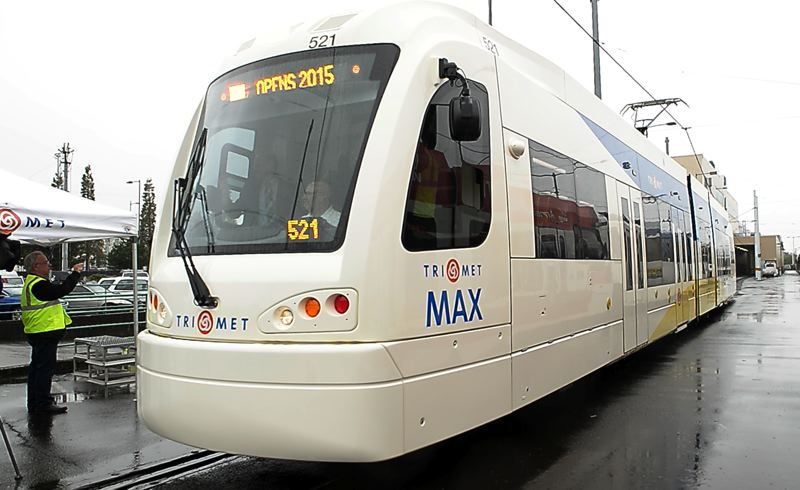
PORTLAND TriMet which runs the area’s bus and light rail system is seeing is public approval on the rise despite service issues and financial woes, The Oregonian reports:
“Poll: TriMet public approval rebounding despite MAX service problems, ongoing financial challenges By Joseph Rose The Oregonian/OregonLive on February 25, 2015 at 7:03 PM
Some 76 percent of Portland area residents approve of the way TriMet is being operated, according to the results of new “attitude and awareness” telephone poll.
That’s a sharp acceleration from this time last year, when a similar survey showedAi??the transit agency’s approval rating had slipped to 66 percent after a series of service cuts, fare hikes and controversies stemming from embarrassing safety lapsesAi??and secrecyAi??at the highest levels of the agency.
DHM ResearchAi??ran the survey of 1,000 Portland are residents over 16.
The poll, conducted in November, has a margin of error of 3.1 percent.
TriMet’s MAX light-rail system had a rough 2014, with switch and electrical problems causing rush-hour meltdowns and even a derailment.
Still, MAX service showed the biggest jump in public approval, from 69 percent in the last survey to 84 percent in the latest census.
TheAi??performance rating for light rail could continue toAi??improve in the coming years.
Meanwhile, 78 percent of respondents said they approved of bus service, an increase of 13 points compared to survey taken at the end of 2013.
“Both riders and non-riders rated the value of our service high,” said Mary Fetsch, a TriMet spokeswoman.
Fetsch said residents have an understanding of the importance of mass transit as the region grows.
DHM Research said the resurgence in TriMet’s public image is likely due, in part, to the post-recession restoration of frequent bus service and the resolution of the agency’s long, uglyAi??labor dispute.
Of course, TriMet still faces the significant challenge of paying for nearly $1 billion in pension and retirement health-care commitments without cutting service or increasing fares to the point where regular commuters stop riding.
Riders gave higher overall satisfaction ratings – 87 percent in 2014 – than in 2013 (at 83 percent). Meanwhile, most non-riders – 84 percent — said they value the benefits TriMet provides to the region.Ai??
Frequent and regular riders used TriMet most often to commute to work and school, with 75 percent saying the fare value was excellent or good.
Occasional and infrequent riders used TriMet most often to get to “recreational activities” such as sporting events, withAi??”personal business” coming in second. About 65 percent of occasionalAi??riders were satisfied with the value of the cost to ride.
People are well aware of the coming Portland-to-Milwaukie MAX Orange Line. Awareness of the project ranked at 80 percent. “Respondents said the main benefits of the new line included reducing traffic congestion, connecting parts of the city and expanding public transportation,” according to a TriMet report on the survey.
78 percent of respondents knew about the Orange Line’sAi??Tilikum Crossing bridge, which has slowly become part of the downtown skyline over the past three years.
Actually it is not a myth, transit customers do prefer rail to buses. The study does leave out the fact that rail’s operating costs can be much less than buses because the tram can operate in multiple units, thus with one driver carrying more passengers.
In the end though, transit customers perceive that BRT is just a bus operating on a tarted up rights of way and for all intents and purposes, BRT is just a bus.
If BRT or guided bus had preformed much better in the past, maybe the mode would be seen in a better light, but BRT tends to cost more and carry less customers than what those promoting the mode had promised.
It must pointed out that the so-called BRT mentioned in the Mayor’s Council’s transit proposals is not BRT at all, rather just a B-line limited stop express bus, with no signal priority at intersections nor a proper BRT guide-way.
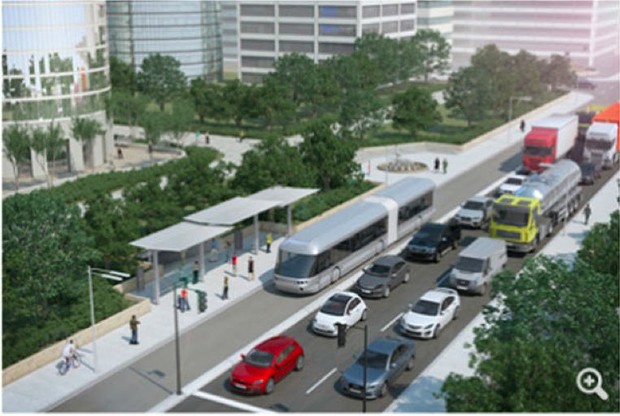
Take a look at the image above. This rendering represents modern bus rapid transit service. The BRT vehicle travels in its own separate lane, free from the constraints of traffic congestion or traffic lights. The bus is sleek and the shelter is pleasant. If you could see the boarding procedure, too, you’d find that passengers buy their fares ahead of time, enabling them to enter quickly through any door, just as they do on a train.
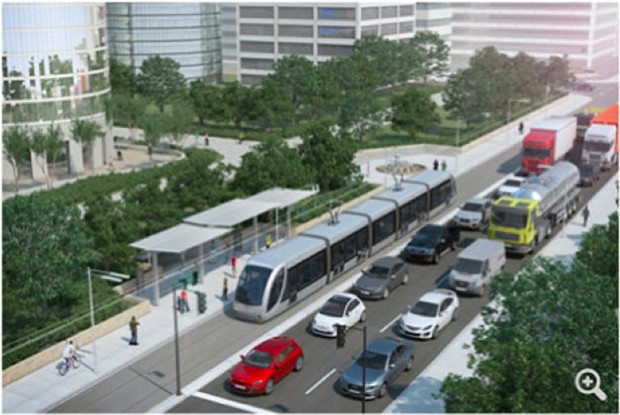
Now take a look at the image below, which shows a modern light rail service. The scenes are remarkably similar. This train travels in the same dedicated lane and even has the same style. The only real difference you’ll find, if you look very close, is the faint sign of tracks on the ground.
Given what we know from these two pictures alone, there’s no reason to suspect these two ridesai??i??modern BRT or modern light railai??i??would be noticeably different experiences. And yet when transport scholars David Hensher and Corinne Mulley of the University of Sydney Business School showed these images to about 1,370 people in six Australian capital cities, the difference in preference was enormous.
For the study, Hensher and Mulley gave survey respondents the two images above, plus two others whose only difference was older-looking vehicle styles (one bus and one train), and asked them to rank the four images in terms of “which one you would like to travel in most.” They found that 55 percent chose the modern light rail image, and another 18 percent chose the older light rail. Only about 17 percent chose the modern BRT. Just 10 percent chose the classic old bus.
I wonder if the Board of Trade would be supporting TransLink’s initiative if their members had to come up with $300 or $400 million for transit improvements or if their members had to pay for the extra cost of subway construction under Broadway?
An artistai??i??s impression of the Parramatta light rail, which a group of businesses want extended to Sydney Olympic Park.
A CONSORTIUM of up to 20 high-profile businesses have formed the West Line Alliance, offering to tip in hundreds of millions of dollars to bring the Parramatta light rail link to Sydney Olympic Park.
The business group hopes to bankroll the project and make the Olympic Park line the State Governmentai??i??s preferred route for stage one, with a final announcement expected before the State Election.
The West Line Alliance includes corporate heavy-hitters such as Goodman Fielder, General Property Trust, Australian Turf Club, Accor Hotels and ANZ Stadium and has brought a number of influential business leaders to the table.
Big business is pushing for a light rail link from Parramatta to Sydney Olympic Park.
Until now, the favoured route for the first stage of the Parramatta light rail link was to Macquarie Park via Carlingford.
The route, one of four options outlined last year, has been the frontrunner because the land corridor to Carlingford has Ai??already been reserved for heavy rail and could be built faster and cheaper.
Parramatta MP Geoff Lee and Parramatta City Council have championed the Carlingford line.
However, the alliance wants the government to consider moving on the Sydney Olympic Park link sooner rather than later.
Sydney Business Chamber Western Sydney director David Borger.
The government is examining four potential corridors before it choses a light rail route
Convened by the Western Sydney chapter of the Sydney Business Chamber, the alliance wants to use a ai???value-captureai??i?? funding model which sees beneficiaries of infrastructure stumping up money for the project.
Western Sydney Business Chamber director David Borger said the link could be partially funded through contributions from developers along the route.
ai???If they are going to spend $1 billion building a light rail link, well there could be a few hundred million dollars from the private sector to do two routes rather than one,ai??? he said.
Rosehill Gardens racecourse is on the proposed route to Sydney Olympic Park.
ANZ Stadium is part of the West Line Alliance behind the push.
ai???If they are going to build a link to Macquarie Park, then build one to Sydney Olympic Park at the same time, or bring it forward rather than a stage two project.
ai???It pushes the public dollar further and makes sense for the beneficiaries of the light rail to make a contribution.
ai???The Gold Coast has levied all the businesses along the light rail route to fund the build and we need to consider all options in terms of public-private funding.ai???
Mr Borger has been a long term supporter of a route from Westmead to Sydney Olympic Park via Camellia.
ai???There is a real opportunity here to connect Westmead, Parramatta and Sydney Olympic Park as one city,ai??? he said.
ai???I just think western Sydney hasnai??i??t been able to capture a lot of knowledge jobs,ai??? Mr Borger said.
But Mr Borgerai??i??s suggested route would require an extension northwest from Parramatta to Westmead, which was not one the four preferred routes released by Transport Minister Gladys Berejiklian late last year.
The business chamber said the Parramatta light rail project had the potential to transform the region and support Parramatta as Sydneyai??i??s second CBD.
The chamber said the project should be prioritised because of its potential to stimulate economic growth and housing supply in western Sydney.
ai???A stark jobs deficit remains as 200,000 people leave the region for work each day and this is forecast to grow to more than 400,000 by 2051 without drastic action,ai??? a statement from the chamber said.
Torstar News Service VIVA Rapid Transit, launched in 2005 to carry residents across York Region.
York Region is starting to feel the burden of carrying the highest per capita debt load in the GTA, and is pulling back on infrastructure projects to rein in borrowing costs.
Yorkai??i??s debt has climbed to $2.54 billion and is expected to peak at $3.7 billion by 2020.
For years, the regionai??i??s debt repayment plan has been dependent on development charges from current and future construction of homes in booming cities such as Markham, Vaughan and Richmond Hill. (Levies collected help cover the cost of money borrowed to build infrastructure such as water and sewage pipes.)
Despite fast-tracking projects and a relatively strong housing market, development charges arenai??i??t keeping up with debt repayment. Almost 85 per cent of Yorkai??i??s debt is based on what it hopes to recover from development fees.
ai???We assumed higher growth in the early years, followed by slower growth in the later years,ai??? said Edward Hankins, director of the Treasury Office for York. ai???But because of the economic recession, some of that growth has not occurred as quickly as we thought.ai???
Officials admit the development charge collection plan is volatile and largely dependent on how the economy fares. Heavy reliance on such fees could leave York taxpayers facing two unfavourable options down the road to cover debt: higher taxes, or more sprawl to keep the development fees coming in.
According to a 2013 report, development levies collected over the past decade amounted to an average of $173 million a year. In 2014, the region reset the rates and collected $250 million, Hankins said. The region is anticipating $330 million annually in 2015 and 2016 ai??i?? even though such numbers have never been met.
But he is optimistic.
ai???York is going to grow. Itai??i??s one of the fastest growing municipalities in Canada. Itai??i??s just a question of how quickly it will grow,ai??? he said.
Yet there have already been consequences to the regionai??i??s aggressive build plan and high debt, according to the 2015 proposed budget document, which is up for discussion this month.
S&P recently downgraded the regionai??i??s credit rating from AAA to AA+, over concerns the region was spending too much and taking on too much debt. To slow down spending, York Region Council decided to delay certain projects, including the Upper York water reclamation centre and water and sewage projects in Vaughan.
The projects could be restarted if growth proves to be faster than expected, or development charge funds improve.
So, the regionai??i??s new focus is building up its reserve funds, Hankins said.
The $1.7 billion currently held in reserves, second in the region only to Torontoai??i??s, is being spent faster than the revenues coming in. By 2017, the depletion trend is expected to reverse, said Hankins.
Critics warn that Yorkai??i??s strategy will put it in much the same straits Peel Region now faces.
ai???Mississauga was able to collect development fees and use them to subsidize tax freezes,ai??? said Sony Rai, a member of the environmental group Sustainable Vaughan. ai???Fast-forward 30 years and now Peel Regionai??i??s infrastructure replacement and repair bill is causing tax increases.ai???
Paul Bottomley, York Regionai??i??s manager for growth management, believes the growth anticipated in the region by 2031 will surpass what is needed to pay off the debt.
According to a land assessment report from 2009, the region anticipates some 1.5 million people will move in over the next two decades. It also expects to add 229,300 housing units over that period, almost 40 per cent of those single-family homes ai??i?? the most lucrative type when it comes to development fees.
A single or semi-detached home brings in $37,720 in development charges. A condo of less than 700 square feet brings in almost $15,865.
But some environmentalists worry that Yorkai??i??s debt repayment policy is not sustainable and is a model destined to fuel sprawl.
ai???They are so far exposed in terms of debt and paying for that with development charges ai??i?? and the only way they can see forward is to keep doing more of it,ai??? said Tim Gray, executive director with the advocacy group Environmental Defence.
He believes that as the region builds out, there will eventually be pressure on the protected Greenbelt lands, where new development is forbidden.
Gray believes that with the provincial Greenbelt review taking place this year, the region could contemplate actively moving toward a high-density model, instead of ai???simply digging itself deeper into the hole.ai???
ai???They need to figure out how we can modify development charges so that revenue can be obtained from denser development,ai??? he said. ai???And if you arenai??i??t building new infrastructure that extends far into the countryside, then your costs are lower,ai??? he said.ai???So you can transition to a new funding model.
ai???But in the short term, and with so much debt on them, itai??i??s a hard sell.ai???
Anyone who thinks they can read between the lines of the two sets of council votes this week ai??i?? about the Scarborough subway and Smart Track ai??i?? should remember that what weai??i??re seeing now at City Hall is merely political foreplay.
The four quick votes against Josh Matlowai??i??s administrative inquiries into the Scarborough subway cost/corridor questions tell us nothing about councilai??i??s ultimate intentions with regards to that $3.4 billion-and-counting monument to Glen de Baeremaekerai??i??s insecurities. Nor does the impressive 42-2 vote in favour of the Smart Track studies reveal evidence of unity of purpose.
Rather, what really matters is that point off in the middle distance where these two sets of transit mega-project proposals, and their respective price-tags, intersect. Because they will, and that collision will likely occur approximately a year from now ai??i?? a kind of supercollider for Torontoai??i??s latest transit ambitions.
City and Metrolinx officials will spend much of the rest of 2015 analyzing the various configurations, how the two routes interact with one another, and how Smart Track fits into the provinceai??i??s $15 billion Regional Express Rail plan. At the same time, the Scarborough subway scheme will be subject to an accelerated approvals process that will look at corridor configurations, lengths, stations, etc.
But the crucial money/financing questions wonai??i??t hit council until next spring, at the earliest, and thatai??i??s when the bonfire of the vanities will begin in earnest.
As an aside, one of the reasons Torontonians are chronically confused about transit is that transit reports wash up on councilai??i??s agenda so frequently, and repeatedly, that itai??i??s often difficult to identify genuine decision moments. As the councillors well understand, those moments occur when they agree to spend or borrow money, and vote on motions that end in phrases such as, ai???authorize city officials to enter into agreementsai??i??ai??? We had one of those moments in the fall of 2012 ai??i?? when the City, the TTC and Metrolinx signed a master agreement to build the four LRT lines. Weai??i??re now facing the $75 million consequence of reneging, which is how you can tell it was a real decision.
Problem is, itai??i??s not always easy to determine where in the process the money vote will occur. Sometimes, what feels like the ninth inning is actually only the seventh inning (Exhibit A: the Scarborough subway vote last spring). But as I said, the councillors all know.
While city officials laid out a process and rough time-table at council this week, several externally-imposed financial imponderables could derail the process ai??i?? most notably the federal contribution to Smart Track. No one, including John Tory, has the foggiest idea how that one will play out. Until we all know the answer to said riddle, the rest is up in the air. After all, the quantum of the provincial contribution to Smart Track is obviously a function of the size of the federal investment. As long as we donai??i??t have answers, sit back and watch for more foreplay.
Amidst all those question marks, my sources tell me that city staff, once they turn their attention to the money issues, will make sure that council is presented with the full financial picture. After all, the combined price tag for Smart Track and the Scarborough subway could easily exceed $12 or $13 billion ai??i?? a substantial, though undetermined, portion of which will come from property taxpayers, development charges and city-issued debt.
Given that the cityai??i??s debt-service ratio will be perilously close to the mandated 15% ceiling by 2020 (the current level is 12%), itai??i??s clear that decisions on the two lines canai??i??t be made independently, both for financial reasons and also in terms of transit effectiveness.
Another piece of analysis we wonai??i??t see until next spring is city staffai??i??s take on the revenue potential for Toryai??i??s tax increment financing (TIF) scheme, which involves borrowing funds for infrastructure investment and paying down the debt using taxes generated by increased property assessment. During the election, candidate Tory claimed TIFs along the Smart Track corridor would bring in $2.6 billion.
What City officials will do, over the next year, is develop various scenarios for what kinds of revenues the City can actually expect, based on low, average and high-growth development projections on the corridor. Theyai??i??ll also quietly canvas the bond markets to see whether TIF notes will sell, and for how much.
The politically expedient move for Tory and his backers would simply be to believe the most optimistic revenue scenario, and choose accordingly. But the reality is that the capital markets will have to absorb a massive release of City of Toronto debt, which is secured against investment decisions that may not happen for decades and are subject to macro-economic unknowns. Indeed, investors have never seen City of Toronto TIF bonds before. The markets will price accordingly, but itai??i??s safe to assume the City will pay a premium ai??i?? i.e., higher servicing charges on the operating budget ai??i?? because it will be pushing out so much speculative debt on top of all the other borrowing the City does in normal course.
Bottom line: if council wants to limit the Cityai??i??s exposure to costly debt charges, it may have to consider additional revenue tools to finance Smart Track.
All the while, more granular cost estimates on the Scarborough subway will come into sharper focus, and I fearlessly predict those numbers will go up every time de Baeremaeker and Scarboroughai??i??s newest grievance-monger, Jim Karygiannis, open their mouths.
In the past, council has tolerated project budget inflation due to mission creep or unexpected complexities, e.g., St Clair right-of-way, Queenai??i??s Quay, Union Station. But the foregoing mega-projects pale in comparison to the Scarborough subway, raising the spectre of mind-boggling budget overruns.
Consider the yelling about the Union Station revitalization, which has seen its cost jump by $80 million, to $795 million. But a 10% increase or overrun on the Scarborough subway budget, a figure that is significantly less than the contingency on the Queenai??i??s Quay revamp, could top $350 million or more, enough to pay for half the Queenai??i??s Quay East LRT. And that number may only be part of an equation that includes additional outlays for Smart Track due to higher borrowing costs, lower-than-expected federal transfers, etc.
Point is, the financial uncertainties associated with one will affect the viability of the other.
About a year or so from now, council will be asked to cast votes on reports that include numbers with dollar-signs, and theyai??i??ll likely be requested to make choices about how to mitigate those very large costs. Among those choices will be service scenarios generated by the cityai??i??s expert transit advisors that reveal the redundancy writ large on these two parallel sets of rapid transit schemes.
So ask yourself this question: if Tory and the rest of council have to choose between these two megaprojects in order to mitigate the cityai??i??s long-term financial risk, which one will they throw overboard?
From where I sit, it seems almost inevitable that weai??i??re barreling down the tracks towards a political either/or moment.
Trams that never have to stop for traffic lights could be the norm in Melbourne in the future, under plans being developed to deal with population growth in the city.
For the past seven years, VicRoads has been using mathematical modelling to figure out how changing conditions – such as traffic light frequency and clearway times – affected traffic flows.
VicRoads director of network policy and standards Andrew Wall said public transport was the focus of future planning because of its ability to carry far more people.
“We’ve used the model to assess what happens if we for example give absolute priority to the tram, which means that when a tram gets to a set of traffic signals, it never has to stop,” Mr Wall said.
“The model lets us look at those sort of situations, so it’s giving us some insights into how hard we can push the traffic signal system to give priority to trams.”
With Melbourne’s population projected to hit just under 8 million by 2053, Mr Wall said the roads authority had to look at “clever ways to move people around the network”.
“The focus on moving people is probably the critical thing for us,” he said.
“We want to set the road network up and the traffic signals up so we’re maximising how many people we move, not necessarily how many vehicles.
“Over time we have given more and more priority to trams, and we’re likely to give even more in the future.”
The mathematics of being stuck in traffic
Professor Jan De Gier and Dr Tim Garoni began working with VicRoads in 2008, as part of an internship with the Australian Mathematical Sciences Institute and the ARC Centre of Excellence for Mathematics and Statistics of Complex Systems.
Since then the University of Melbourne researcher has been applying the basic principles of mathematical physics and statistical mechanics to roads in a unique way.
“We studied simple particle models in mathematical physics and noticed that some of these ideas were actually applicable to traffic flow, so we could use very efficient models and intuitive ideas that we learned over the years, in the modelling of traffic,” Professor De Gier said.
“You can view cars and buses and trams on a traffic network as simple particles, so you ignore a lot of the details that are inessential for traffic.
“If you model particles flowing through on a graph … and you set up the rules properly, you’ll see that they behave very much like traffic, so they spontaneously form traffic jams, and other things.”
Mr Wall said Professor De Gier’s team had essentially created “a sandpit” that allowed the authority to try out any number of traffic scenarios.
“So they’ve provided the tool, it’s up to us to use the tool to help inform decisions on how we operate the road network,” he said.
He said mathematics was being used in similar ways in European countries like Germany and Switzerland because it was a cheap and effective alternative to tradition modelling.
Mr Wall said using mathematical modelling was actually more informative than conducting real world traffic tests.
“We did a [real world] trial around Kew, a network of around 50 intersections, over four weeks, where we ran the traffic signal system differently on a day-on, day-off basis,” he said.
“What we found with that is that the variability in traffic from day to day made it really difficult to assess whether we were having an impact.
“So that sort of pointed us to that there’s got to be another way to analyse and assess the changes, which led us to a discussion with some mathematicians on a different approach to how we might do this.”
To develop a sophisticated traffic model of each individual road, intersection and vehicle in detail would cost between $500,000 and $1 million, Mr Wall said.
“This model can be set up for that same network for a fraction of that cost and lots of different options tested.”
Professor De Gier said the method meant that they could see how changing parking policy, tram frequency and traffic light intervals affected the network several kilometres away.
“VicRoads didn’t have tools to model traffic on a network, so all they could do was model in a few intersections or very global origin-destination modelling,” he said.
“What we can do with them is simulate suburbs or collections of traffic intersections of about 100, and see how traffic evolves on such a network if we change certain things.”
Street parking benefits trams
One of the surprises that has come from his research came from when his team modelled the effect of clearways on tram times, Professor De Gier said.
“The traditional thought was that if you have clearways all day then that would be good for cars and trams,” he said.
“It turns out that [with clearways] cars overtake trams and can obstruct the tram at the next intersection.
“So having parking provides a gating effect for trams who can then move through the network better.”
For the first time this year, Professor De Gier’s team will not be looking at generic traffic models, but will be looking at a specific area – Melbourne’s inner north.
Much of this research will be done at Monash University by research fellow Joyce Zhang of the new ARC Centre of Excellence for Mathematical and Statistical Frontiers.
“They’re extending the use of this model to look at the road network in the inner north,” Mr Wall said.
“So while we’re using this as a generic tool to look at networks, it’s actually being applied to look at the whole road network in the inner north and how that might work in the next 10 or 20 years.
“There’s a lot of north-south tram routes in that area, there’s a lot of population growth happening on those roads and to able to cater for that population growth, we need the north-south tram routes to work really well in terms of moving people.”
TransLink CEO Ian Jervis has been made to “walk the plank” in an attempt to appease the No side of the upcoming plebiscite.
A quote from Oliver Cromwell comes to mind, when he dismissed the rump parliament.
You have sat too long for any good you have been doing. Depart, I say, and let us have done with you. In the name of God, go!
Many will see this as merely rearranging the deckchairs on the Titanic and one wonders how many more people will forced to “walk the plank?”
TransLink CEO Ian Jarvis steps down ‘to restore public confidence’
Ai??The board decided to replace Jarvis ahead of a controversial plebiscite in Metro Vancouver this spring that will ask the public to approve a 0.5 per cent sales tax to fund transportation expansion
By Kelly Sinoski, Vancouver SUN
TransLink CEO Ian Jarvis has stepped down, effective immediately “to restore public confidence” in the transportation authority, said board chairwoman Marcella Szel.
Photograph by: Jenelle Schneider, Vancouver Sun
===
METRO VANCOUVER – Ian Jarvis has stepped down as TransLink CEO, effective immediately, in an attempt “to restore public confidence” in the transportation authority, said board chairwoman Marcella Szel.
The decision was made to replace Jarvis ahead of a controversial plebiscite in Metro Vancouver this spring that will ask the public to approve a 0.5 per cent sales tax to fund transportation expansion across the region.
Doug Allen, who most recently served as president and Chief Executive Officer of InTransit BC, will replace Jarvis on an interim basis.
“The decision was not taken lightly,” Szel said. “We believe it’s the right thing to do. We need to build public confidence at TransLink.”
A search committee has been established by the board of directors to undertake a comprehensive search for a new CEO. This search is expected to take several months.
Jarvis, who has served TransLink since 1999 and as CEO since 2009, will act an advisor to the board until the conclusion of his contract in June 2016. He will continue to be paid his salary, while Allen will also be paid $35,000 per month for the next six months.
“We are not particularly happy paying two CEO salaries for a year-a-half,” Szel said. “But it was the board’s view to change leadership and change leadership now.”
She said the board has been concerned about public confidence at TransLink for some time, especially over complaints about SkyTrain breakdowns and the Compass Card, and “is listening to customers and the public regarding the need for change and has taken action.”
TransLink will use Jarvis’s expertise while counting on Allen to bring “fresh eyes” and more accountability and transparency to the transportation authority, she added.
She said new leadership is needed both before and after the plebiscite, which will determine whether TransLink will have more funds to expand the system or continue as it is now.
“We need new vision and new strength to lead us through that phase,” she said.
The new CEO will oversee a $10-billion transportation system and $1.5 billion dollar operating budget, 6,700 employees, and
TransLink’s operating companies: Coast Mountain Bus Company, BC Rapid Transit Company, and Transit Police. Building a better relationship with customers and key stakeholders will be paramount.
Allen recently served as president and Chief Executive Officer of InTransit BC, the company that built and operates the Canada Line.
Allen is not a candidate for permanent CEO and will work directly with the Board of Directors in recruiting and selecting his successor.
“During this transition period, Mr. Allen will provide excellent leadership on all priorities, including meeting aggressive targets on the Compass program, implementing recommendations from the independent review of the SkyTrain outages, and moving forward on actions to improve safety and service for our customers,” said Szel.
 The TTC recently announced that










Recent Comments