LIGHT RAIL FIRM RELEASES INDEPENDENT ANALYSIS OF KEVIN FALCON TRANSIT STUDY
UPDATE:
Media so far
News1130Ai??http://www.news1130.com/news/local/article/187220–rail-group-provincial-report-biased
Chilliwack TimesAi??http://www.chilliwacktimes.com/news/False+assumptions+worry+rail+expert/4325083/story.html
Laila Yuile (2nd item in the post) Ai??http://lailayuile.com/2011/02/22/government-is-as-government-does/

LIGHT RAIL FIRM RELEASES INDEPENDENT ANALYSIS OF KEVIN FALCON TRANSIT STUDY
“The MoTi had formed their conclusion prior to commissioning the report, and the evidence in the report has beenAi??selectively incorporated, in order to substantiate the conclusion that they wanted to see.”
“The BC MoTI and TransLink appear to have predefined that Bus Rapid Transit [BRT] was the only option and theAi??report was to prove that point of view.”
BC Liberal Responses to Fraser Valley Transit Survey

Flagship BRT Fizzles in the USA

Bus Rapid Transit or BRT is the transit flavour ‘du jour’ of BC politicians. Any mention of transit in the region ultimately leads to BRT, as if it was the grand panacea to solve our transit woes. The trouble is, our politicos have never read a book about public transit,Ai??let aloneAi??perused the chapter on buses.
A bus can never compete against rail transit unless it is guided or operates on a specially created busway, but when such investment is made for buses, the costs rise significantly and nears that of light rail. When one compares the benefits of “rail’ versus bus, transit experts will usually recommend a slightly more expensive ‘rail‘ line as it would provide more bang for ones buck.
For over fourty years, bus manufacturers have tried to provide a bus alternative to light rail and to date have not found the winning formula. From busways andAi??guided-bus in the 70’s and 80’s, to Guided Light TransitAi??Ai??in the 90’sAi??until now, except for small installations here and there around the world, the BRT transit alternative has stalled.
BRT, like light-metro, isAi??a niche market transit systemAi??simply because for a few dollars moreAi??in the case of BRT orAi?? for a whole lot of dollarsAi??less, as in the case of light metro, one gets a bigger bang for ones investment with light rail.
In BC,Ai??the Bus Rapid Transit being talked about isn’t even BRT, but TransLink speak for express buses, asAi??BRT or rapid bus seemsAi??more grand when one says it. Sadly, for many transit customers a bus, is a bus and taking the care is just easier.
Bristol withdraws busway support
Wednesday, February 9, 2011 11:15 PM EST
http://www.newbritainherald.com/articles/2011/02/09/news/doc4d535ee5dd51d826362666.txt
By Steve Collins
Staff Writer
BRISTOL ai??i?? Convinced that commuter rail is key to Bristolai??i??s future, the city has taken a formal stand against the proposed $573 million busway between Hartford and New Britain.
ai???Connecticut has got to stop spending money, our money, on short-sighted solutions that arenai??i??t really solutions at all but more like a finger in the dike,ai??? said Mary Alford, a member of Bristolai??i??s Transportation Commission.
ai???We need a long-range plan for transportation here and the busway isnai??i??t it,ai??? she said.
The move to endorse commuter rail instead of the busway reverses the cityai??i??s 2004 endorsement of the busway project. It follows the lead of Newington, whose town council recently yanked its support for the busway as well.
The only opponent of the City Councilai??i??s decision was Mayor Art Ward, who did nothing to try to convince colleagues they were wrong.
Instead, Ward said he was obligated to continue his support for the busway after promising New Britain Mayor Tim Stewart and others last winter that he would go along with the project out of a spirit of regional cooperation.
Mike Nicastro, head of the Central Connecticut Chambers of Commerce, said Wednesday he was ai???absolutely thrilledai??? to have the cityai??i??s backing for the rail alternative.
ai???Iai??i??m very, very proud of that,ai??? Nicastro said.
Supporters of the busway argue that itai??i??s crucial to the economic development of New Britain and Hartford, important to Central Connecticut State University and a good way to use lots of federal money to create construction jobs in the region soon.
But Bristolai??i??s Transportation Commission, after reviewing the plans, said that its use of the old Highland rail right of way between New Britain and Newington would gut hopes for the revival of rail travel between Hartford and Waterbury.
In a statement endorsed by city councilors, the panel said the busway ai???will negatively alter the ability to improve the transportation landscape of the City of Bristol and adversely affect its future; especially its economic future.ai???
Alford said that creating the busway would ai???hurt Bristol while not building the busway will not hurt New Britain.ai???
She also questioned its cost and whether promised federal funds would ever arrive.
City Councilor Kevin Fuller said the cityai??i??s position would be delivered Thursday in person to Gov. Dannel Malloy, who has the power to kill the busway.
New French Tramways
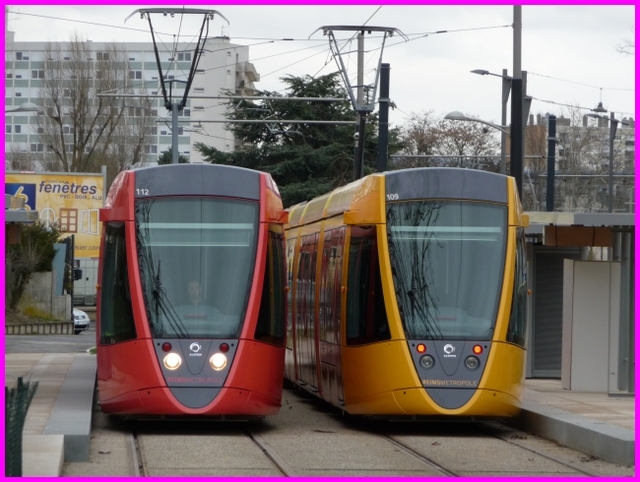
Reims Tramway is under test:-
http://www.lunion.presse.fr/article/marne/le-tram-a-lepreuve-du-feu
http://www.tramwaydereims.fr/start.html
http://en.wikipedia.org/wiki/Reims_tramway
and http://www.lineoz.net/forum/viewtopic.php?f=1&t=10893&sid=66eedf4b75d814adaceb51ca2f60e00f&p=306994#p306994
Map of the system:-
http://www.mars-reims.fr/images/Panneau%20CITURA%20(800×1200).pdf
Information on French Light Rail/Tram systems at:
http://www.transbus.org/dossiers/tramway_projet.html
Images of the new Alstom Citadis 302Ai??LRV’s

Worlds 1st NGV Tram system to open in 2012
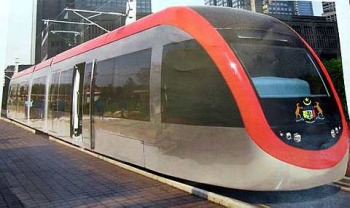
Melaka [Malaysia] Tram to open to public in 2012
AYER KEROH — Train maker, Mrails International Sdn Bhd expects its RM272 million Melaka Tram, the first natural gas vehicle (NGV) powered tram in the world, to open to the public in May next year.
New Strait Times 19 February 2011
http://www.nst.com.my/nst/articles/MelakaTramtoopentopublicinMay2012/Article/#ixzz1EUjwyIAq

Susan Heyes and the Canada Line fiasco – Justice denied!

The Canada Line was never about providing good public transitAi??for the region, rather the metro was all about political and corporate prestige. The Vancouver International Airport gang wanted a prestigious metro to connect YVR to downtown Vancouver, for corporate prestige because they thought that a metro would make YVR ‘world class’; the City of Vancouver wanted a subway for political prestige because the city fathers thought that a subwayAi??would makeAi??the city ‘world class’; and the Premier of the province, wanted a P-3 project, for political prestige, to sell voters on a ‘world class’ financing system. Anyone who got caught in the way of this prestigious ‘world class’ runaway train, were simply steamrollered -Ai??such was the fate suffered by Susan Heyes.
Despite the hype and hoopla by TransLink and their allies in the mainstream media, theAi??$2.5 billion to (according to some sources) $2.8 billion Canada Line’s performance is somewhat mediocre, with much of its ridership made up of previous bus customers, $1 a day U-pass students and YVR workers riding free on Sea Island. To add more insult to the regional taxpayer, for about $1.5 billion less, the region could have got a longer and more flexible light rail line from Steveston & YVR to downtown Vancouver, offering more customer benefits than the present metro.
The political chicanery with the Canada Line started at the beginning, with a totally unrealistic price of $1.3 billion for the 19 km.Ai??subway line andAi??as costs spiraled out of controlAi??the scope of the metro project was greatly reduced to contain costs.
- Stations were designed to accept only three car trains.
- The switch from SkyTrain to a conventional metro was made to save money on the reaction rail, made necessary by the Linear Induction (LIM)Ai??motors used by the proprietary SkyTrain system.
- The terminal stations in Richmond and YVR are single track stubs that can handle only one train at a time and there is no runawayAi??tunnel in Vancouver with a cement wall only metres away from where the train stops.
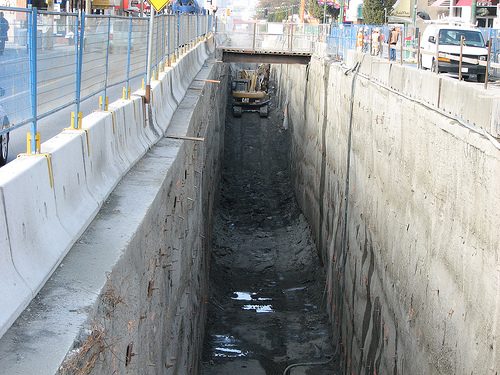
- The switch was made from bored tunnel to cut and cover construction, with savings made from not paying any compensation to businesses affected by a great trench in front of their place of business.
As built, the Canada line has less potential capacityAi??than modern LRT were to have been built instead. This embarrassingAi??fact has been camouflaged by TransLink by arbitrarily lowering theAi??industry standard for capacityAi??of LRTAi??by 50%. from 20,000 persons per hour per direction to 10,000 pphpd! Pork pies all around for the Canada Line and TransLink!
The cost estimated to increase the capacity of the Canada Line to a proper metro standard – $1.5 billion to $2 billion!
The result is now history andAi??to nobody’s surprise, theAi??merchants and businesses adjacent to the cut and cover construction suffered greatly, with many going out of business. Cries for help fell on deaf ears and one merchant, Susan Heyes, bravelyAi??took TransLink to court for compensation and won. TransLink appealed and the BC court of Appeal overturned the judgment and the $600,000 thousand in compensation.
I will not state myAi??opinion on the BC Court of Appeal decision, except I belive the judgement is flawed and politically inspired, just as the entire RAV/Canada line scheme was, for BC is alone in the world for not paying compensation to those adversely affected by transit construction, especially cut and cover subway construction.
A news release by Susan Heyes
We have a Legal System here in BC ai??i?? but do we have Justice?
On May 27nth, 2009, after four years of litigation, BC Supreme Court Justice, Ian Pitfield, awarded $600,000 in damages to my company Susan Heyes Inc. as compensation for business losses caused by the construction of the Canada Line.Ai?? The appeal of this ruling in my favour was heard April 15th, 2010. Ai??
Today, the decision was finally announced contradicting the findings of the lower court.Ai??
In upholding this appeal, the legal system has supported the confiscation of individual citizenai??i??s livelihoods by government funded private, for profit ventures. This shocking ruling has failed to protect the rights of citizens, and has failed to uphold justice and fairness in a democratic society.
The Canada Line project was built on the backs of hundreds of blindsided small business people along the Cambie corridor.
The project chose the most disruptive of several methods of construction.Ai?? This discretionary and confidential decision alone should have negated the defence of Statutory Authority which the Appeal Court Justices used today as the basis for their ruling.Ai??
Under the law, the defence of Statutory Authority can only be used when it is proven in court that no other less disruptive method of construction was available. Instead of the devastating cut-and-cover construction, a bored tunnel method was not only available, but it was the basis of all public consultations and years of engineering reports and studies.
This project was enabled by the strategic use of confidentiality agreements at every stage, leaving citizens and even municipal officials misinformed and out of meaningful consultation. The last minute secret switch from underground bored tunnel to cut-and-cover, was never approved by Vancouver City Council, as a decision making body. They had authorized the Cityai??i??s Engineering Department to negotiate the agreement that provided access to Vancouverai??i??s streets for the project in a vacuum.Ai?? The engineers were forced to sign confidentiality agreements that prohibited them from informing their bosses ai??i?? City Council ai??i?? of this critical switch.Ai??
I question the validity of any contract or agreement that allowed this project to proceed, that was obtained in the absence of the whole truth about the project and its impacts on citizens and small businesses. Compensation should have been factored into the business plan.
I am appalled that our legal system has failed to support the rights of citizens, and has attempted to provide a legal justification for the excessive harm caused by this P3 project. I further wonder how many tens of millions of dollars have been spent to legally defend the project, instead of fairly compensating the victims. Ai??
The May 27th 2009 ruling from Justice Pitfield must be upheld by the Supreme Court of Canada. The outcome of this litigation will set a precedent for all small businesses across Canada. The precedent that it sets should be just and fair, and reasonable. When governments use their powers to confiscate value for the common good ai??i?? individuals must be compensated.
Ai??
Susan Heyes
HAZEL&CO
4255 Main Street
Vancouver, BC
V5V 3P9
Ai??
604 687-0721 w
604 551-8852 c
From the Vancouver Sun
Now we know why SkyTrain is so expensive to operate.

SkyTrain workers vote to strike but talks continue
SkyTrain workers have voted 96 per cent in favour of strike action if necessary to back their union's demands in contract talks with TransLink.
Gerry Cunningham, president of the Canadian Union of Public Employees (CUPE) local 7000, said no job action is planned and he's hopeful a deal can be reached without disrupting rapid transit service.
"It's too early for that kind of stuff," he said. "We don't want to inconvenience the thousands of commuters who rely daily on the services we provide."
A new round of mediated talks are slated to begin Feb. 22 with the assistance of mediator Grant McArthur.
CUPE represents 530 members who work on the SkyTrain Expo and Millennium Lines, including attendants, control room operators, administrative staff and other workers who maintain trains, tracks and stations.
The union's current contract with TransLink's SkyTrain subsidiary, B.C. Rapid Transit Co., expired last Aug. 31 and bargaining has been underway since then.
SkyTrain management tabled a final offer that was rejected by CUPE's bargaining committee, which then asked members for a strike mandate.
B.C. Rapid Transit spokesperson Jennifer Siddon would not discuss the company's response in the event of a walkout, saying management are looking forward to mediation.
"A strike vote is a regular part of the negotiations process," she said. "It's business as usual for our staff and our customers."
It's a similar situation for 180 Canada Line workers, whose negotiators have been in talks with operator Protrans BC after a strike vote was staged in early January. Canada Line employees are seeking a first collective agreement after unionizing last summer.
Talks with the assistance of a mediator broke of Monday (Feb 14) with no agreement.
B.C. Government and Service Employees' Union rep Oliver Rohlfs said it will likely be a few weeks before the mediator reports back with recommendations, if any, to avert a Canada Line walkout.
Until that happens, the union is barred from issuing 72-hour strike notice.
The mediator could seek binding arbitration, he said, or clear the way for strike or lockout action.
Labour negotiations also get underway soon between TransLink and its bus drivers across Metro Vancouver. Their contract expires March 31.
Previous contracts reached with transit workers ensured labour peace during the 2010 Winter Olympics.
http://www.bclocalnews.com/surrey_area/surreyleader/news/116353819.html
Absurdity, Hiatus, Ignominy, Irony, Paradox and Prognosis
The Cardinal cordially welcomes Zweisystem back & offers him wishes for a speedy recovery from his recent illness; – Hurry up and get the heck out of there!
Zwei, remember Mark Twainai??i??s advice `be careful when reading health books; you may die of a misprintai??i??
Ai??
With Zweisystem back in the section, continuing his mission, to hold TransLink, BC Transit & the politicians to account over their absurd vision for the Fraser Valleyai??i??s transport plans; Fang will step out of the parochial comfort zone of provincial BC and continue to report on what the rest of the civilised world is doing to improve the lives of their citizens.
Ai??
Taking absurdity to its incongruous limit, Zwei posted a letter, published in the Delta Optimist from Ken Hardie – Bio Director of Communication atTransLink, on the Blog under the title `Porkies from TransLinkai??i??.
Ken Hardie who? Donai??i??t Panic Ken Hardie is ArthurAi??Dent?
http://vancouverpublictransit.wordpress.com/2008/06/30/ken-hardie-is-arthur-dent/
However Vogon Ken Hardie, is not the hapless protagonist and anti-hero in the comic science fiction series The Hitchhiker’s Guide to the Galaxy by Douglas Adams. Rather he is the architect of the Earth’s destruction as it is demolished to make way for a hyperspace bypass; aka the Gateway Programme.
More of a Ford PrefectAi??then?
A hiatus of sorts occurred in late December 2010, with the release of the Fraser Valley Regional Development FVRD Report & the Fraser Valley Transit Study FVTS. Strategic View of Transit in the Fraser Valley; Rail for the Valley have published their response to the TransLink proposal, concluding that `This report merely postpones a serious attempt to grapple with crafting a long-term solutionai??i?? a view held by much of the Fraser Valley press.
Ignominy, was very obvious in the response of the BC Liberal candidates to the Rail for the Valleyai??i??s Questionnaire response on crucial transportation issues in the Fraser Valley; the Liberals response was deafening ai??i?? nothing. Five responses were received from the BC NDP candidates. Then there is Kevin Falcon, whose anathema for any expansion of transit modes, especially Light Rail, in BC which arenai??i??t either a bus or the Evergreen or Expo Lines is well documented.
Ai??
Irony, yes; In Europe and the US, at-grade Light Rail & Tram schemes are proliferating. Since the beginning of 2011, the Cardinal has reported on the approval for 29 new French Tram schemes, new proposals, extensions & expansions in several US cities and the go-ahead given to extensions of the Birmingham, Nottingham & Manchester systems in Britain. Elsewhere in Europe, Germany continues to expand its Tram-Train network and approvals have been announced for systems in Denmark, Finland, Ireland & Norway; yet in BC & Canada, more silence unless you count Toronto where Mayor Ford is making a lot of noise as he threatens to close that city’s streetcars down.
Ai??
Ai??A Paradox, definitely in Canada!
Automated rapid transit systems, automated elevated Light Rail systems, Subways and Metros are preferred, by politicians, proponents, planners and SkyTrainai??i??s legion of blogosphere juveniles, they argue the superiority is down to:
Ai??Ai??Ai??Ai??Ai??Ai??Ai??Ai??Ai?? Faster journey times
Ai??Ai??Ai??Ai??Ai??Ai??Ai??Ai??Ai?? Greater speed of service
Ai??Ai??Ai??Ai??Ai??Ai??Ai??Ai??Ai?? Cheaper fares
Ai??Ai??Ai??Ai??Ai??Ai??Ai??Ai??Ai?? Lower operating costs per mile
Ai??Ai??Ai??Ai??Ai??Ai??Ai??Ai??Ai?? Higher capacity & efficiency
Ai??Ai??Ai??Ai??Ai??Ai??Ai??Ai??Ai?? Better serves higher population densities
Ai??Ai??Ai??Ai??Ai??Ai??Ai??Ai??Ai?? Less likely to be disrupted by cold weather related issues
Ai??Ken Hardie, Bio Director of Communication at TransLink, what in the world is a Bio Director? ..but Donai??i??t Panic? Captain Mainwaring,
star of the TV series Dadai??i??s Army has the answers.
Ai??http://www.youtube.com/watch?v=ZR6wok7g7do&feature=related
Prognosis – The Answer is 42.
..Answer to the Ultimate Question of Life, the Universe and Everything..
Coincidently, 42 is the number of Light Rail, Tram systems, planned, built, commissioned & opened world wide in the same period since work on the Canada Line commenced.
Ai??
Reporter: Mr Gandhi, what do you think of Western Civilization ?
Mahatma Gandhi: I think it would be a good idea.
Porkies from TransLink!

In the UK, London's Cockney's (the East End crowd) have long had an interesting rhyming slang tradition – examples: jam jar is a car; dicky dirt a shirt and so on.
Well, a pork pie or porkie is – well you guessed it.
The following letter from Ken Hardie, to the Delta Optimist, is full of "Porkies" and if this is what is to be expected of TransLink in the future, it is time that this moribund bureaucracy is dissolved.
Zweisystem is going to dissect Mr. Hardie's letter and my comments will be highlighted in yellow italics.
Please remember, in 2008, noted American transit expert Gerald Fox, in a letter to a Victoria transportation group, shredded TransLink's Evergreen Line business case, stating; "I found several instances where the analysis had made assumptions that were inaccurate, or had been manipulated to make the case for SkyTrain. If the underlying assumptions are inaccurate, the conclusions may be so too."
Fox later said; It is interesting how TransLink has used this cunning method of manipulating analysis to justify SkyTrain in corridor after corridor, and has thus succeeded in keeping its proprietary rail system expanding. In the US, all new transit projects that seek federal support are now subjected to scrutiny by a panel of transit peers, selected and monitored by the federal government, to ensure that projects are analyzed honestly, and the taxpayers’ interests are protected. No SkyTrain project has ever passed this scrutiny in the US."
Re: SkyTrain supporters have failed us for far too long, letter to the editor, Feb. 2
SkyTrain critic Malcolm Johnston's latest letter omits some important points that need to be included in a thoughtful analysis of Metro Vancouver's rapid transit system.
In looking at systems around the world, most people here would use SkyTrain to describe automated light rail operating on a segregated right-of-way. Actually, the term SkyTrain is used to describe elevated railways, not automated railways. Johnston usually refers only to seven systems he reports as using SkyTrain's specific propulsion technology. There are only seven SkyTrain type proprietary railways in existence; Detroit, Toronto (soon to be dismantled); Vancouver, JFK airport New York, Kuala Lumpur; China and Korea; the rest are other proprietary transit systems. In fact, there are nine or 10 more automated systems that operate quite successfully in Japan, China and Dubai, not to mention our own Canada Line. Automatic or driverless railways have nothing to do being elevated, it is the signaling kit used, with the first automatic railway first operated in London, England in 1927.
Automated light rail is efficient, with our SkyTrain system operating at the lowest cost per mile in a comparison with a U.S. Federal Department of Transportation review of 10 major American rapid transit systems. This is only true because TransLink does not include the annual $250 million debt serving charges, which are included with US LRT accounting. Factor in SkyTrain's annual provincial subsidy of over $250 million and the mini-metro becomes very expensive when compared to modern light rail. It is, however, not the answer for every rapid transit application, which is why TransLink continues to keep all technology options on the table for expansion on the Broadway corridor and in the South of Fraser. It seems that SkyTrain is avoided by transit planners around the world with only seven such systems built, despite being on the market for over 32 years!
SkyTrain is popular with the public, as Johnson himself found out during discussions of rapid transit technology options for the Evergreen Line. Ha, ha, ha, SkyTrain is so popular for the Evergreen line, no one wants to ante up $400 million to get construction rolling. As well transit expert Gerald Fox, as noted many times by Zwei, reveals that the Evergreen line planning is grossly manipulated. With respect to the South of Fraser, we would particularly note the success of the Canada Line, which is well ahead of its ridership projections, is based largely on the number of people from South Surrey, White Rock and Delta who bus-in to the Richmond stations daily. Ha, ha, ha, the Canada line is only successful in TransLink's minds; no where else in the world that a $2.8 billion, truncated metro line, carrying less than 45,000 actual passengers a day, be deemed successful. Please note: 45,000 passengers a day traveling there and back, with some making multiple trips per day (U-Pass holding students) equals about 100,000 boardings per day.
Contrary to Johnston's assertion, 45 per cent of Canada Line riders tell us they used to drive for the trip they were making. Belive that and I can sell you shares in the Golden Ears Bridge P-3!
Rapid transit has an enormous impact on how our region grows and develops, and survey after survey shows it is the most effective in attracting people to public transit. Really, why then TransLink discontinue 30% of express bus service, due to lack of ridership from South Delta to Bridgeport Station?
While Metro Vancouver has clearly valued the benefits of automated light rail with its speed of service, high capacity and efficiency, we agree with Johnston when he correctly points out there are other rapid technologies we should consider as effective and cost-efficient ways to expand our network. Mr, Hardie quietly forgets that LRT made SkyTrain obsolete twenty years ago, as LRT has a higher capacity, etc., etc. than SkyTrain!
Where we disagree is with his characterization of our SkyTrain system, with its 100 million-plus riders per year, as a "failure." .Compare with carrying 50% more passengers, with a LRT system, costing 50% less! Oh yes, let us not forget that 80 million per year of your SkyTrain passengers are forced from buses onto the metro and that no other city in North America has copied Vancouver or built with a SkyTrain style metro is tantamount to failure. SkyTrain's success is born on the back of the regional taxpayers
Ken Hardie,
TransLink
Nottingham Tram – Councils Negotiate NET Settlement
Nottingham NET Phase 2
Nottingham City Council and Nottinghamshire County Council have negotiated a settlement which will allow the City Council to take the project forward as sole promoter.
http://www.nottinghamcity.gov.uk/netphase2/index.aspx?articleid=7487




Recent Comments