Posted by Cardinal Fang on March 1, 2011 · Leave a Comment
The Cardinal has reported on the success of French Light Rail/Tramways, regularly on the Rail for the Valley blog. In this article the history, development, style, politics & importantly financing will be outlined.
With a light rail renewal France has gone full steam ahead to become a leader in technological design and leading style. Howard Johnston, EditorAi??of Tramways & Urban TransitAi??reports in railway-technology .com
http://www.railway-technology.com/features/feature1096/
Ai??You are directed to the following document:Ai??
Comparative Performance Data from French Tramway Systems.
http://www.pteg.net/NR/rdonlyres/B4142077-F4F3-4650-9012-A65DD91E3B1F/0/LRTfrenchcomparisonsreport.pdf
for more information,Ai??annotations & observations on:
Politics of Trams
The Local Authority is the principal decision-making body involved in public transport projects, such as tramways, and it represents a pool of municipalities from within the metropolitan area. One important task, the Local Authority creates and modifies the urban transport area, for which the Authority establishes the Urban Local Transport Plan ai??i?? called a Plan de dAi??placements urbains (PDU) in French ai??i?? which was established by the LePage Act for air quality.
For individual transport projects, the Local Authorityai??i??s main powers lie in the selection of the choice of investments and the definition of the bid. As well, the Authority takes charge of selecting and
securing the public transport operators of their network.
Planning Processes
In 1982, the French government mandated ai??i?? through its Internal Transport Planning Law (Loi
dai??i??orientation sur les transports intAi??rieurs) ai??i?? that the local authorities would be responsible for
establishing their transport policy, running the urban public transport network, and implementing new schemes.
Along with the transfer of this competency, the local authorities were given the financial tool to finance their public transport policy through the Versement transport
This plan was initiated to help deal with ecological problems, such as air pollution, noise, and traffic congestion, by forcing municipalities to think about and organise their transport policies, projects, and plans.
The importance of the PDU was amplified in 1996 when the Clean Air Act (Loi sur lai??i??air) made PDUs
mandatory for French cities with over 100,000 inhabitants and imposed a favourable policy towards public transport systems in order to obtain a reduction in car traffic. This policy supported cities and the measures they could take to develop public transport and limit the use of cars in the short and medium terms as a means to reducing the amount of car-generated emissions.
Cities have a host of options they could implement under this favourable policy: restrict traffic;
transform spaces dedicated to cars into areas for public transport, bicycles, and pedestrians; or
introduce elements through the Local Urbanism Plan ai??i?? Plan local dai??i??urbanisme (PLU) ai??i?? that act to
regulate land use and can, for example, fix the number of parking spaces to construct according to the number of residential units or office space constructed in a new building. The principal goal of each of these approaches is to reduce the amount of trips individuals make by private automobiles.
Financing
French tramways are financed from an assortment of resources. The money needed to build and
operate a tramway scheme is balanced by contributions from the government, the local authorities, local companies, and the passengers themselves.
Ai?? The state government contributes only to the capital costs of tramway schemes, not to the operations of the systems (except in the greater Paris region).
This contribution is presently calculated as up to 35% of the capital costs of the project (excluding design and project administration costs, utilities diversion, highway improvement, land acquisitions, and rolling stock purchase, which are paid for entirely by the Transport Authority).
The government contribution is limited to a maximum ofAi?? ai??i?? 4.5 million for every line kilometre of tramway.
Ai?? Utilities diversion costs are funded both through the project and by private companies. If the utility is owned by the municipality, then the tramway sponsor (as part of the municipality) will pay for the diversion of that utility. Water supply, sewage, and central heating are publicly owned utilities in France. For private utilities (electricity, gas, telephone…), the private owners of those utilities are responsible for the diversion of the utility and its cost.
A judicial precedent prescribes this responsibility.
Ai?? The Transport Authority is financed directly by the municipalities that are served by it.
Ai?? The versement transport (transport tax), a specific tax dedicated to financing public transport, is levied on companies based on the company payroll. The money generated goes directly to the Transport Authority.
Ai?? Nationally in France, passengers themselves contribute almost one-quarter of the annual investment and operations financing through fare box revenues.
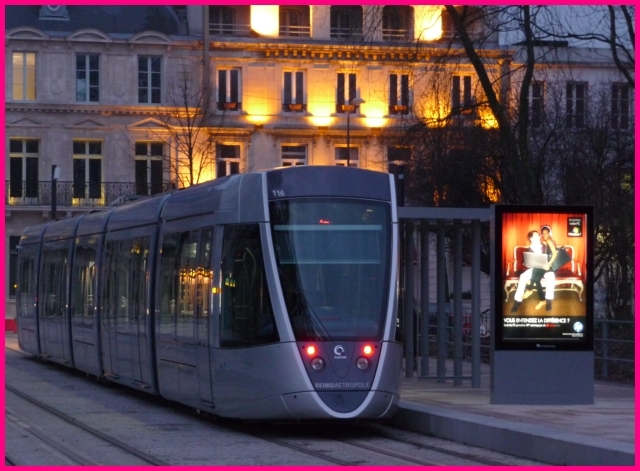
Ai??Reims Alstom Citadis
http://www.bouygues-cyprusairports.com/pdf/9-%20PPP%20Tram.pdfAi??Ai??Ai??Ai??
Posted by Cardinal Fang on February 27, 2011 · 1 Comment
Toronto owes mayor a thank you on transit
Toronto Star.com February 24th
http://www.thestar.com/opinion/article/943888–toronto-owes-mayor-a-thank-you-on-transit#article
Toronto owes Mayor Rob Ford a big thank you for three things.
[Most definitely not]
The first is for raising timely doubts about the wisdom of proceeding with Transit City. This was the previous council’s expensive one-size-fits-all plan to replace buses on some routes with disturbingly long streetcars mostly on their own rights-of-way and sometimes underground — also known as light-rail transit or LRT.
The second is for reminding us that heavy-rail transit — usually known as subways — is the backbone of Toronto’s transit system and we could use more backbone.
The third is for his recent plan, still mostly secret, to have the private sector pay for subways from the proceeds of development of land around stations.
It’s the third thank you that should be expressed the most fervently, not because his plan will solve our transit woes — it won’t — but because Ford has cast a spotlight on the vital link between transit and land development. He has illuminated this link with a brightness no one else in Toronto has come near to achieving.

ST CLAIR CLEANED UP – Richard Gilbert
Transformed Transit City just the ticket for Toronto by Richard Gilbert
http://www.thestar.com/opinion/editorialopinion/article/901594–transformed-transit-city-just-the-ticket-for-toronto
Or does Toronto, owe Ford a thank you?
One respondent, clearly does not think so, the Cardinal agrees, Quote:
Stop with the irrelevant comparisons to Hong Kong
Toronto is not Hong Kong and repeating the comparison over and over will not make it so. The Official Plan already recognises the need to meld transit and land use, this is not new. The subways built in the 50's and 60's were built primarily in response to demonstrated demand, they weren't justified on the basis of "created" demand until the SRT was built to stimulate Scarb.TC. There are existing subway stns that need to develop (Downsview, Eglinton, Islington, Warden, VicPk etc) before we start building others for which there is not enough development market yet. Go ahead and blow all the money on one subway line, then enjoy waiting 20 yrs for the next one, if there is a next one. Gilbert is full of it, yet again.
TransLink, BC Transit & the BC Government, would also do well to heed the statement that Vancouver is also not Hong Kong, any comparison is also irrelevant!
Posted by Cardinal Fang on February 26, 2011 · 1 Comment
Late February has brought a mixed bag of news on Light Rail, Tram, Streetcar, LRT & Transit projects in North America, some positive & some negative. The Cardinal posts a selection of national, local press and on-line Blog reports.
1) Gray: Streetcars are a ‘Very Wise Decision’
2) Subway boosters welcome mayor’s vision for Sheppard
Intensification needed for private funding not a concern, says resident
Inside Toronto.com February 26th
http://www.insidetoronto.com/news/cityhall/article/959469–subway-boosters-welcome-mayor-s-vision-for-sheppard
Toronto Mayor Rob Ford’s plan to build a Sheppard subway through Scarborough has thrilled local subway advocates, who don’t fear the intense development it would bring.
But merchants in Sheppard East Village are worried street improvements tied to the light-rail line – slated for construction this spring but now apparently doomed – are about to vanish.
from Stephen Rees’ Blog, a map of the Sheppard EastAi??LRT compared to the Ford subway plan.
http://stephenrees.files.wordpress.com/2010/12/nw-transit-graphic_1042901a.jpg
3) Portland, Oregon. – why build Lake Oswego modern streetcar?
Portland Business Journal February 25th
http://www.bizjournals.com/portland/blog/2011/02/oswego-streetcar-a-tricky-proposition.html
A staff writer for Portland Business Journal says one reason being advanced to
extend Portland Streetcar southward to Lake Oswego is because the tracks already
are there and the investment could be counted toward the local match for federal
capital funds
4) Los Angeles $1 Million Approval for Streetcar
blogdowntown February 25th
http://blogdowntown.com/2011/02/6152-1-million-approved-for-streetcar
L.A Streetcar Economic Study Released
http://www.lastreetcar.org/

Posted by zweisystem on February 26, 2011 · 2 Comments
It has been said that a picture is worth a thousands words………………………..

……………..but this picture of a cross section of the new ten lane Port Mann Bridge says it all – there is no rail transit being planned for the bridge!
Even Zweisystem, with his rudimentary knowledge of engineering knows if that a bridge is to carry "rail" traffic, it must be designed do at the very beginning, to allow for the stresses imposed by rail operation; one just doesn't add rails at a later date. There is no indication at all of any provision for rail at all.
So much for those pretty 'artists impressions' of the new bridge showing LRT crossing the span, it's not going to happen. It seems we have been fooled again by a government hell bent to blacktop the Fraser Valley.
And please do not say BRT or bus rapid transit is rapid transit, it is a bus and yes, there may be bus lanes on the new bridge, but buses are not seen by the customer as good transit. With the current government, BRT is just an excuse to build new highways!
What is interesting is that with no provision for rail transit on the new Port Mann Bridge, gives a great viability to the RftV/Leewood Richmond/Vancouver to Rosedale tramtrain.
Posted by zweisystem on February 25, 2011 · Leave a Comment
From a previous post http://www.railforthevalley.com/latest-news/zweisystem/now-we-know-why-skytrain-is-so-expensive-to-operate/ we find that there are 600 or more employees (530 in the CUPE Union) that work on the SkyTrain Expo and Millennium Lines. The Canada Line is a conventional metro and employs over 200 people (with 180 in the CUPE union) and both metro systems are quite separate.
The Canada Line, a standard gauge metro is 19.2 km long and has 16 stations.
The Millennium Line is 20 km long and has 13 stations.
Canada Line, is 19.2 km long and has 16 stations.
The Canada line is not a proprietary Skytrain railway, nor is it compatible in operation with the SkyTrain in operation, as such it is a separate metro system.
The SkyTrain Expo and Millennium Lines combined total 49.2 km, (actual track mileage) with 33 stations.
The claim by TransLink that the three combined Vancouver metro lines have about 360,000 boardings a day is open to debate, as TransLink, like BC Transit before, deliberately overstates ridership by about 10% to 20%. As well, there is no actual counting of boardings counts (except with the Canada line where boarding counters are on each car), rather TransLink uses a secret method to ascertain ridership. Also the 360,000 claimed boardings a day does not translate to about 180,000 passengers a day, rather with the proliferation of the $1.00 a day student U-Pass to all post secondary institutions along the SkyTrain routes, many students are making multiple trips or boardings. Some estimate that many U-Pass holders board the Skytrain system four or more times a day!
With over 54,000 UBC and 27,000 SFU students alone, eligible for the $1.00 a day U-Pass, multiple trips made by students can easily inflate metro ridership numbers and give the impression that the metro system is carrying far more unique customers than it really is!
It also should be noted that TransLink's philosophy of operation is to force all Vancouver bound transit customers onto the one metro line (Expo line & Canada Line), thus much of the SkyTrain's ridership, over 80% according to TransLink, are forced to transfer from bus to metro to make the journey into downtown Vancouver.
The total Vancouver metro system is 68.7 km long with 47 stations, employs over 800 people, with over 710 belonging to the CUPE Union.
Just the Expo & Millennium Lines have about 260,000 (claimed) boardings a day, yet has about 600 employees to oversee the two lines.
It is almost impossible to have an apples to apples comparison with SkyTrain and light rail, but it does seem that the SkyTrain transit system when compared with a comparable light rail system, holds true to Gerald Fox's AGT/LRT study released some twenty years ago, that when comparing LRT with an automatic metro, on equal routes, found that automatic transit systems employed about 15% more staff than comparable light rail systems.
The following are staffing levels of various UK public transit systems.

Croydon Tramlink
Type – at-grade Tramway
Route Length 28km
No of Vehicles 24No
No of stations 39No
Annual ridership 28 million
No of staff 190
Nottingham NET
Type – at-grade Tramway
Route Length 14km
No of Vehicles 15No
No of stations 23No
Annual ridership 10 million
No of staff 120 (tram conductor operation)
Manchester Metrolink
Type – at-grade Tramway
Route Length 37km
No of Vehicles 58No
No of stations 37No
Annual ridership 21 million
No of staff 330
Birmingham Midlands Metro
Type – at-grade Tramway
Route Length 21km
No of Vehicles 16No
No of stations 23No
Annual ridership 5 million
No of staff 170 (tram conductor operation)
Sheffield Supertram
Type – at-grade Tramway
Route Length 29km
No of Vehicles 25No
No of stations 48No
Annual ridership 15 million
No of staff 200 (tram conductor operation)
London Docklands Automatic Light Railway (DLR)
Type – grade separated Automatic Light Rail
Route Length 34km
No of Train sets 118No
No of stations 40No
Annual ridership 69 million
No of staff 470
Tyne & Wear Metro
Type – at-grade Light Metro [proportion of system – track sharing with heavy rail]
Route Length 78km
No of Train sets 90No
No of stations 60No
Annual ridership 41 million
No of staff 700
London Underground (LUL)
Type – Heavy Metro subway & sub-surface
Route Length 420km
No of Train sets 789No
No of stations 275No
Annual ridership 1.3billion
No of staff 11,300
Posted by Cardinal Fang on February 23, 2011 · 2 Comments
Tram and train used to be two entirely different public transport systems. Tram served shorter (read: urban) distances. Train served longer (read: regional) distances. But the difference between city and region has disappeared in much of Europe. The difference between tram and regional rail is blurring as well. A new generation of light rail transit vehicles can play the role of both tram and train. By doing so LRT offers an important breakthrough in the thinking on sustainable urban and regional mobility.
Light Rail Transit, LRT or Tram-Train
Tram-train | FranAi??ais
Regiotram | Deutsch
Light Rail | Nederlands
Ai?? From the Connected Cities web site:
http://connectedcities.eu/showcases/lrt.html
The Karlsruhe model
Ai??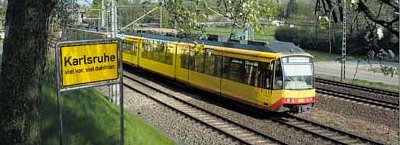
Karlsruhe’s Stadtbahn
The German city of Karlsruhe is where it all began. In the early nineties the municipal public transport authority or KVV managed to claim the right to use a number of regional rail lines, owned by the state. The use of these regional lines enabled the rapid expansion of the local light rail network. By that time such a move was unheard of. Transport theory told that tram and train systems were incompatible. Vehicles could not cross over from the one to the other network. It were the users of these systems that had to bridge the gap. But transferring between systems meant walking, waiting and too often loosing connections. The Karlsruhe model showed that technical differences and differences in management could be overcome. It also showed that combining the two networks in one operation leads to a significant increase of its use.
The regional tram
Some have interpreted the ‘Karlsruhe Model‘ mainly as a technical advance since the Karlsruhe Stadtbahn vehicles were adjusted to both low and high voltage systems as it combined both light and heavy rail. Some saw in the Karlsruhe example evidence that an above ground light-rail system could be a preferable alternative over an underground metro or S-Bahn. But its true significance is that Karlsruhe showed there is a regional future for the tram. The ‘Karlsruhe model’ showed that a tram can successfully operate over far greater distances than the 5-10 kilometre that most textbooks considered to be the maximum.
Hybrid
So, LRT started with a light rail vehicle called Stadtbahn in the German city of Karlsruhe. The Stadtbahn started to use parts of the national rail infrastructure to expand its reach. It was a small revolution: a municipal transport authority being allowed to use national infrastructure. It was a clear innovation also that a light rail vehicle could operate using both alternating current and direct current, depending on the part of network it used. Since then the Karlsruhe model has resulted in new examples of LRT. In some of these cases the ownership of the national infrastructure was transferred to the municipal or regional transport authority. This allowed bypassing the need for technical or management solutions. In other cases the LRT vehicle combined the use of diesel fuel with the use of direct current. Even combinations between regional rail and metro also emerged.
Definition
Dutch experts refer to these LRT systems as light rail or light train. Germans call it regiotram. And the French use the term tram-train. Sometimes these systems are named after the region where they operate: SaarBahn, RijnGouweLijn or RandstadRail. Three major producers of rail vehicles supply this growing market with targeted products. Bombardier developed the FLEXITY Link. Alstom delivers the Regio CITADIS. Siemens produces the AVANTO, in the US marketed as S70. These vehicles have in common:
- a modern tram-like look
- a low floor providing easy access
- a cruising speed slightly above 100 km/h
Ai??
Siemens AVANTO in the Paris region
Future
In the end it doesn’t matter how you call LRT. More important is what it does. LRT shows there is a regional future for the tram. Or, arriving from the opposite direction: LRT shows there is an urban future for regional rail. LRT means that existing tram or regional rail infrastructure can be used much more efficient if only we put aside the idea that tram is a tram and a train is a train. Tram and train can merge into one seamless public transport system. It can bridge distances up to 60 kilometre depending how much tram or how much train LRT combines. A LRT line that is 95% train and 5% tram reaches further than a line that is 50% train and 50% tram. So much should be clear.
Examples
LRT operates currently in several European and American cities:
The best of two worlds
Cities and regions struggling to find suitable mobility solutions might want to look at the LRT-option, especially when these cities or regions have already one or more urban tram or regional rail lines. LRT combines the best of two worlds. Let’s take full advantage of it.
Posted by zweisystem on February 23, 2011 · 3 Comments

Mr. Ford's utter stupidity is breathtaking and the financial roller coaster ride he is taking the Toronto taxpayer on is beyond belief. This is the sort of simpleton anti tram, anti light rail planning which seems to be the rigour of right-wing politicians in North America and Europe – to hide their real agendas of increasing car use, which in turn leads to more road construction and more taxpayers money diverted to their wealthy corporate friends who supply and service the cars and build the roads and highways.
Peak oil is here; global warming is a reality, yet Toronto's new mayor, if he gets his way, will dismantle one of the world's best public transit systems (just the streetcars alone carry more passengers per annum, than Vancouver's SkyTrain!) and just in time, it seems, when gas may top $2.00 a litre by the end of Mr. Ford's first term.
Let us hope that the locals see Ford as the buffoon for which he is, and give him a clear message to "keep his hands off Toronto's streetcars" and discontinue his extremely expensive metro or nothing politics. If not, Toronto may turn into the most highly taxed region in Canada, where metro/subway only planning squandered large amount of tax monies on small but very expensive transit projects.
I think Mr. Ford's political legacy is already written – the man who destroyed Toronto.
Posted by John Buker on February 22, 2011 · 1 Comment
Rail group: Provincial report biased
Sheila Scott Feb 22, 2011 05:20:09 AM
FRASER VALLEY (NEWS1130) – The group Rail For the Valley says an independent firm has taken a look at a provincially commissioned transit study into light rail released in December, and found the government report was biased.
The study commissioned by the Ministry of Transportation found interurban light rail wasn’t a viable option for the area.
John Vissers with Rail For the Valley says the analysis the group commissioned with British companyAi??Ai?? Leewood Projects found the government didn’t look at all of the available information. “What they saw was a clear agenda dismissing light rail.”
Quotes from the Leewood analysis:
“The MoTi had formed their conclusion prior to commissioning the report, and the evidence in the report has been selectively incorporated, in order to substantiate the conclusion that they wanted to see.”
“The BC MoTI and TransLink appear to have predefined that Bus Rapid Transit was the only option and the report was to prove that point of view.”
Vissers is hoping Liberal Leadership candidates will take another look at the viability of light rail.
via Rail group: Provincial report biased – News1130.
Posted by John Buker on February 22, 2011 · Leave a Comment
False assumptions worry rail expert
BY PAUL J. HENDERSON, THE TIMES FEBRUARY 22, 2011
The provincial government’s lack of interest in interurban light rail from Chilliwack to Surrey is biased and based on a number of false assumptions, according to a British light rail consultant.
At the request of the Rail for the Valley advocacy group, David Cockle of UK-based Leewood Projects analyzed the provincial government’s Strategic Review of Transit in the Fraser Valley. Cockle found that the Ministry of Transportation and Infrastructure and Translink “appear to have predefined that Bus Rapid Transit (BRT) was the only option and the report was to prove that point of view.”
Chief among the criticisms is that a maximum of 250 passengers per day was assumed when the province considered daily interurban rail service. But when it came to equivalent bus service, the number of 800 boardings was assumed.
Cockle also said the province’s report uses false assumptions to extrapolate costs of $18.6 million per kilometre for light rail. That dollar figure was based on double-tracking the entire line with stations every 1.6 kilometres “and other costs entirely unnecessary for Light Rail Transit.”
“The MoTi had formed their conclusion prior to commissioning the report, and the evidence in the report has been selectively incorporated, in order to substantiate the conclusion that they wanted to see; despite the proven facts that the light rail option, for the Fraser Valley, would have an annual cost of less than a quarter of the figure quoted in the FVTS report.”
Cockle pointed out that while B.C. seems set against passenger rail, in the first few weeks of 2011 seven new, and three extensions, of UK and European light rail systems were announced as were three new and three extensions in the U.S.
Ai??Ai?? Copyright (c) Chilliwack Times
via False assumptions worry rail expert.
Posted by Cardinal Fang on February 22, 2011 · Leave a Comment
France: Lyon Tram-Train
Railway Gazette 22 February 2011
http://www.railwaygazette.com/nc/news/single-view/view/first-tram-train-arrives-in-lyon.html
The first of 24 Citadis Dualis tram-trains for the TER network west of Lyon arrived at the L’Arbresle maintenance centre on February 18, having left Alstomai??i??s assembly plant in Valenciennes two days earlier.
Two more vehicles will be delivered to SNCF in Lyon during the next few weeks. The three trains will then undergo trials to test current intake and measure electromagnetic emissions. The first vehicles are expected to enter service this year on the newly-electrified route from Lyon Saint-Paul to Sain-Bel.
In May 2007, SNCF ordered 31 Alstom Citadis Dualis tram-trains, seven for the Pays de la Loire region and 24 for RhA?ne-Alpes, under a ai??i??650m framework agreement for 200 vehicles. Pays de la Loire placed a conditional order for another eight trains in March 2009; options for the remaining 161 are still open.
Parts are being supplied by various Alstom sites; the bogies are being manufactured at Le Creusot, the motors at Ornans and the traction equipment at Tarbes, while Villeurbanne and Saint-Ouen are providing on-board computer systems.
French news article
http://www.paperblog.fr/3891206/le-tram-train-de-l-ouest-lyonnais-s-essaye-en-allemagne/

Alstom Technical Specification:
http://www.alstom.com/transport/products-and-services/rolling-stock/tram-trains-citadis-dualis-and-regio-citadis/
French newspaper article
http://www.urbanews.fr/le-tram-train-de-louest-lyonnais-sessaye-en-allemagne.html





Recent Comments