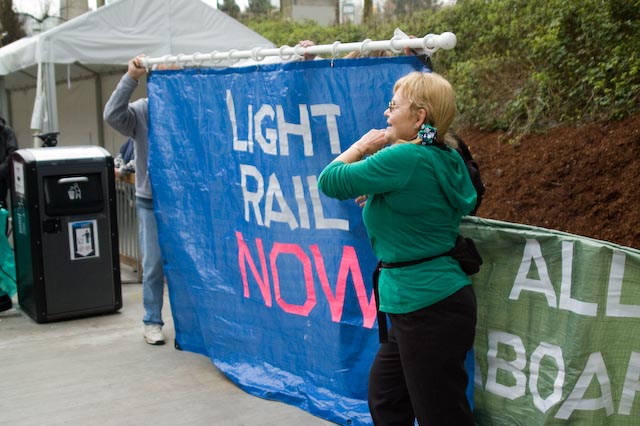
Report from the Rally & Ride, with pictures
By all accounts, the rally was a success!
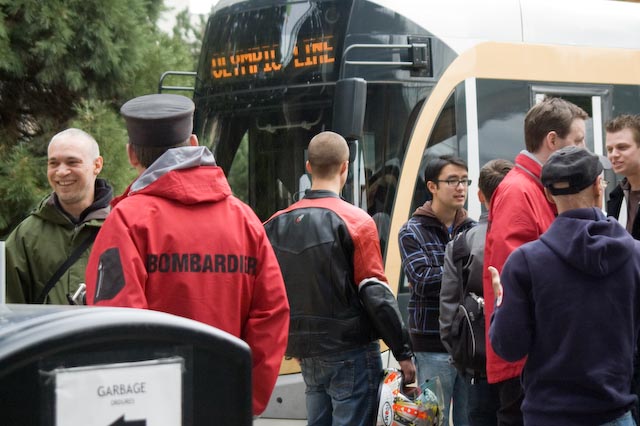
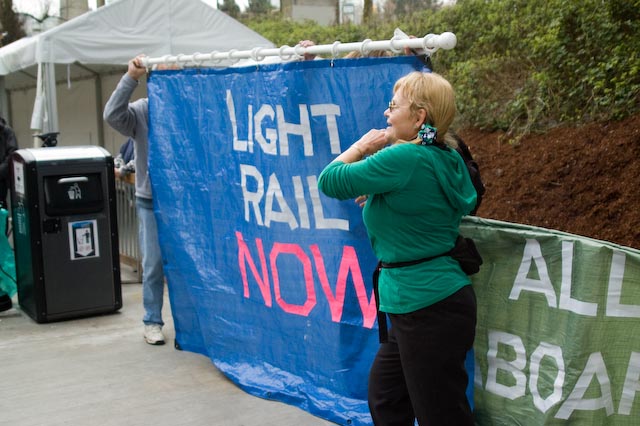
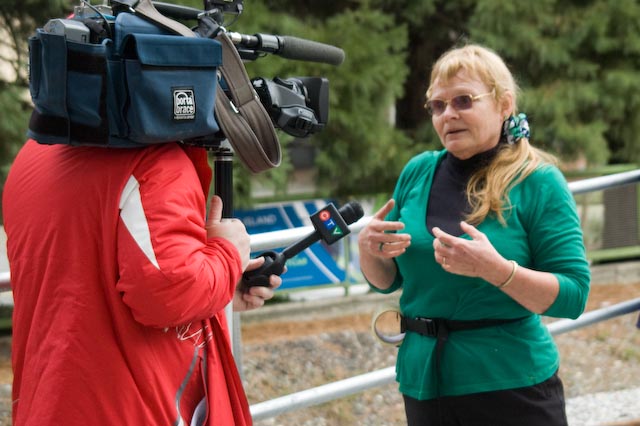
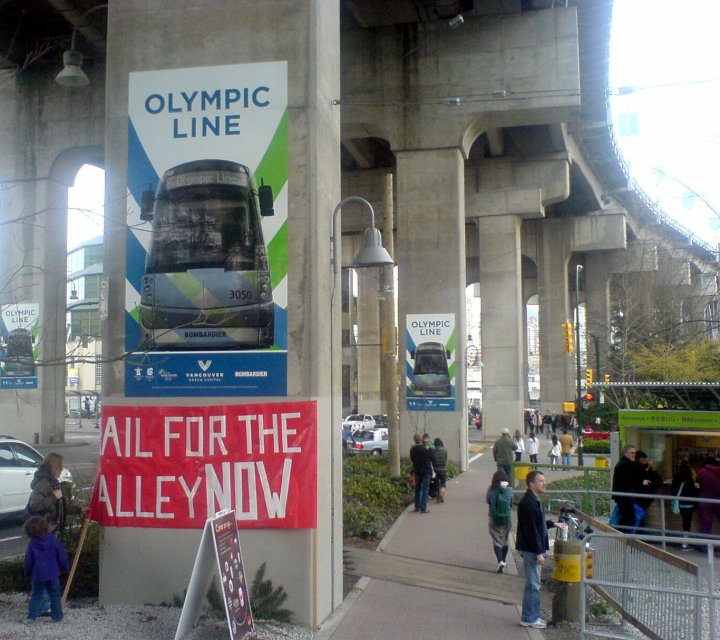
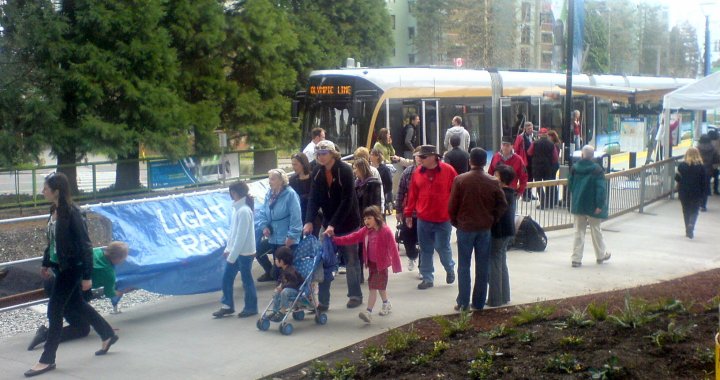
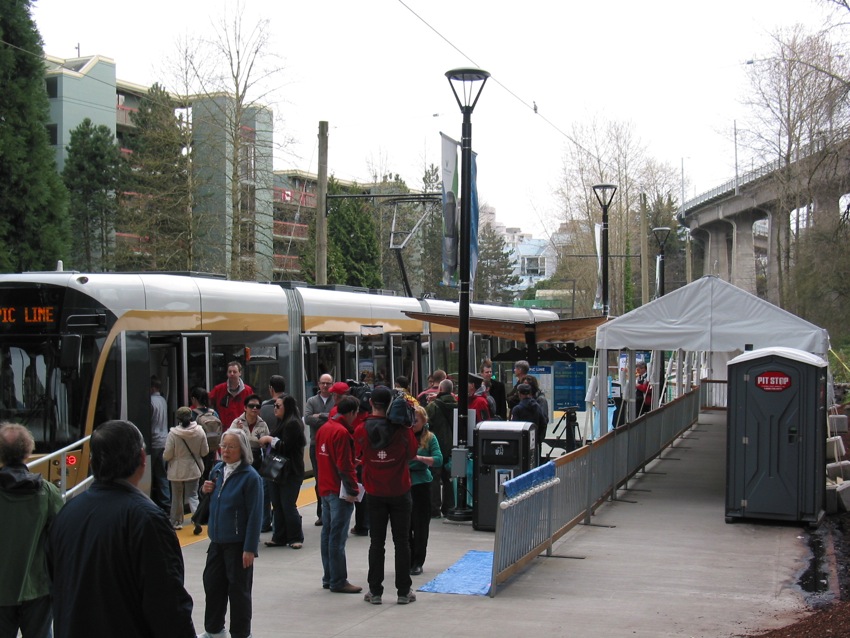
We handed out hundreds of leaflets, got media attention (CBC and News 1130), and overall raised a whole lot of awareness. There were large numbers of people of all ages taking the train; Bombardier’s volunteer conductors were kept busy with crowd control!
Thank you to all our volunteers!
From the Tri City News – Olympic transit wasn’t as good as the hype
An interesting letter that appeared in the Tri-City news, reflecting that transit service during the Olympics wasn’t all what TransLink claimed. The reason for reproducing the letter is that Zwei has heard from several people that the regional transit system wasn’t working as advertised and many just took the car instead.
Olympic transit wasn’t as good as the hype
The Editor,
Re. A?ai??i??Ai??Olympics proved ready to roll (with more cash), says CEOA?ai??i??A? (The Tri-City News, March 12).
I guess TransLinkA?ai??i??ai???s CEO did not bother to actually ride any part of the regionA?ai??i??ai???s transit system himself during the Olympics.
My family and I thought we would take the West Coast Express downtown one Saturday during the Games. The earliest train was 1 p.m. and we arrived an hour early just in case. We were told the train was standing-room-only in Mission and officials werenA?ai??i??ai???t sure if there was going to be room when it got to our station. We were then informed that no one got on or off in Port Coquitlam and that they were going to order buses (they hadnA?ai??i??ai???t done so yet?). I heard a least 50 people were left on the platform in PoCo. I saw the parking lot at Coquitlam fill up and then empty as people were turned away, not even allowed to buy a ticket.
We were then informed a bus would be coming and I thought that wasnA?ai??i??ai???t so bad A?ai??i??ai??? a bus ride down town. But I was then told that bus would not take us downtown but to a SkyTrain station. I reminded officials I paid extra for the West Coast Express to be taken downtown, not to an already overloaded SkyTrain system.
At that point, we decided to drive, despite all the warnings not to. There was no traffic and parking was a breeze A?ai??i??ai??? and cost us only $7, not the almost $30 I had paid to TransLink. To top it off, we beat the train downtown. We enjoyed the festivities especially knowing we werenA?ai??i??ai???t stuck to a train schedule going home. Again, on the drive home, there were no traffic issues. In the meantime, people I know who took the train said the first one home was a gong show.
I let everyone I knew not to take transit but to drive instead and heard similar stories of no traffic and easy, cheap parking with no hassles.
So while TransLink can claim it was running double the systemA?ai??i??ai???s normal capacity, it likely didnA?ai??i??ai???t count the hundreds (thousands?) who gave up and either didnA?ai??i??ai???t go or drove instead, or the frustrations and long line-ups as buses or trains went by full.
The Tri-Cities were definitely not well-served during the Olympics and spending over a billion dollars on the planned Evergreen Line to funnel everyone from this area into an already overcrowded system will not help.
I used to take one bus downtown and it would take an hour door to door. The billion-plus investment into the Evergreen Line will mean it would cost me more money to ride, take me longer and more transfers then the bus did. That is progress?Ai??Ai??
http://www.bclocalnews.com/tri_city_maple_ridge/tricitynews/opinion/letters/87868647.html
A letter in the Aldergrove Star & The Surrey Leader
Affordable transit needed
Published: March 18, 2010
Editor:
I find it surprising that the Mayor of Chilliwack does not want to join the ‘South of the Fraser Rail Task Force’ until after the $400,000 study has been completed.
Certainly she hasn’t shown the mettle as previous politicos a century ago that lobbied and welcomed the original Interurban service.
The Light Rail Committee has been advising the Rail For The Valley group on a possible solution for the return of the Interurban to the Fraser Valley, based on modern light rail in the guise of the very successful TramTrain.
TramTrain is a streetcar that can operate on mainline railways. In other words, we are advising for an ‘interurban’ service, not unlike the interurban service that ran until the early ’50s.
The LRC has been advised by several professional transit planners, that the geometry of the original BC Electric line was designed for short wheelbase interurbans (used by the BCE) which precludes any commuter rail or standard DMU operations.
Modern TramTrain with short wheelbase articulated cars can handle the existing tracks with ease and at speed, with little or no expensive track alterations.
The LRC has been advised by ‘real’ experts that a half hourly Vancouver to Chilliwack TramTrain service can be had for about $500 million, even cheaper if diesel LRT is used.
Now $500 million will buy you about 4 kms. of SkyTrain.
Put another way, we could build TramTrain to the Tri-Cities instead of the proposed $1.4 billion SkyTrain Evergreen Line and a Vancouver to Chilliwack Interurban service and still have money left over for other transit projects in the region.
Affordable solutions for ‘rail’ transit are available, only if we pursue them.
http://www.bclocalnews.com/surrey_area/aldergrovestar/opinion/letters/88447727.html
http://www.bclocalnews.com/surrey_area/surreyleader/opinion/letters/89136387.html
Costly SkyTrain technology choices baffle – From the North Shore News

It seems that the efforts of Zwei and others have paid off’ asAi??Ai??others in the region are taking note of LRT and TramTrain and the hugeAi??Ai??costs that go along with the SkyTrain light-metro system and subway construction. TramTrain andAi??Ai??especially “Rail for the Valley” itselfAi??Ai??may find some welcome allies to their cause from the North Shore, especially from taxpayers fed up throwing money at Vancouver-centric transit projects.
MaybeAi??Ai??TransLink shouldAi??Ai??rethink the Evergreen Line along TramTrain lines and start looking at the bigger regional picture, with much cheaper TramTrain and LRT. Certainly TramTrain could be part of the transit solution for the North Shore, as well as North Delta, Crescent Beach and Whiterock.
Questions are being asked; affordable solutions are being offered for out current transit malaise and its time to make TransLink and the provincial government listen!
Costly SkyTrain technology choices baffle
Elizabeth James, Special To North Shore News
“Light rail service can occur at a small fraction of the cost of the proposed fully elevated multibillion dollar system, with similar or better results in ridership. So why was the rail alternative largely ignored from any serious analysis? “
Prof. Panos Prevedouros, civil engineer and member of the Honolulu Transit Advisory Task Force, March 8, 2010
Is there any truth to the persistent rumour that Victoria’s ongoing fascination with SkyTrain has frustrated attempts by management of Bombardier Inc. to break into the lucrative light-rail and tram markets in North America?
If there is, that might explain why the company volunteered to loan Olympics-bound Vancouver the European cars that proved to be such an immediate success; we were being given the old marketing soft-sell, so to speak.
But if that is the case, why were cash-strapped regional taxpayers not offered this conversation — about what amounts to a demonstration light-rail system — before they were forced to swallow their third SkyTrain-style transit line at a capital cost of more than $2.4 billion?
Why would any government risk the ire of the public by building a few gold-plated transit lines when, instead, it could have show-cased to the world a region-wide, light-rail system for the same money or less? It does not make sense, never did.
Common sense notwithstanding, it is imperative that the mystery behind the choice of technology decisions for the Millennium and Canada Line projects be unravelled, and fast.
This is because, under another of its infamous cones of silence, Victoria is planning yet another incarnation of TransLink, an incarnation we’ve learned to expect will remove the body even further beyond open and transparent.
Furthermore, B.C. Transportation Minister Shirley Bond already has two more rapid transit lines on the political drawing board — the many times announced Evergreen Line and the East-West line along, or adjacent to the Broadway corridor to UBC.
Nowhere is the unravelling more important to taxpayers than here on the North Shore where, for years, residents have complained that they are little more than a cash cow for an unaccountable, Vancouver-centric TransLink operation.
TransLink and its puppet-master need to know, once and for all, that we are TransLink-taxed to the max; we cannot afford any more of their “$1.35 billion not a penny more” blunders that end up costing us almost twice as much.
Since 1999, when the Greater Vancouver Transportation Authority assumed responsibility for transit in the Lower Mainland, TransLink has been a consistent thorn in the side of regional taxpayers, and with good reason.
Underfunded from the start, the capital, operating and debt-servicing costs of the provincially dictated Bombardier Millennium Line and the SNC-Lavalin Canada Line have, more than once, threatened to bring the operation to its knees.
Squeezed between a succession of obdurate provincial governments and an increasing public resistance to being taxed by a body the people could not hold to account, the “old” TransLink board grew increasingly dysfunctional. It had virtually no way to raise funds enough to cover the annual budget shortfalls that arrived with monotonous regularity.
As a result, in 2006, then minister Kevin Falcon ordered a review of the organization, rearranged the deck chairs and changed the official name to South Coast Transportation Authority. (Watch out Abbotsford, the TransLink taxman cometh.)
Assuring the public that his newly appointed, privatized board of transportation experts would still be accountable to a council of elected mayors, Falcon installed Tom Prendergast, the transit-savvy former VP of the New York subway system, as president.
The ship had a new coat of paint but no-one had thought to patch up the hole in the bow. So it was not long before the new TransLink board began to founder for the same reasons as its predecessor — the need to build and operate underfunded capital projects, as and when dictated by the province, but with no ability to wring enough additional dollars out of taxpayers to make up the shortfall.
A mere 15 months later Prendergast resigned and returned home to head up the entire New York transit system. (This time, hopefully, he paid his own $60,000 moving costs.)
Perhaps the most intriguing local development, however, comes out of Langley, where a chomping-at-the-bit Rail for the Valley group, independent of TransLink, has decided to approach the issue the old-fashioned way. Tired of hearing that “people should get out of their cars to reduce air-pollution,” at the same time they were being told to hurry up and wait until increased ridership (development?) was available to justify transit infrastructure, they set about investigating all technology options and arrived at a conclusion: In a nutshell, RFTV wants to introduce a European tram-train — a streetcar that can operate on shared mainline railway tracks — which would run from Vancouver to Chilliwack.
Based on a consultant’s opinion, they say it can be done for a capital cost well under $10 million per kilometre — fraction of the predicted cost of a SkyTrain and/or subway project for the Evergreen or Broadway-UBC routes.
More to the point for North Shore residents is this: Some years ago, I approached District of North Vancouver Mayor Richard Walton, with a suggestion that the three North Shore municipalities look at the feasibility of going it alone on a shared-track, light-rail transit service from the Ironworkers’ Memorial bridge to Horseshoe Bay. The rationale was that, if we were serious about switching from cars to transit, the North Shore needed a seamless, low-level, east-west service outside the congested Marine Drive corridor.
The mayor expressed interest at the time, but the idea fizzled when, not long after, the province folded the North Vancouver ports complex into what is now the Vancouver Ports Authority, thus appearing to tie up the trackage along that stretch.
In view of the RFTV initiative, and bearing in mind the need to replace North Shore jobs lost to the BC Rail not-a-sale, perhaps it’s worth revisiting the idea — but from a different angle.
Since a tram-train runs on regular railway tracks, why not look at the feasibility of using the existing rail-bridge at the Ironworkers’ Memorial location for a tram-train that would connect North Vancouver to the mainline in Vancouver? In fact, judging by the numbers being put forward by the RFTV group, it’s conceivable that a North Shore to Vancouver and all points east to Chilliwack could be built for a fraction of the cost of building the Canada Line.
The main point to consider is that whether or not Langley residents have discovered a workable answer to some of our growing transit woes, they are asking the right questions.
It behooves us all to join in the chorus and repeat our own version of the question asked by Hawaii’s professor: Why has discussion of a popular light-rail alternative consistently been shelved in favour of building SkyTrain at triple to as much as 10 times the cost?
Saturday March 20 – LIGHT RAIL RALLY AND RIDE
Spread the word, Invite your friends in Vancouver – this is not just a Rail for the Valley event

LIGHT RAIL RALLY AND RIDE
Granville Island, Vancouver
Saturday, March 20, 2:00pm Granville Island Olympic Line Station
(Click here for the event on Facebook)
This may be your last chance to experience Vancouver’s state-of-the-art 2010 Streetcar while it’s still in operation. (Rides are free!)
The Streetcar Demo has been a phenomenonal success, but the trial is slated to end on March 21. In light of its success, there is a major push on to extend the service indefinitely. Such a small line (only 1.8 km long, from Granville Island to the Olympic Village) could end up being the tiny seed that begins the construction of a light rail and streetcar network eventually encompassing the whole of Vancouver and the Fraser Valley.
Click here for more background:
Streetcar named desire shows transit future (The Province, Feb. 28, 2010)
http://www.theprovince.com/news/world/Streetcar+named+desire+shows+transit+future/2623789/story.html
So, LET’S RALLY, and Ride the Rails on Saturday March 20 the first day of spring, in support of Light Rail and streetcars for Vancouver and the Fraser Valley.
Take the whole family, and make it a day. After the rally, visit Granville Island on the first day of spring!
GETTING THERE
For the time being (at least until March 21), getting to Granville Island is transit-friendly:
1) Get onto the Canada Line (If you’re take Skytrain, the connection to the Canada Line is at Waterfront Station)
2) Get off at Olympic Village Station (6th Ave).
3) Ride the Olympic streetcar!
CARPOOLERS: let us know if you need a carpool, or if you can carpool somebody. railforthevalley@gmail.com
Saturday March 20 – LIGHT RAIL RALLY AND RIDE
Spread the word, Invite your friends in Vancouver – this is not just a Rail for the Valley event
LIGHT RAIL RALLY AND RIDE
Granville Island, Vancouver
Saturday, March 20, 2:00pm Granville Island Olympic Line Station
(Click here for the event on Facebook)
This may be your last chance to experience Vancouver’s state-of-the-art 2010 Streetcar while it’s still in operation. (Rides are free!)
The Streetcar Demo has been a phenomenonal success, but the trial is slated to end on March 21. In light of its success, there is a major push on to extend the service indefinitely. Such a small line (only 1.8 km long, from Granville Island to the Olympic Village) could end up being the tiny seed that begins the construction of a light rail and streetcar network eventually encompassing the whole of Vancouver and the Fraser Valley.
Click here for more background:
Streetcar named desire shows transit future (The Province, Feb. 28, 2010)
http://www.theprovince.com/news/world/Streetcar+named+desire+shows+transit+future/2623789/story.html
So, LET’S RALLY, and Ride the Rails on Saturday March 20 the first day of spring, in support of Light Rail and streetcars for Vancouver and the Fraser Valley.
Take the whole family, and make it a day. After the rally, visit Granville Island on the first day of spring!
GETTING THERE
For the time being (at least until March 21), getting to Granville Island is transit-friendly:
1) Get onto the Canada Line (If you’re take Skytrain, the connection to the Canada Line is at Waterfront Station)
2) Get off at Olympic Village Station (6th Ave).
3) Ride the Olympic streetcar!
CARPOOLERS: let us know if you need a carpool, or if you can carpool somebody. railforthevalley@gmail.com
Half a million riders; but the Olympic streetcar won’t be staying- From News Radio 1130
500,000 customers moved in two months, by two Flexity trams is a very good statistic and bodes well for further expansion of LRT/streetcar in the region. It is time to build a ‘real’ streetcar/LRT line to show what a streetcar/LRT can do!

Ai??Ai??
Ai??Ai??Half a million riders; but the Olympic streetcar won’t be staying
Dave White Mar 14, 2010 02:20:19 AM
VANCOUVER (NEWS1130) – As of Saturday 500,000 riders have taken a trip on Vancouver’s Olympic streetcar, but the city has no immediate plan to keep the trains running after the Paralympics wrap up.
While the number of passengers certainly says something about the Olympic Line’s popularity, the City of Vancouver’s Dale Bracewell says the agreement with Bombardier is to only keep the trains running for the two month trial. “The track that we have is here permanently, we will have our downtown historical vehicles using the track again this summer. But it’s all ready to go for when an ultimate downtown streetcar project is realized.”
There’s no word when that project will come to fruition, but Bracewell says it’s in the city’s long term vision.
The streetcars will continue to run free of charge until March 21st, and will then return to Belgium.
Mayor not ready to jump aboard transit . . . just yet – From the Chilliwack Times
More Valley transit news.
Tyler Olsen, The Times
Published:Ai??Ai??Friday, March 12, 2010
Promoters of a rail line connecting the Fraser Valley with Metro Vancouver are urging Chilliwack politicians to jump aboard plans for a demonstration project along the old interurban rail line.
Chilliwack is the only municipality between here and Delta not represented on the South of the Fraser Rail Task Force headed by Langley mayor Rick Green.
“What we’re working for is simply to develop a demonstration project to show that this would work, that it’s viable and that it’s cost-effective,” Rail for the Valley spokesperson John Vissers–who also works with the task force–told the Chilliwack Rotary Club Tuesday.
While Vissers said participation on the task force isn’t required for Chilliwack to be part of a demonstration project, he added that Chilliwack’s support and assistance is vital for the project to be an unqualified success.
“We don’t believe this plan will proceed in the scope we think is necessary without Chilliwack’s full support,” said Vissers.
“If Chilliwack doesn’t participate as a player, then they might get left out of the planning process, and that would be a shame.”
Mayor Sharon Gaetz told the Times it’s too early to commit to the committee.
She pointed to an ongoing Fraser Valley Regional District study that is looking at transportation options between valley communities and is slated to deliver its final report at the end of May.
“They spent almost $400,000 on this study and the results haven’t come back yet, and we just think it’s premature to be advocating one particular solution without all the information,” said Gaetz.
“When and if we get to that place we will be happy to sit at the table.”
Gaetz said Chilliwack must ensure that it can afford whatever costs a new rail (or bus) system would require.
She said city staff estimated upgrading the 17 or 18 crossings required by a passenger rail system would cost about $500,000 each.
“Unless the province swoops in with a whole tanker of money, I don’t think it’s something we could afford right now.”
Rail for the Valley would like to see light rail trains run along the little-used Interurban rail line that weaves through Chilliwack, Abbotsford, Langley and Surrey.
Vissers stressed the line would be a community rail system (rather than a commuter system) that focused on linking south-of-the-Fraser municipalities together. One terminus would be in Chilliwack, the other at the Scott Road SkyTrain station. Along the route there are shopping centres, industrial areas and several university and college campuses.
“The goal is to connect the communities south of the Fraser, not just provide a route into the downtown Vancouver core,” said Rail for the Valley president Paul Gieselman.
Quizzed on the cost, Gieselman said cost would be cheaper than alternatives. He pointed to the public ownership of the right of way, the existence of track and the need for low-tech station platforms that would cost far less than their ritzier SkyTrain cousins. Upgrading the rail crossings would be the largest cost, he predicted. But he said all the work could be done relatively quickly and for the cost of three kilometres of SkyTrain track.
“A demonstration project could be implemented far earlier than any other comparable transportation project,” he told Rotary.
The hope is that the province would fund a demonstration project that could itself lead to a permanent rail system.
http://www2.canada.com/chilliwacktimes/news/story.html?id=dfac147a-2f54-47a7-9f14-f4985bca162f
It seems Chilliwack’s staff are not on board with the Interurban project and have been advising the Mayor badly. What is needed is a complete rewriting of the motor vehicles act, pertaining to streetcars, on-street streetcar operation and modern signaling. If a station or stop is included in an intersection, there is no need for crossing barriers. In fact there need not be any additional barriers needed if we call the proposed interurban project a streetcar or TramTrain.
Zwei lives in South Delta and there are three highwayAi??Ai?? intersections ( Hwy 17) where vehicles are allowed to travel at 80 kph, yet thereAi??Ai??are no barriers to be raised or lowered at the intersection which is simplyAi??Ai??is controlled by traffic lights and I would like someone to explain to me why a railway crossings differs. Red lights or stop signs mean stop.
I think the good mayor had better get on board with the interurban project, lest sheAi??Ai??be left behind at the station!
Some Interesting Tram Photos
Not much news on the transit front, other than the SkyTrain Subway to UBC and the endemic funding crisis with TransLink. I thought a few tram pictures would be nice.
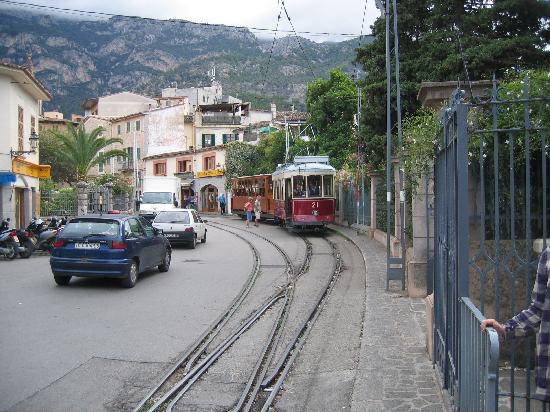
Vintage interurban in Soller, Mallorca

The Soller Interurban stops in front of a hotel.
Now, for our double-deck tram friends, the Swedes are no slouches when designing a modern double-deck, articulated tram!
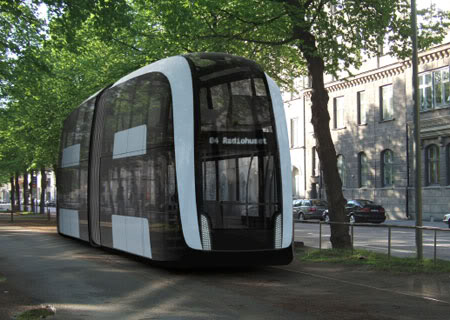
Double-deck tram for Stockholm?
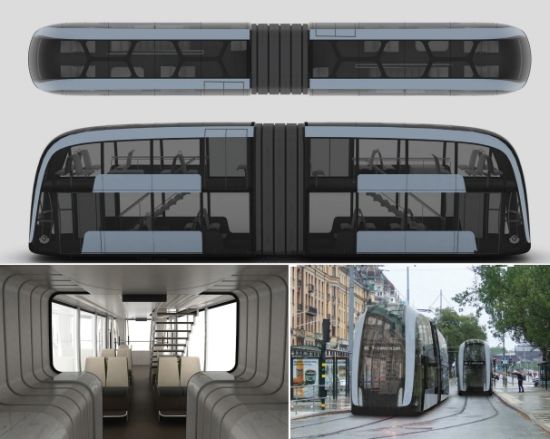
Can you imagine this trundling down Broadway?
For the LRT can’t operate in narrow roads or on steep grades crowd, let’s travel to Lisbon and see where it does every day.
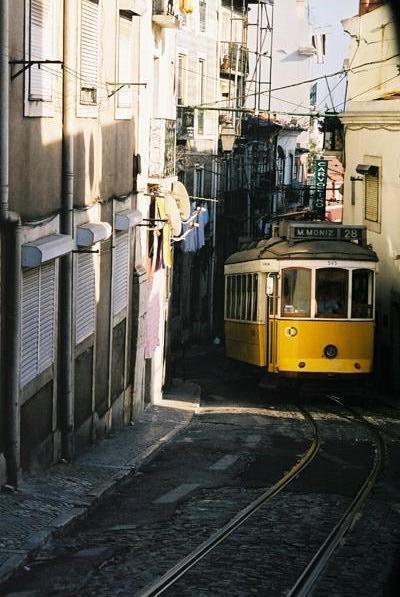
Tight & steep, a Lisbon tram negotiates a steep hill.
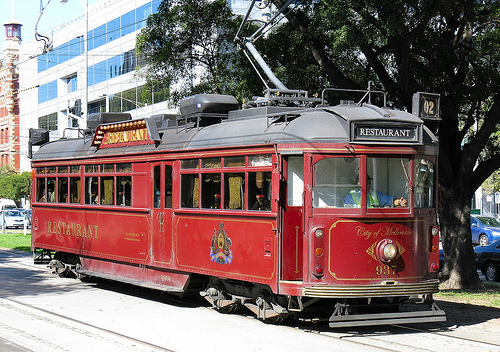
And finally, Melbourne’s famous Restaurant tram, where one can have fine dining while touring the tram system.Ai??Ai??Appies on Broadway maybe?
Rail for the Valley News – Two Events
Two events upcoming! One of them is in Abbotsford, the other is in Vancouver.
~~~~~~~~~~~~~~~~~~~~~~~~~~~~~~~~~~~~~~~
Event 1
Friends of Rail for the Valley ANNUAL GENERAL MEETING
Tuesday, March 16, 7:00pm
Abbotsford UFV, Building D, Room D213
On March 16th we will be holding our first Annual General Meeting (AGM) for the Friends Of Rail For The Valley Society. Here we will discuss progress of the campaign, society details, future direction, and other related issues. This is a very important meeting for our Society.
We will also need to elect some more directors, so please consider that, and also invite anyone you think would be interested in helping out.
-Paul Gieselman (President)
Get involved in the community effort. We need your help!
There will be refreshments. Bring a friend. Membership is $10, and you can sign up at the AGM.
*Please RSVP railforthevalley@gmail.com, so we know the number of people who will be coming.*
~~~~~~~~~~~~~~~~~~~~~~~~~~~~~~~~~~~~~~~
Event 2
Rail for the Valley A?ai??i??ai??? LIGHT RAIL RALLY & RIDE A?ai??i??ai??? Granville Island, Vancouver
Saturday, March 20, 2:00pm (first day of Spring)
Meet at the Granville Island Olympic Line Station
More details to come
This is your chance to experience VancouverA?ai??i??ai???s state-of-the-art 2010 Streetcar while itA?ai??i??ai???s still in operation. (Rides are free!)
Some background (From the Province)
Streetcar named desire shows transit future (The Province, Feb. 28, 2010)
A?ai??i??Ai??ItA?ai??i??ai???s a tiny 1.8-kilometre Olympic streetcar demonstration project between Granville Island and the Olympic Village that may prove to be the key transit legacy A?ai??i??ai??? especially south of the Fraser. The False Creek service also drew more riders than expected and, from day one, itA?ai??i??ai???s been very much A?ai??i??Ai??a streetcar named desireA?ai??i??A? for those in the Valley who call for just such a service on the former Inter-urban rail corridor from Surrey to Chilliwack.A?ai??i??A?
Yes, VancouverA?ai??i??ai???s Olympic Streetcar Line illustrates what we can have in the Valley all the way to Chilliwack, very soon and at very low cost, using the already-existing Inter-urban rail line.
The demo project is scheduled to end on Sunday, so letA?ai??i??ai???s get together and have a RALLY FROM THE VALLEY at Granville Island Station on Saturday. (The line was so successful, that there is a small but real chance it could be made permanent. I will keep you posted.)
Take the whole family, and make it a day. After the rally, visit Granville Island on the first day of spring!
Please RSVP railforthevalley@gmail.com if you can make it. More details to follow.
CARPOOLERS: let us know if you need a carpool, or if you can carpool somebody.



Recent Comments