Talking transportation – From the Chilliwack Progress
More conversation about ‘rail‘ transit from the Fraser Valley. For very little money as compared to the SkyTrain light-metro, we could have a Diesel LRT demonstration line up and running from Chilliwack to Langley by the end of the year.
It is time that BC’s regional transportation policies reflect the 21st century, where building ‘rail’ transit as cheaply as possible, affordably servicing as many destinations as possible is far more important than building very small but expensive ‘trunk‘ metro lines that must be force fed ridership from buses to achieve symbolic high ridership, while at the same time bankrupting the transit authority.

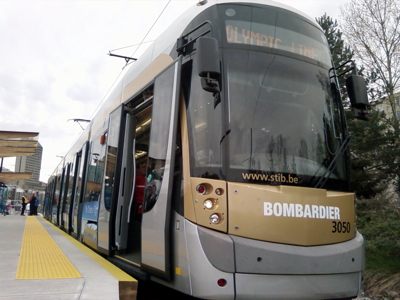
Bombardier's Flexity-Wide TramTrain
Talking transportation
Greg Knill – Chilliwack Progress
The problem with so much of the talk around transportation issues in this region is that itA?ai??i??ai???s backwards. It starts with a A?ai??i??Ai??solution,A?ai??i??A? then lines up the obligatory evidence to prove why that solution would work.
WhatA?ai??i??ai???s needed is a discussion that starts fresh A?ai??i??ai??? a discussion that begins with the broad objectives of how we want our transportation system to evolve, then looks at what technology would best suit getting us there.
Last week the Chilliwack Chamber of Commerce brought in one of the more outspoken advocates of a community rail link between Chilliwack and Abottsford. His presentation drew a large turnout, indicative of the interest in this issue.
Talk about a rail link in the Valley is nothing new, of course. Unfortunately, that is where the discussion has centered. Rather than talk about transportation connectivity, the discussion has been about the viability of a train on the old Inter Urban rail line.
But the issue should be about more than a revival of an old rail link. It should be about a regional transportation plan that delivers the maximum economic and social benefits, at the lowest cost to the users and the governments that will inevitably subsidize the venture.
As Peter Holt told the Chamber on Thursday, far too much of the transportation talk in the Lower Mainland has centered on Vancouver.
WhatA?ai??i??ai???s needed here is a way for the various municipalities outside that sphere to develop a model that serves their interests. The object should be connectivity, based on the assumption that greater worker mobility will enhance economic opportunities throughout the region.
That will take more political will and direction.
WeA?ai??i??ai???ve seen it around issues like air quality. LetA?ai??i??ai???s see it around issues like transportation.
http://www.bclocalnews.com/fraser_valley/theprogress/opinion/89472487.html
Rail advocate quotes Gretzky to push plan
Another fine article on the proposed ‘valley’ rail. There is an ever growing support for the ‘return of the interurban’ but please, there is really no such thing as ‘community rail’ and it would sad if the proposed interurban project were to beAi??Ai??side-tracked by an unproven transit philosophy. Any form of rail transit is expensive and it must be built to cater to to specific customer demands and wants, if not the public (the customer) will not use it. Community rail is a figment of an academics imagination, whichAi??Ai??makes good copy, but has little substance.Ai??Ai??The modern development of theAi??Ai??interurban, is nowAi??Ai??”TramTrain‘Ai??Ai??and is built to satisfy longer distance travel, rather than a short distanceAi??Ai??travel and definitely should not be seen as a feeder to the SkyTrain metro system.
Rail For The Valley supports a Vancouver to Chilliwack TramTrain, a 21st century transit philosophy that has proven to be not only affordable andAi??Ai??successful and is now used in over 20 locations around the world. The term, Community Rail, like the SkyTrain light-metro are onlyAi??Ai??mentioned in the METRO and Fraser Valley region and it is time that we join the rest of the world in designing and building proven light rail transit.

TramTrain in the country
Rail advocate quotes Gretzky to push plan
By Brian Lewis, The ProvinceMarch 28, 2010
If more of our federal, provincial and municipal politicians who represent constituents south of the Fraser River thought like Wayne Gretzky, then moving throughout this vast and fast-growing region would be as enjoyable as it once was watching the Great One score hat tricks.
“Skate to where the puck is going, not to where it is now,” was Gretzky’s advice to fellow hockey players.
But his straightforward lesson still applies to far more than jocks chasing a little rubber disc on the ice. It’s also tailor-made for public transportation planning, for example.
This is why engineer and community-rail guru Peter Holt used the Gretzky analogy in his recent presentation to the Chilliwack Chamber of Commerce when he spoke about why he and many others strongly feel that the Fraser Valley’s best long-term transportation solutions are riding on the rails.
The eloquent ex-Brit and former Royal Navy engineering officer has an extensive professional background that includes a number of senior roles in Canadian aerospace programs and with the Department of Foreign Affairs.
Since moving his family to Surrey in 1997, Holt has focused on regional issues and served as executive director of the forward-thinking Surrey Board of Trade between 2004 and 2007. That’s where he also furthered a keen interest in urban and regional growth, public transit and, of course, trains.
On the nostalgic side, he’s an enthusiastic spokesman for the Surrey-based Fraser Valley Heritage Rail Society, which is well along in restoring one of the original cars from the old B.C. Electric interurban rail line that ran from downtown Vancouver and up the Fraser Valley to Chilliwack from 1910 to the early 1950s.
On the practical side, Holt sees the “Fraser Valley Heritage Railway” and its refurbished vintage rolling stock as an excellent medium for creating awareness of the potential to fully restore the 103-kilometre right-of-way, which is still owned by the B.C. government, to accommodate a new, state-of-the-art community rail system.
Not only is the interurban right-of-way a wholly-owned public asset, Holt points out, but the legal authority to use it for public transit has also been established.
An introductory “heritage tourism” service during the summer on part of the line could be introduced by late 2011 for as little as $700,000, he suggests, and the City of Surrey is very serious about backing the initiative.
But the primary goal for Holt, his rail-heritage pals and a number of Valley rail advocacy groups, is a full community-rail service that would link SkyTrain in Surrey with Langley, Abbotsford and Chilliwack.
Holt told the Chilliwack business group that about 20 years from now, another 400,000 people will be living in the Fraser Valley. That’s equal to another city roughly the size of Surrey today.
But, he warns, expanding the road system to accommodate this growth will be much more expensive and far more environmentally damaging than choosing a community-rail option.
“Of course cars are more convenient today, but as our roads become more congested and expensive to expand, people will have to look at other transit options,” Holt says.
In other words, plan transit based on where it’s going, not where it’s at today.
That’s how politicians can score with taxpayers.
http://www.theprovince.com/sports/Rail+advocate+quotes+Gretzky+push+plan/2736247/story.html
Support In The Valley

On March 25, Peter Holt, an influential advocate for passenger rail, made a presentation to the Chilliwack Chamber of Commerce regarding the need for passenger rail in the South of the Fraser River communities. Brian Lewis of the Province was there and this is what he had to say…
If more of our federal, provincial and municipal politicians who represent constituents south of the Fraser River thought like Wayne Gretzky, then moving throughout this vast and fast-growing region would be as enjoyable as it once was watching the Great One score hat tricks.
“Skate to where the puck is going, not to where it is now,” was Gretzky’s advice to fellow hockey players.
But his straightforward lesson still applies to far more than jocks chasing a little rubber disc on the ice. It’s also tailor-made for public transportation planning, for example.
This is why engineer and community-rail guru Peter Holt used the Gretzky analogy in his recent presentation to the Chilliwack Chamber of Commerce when he spoke about why he and many others strongly feel that the Fraser Valley’s best long-term transportation solutions are riding on the rails.
The eloquent ex-Brit and former Royal Navy engineering officer has an extensive professional background that includes a number of senior roles in Canadian aerospace programs and with the Department of Foreign Affairs.
Since moving his family to Surrey in 1997, Holt has focused on regional issues and served as executive director of the forward-thinking Surrey Board of Trade between 2004 and 2007. That’s where he also furthered a keen interest in urban and regional growth, public transit and, of course, trains.
On the nostalgic side, he’s an enthusiastic spokesman for the Surrey-based Fraser Valley Heritage Rail Society, which is well along in restoring one of the original cars from the old B.C. Electric interurban rail line that ran from downtown Vancouver and up the Fraser Valley to Chilliwack from 1910 to the early 1950s.
On the practical side, Holt sees the “Fraser Valley Heritage Railway” and its refurbished vintage rolling stock as an excellent medium for creating awareness of the potential to fully restore the 103-kilometre right-of-way, which is still owned by the B.C. government, to accommodate a new, state-of-the-art community rail system.
Not only is the interurban right-of-way a wholly-owned public asset, Holt points out, but the legal authority to use it for public transit has also been established.
An introductory “heritage tourism” service during the summer on part of the line could be introduced by late 2011 for as little as $700,000, he suggests, and the City of Surrey is very serious about backing the initiative.
But the primary goal for Holt, his rail-heritage pals and a number of Valley rail advocacy groups, is a full community-rail service that would link SkyTrain in Surrey with Langley, Abbotsford and Chilliwack.
Holt told the Chilliwack business group that about 20 years from now, another 400,000 people will be living in the Fraser Valley. That’s equal to another city roughly the size of Surrey today.
But, he warns, expanding the road system to accommodate this growth will be much more expensive and far more environmentally damaging than choosing a community-rail option.
“Of course cars are more convenient today, but as our roads become more congested and expensive to expand, people will have to look at other transit options,” Holt says.
In other words, plan transit based on where it’s going, not where it’s at today.
That’s how politicians can score with taxpayers. blewis@theprovince.com
http://www2.canada.com/theprovince/columnists/story.html?id=d9192722-fe39-4e68-945b-80f2d3c37047&k=84094
Transit at a crossroads – From The Surrey Leader
Well here we go again, TransLink is planning for ‘rapid’ transit for Surrey and the Fraser Valley.Ai??Ai??Zwei has seen this all before and I’m afraidAi??Ai??I amAi??Ai??not at all enthused with the process, nor have much faithAi??Ai??in TransLink to do an honest study. Zwei hates the term ‘rapid transit’ as it refers to metro and only metro and I must remind everyone concerned that a transit system is as fast as it is designed to be, with TransLink in the past, deceitfully planning LRT to be slow!
The picture of the supposedly Eugene BRT, is in fact a guided, rubber tired Guided Light Transit (GLT) vehicle that costs almost as much to install than a tram, yet has far less capacity. GLT, must operate on a dedicated rights-of-ways and cannot operate on-street in mixed traffic. The Eugene BRT uses standard articulated buses,Ai??Ai??busways, signal priority, high level loading platforms and greatly reduced stops to increase commercial speed. With BRT comes lots of new road construction as well.
With 10 minute peak headways (approx. 700 pphpd), there was little scope to plan for light rail.
Zwei also hopes that the light rail consultant has indeed worked on completedAi??Ai??light rail projects, but what Zwei has read so far, there is little hope with this.
It just seems to me the same well oiled TransLink ‘dog and pony show’,Ai??Ai??done many times before, to keep the locals happy, while in reality doing nothing until the provincial government orders them to build another SkyTrain light-metro line.

EVAN SEAL / THE LEADER
Transit at a crossroads
By Jeff Nagel – Surrey North Delta Leader
ThereA?ai??i??ai???s no timetable or money yet to build anything, but TransLink has begun asking local groups what shape an eventual rapid transit extension in Surrey should take.
Various corridors will be examined that could see rapid transit lines connect the existing SkyTrain stations to more town centres in Surrey and on to Langley and White Rock.
A?ai??i??Ai??WeA?ai??i??ai???re not just talking about SkyTrain here,A?ai??i??A? TransLink project planning manager Jeff Busby said.
A?ai??i??Ai??WeA?ai??i??ai???re looking at light rail and Bus Rapid Transit, where youA?ai??i??ai???d use buses but youA?ai??i??ai???d run them in their own lanes so theyA?ai??i??ai???d have some of the advantages of rapid transit.A?ai??i??A?
He said the Olympic streetcar demonstration line to Granville Island is a good example of what light rail could look like south of the Fraser.
TransLink is not locked in to routes that have been bandied about previously.
The Provincial Transit Plan included a map suggesting lines be built heading south on King George Highway and also east on 104 Avenue to Guildford, then southeast via Fraser Highway to Langley.
The South of the Fraser Area Transit Plan also flagged the same routes for further study.
Ai??Ai??But consultants hired by TransLink to examine routes and technologies for the Surrey extension are also directed to look at the old Interurban rail corridor that many light rail fans say could be quickly used to launch a modern service.
Even Hydro rights-of-way that cut across Surrey could be potential routes, Busby said.
A?ai??i??Ai??ItA?ai??i??ai???s a blank slate at this point,A?ai??i??A? Busby said. A?ai??i??Ai??Everything is on the table.A?ai??i??A?
He mainly wants to know what local residents want to get out of a rapid transit expansion.
A?ai??i??Ai??How important is it that all the centres get connected? Are there some that are more important? What land-use and other planning goals should we be aware of?A?ai??i??A?
So far, TransLink is meeting with local stakeholder groups, with full public meetings to come in the fall.
The aim of the process, Busby said, is to shortlist options and then develop a preferred solution for the Surrey area that can be ready to launch if TransLink gets more sources of funding.
But Busby said the costs have to be weighed against performance factors, like the speed, frequency and carrying capacity of the various options.
SkyTrain carries the most people A?ai??i??ai??? 10,000 to 25,000 per hour A?ai??i??ai??? compared to 6,000 to 10,000 for light rail and 2,000 to 3,000 for Bus Rapid Transit (BRT).
The region has existing B-Line express bus routes A?ai??i??ai??? including VancouverA?ai??i??ai???s busy Broadway corridor to UBC A?ai??i??ai??? but none are as advanced as the type of BRT service Busby envisions.
BRT would feature permanent stations rather than stops and routes largely separated from traffic, potentially using traffic signal priority or else special bridges or trenches to scoot through congested intersections.
A?ai??i??Ai??We like at-grade street car-type light rail,A?ai??i??A? countered Surrey Coun. Marvin Hunt, who sits on the cityA?ai??i??ai???s transportation committee.
He said King George Highway is a natural for the route as is 104 Avenue, and said thereA?ai??i??ai???s ongoing debate over whether Fraser Highway or the old interurban rail route should be used for the southeast corridor to Langley.
Hunt said Bus Rapid Transit doesnA?ai??i??ai???t inspire public confidence and spur denser development in the same way as rail because buses seem temporary and can be easily changed.
A?ai??i??Ai??Once you get something thatA?ai??i??ai???s solidly in the ground, people respond to that a whole lot better,A?ai??i??A? he said.
Local transit advocate Paul Hillsdon also likes light rail as a long-term solution, but thinks itA?ai??i??ai???s better to back less-costly BRT than get nothing or wait.
A?ai??i??Ai??Considering TransLink is broke and we need change now, the cheaper, more affordable short-term solution, I think, is creating a Bus Rapid Transit network.A?ai??i??A?
He envisions a network of seven fast, frequent lines that would connect all Surrey town centres (using 104, 72 and 64 Avenues and Scott Road, King George, 152 Street and the Fraser Highway) as well as the entire north-south 200 Street corridor through Langley Township and 24 Avenue from Crescent Beach to Langley.
A?ai??i??Ai??It would service areas that are going to grow by leaps and bounds over the next decade,A?ai??i??A? he said.
Surrey is expected to take a quarter of the regionA?ai??i??ai???s growth by 2041, when the population is to hit 750,000.
Allen Aubert, who was one of SurreyA?ai??i??ai???s representatives on the South of Fraser Area Transit Plan, says time is of the essence and something must be built within five to 10 years.
ThatA?ai??i??ai???s why he says the old Interurban route has a critical advantage: it already exists.
A?ai??i??Ai??It goes to Cloverdale, to Sullivan, to Newton where thereA?ai??i??ai???s a big exchange,A?ai??i??A? he said. A?ai??i??Ai??And lo and behold, it can connect to SkyTrain at Scott Road. WhatA?ai??i??ai???s not to like?A?ai??i??A?
Past estimates suggest modern light rail cars A?ai??i??ai??? similar to BombardierA?ai??i??ai???s Olympic Line trams A?ai??i??ai??? could be put on the Interurban route from Scott Road all the way to Langley City for about $150 million, barely a tenth of the planned Burnaby-to-Coquitlam SkyTrain extension.
A?ai??i??Ai??ItA?ai??i??ai???s so cheap,A?ai??i??A? Aubert said, adding a spur line could easily be built running up King George from Newton to City Centre.
Aubert and others agree that whatever comes must serve local town centres, rather than be designed primarily to move commuters to Vancouver.
They say thatA?ai??i??ai???s the only way transit-oriented communities will develop and would reflect the reality that 80 per cent of trips south of the Fraser stay in the region.
Ai??Ai??For more on the Surrey Rapid Transit process see: http://www.translink.ca
http://www.bclocalnews.com/surrey_area/surreyleader/news/88966702.html

Not a picture of the Eugene Oregon BRT, rather a GLT guided bus that must run on a dedicated ROW.
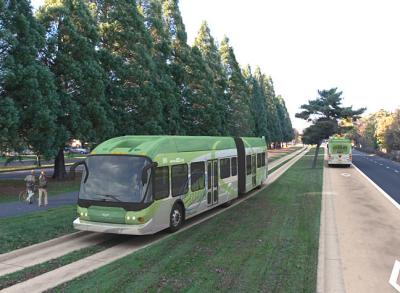
- Eugene Oregon Emerald Express BRT
Light Rail – It’s Child’s Play!
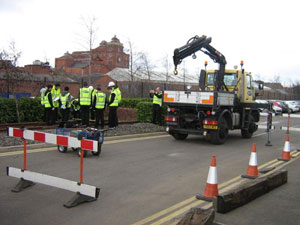
This item from Nottingham Express Transit’s web site is very interesting. Here we have Engineering students working on a tram or light rail line, doing simple maintenance tasks and learning to drive a tram. Not child’s play but it is illustrative of light rail’s inherent simplicity that makes it so cheap to build and operate when compared to it vastly more expensive distant relative SkyTrain.

Ai??Ai??
Top Valley students learn to run a tramway
On Tuesday 23 February, Nottingham Tram Consortium played host to a group of Engineering Students from Top Valley School and Engineering College. During their visit, the students were given a behind-the-scenes tour of the facilities available at NET’s Wilkinson Street depot. The purpose of the visit was to enable the students to gain an understanding of the reasons for undertaking maintenance in the industrial environment and its role within the organisation and some of the activities required to maintain a safe, reliable and high-quality tramway operation. The visit included a number of activities throughout the day, including a full tour of the depot site, tram maintenance facilities the control room from where the tramway operations are managed.
Working in groups, the students followed a set of instructions to complete a planned track maintenance task, with assistance from members of the engineering team. The group was also fortunate enough to understand and appreciate aspects of the tram including a short driving course within the depot sidings.
Top Valley School and Engineering College facilitates students from across Nottingham who are undertaking the Engineering Diploma along side their GCSE studies. The course, part of the National Curriculum, has been developed by industry and employers to bring the importance of engineering into the classroom whilst giving the participants the opportunity to learn and interact Nottingham Tram Consortium, supporting the community with which it serves, has been working in partnership with Nottinghamshire Educational Business Alliance and Top Valley School and Engineering College to develop a long-term partnership. Working together, students will be able to engage and experience engineering activities that will benefit their long-term aspirations and career goals.
TransLink is on the right track – Or Is It?

TramTrain, The interurban of today
Is TransLink on the right track or is it merely taking an ‘avoiding‘ line with the Fraser Valley. TransLink deja vu is happening again with a so called consulting with the public/see your taxpayers dollars at work routine, its a well oiled ‘dog and pony show’ and I’m afraid I’ve seen too many. As pointed out in an earlier blog, TransLink is up to its old dirty tricks by vastly understating LR T’s capacity; it’s an old act and I guess that you can’t teach a very tired old dog new tricks. ThereAi??Ai??are threeAi??Ai??fresh ‘hoofer’s’ on the scene all wantingAi??Ai?? in on the showAi??Ai??own and one wonders can TransLink tired routine keep up with them and their new acts?
This time it will be different, because Rail for the Valley has a new routine for TransLink’s Valley frolics; it’sAi??Ai??coming your way very soon and will be a show stopper!
From the Langley Times
TransLink is on the right track
By Frank Bucholtz – Langley Times
The regional transportation authority is asking the public for input into what type of rapid transit would best serve the south of the Fraser region, including Langley.
For starters, the agency recognizes that SkyTrain is not necessarily the answer. SkyTrain works well, but it is very expensive to build. It moves a tremendous number of people, as was witnessed during the Winter Olympics, but it is questionable whether those volumes of people would ride a SkyTrain line between Langley and Surrey.
One of the biggest problems with SkyTrain is that it sucks up a tremendous amount of capital, starving TransLink from offering more bus service. A new SkyTrain line also requires payment of a large amount of interest each year.
Advocates for the restoration of interurban service along the BC Hydro rail corridor, including VALTAC and South Fraser OnTrax, will now have an opportunity to advocate for that service. Those who rode the streetcar on the line to Granville Island during the Winter Olympics and recently-completed Paralympics got a glimpse of what a modern interurban rail car would be like A?ai??i??ai??? and itA?ai??i??ai???s impressive.
Restoration of interurban service between the Scott Road SkyTrain station and Langley could cost as little as $150 million, says Allen Aubert, who was a public representative when TransLinkA?ai??i??ai???s South of Fraser transit plan was drawn up.
This is one-tenth the cost of the much-touted Evergreen Line in the Tri-City area A?ai??i??ai??? a line that is merely an extension of the existing SkyTrain system into Coquitlam and Port Moody.
Hydro owns the railway right of way between Surrey and Chilliwack, with Canadian Pacific Railway owning the tracks through LangleyA?ai??i??ai???s urban area. However, CP has a contractual obligation to allow the tracks to be used for passenger rail, part of the deal when the tracks were sold in 1988.
Aubert said the great advantage of the interurban is that it links existing communities and would serve to encourage local transit use south of the Fraser. This is a key point, as few people are willing to use TransLink bus service in this area unless they have no other choice.
The original interurban also served as a valuable link between communities, something reflected in the name A?ai??i??Ai??interurban.A?ai??i??A?
People didnA?ai??i??ai???t just use it to travel to downtown Vancouver. There were many trips to New Westminster, which at that time was the commercial centre for the entire Fraser Valley.
There are also other options. A rapid bus route using dedicated bus lanes has the ability to offer service with far more speed than conventional bus routes. A B-Line route, which is a modification of rapid buses, offers faster service A?ai??i??ai??? yet TransLink has failed to offer any such service south of the Fraser.
Langley residents who would like to see some of their TransLink tax dollars actually put to work here should take the time to let TransLink know what they think about transit options.
They can do so online, by going to the following website A?ai??i??ai??? http://www.translink.ca/en/Get-Involved/Public-Consultations/Surrey-Rapid-Transit-Study.aspx.
http://www.bclocalnews.com/surrey_area/langleytimes/opinion/88959037.html
Man walking on tracks holds up SkyTrain – From The Vancouver Sun

Trams coexisting with people is normal in Amsterdam
This is the third time in as many weeks where a person walking on the SkyTrain guideway stops SkyTrain servcie; of course people walk all over LRT/tram track everyday and with ;ding-ding’ of a tram bell, they get out of its way!
Ai??
Man walking on tracks holds up SkyTrain
By ANDREA WOO, VANCOUVER SUNAi??Ai??Ai??March 25, 2010 7:02 PMAi??Ai??Ai??METRO VANCOUVER – A man walking on the SkyTrain tracks between the New Westminster and 22nd Street stations is causing major delays in service.Ai??Ai??Police are now waiting for the man at 22nd Street station.
Ai??Ai??TransLink is setting up a bus bridge to move passengers.
http://www.vancouversun.com/walking+tracks+holds+SkyTrain/2726786/story.html
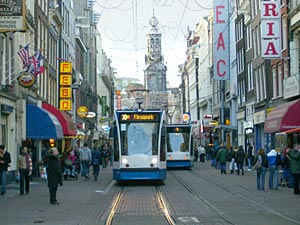
Trams and shoppers on an Amsterdam shopping precinct
A?ai??i??E?Blank slateA?ai??i??ai??? transit plan bodes well – Um no, Not Until TransLink Stops Playing Dirty Tricks!
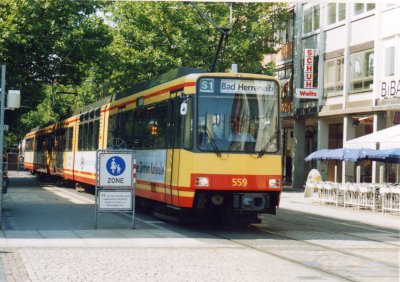
Though the transit debate is supposed to be a ‘Blank slate’, it seems TransLink is up to its own dirty little tricks as usual. It has been a long and well established fact that light rail (LRT) can and does carry over 20,000 persons per hour per direction. The claim that it can carryAi??Ai??Ai??Ai??only 6,000 to 10,000 pphpd is completely wrong and shows that the SkyTrain Lobby’s ‘dirty tricks department’ is in full operation.
It is the ability of modern LRT to cater to 20,000+ passenger loads, when there is demand, is one of the reasons it made the much more expensive SkyTrain light-metro obsolete. I wish that TransLink stop this tiresome little propaganda campaign and start to do real planning before it is further embarrassed by future events.
Want good transit planning? AvoidAi??Ai??using TransLink!
From the Surrey Leader:
Ai??Ai??A?ai??i??E?Blank slateA?ai??i??ai??? transit plan bodes well
Published: March 23, 2010 4:00 PM
Although financially TransLink remains in a world of hurt (it needs hundreds of millions of dollars more each year to maintain and improve the transit system, with no funding source as yet identified), conceptually, things may be looking up.
TransLink planners are currently brainstorming how to improve rapid transit in Surrey, and according to project planning manager Jeff Busby: A?ai??i??Ai??Everything is on the table.A?ai??i??A?
That includes creating bus-only lanes, running transit routes through Hydro rights-of-way, using existing rail lines, and developing at-grade light rail.
The idea is to have the priorities already identified if and when TransLink receives more funding.
This A?ai??i??Ai??blank slateA?ai??i??A? approach to transit is a welcome one.
The perennial favourite for government has always been SkyTrain because it carries the most people A?ai??i??ai??? 10,000 to 25,000 per hour A?ai??i??ai??? compared to 6,000 to 10,000 for light rail and 2,000 to 3,000 for rapid buses.
But it is prohibitively expensive to build A?ai??i??ai??? more than $100 million per kilometre as opposed to $25 million per kilometre for light rail. And utilizing existing rail lines would be even more economical.
VancouverA?ai??i??ai???s Olympic experience proved bigger is not always better. The Olympic streetcar that shuttled crowds between Granville Island and the AthleteA?ai??i??ai???s Village was hugely popular. So much so that Vancouverites want to see it stay.
Citizens south of the Fraser would likely have the same reaction to a revival of the old Interurban rail route, which would link the communities of Cloverdale, Sullivan and Newton A?ai??i??ai??? plus connect with the SkyTrain at Scott Road.
As Interurban advocate Allen Aubert says, A?ai??i??Ai??WhatA?ai??i??ai???s not to like?A?ai??i??A?
Most people travelling from south of the Fraser A?ai??i??ai??? 80 per cent A?ai??i??ai??? stay within the region.
Offering a variety of transit options that would make hopping from town centre to town centre a pleasant and affordable option would be a move in the right direction.
http://www.bclocalnews.com/surrey_area/surreyleader/opinion/88967567.html
Two letters in the North Shore News

The usual suspects yes, but an insight to the up coming Evergreen Line/Broadway – UBC metro line debate.
Take the regional view on transit investment
North Shore News
Published:Ai??Ai??Wednesday, March 24, 201o
Dear Editor:
In her March 17 columns Costly SkyTrain Technology Choices Baffle, Elizabeth James, cites U.S. professor Panos Prevedouros saying, “Light rail service can occur at a small fraction of the cost of the proposed fully elevated multibillion dollar system, with similar or better results in ridership.”
If there is any truth in this, she should then explain why from Toronto to Seattle, light rail lines cost close if not as much as the Canada Line per kilometre; why from Buffalo to San Jose, they have failed to attract promised ridership and why the Canada Line ridership is four times higher than the more expensive Seattle light rail one?
Given the dismal state of public transit south of the border, we should take any advice of a U.S. “expert” on that matter with a grain of salt and prefer to stick with the proven track record of our local engineering services. Have you also noticed how the Canada Line was moving smoothly more than 200,000 passengers a day during the Olympics? It is a figure you can routinely expect for the foreseeable future if the province is true to its word to double transit ridership in the region. Could LRT be capable of such a job?
The column — discounting the third SeaBus — seems also to insinuate that all transit investments are “Vancouver centric” and not serving the North Shore. The Canada line zipping through Vancouver helps tremendously my commute, and others’, from the Richmond area to North Vancouver, where I meet people from the North Shore happy to get to the airport in a fast, reliable and timely manner. That is the essence of a regional investment. It is not necessarily happening in the border of your community, but it helps it. And you know what: Everyone aboard the train regrets that more money has not been spent in Vancouver to improve the Canada Line/SeaBus connection.
Parochial rants are just that, parochial.
Viven Chiu,
Richmond
(Editor’s note: Viven Chiu is co-author of the 2003 Study Marigni report The Richmond-Airport-Vancouver Rapid Link Project.)
James right to question SkyTrain technology costs
North Shore News
Published:Ai??Ai??Wednesday, March 24, 2010
Dear Editor:
I welcome Elizabeth James’ column, Costly SkyTrain Technology Choices Baffle, as she asks the same questions the Light Rail Committee have been asking for years. Why are we still building with this extremely costly, “Edsel” transit system made obsolete by modern light-rail decades ago.
Despite being on the market for more than 30 years, only seven SkyTrain-type systems have been built, all done in private deals with little or no public consultation. SkyTrain was even too expensive for the Canada Line, which uses a generic metro system, incompatible with SkyTrain.
Most taxpayers do not know what the real cost of SkyTrain is, as TransLink refuses to divulge the real costs, including debt servicing. What is known, by a very few, is that SkyTrain is subsidized by more than $230 million annually. U.S. transit projects are built with voter-approved, long-term bonds which tell the taxpayer the real cost of the project. To date, the taxpayer has invested more than $8 billion on our metro system, yet there is little evidence of a modal shift from car to transit, with TransLink admitting that more than 80 per cent of SkyTrain’s riders first take a bus to the metro.
For the same cost of the RAV/Canada Line and the proposed SkyTrain Evergreen Line, almost $4 billion, we could have built the following:
1) LRT Steveston/YVR to Vancouver;
2) LRT BCIT to UBC;
3) tram-train from Vancouver to Chilliwack;
4) tram-train Evergreen Line;
5) tram-train to the North Shore.
American transit specialist Gerald Fox’s comments on TransLink’s Evergreen Line business case should send shivers down taxpayers’ spines: “It is interesting how TransLink has used this cunning method of manipulating analysis to justify SkyTrain in corridor after corridor, and has thus succeeded in keeping its proprietary rail system expanding.”
Malcolm Johnston,
Light Rail Committee
Delta
Report from the Rally & Ride, with pictures
By all accounts, the rally was a success!
We handed out hundreds of leaflets, got media attention (CBC and News 1130), and overall raised a whole lot of awareness. There were large numbers of people of all ages taking the train; Bombardier’s volunteer conductors were kept busy with crowd control.
Thank you to all our volunteers!





Recent Comments