Why the Valley Interurban Must Service Abbotsford International Airport (YXX)
To be successful, a transit system or transit line must serve popular destinations in order to generate ridership, the notion that transit customers will take ‘rail’ because it is just there is wrong. In order for successful interurban service it must serve destinations where customers want to go and Abbotsford International Airport (YXX) is a natural destination, especially if some airlines move their operations from the very expensive YVR to YXX.
AsAi??Ai??the interurban is in light-rail family, it can if need be, operate on-street makingAi??Ai??an easier and much cheaper route, instead of extremely expensive ‘greenfields’ construction. A strong case can be made forAi??Ai??a routeAi??Ai??diverging West from the Southern Railway of BC rights-of-way at Huntington/Douglas, WestAi??Ai??along the medianAi??Ai??of Vye (servicing as well the penitentiary complex) & Huntington Rd’s.Ai??Ai??, turning North onAi??Ai??Mount Lehman Road until it arrives at YXX.Ai??Ai?? An on-street single trackAi??Ai??10 km. route with one or two passing loops, serving two destinations (three destinationsAi??Ai??if one includes the TRADEX Convention Centre at YXX), would cost in the neighborhood of $100 million or about $10 million/km., yet may be the crucial link and revenue generatorAi??Ai??for the proposedAi??Ai??interurban service.
There is persistent rumour that if YXX has a rail connection, one or two larger scheduled airlines would make the move to YXX. With the interurban directly servicing Vancouver http://railforthevalley.wordpress.com/2009/03/01/why-the-valley-interurban-must-service-vancouver/Ai??Ai?? it would give Vancouver customers a ‘seamless’ rail journey to YXX, which must send chills down YVR’s management’s spine. Unlike RAV, where YVR is just to close to attract much ridership, a direct Vancouver to YXX rail service would provide the incentive for airlines to make the switch to YXX, with easy connections not only to Vancouver, but Surrey, Langley and Chilliwack.
$100 million may seem like a large investment for the airport connection but it would bring at least a ten fold investment backAi??Ai??to Abbotsford and environs,Ai??Ai??more if airlines make YXX their hub. For those who want the ‘Return of the Interurban’ serious consideration must be made for a connection to YXX and it must be included in future interurban and transit planning.
Why the valley interurban must service Vancouver.
The current thinking is that the proposed valleyAi??Ai??’interurban’ service terminate at Scott road SkyTrain station and this is a big mistake. Lest we forget the majority of interurban customers will want to go to Vancouver and forcing them to transfer to SkyTrain will add at least 30 or more minutesAi??Ai?? to their journey. What is also forgotten is that one can lose upwards of 75% of potential customers per transfer, which was reflected in Karlshrue Germany, where after opening their first tram-train, eliminating one transfer point, from commuter train to tram, weekday ridership rocketed from 488,400 to 2,064,378 – a 423% increase in just a few weeks! So were sown the seeds of success!
The Fraser River Bridge is there, the line is mostly double tracked to Vancouver Central Station and gaining pathways for the interurban would be one of scheduling with the other users. Track-sharing and providing pathways for the interurban to serviceAi??Ai??Vancouver maybe difficult, but Ai??Ai??not impossible, the old interurban track-shared across the Fraser River Rail BridgeAi??Ai??100 years ago and certainly today it can again!
Servicing Vancouver, means the interurban will service a large population base, which would ensure ridership, which wouldAi??Ai??bring anAi??Ai??early success andAi??Ai??is what the proposed interurban service needs! Rail for the Valley must include direct interurban service to downtown Vancouver, as the benefits of a direct Vancouver to Chilliwack rail service far outweigh the obstacles.
B.C. on the hook for $3.3-billion Port Mann bridge
The Ministry of Transportation announced today that the Port Mann P3 has failed, and B.C. will now directly fund the bridge construction. Globe and Mail article here.
The B.C. taxpayers will be taking all of the risk, if traffic on the bridge is less than forecast.
What this means is…..
If the government does invest in a light rail alternative for the Fraser Valley, successfully encouraging people to leave their cars for more sustainable transportation options, resulting in less traffic on the bridge than forecast, taxpayers will have to pay up!
Not to worry, people.
Not to worry.
Kevin Falcon says he is A?ai??i??Ai??very comfortable with traffic forecasts.”Ai??Ai?? Why’s that, Mr. Falcon? Maybe because the current plan for the valley is “no light rail alternative for the foreseeable future?”
Next time you’re stuck in traffic, you’ll know at least someone’s comfortable.
On another note, check out this latest location of VALTAC‘s rail for the valley trailer:
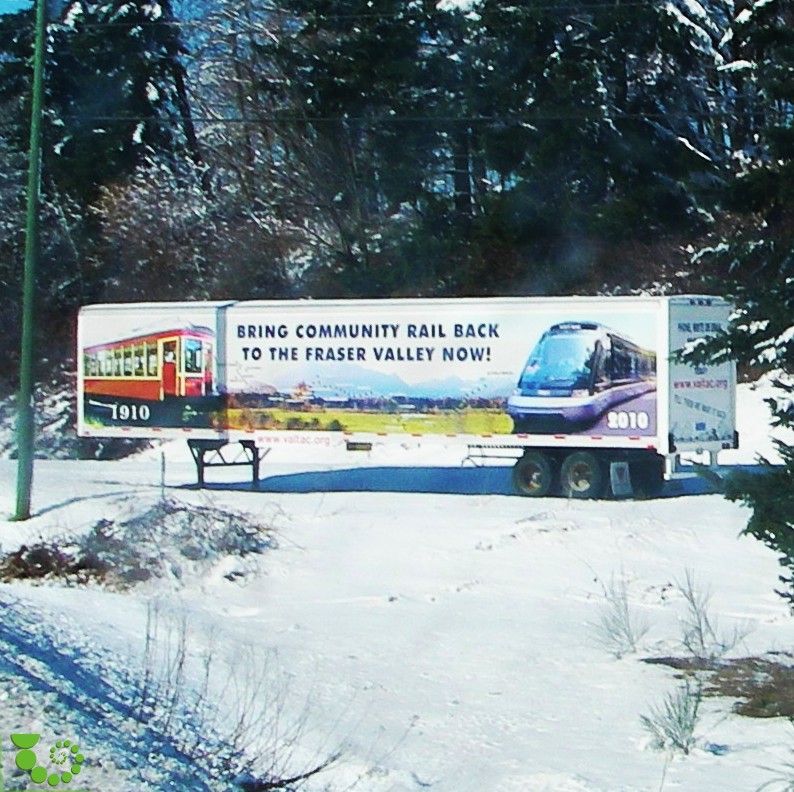
Picture taken by Terry Lyster. “Taken yesterday in Abbotsford just after Hwy 1 was made passable. The Interurban moved in all weathers; the only time it was stopped was during the great flood of 1948. Darn Sumas Lake! Several winters ago, Southern Rail of BC carried emergency provisions and rescued people during a freeway closing blizzard. Fancy that.“
There is a good reason why the propaganda system works the way it does. It recognizes that the public will not support the actual policies. Therefore it is important to prevent any knowledge or understanding of them.A?ai??i??A?
Prime Minister Stephen Harper has promised to give $350 million for the beleaguered and ill planned Evergreen SkyTrain Line,Ai??Ai??which must bring joy to the hearts of the SkyTrain lobby and Bombardier Inc.
The SkyTrain/metro lobby is waking up to the fact that Fraser Valley residents wantAi??Ai??light-rail and they want it sooner rather than later. For almost 30 years the great SkyTrain propaganda machine ground on and on, spewing reams of phony claims, based on contrived facts. The so-called business case for the Evergreen SkyTrain line continues the sad saga of manipulating truth to insure more of the light metro is builtAi??Ai??http://railforthevalley.wordpress.com/2008/12/26/can-translinks-business-cases-be-trusted/ .Ai??Ai??Ai??Ai?? It seems the Prime Minister has also been scammed to support this white elephant, with loads of Federal (photo-op) money for ‘politically prestigious’Ai??Ai?? and politically correct transit mega-projects. One guesses the Prime Minister is trying to buy votes for Conservative MP’s alongAi??Ai??the Evergreen line will operate; shades of Glen Clark’s Millennium Line.
The Vancouver Sun also embarrassed itself with a picture of a classic European style tram operating on-street instead of showing ugly elevated guideways which will be in place with the elevated automatic SkyTrain ART light-metro!Ai??Ai?? It seems the Vancouver Sun continues its long history ofAi??Ai??pro-SkyTrain propaganda and anti-LRT rhetoric, distorting facts to favouring SkyTrain.Ai??Ai?? The Evergreen Line will definitely not run at street level. Ai??Ai??http://www.vancouversun.com/Business/Harper+expected+announce+billion+Evergreen+transit+line/1329040/story.html
For the taxpayer, the Evergreen SkyTrain Line means higher property taxes; for the car driver, a car levy; and for the transit customer, higher fares, all brought to you courtesy of Gordon Campbell, Kevin Falcon, and now Stephen Harper. Harper’s and Campbell’s latest Evergreen Line gambit may backfire if Fraser Valley residents feel they have been ignored far too long and return MP’s and MLA’s not belonging to the federal Conservative or provincial Liberal parties.
As Abraham Lincoln said, “You can’t fool all the people all the time.”
Is TransLink Going Bankrupt? Has Gordon Campbell Made a Secret Deal With The Devil (TransLink)?
An interesting email came my way today, with the astonishing claim that TransLink will go bankrupt next year!
Two tiny snippets out of that tell the whole story…
Even with the inflated ridership claims, the provincial subsidy per trip (TransLink) is $5/rider, and for Victoria’s BC Transit system it is over $20/rider.!!! We all pay for that…likely much of it out of gasoline tax revenues.
The other snippet is that,as we’ve been told by Tom Prendergast, without an additional $300/million/year, T-Link will have to close its doors. The vehicle levy of course is back on the table.
If this is true, it begs the question; “Has Gordon Campbell and Kevin Falcon already entered into a secret agreement with TransLink to reintroduce the auto levy after next May’s election?” Rail for the Valley must get into election mode nowAi??Ai??and force political candidates in all political parties to come clean on regional transit planning; as it stands now the valley taxpayer is going to pay hefty tax hikes to fund other peoples expensive transit systems!
The Valley Interurban – As Shovel Ready as One Can Get!
In today’s lexicon of government deficit spending, ‘shovel ready’ has become the clichA?Ai?? of choice for politicians to fund their pet mega-projects. Evergreen Line, Gateway are all said to be shovel ready, yet much planning and design work must take place before the shovels are actually in the ground.
The Valley Interurban project is almost complete; the tracks are there; the vehicles are ready for hire and all what is needed is negotiations with the Southern Railway of BC and the Super Port railway folks for ‘pathways’ for the interurban service. No major engineering is needed. What must happen is track renewals, new signaling, simple bus-stop style station infrastructureAi??Ai?? and passing loops at strategic points. It is not an exaggeration to say that a basic 5 or 6 returns a day service could be up an running within 1 year and certainly a more intensive hourly or half hourly service could be in place within 2 years.
It is certain that the Valley Interurban project meets the current definition of ‘shovel ready’ but it seems it doesn’t meet the politicians desire for building grand metro and highway projects which more and more look like pre-election monument building thanAi??Ai??building affordable and sustainableAi??Ai??transportation infrastructure for the region.
TRAM-TRAIN TECHNOLOGY SEARCHING FOR A PROBLEM – From the LRTA. And what is tram-train? The interurban!
The following discussion paper from the LRTA should be of interestAi??Ai??for those who want the return of the interurban to Chilliwack. Just substitute interurban for tram-train.
A programme on BBC 1 giving a nostalgic look at the former local railway route from York to Beverley (1) interviewed locals along the former route to see if they wanted it put back. It brought out many strong viewpoints, some for and some against. Unfortunately the line closed at a difficult period when British Rail was approximately midway through its policy change to diesel power. Those unfortunate enough to own a house on the former route realised that if pressure to put the line back gained momentum, their house could be in the way. As a whole, it highlighted the many problems that could be encountered with a successful YES campaign. For reasons, not very clear to the general public, the difficulties of introducing the tram-train concept in this country are thought to be fairly substantial but made more so because of our reluctance to look at the successes in Europe. The York to Beverley route with tram-train technology should be a resounding success because existing systems in Europe have already proved its better performance than what went before it and also an ability to circumnavigate obstacles on the former track bed as well as going to pick-up points nearer passenger demand. Added to all this is its sharper acceleration and improved braking power which would probably remove a need for railway type signalling and the expense that goes with it. Much of this is already practised on Metrolink in Manchester. Lower operating costs could increase frequency and with it an improved passenger demand. The tram-train power requirements would be electrification at tramway voltage at each end of the route with an on-board diesel engine being used on the middle section. This would ensure “clean” operation as it passed through the streets of York and also suitable for an extension as a tram into Hull city centre. At this stage of the Discussion Document, a brief look at Germany’s better known tram-train projects could be very helpful. The main-line electric railway services into Saarbrucken Station (Hbf) had a similar problem to Leeds in that a passenger had a short walk to reach the shopping centre. Saarbrucken did something about it and provided a tram-train service over railway tracks at railway voltage to a convenient point where it could branch off as a tram at tramway voltage and pass through the streets of the CBD. It was such a success that at peak periods it was necessary to couple two three unit articulated units together. Leeds had a similar proposal but could not satisfy Central Government requirements. Karlsruhe did something very similar some years earlier but on a much larger scale and its success can be judged by the high passenger demand for extensions.
Tales of Transit studies past – You’d be amazed at the hundreds of politicians manipulated over the last 30 years!
Since SkyTrain was forced onto the region, transit planning has been skewed to fit the expensive proprietary light-metro. Most recently, noted American transit specialist, Gerald Fox, found the business case for the Evergreen SkyTrain LineAi??Ai??had, “several instances where the analysis had made assumptions that were inaccurate, or had been manipulated to make the case for SkyTrain.” (the full letter is found at http://railforthevalley.wordpress.com/2008/12/26/can-translinks-business-cases-be-trusted/Ai??Ai??). This is not news, for over 30 years TransLink, as BC Transit before have manipulated rapidAi??Ai??transitAi??Ai??studies to favour SkyTrain over light-rail, with the desired result of confusing both politicians and the media with false facts, manipulated statistics, and plain untruths.
In 1994, three rapid transit studies; Broadway-Lougheed Corridor Study,Ai??Ai??Coquitlam – New WestminsterAi??Ai??Corridor, and VancouverAi??Ai??- RichmondAi??Ai??Corridor studies were published by BC Transit. All three rapid transit studies are the foundation of TransLink’s SkyTrain or light metro construction program; all three studies are badly flawed and are of little use, yet no one seems able to ‘bell the cat’. The problem is a familiar one; the studies completely misrepresentedAi??Ai??the abilitiesAi??Ai??modern LRT to the detriment of the mode.
Example #1: Even though it was well known that modern LRT could carry over 20,000 persons per hour per direction, the study limited LRT’s capacity at 10,000 pphpd!
Example #2: The study used European metre gauge tramway’s (Geneva & Bern) with smaller profile LRV’s as comparisons with the SkyTrain light-metro.
Example #3: The studies state, without any collaborating research or evidence, that just by building SkyTrain, would attract more riders to transit.
Example #4: Despite the fact that San Diego’s LRT was 16.5% the cost to buildAi??Ai??than the SkyTrain Expo Line; Portland 27% the cost to build than the Expo Line and Calgary’s LRT was 50% theAi??Ai??cost to buildAi??Ai??than the Expo Line, the studies pegged the cost of LRT at 62.5% to 65.5% the cost of SkyTrain to build!
These studies have laid the groundwork of 15 years of misinformation which many regional politicians have taken for gospel, repeating transit nonsense as fact.Ai??Ai??Even today,Ai??Ai??TransLink and the provincial government continue investing massive sums of taxpayer’s money, with little or no public input, into SkyTrain and/or light-metro, which planning foundation is a quicksand of deliberate misinformation and professional fibbing. The RAV/Canada line and the proposed SkyTrain Evergreen line is more of the same; gold-plated rapid transit projects that have done little to alleviate traffic congestion, gridlock and pollution, while at the same time, driving up fares and taxes.
For Rail to the Valley to succeed, the SkyTrain myth must be ended once and for all and regional politicians must be educated about modern public transport philosophy and the importance of modern LRT’ ability to provide an affordable alternative to the car. Until this happens, the provincial government’sAi??Ai??and TransLink’s ‘SkyTrain dog and pony’ show will continue.
Carole James & the NDP – Have they missed the train?
Carole James and the provincial NDP’s regional transportation platform is in stealth mode, which is not surprising, as past NDP administrations have ignored sound public transport practice and used ‘rail’ transit solely as an election tool. Glen Clark, successfully used ‘rail‘Ai??Ai??projects as reelection tools:Ai??Ai??theAi??Ai??West Coast Express (known at the time as the Reelection Express) and the flip-flop on the Broadway – Lougheed Rapid Transit Project, from LRT to the Millennium Line SkyTrain and changing theAi??Ai??route to ‘show it’, billboard style,Ai??Ai??in NDP ridings.
The West Coast Express has never been a trueAi??Ai??alternative to the car, butAi??Ai??helped inAi??Ai??spreading sprawling population growth along theAi??Ai??North shore of the Fraser River to Mission, by providing a highly subsidized commuter rail service, exacerbating traffic congestion and gridlock in the region. The Millennium Line flip-flop cost the NDP many supporters, who worked hard to make modern light-rail a reality in regional planning and were seen to be ‘slapped in the face’ by Glen Clark and Joy McPhailAi??Ai??and did not vote in the 2001 election, the same election that the NDP were reduced to a rump of 2 seats.
The provincial NDP do not have a regional transportation plan and certainly have no vision for the return of the interurban to the Fraser Valley. The silence on this issue is deafening. Yet, reinstating the Vancouver to Chilliwack Interurban is a relatively easy thing to do; the tracks are there and vehicles are available, the only thing that has to be done is to negotiate with the Southern Railway of BC and the CPR/CNR over shared tracks in Langley. A basic (hourly) service could start within a year, with majorAi??Ai??track improvements happeningAi??Ai??when ridership demands new ` investment. The interurban is as ‘shovel ready’ project, as one can get!
What is needed is the political will to make this happen and certainly the Valley Interurban would grab the voters attentionAi??Ai??in May’s election, but the NDP are in silent running mode. The fear is that Carole James, like Glen Clark before, has succumbed to the ‘SkyTrain’ lobby, which always wants “one more line” to be built, this time the Evergreen Line, to make the network a success.Ai??Ai??Now, withAi??Ai??over $6 billion invested by theAi??Ai??taxpayer on the light-metro (those annual subsidies do add up), the best TransLink can say is that “80% of SkyTrain’s customers, first takeAi??Ai?? a bus to the metro“. SkyTrain has just given bus riders a slightly faster trip while at the same time, failing to attract the all important motorist from the car. The failure of TransLink to have independently audited ridership numbers and their refusal to accurately explain how they calculate ridership, indicates they have something to hide.
This election, the NDP could signal the end of the SkyTrainAi??Ai??and hugely expensiveAi??Ai??light-metro planning and join the rest of the world planning and building with light-rail. Supporting light-railAi??Ai??and the valleyAi??Ai??interurban, would go a long way to bring affordable ‘rail’ transit to the region. If that $6 billion, that has been spent on SkyTrain, had been invested in LRT instead the region would have that magic 300 km. light-rail network that would have gone a long way reducing congestion & gridlock, so much so that there would have been little need for new a 10 lane mega-bridge and the Gateway bridge and highways project. Many commentators have stated that this May’s provincial election is Carole James and the NDP’s to lose and by not supporting modern LRT and the valley interurban project, may be very well left behindAi??Ai??on the station platform, after missing the election train!
Five reasons Why Gordo and his ‘Falcon’ don’t want the "Return of the Interurban".
It is all too simple, the tracks are there from Vancouver to Chilliwack, the diesel light-rail vehicles areAi??Ai??available from many manufacturers and have been proven in revenue operation, and the precedent of the Karlsruhe two-system or zweisystem LRT with almost 20 years of safe operation track-sharing with mainline railways, makes the return of the interurban an almost shovel-ready project. Why then does Premier Campbell and his Minister of Transportation, Kevin Falcon, not want the “return of the interurban” for the Fraser Valley. There are five mainAi??Ai??reasons.
1) The interurban is not seen to be a Metro Vancouver rapid transit project. The monied ‘West-side types’ (locally known as the creme de la creme) who run and finance the provincial and federal Liberal Parties, see the interurban as a non-vote getter, thus not essential – not needed. It’s the same Liberal ‘West-side types’ that forced the now $2.5 billion (over $1.2 billion over budget) RAV/Canada line subway on TransLink because they did not want LRT operating on the formerAi??Ai??interurban rapid transitAi??Ai??route, the Arbutus Corridor.
2) Because LRT is much cheaper to build, there is less chance of ‘friends of the government’ or ‘ ‘friends of the bureaucracy’ getting contractsAi??Ai??to work on the project. Simply put, light rail is too cheap to build for political or bureaucraticAi??Ai??benefit.
3) 30 years of the SkyTrain myth has ingrained itself on planning in the region; transit is no longer built to move people affordably, rather it is built to facilitate land development. For developers, the bigger and more expensive a transit project is, the better it is. Building SkyTrain in the region has been like forcing round pegs into square holes.
4) The BC Liberals think ‘valley‘ seats are safe seats and don’t care about any transit improvements because they thinkAi??Ai??FraserAi??Ai??Valley voters, like sheep, will always return Liberal MLA’s to the legislature.
5) The trucking industry and the Road Builders Association are big supporters of the BC Liberal Party and Campbell’s and Falcon’s ‘rubber on asphalt’ transportation policies favour theses two groups. Rail, unless there is political benefit, is not even on the radar screen. ‘Rubber on Asphalt’ is the credo of the Transportation Ministry.
There are many more reasons why the Liberals do not want the ‘return of the interurban’ to the valley, butAi??Ai??here are the top five. It is up to ‘rail’ advocates to make ‘rail for the valley’ an election issue, to force both the BC Liberals and the NDP, to come out of the closet with real (not empty promises) plans for the return of passenger rail service from Vancouver to Chilliwack. The clock for this May’s election is ticking down……………………………..



Recent Comments